
Avatar
Matt
90d9080b825ff98e9bb60f5735ff7ee5c5db6267ab93a3ec7b1d5d30374bba8a
Replying to Avatar jack

Great company they should put Bitcoin on their balance sheet

Replying to Avatar Aaron van Wirdum

Listened to Michael Saylor on the nostr:npub1r8l06leee9kjlam0slmky7h8j9zme9ca32erypgqtyu6t2gnhshs3jx5dk podcast. It's 3 months old, but sheds some light on the ARK funding story.

https://youtu.be/_QN0RcQFf6w

TL;DW: Saylor strongly believes in *OSSIFICATION NOW*. From that POV, protocol development is a liability.

Some quotes (and thoughts)πŸ‘‡

"You only get to play God once. And Satoshi played God. And you can say 'well Satoshi got to do it, why can't I?' Well the answer is Satoshi did it, the reason we're talking about Satoshi is 'cause the other 100,000 would-be Satoshis failed. If you read the history of the world, work your way through 10,000 pages of Western history, there will be thousands and thousands and thousands of episodes of 'alpha male thinks he was put on this earth, you know, to change everything', full of hubris [...] he's gotta do more, change more, etcetera.'" (53:34)

"Bitcoin Core developers, or protocol developers, they want to fix something, or they want to make a contribution, because it's in their DNA, but developers are just the lawyers of cyberspace. When a lawyer shows up at the capital, they gotta make a law to save you from yourself, and the more laws they make, the more they cripple the economy, until eventually there's so many laws that the entire civilization collapses under its own weight." (58:06)

"The world is full of people that need something to do. I would say, the real key to wisdom, channel your energy constructively. If you're gonna do something, improve Lightning, build an application, persuade someone to adopt Bitcoin as a reserve asset, educate someone… these are all constructive things. Destructive, dilutive, distractive things are: fight with random people 'cause they want to fight with you, attack the core network and make it confusing and introduce anxiety, and confusion and fear, uncertainty and doubt into the base layer. Right? And then attempt to imprint your ego, you know, on the base protocol, you know? Like, 'I gotta introduce this so my name will go down in history forever'." (2:38:55)

My view: it's understandable to want Bitcoin to behave like the granite under Manhattan (his analogy); a solid bedrock that never changes. Especially if you truly believe Bitcoin will take over the world as SoV-only and "there is no second best". But IMO this is wishful thinking. While I agree it's near-impossible for an alt to overtake Bitcoin, I do think adoption could stall.

Luckily, Bitcoin isn't really a natural element. It's spontaneous order, more like language. Hard to change and no one can dictate changes, but if market wants it to change, it can.

Furthermore, despite Stephan asking a few questions in that direction, Saylor mostly failed to distinguish between protocol upgrades and general software maintenance.

Arguing against any hard/soft forks is one thing, but Bitcoin Core 26.0 can obviously not last for centuries...

Having said that, Saylor is of course free to not upgrade anymore and stick to Bitcoin Core 26.0 for as long as he lives.

Great post. Reading the genesis book currently it is awesome 🫑

Replying to Avatar Matt

πŸ˜‚

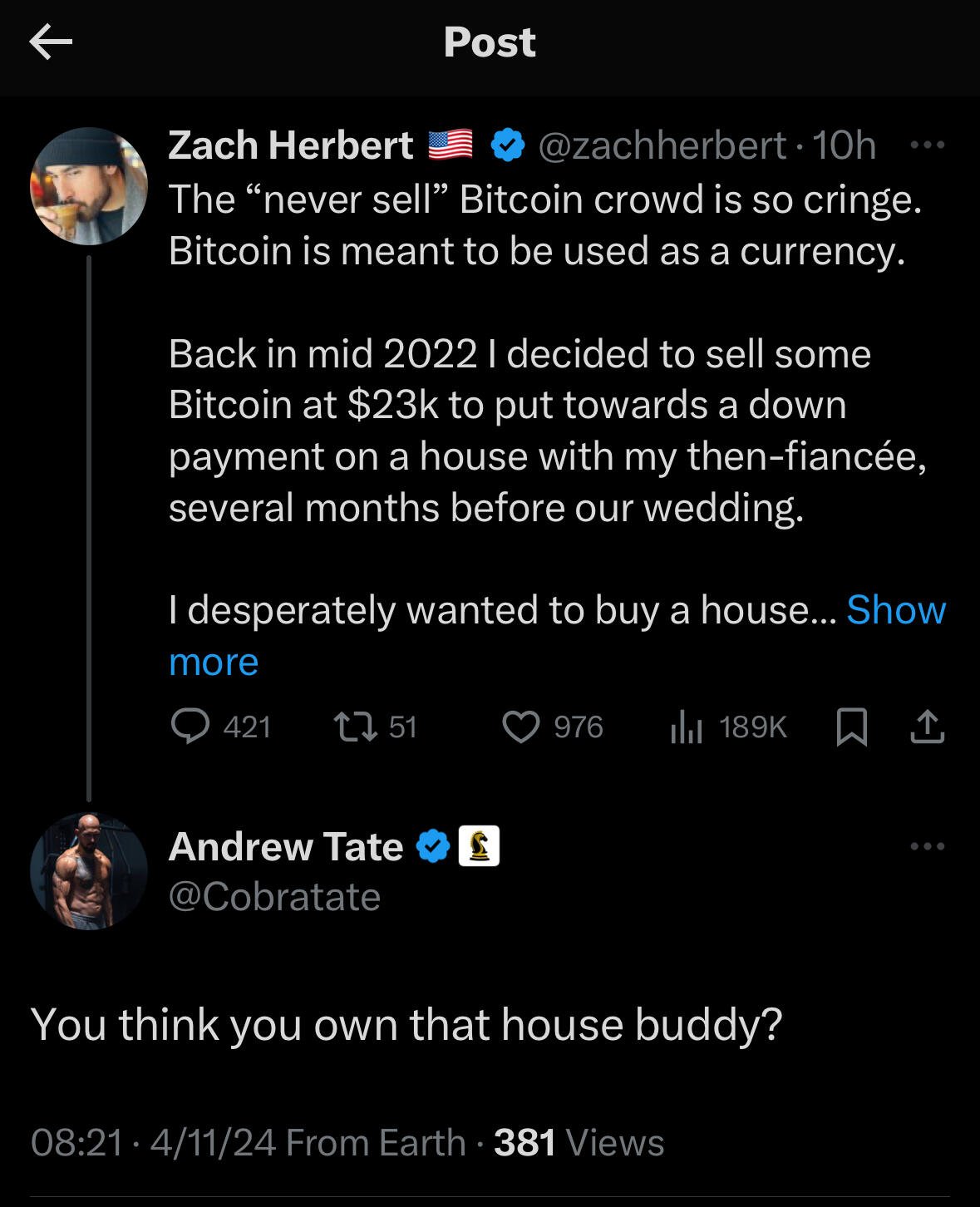
You think you own that Xitter account Andrew?

The blocksize war wasn't so much about the blocksize (or, even, scaling Bitcoin). It was really about who controls the consensus rules and how we upgrade the protocol.

For context, a bunch of startups raised tons of money between 2013 and 2016 based on ridiculous user sign-up projections and then we had a long and painful bear market and they were looking for scapegoats (the developpers that were "throttling the network") to justify the lack of growth. I am thinking here specifically of Coinbase, Bitpay and Blockchain.info.

The vibe I got is that they thought of Bitcoin itself as a corporation, that they were the equivalent of Bitcoin's board of directors because they represented the interest of VC investors, and thus they were entitled to decision making power over the network.

I don't doubt that a few people were genuine about scaling p2p e-cash (e.g. Roger Ver) but I suspect what really motivated them is that they believed control of the Bitcoin network would be an asset to their business interests, and lack of control was being used as an excuse to why their interests weren't being satisfied.

There was also a bunch of developers that I believe may have been afraid of losing their relevance (Gavin and Garzik specifically). Regardless of their intentions or psychology, it seemed clear to me that the consortium of vc-backed startups (particularly Bitpay, Coinbase, blockchain(.)info and Roger) had picked a team of developers they thought they could control and wanted to appoint them as a technical management team whicn would execute their strategy, and these guys were willing to step up for that role.

I was physically in the room when the CEO of Blockchain.info (with the very obvious support of Coinbase CEO Brian Armstrong) announced that Bitcoin Core devs were being fired and would be replaced. This was after a couple days of failed discussions with other industry people. This was the moment when I realized what was really going on.

And finally, you had a Bitcoin mining giant (Bitmain) controlling both asic production and mining pools with a vested interest in promoting the idea that Bitcoin was a democracy and the way to vote was to buy hashing power. The main ideology being pushed here was that a formal governance mechanism of the protocol needed to be established and that hashrate was the only objective measure of who makes decisions.

The underlying big blocker ideology was that the chaos of spontaneous consensus of nodes is unpredictable, flimsy, bad for business. The absence of a formal governance process was seen as the root cause of the issue.

These companies really believed they could control the protocol, and controlling development of the protocol was seen as a very valuable asset to your company. I imagine they thought of themselves as the founders of a new consortium that would solidify itself into a permanent institution. The business interests would pay developers and set the goals, and the mining interests would ratify their decisions with hash power voting. That was their plan.

This became blatantly obvious when Bitmain used its refusal to activate segwit as leverage to get what it wanted (a blocksize increase and recognition of its hashpower as a vote mecanism) even though Bitmain iself acknowledged it was not really opposed segwit.

It was classic traditional politics: I'll give you segwit if you give me something in return.

This is the language the VC suits, investors and tech startup people understand and they were very happy to "negotiate" and find "consensus".

This eventually materialized into the New York Agreement, negotiated literally as a backroom deal during theConsensuss shitcoin conference. I was there and I refused to attend.

This (private) meeting consecrated the alliance of startups/investors and bitcoin mining interests in their appointment of a technical management committee. If you think this sounds like Jekyll Island, you're not alone.

They packaged segwit with a blocksize increase (Segwit2x) and decided to force a hard fork as a condition to "allow" us to have Segwit.

We know the rest of the story: we ended up activating anyway via UASF (or more precisely, the miners activated Segwit after they New York Agreement signatories became scared UASF would lead to a chain split which they were going to lose). And the blocksize increase was also abandoned shortly after when they realized their hard fork would cause a chain split and that they would not be able to claim that their new shitcoin is the real bitcoin.

All these people were subsequently were very pissed off they couldn't control the network, which they thought they were entitled to. Some ragequit, others created a bunch of shitcoins out of spite, Roger went on to spearhead BCH as the real Bitcoin, all these fools realized they might as well make some money off of it, everyone went all-in on the shitcoin casinos after that. The "small blockers" eventually went on to evolve into the Bitcoin Maximalists and cypherpunks that today tell you to run your own node and own your own keys.

πŸ‘πŸΌ

Engagement farming has ruined Twitter