
We need to take our time to get this right.
All protocol changes have risks and bitcoin is our hope for the future. Proponents must prove that their protocol change is both safe and necessary.
Safe? I have still never seen anyone do a review and deep-dive of the non-technical risks of covenants.
Necessary? We might have a scaling problem in the future but don’t have one yet. We should cross that bridge when we get there and assess all of our options at that time. Who knows what we will invent between now and then? 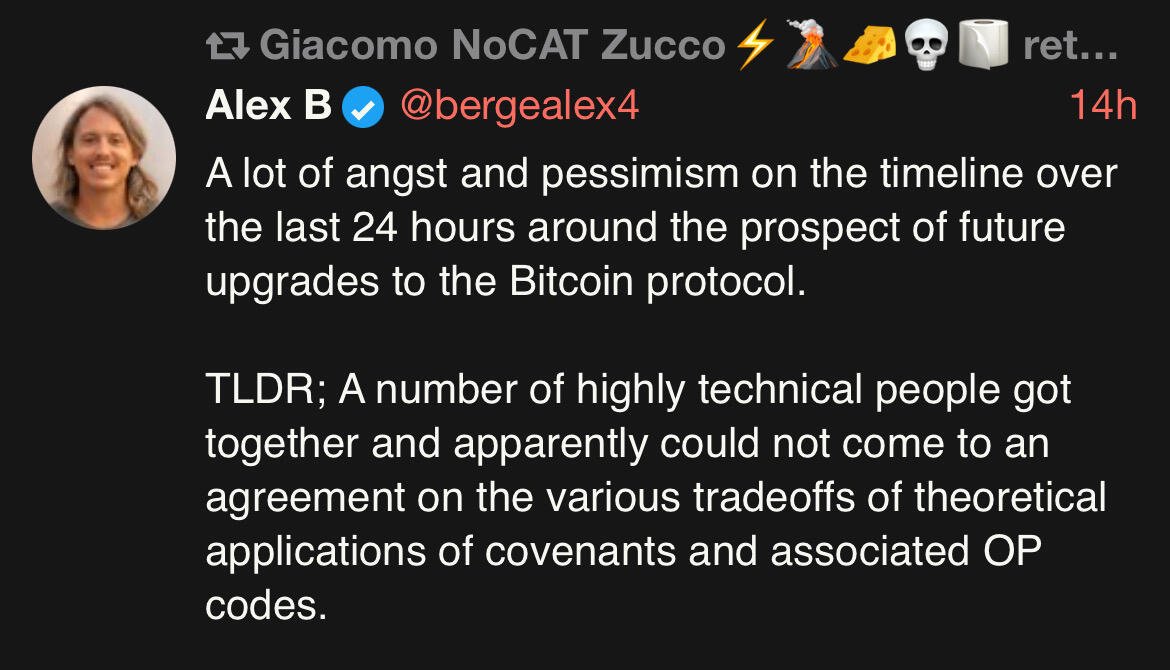

Got rid of mine. No idea if it’s a problem, but just didn’t want the radiation so close to my head.

Tornado Cash? Needed a banking license. Samourai Wallet? Needed a banking license. WhatsApp, Apple, X, probably all need licenses too.
Sounds retarded? Correct. That's why the SEC has proposed a rule to formalize licensing requirements for communication protocols.
In a speech at the annual U.S. Treasury Market Conference, Gensler announced to rule on proposed amendments to the Exchange Act by November, which expand the definition of the term "exchange" to mean "systems that bring together buyers and sellers of securities [...] (i.e. "communication protocols")."
Critics argue the rule may be weaponized to criminally indict software developers given the already hostile environment for crypto- and privacy devs.
If this rule passes, we are fucked beyond comprehension.
Full story:
https://www.therage.co/gensler-to-rule-on-licensing-requirements-for-communication-protocols-2/
Presumably this doesn’t apply to bitcoin, as it’s not a security?

> The term “AMM” appears 19 times in that article. 🤷♂️
It doesn't talk about AMMs in relation to CTV creating on-chain AMM-style marketplaces
> You don’t need introspection if the addresses are preregistered. Scanning the address will list all the UTXOs. Once you know the UTXOs then you also know the amounts.
The need for introspection relates to needing to look at the previous price of the AMM, to determine what the new price should be. It doesn't matter who previously did a trade for calculating the price, just that someone did, and you can verify that someone did.
> No, you don’t need multiplication if you can determine the product in another way. You might be able to create a state machine through a chain of predefined UTXOs that represent the AMM’s balance ratio.
I'm not sure how exactly this would be done, but even if it were possible to validate or invalidate certain pathways, you would still need a ridiculous amount of compute for this. CTV commit to all inputs and outputs, so you need to compute for all the possible prices for all the possible participants ahead of time.
You run into the infinite compute problem again
The key thing with CTV, is all possible states must be known ahead of time. So AMM with price x and pool of a,b,c,d....z users
All that must be precomputed. It's virtually impossible to precompute all the possible states of an AMM ahead of time.
This is specifically because you're committing to ALL inputs and outputs. If it was only committing to a subset of inputs and outputs, then you wouldn't need to precompute all the possible states ahead of time.
> CTV would enforce that only valid state transitions can occur by committing to specific transaction templates. If input A and input B, then move to point on the curve #1. But if input A and input C, then move to point #2. You’re determining the product based on the inputs provided. It has the same effect as multiplication, just doesn’t require computation or introspection.
This is an oversimplification of all the possible states. Also there isn't a good way to add funds to the AMM. You'd need to calculate all the possible states ahead of time when folks first add funds. And you'd also have to precompute anyone on the registrar that could add funds, for any amount. You'd also need to precompute anyone being able to withdraw funds from the AMM for any amount ahead of time too.
Like the number of states you need to precompute, makes the entire thing impossible.
> Looks like nobody responded with any information showing the non-technical risks were considered. I still haven’t seen anything either. It’s on the proponents to show safety. It would be negligent to not fully consider all risks.
Yea ended up getting limited visibility on that post. The main resources I've seen have been on mailing lists. But many of them were also for old versions of CTV.
The BIP119 PR is probably the best resource for risks discussed:
https://github.com/bitcoin/bitcoin/pull/21702
For example:
- https://github.com/bitcoin/bitcoin/pull/21702#issuecomment-825557354
- https://github.com/bitcoin/bitcoin/pull/21702#issuecomment-1106795814
- https://github.com/bitcoin/bitcoin/pull/21702#issuecomment-1107666137
- https://github.com/bitcoin/bitcoin/pull/21702#issuecomment-1129462467
- https://github.com/bitcoin/bitcoin/pull/21702#issuecomment-1335764227
Most of these concerns seem to be related to getting consensus on the change or confusion about the change, and I think one concern is related to complexity (raised by John).
➡️ “It doesn't talk about AMMs in relation to CTV creating on-chain AMM-style marketplaces”
Of course not. It was explaining how AMM marketplaces create centralizing MEV.
➡️ “The need for introspection relates to needing to look at the previous price of the AMM, to determine what the new price should be.”
I explained how you might create a state machine using output UTXOs to model the AMM pricing curve. If you don’t understand the concept, you could ask an AI to explain it to you.
➡️ “I'm not sure how exactly this would be done, but even if it were possible to validate or invalidate certain pathways, you would still need a ridiculous amount of compute for this.”
You don’t fully understand the concept so you assume it must take “ridiculous” compute.
I showed how it might be possible, but it may or not be feasible. I don’t know and neither do you. The point is that nobody knows for sure and it’s likely that nobody has looked into it either.
I don’t need to prove it’s safe. The people advocating for the feature do.
➡️ The BIP119 PR is probably the best resource for risks discussed
I reviewed the links you sent. I didn’t see any analysis of non-technical risks. If I missed anything, please forward it to me.
You seem like a well-read person on the topic and you can’t seem to refer me to anyone who’s done a non-technical risk assessment.
I guess we can leave it there unless you want to discuss anything further.

More news on that “conspiracy theory”. Let’s hope this law passes.
This paper is incredibly well written. I have no doubt that bitcoin is constitutionally protected.
But, really, that doesn’t matter. The constitution is just a piece of paper that is ignored daily without recourse. Government surveillance, civil asset forfeiture, lockdowns and vax mandates, etc. etc.
It doesn’t matter if you’re right. If you do win, it will be decade from now and you’ll never recover your legal fees. They fight with the unlimited resources of the government and you fight with your own limited personal resources. Justice will be fleeting as they’ll just target someone else the next day. Nobody will be held accountable.
Technology is the only solution. This is why we build. nostr:note1pqnves3wd293srx53atmjztzq7r2ercmdhq6u2vufk8p4xenkn0sqftaq2
> It appears that it might be possible for CTV to create on-chain AMM-style marketplaces. On chain marketplaces create arbitrage opportunities which motivate people to pay for faster transactions:
That article doesn't mention AMMs at all. It mentioned inscription marketplaces, like Magic Eden, which is running today, where you need to construct a PSBT to create an "ask" for a Rune (you can't even do bids). They were talking about that creating some MEV.
> Please show me where the non-technical risks were discussed. I haven’t been able to find anything other than Peter identifying the risk of cheaper OOB payments.
Great question. Let's see what folks say:
https://x.com/matthewjablack/status/1838340344607355010
utxos.org is obviously a great resource. And mailing list for previous iterations of CTV
OpTech had some things to say: https://utxos.org/analysis/optech/
> We were previously discussing AMM style marketplaces.
AMM style marketplaces can't be built with CTV.
> I suggested that perhaps specific UTXOs could represent points on the hyperbolic constant product curve (x * y = k) that’s used in AMM marketplaces.
You can't do transaction introspection with CTV, so this isn't possible
> You haven’t yet shown me why it’s impossible to create AMM style marketplaces using CTV.
You haven't shown me how you can!
First of all, you need to do multiplication to do x * y = k. You don't have OP_MUL in Bitcoin script since it was disabled back in 2010 by Satoshi. You can emulate OP_MUL using CAT in order 1400 bytes. But you cannot emulate it with just CTV.
Bitmatrix ran into this problem when they were building an AMM on Liquid. They were able to get MUL working using OP_SUBSTR and OP_CAT:
However CTV doesn't enable MUL in any capacity. You cannot create an AMM if you cannot calculate the price after a swap occurs.
➡️ “That article doesn't mention AMMs at all.”
The term “AMM” appears 19 times in that article. 🤷♂️
➡️ “You can't do transaction introspection with CTV, so this isn't possible”
You don’t need introspection if the addresses are preregistered. Scanning the address will list all the UTXOs. Once you know the UTXOs then you also know the amounts.
➡️ “First of all, you need to do multiplication to do x * y = k.”
No, you don’t need multiplication if you can determine the product in another way. You might be able to create a state machine through a chain of predefined UTXOs that represent the AMM’s balance ratio.
Specifically, I’m suggesting to model the AMM's pricing curve through output UTXOs. Each UTXO represents a specific state of the liquidity pool at a point on the curve, with predefined balances of Bitcoin and tokens.
Trades are executed by consuming a state UTXO and creating a new one corresponding to the next state along the curve, effectively moving the liquidity pool's balances according to the AMM's pricing function.
CTV would enforce that only valid state transitions can occur by committing to specific transaction templates. If input A and input B, then move to point on the curve #1. But if input A and input C, then move to point #2. You’re determining the product based on the inputs provided. It has the same effect as multiplication, just doesn’t require computation or introspection.
➡️ “Great question. Let's see what folks say”
Looks like nobody responded with any information showing the non-technical risks were considered. I still haven’t seen anything either. It’s on the proponents to show safety. It would be negligent to not fully consider all risks.

Freedom countries pushing back on global socialism 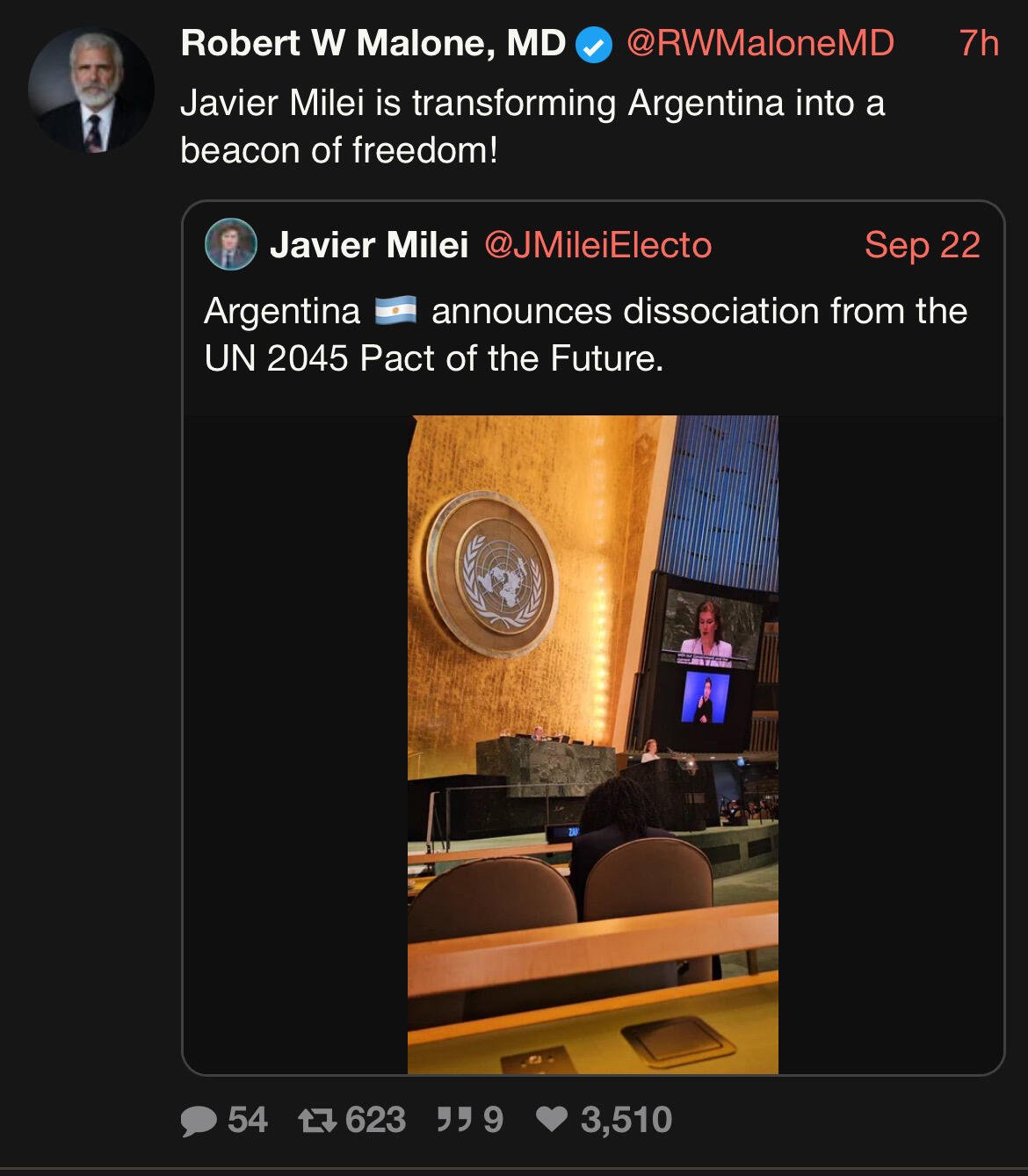
Claims to support Ukraine. Doesn’t seem to mind that they’re being used by Western countries as cannon fodder. How many Ukrainians have died? Remember, there was a peace treaty almost signed and all they had to do was stay neutral. But UK and US killed the treaty to intentionally escalate the war.
Thanks for the reminder. Going to donate to Zeus now. nostr:note1fzm4ym97tjykvxzkr9jk6yc2wdlwj2p5sfrqjf696xal3xkp9puscwvghq


Now he’s trying to remove spam filters from Bitcoin core.
➡️ “Why would CTV motivate people to pay for faster transactions more than any other normal transaction?”
It appears that it might be possible for CTV to create on-chain AMM-style marketplaces. On chain marketplaces create arbitrage opportunities which motivate people to pay for faster transactions:
➡️ “CTV has been pretty well researched over the past 4 years since its inception.”
Please show me where the non-technical risks were discussed. I haven’t been able to find anything other than Peter identifying the risk of cheaper OOB payments.
➡️ “The key thing here, is you can't exit the contract if your counterparty is offline. So once the DLC options contract is created[…]”
It looks like you’re now referring to DLC contracts. We were previously discussing AMM style marketplaces.
You raised the issues of how the parties could be known. I suggested that a preregistration step might work.
You raised the issue whether the prices could be known. I suggested that perhaps specific UTXOs could represent points on the hyperbolic constant product curve (x * y = k) that’s used in AMM marketplaces.
You haven’t yet shown me why it’s impossible to create AMM style marketplaces using CTV.
> They open the door to future mining centralization.
Can you elaborate on how they increase mining centralization?
From what I can see, CTV actually reduces mining centralization, by making trustless coordination-free mining pools possible. Since coinbase transaction can be constructed to send funds directly to a covenant that miners can later claim their funds from in a trustless manner, it'll dramatically reduce the reliance on pool operators for larger miners.
https://utxos.org/uses/miningpools/
> Maybe someday there will be an existential scaling crisis, but we don’t have one right now. The mempool is clearing at a few sats/vbyte.
You could make the argument that the mempool is clearing at a few sats/vB because not enough people are actually practicing self-custody. Most of the activity is on centralized exchanges or ETFs. Vaults make self-custody way more feasible and safe.
> There are also alternatives that devs haven’t yet explored. We should exhaust all reasonable alternatives before proposing a core protocol change.
Yes that is true for covenants. You can "technically" simulate a covenant on Bitcoin today by locking UTXOs with a key that must be provably destroyed. Before destroying the key, you presign the unvaultiong transaction with the spending paths you wish for the covenant.
But let's be honest, the concept of needing to literally provably destroy the private key is an incredibly terrible process prone to error. And relying entirely on pre-signed transactions to get your funds back is just terrible as well. Instead of having to backup seed phrase, you need to back up pre-signed txs.
> We should instead identify key use cases (vaults?) that are absolutely essential (that can only be solved with a core protocol change) and build specific solutions, scoped as narrowly as possible to prevent unintentional side effects.
Ironically the solution that enables effective vaults (OP_VAULT) relies on OP_CTV support
IMO risks for CTV are very well defined, and every action commited to in CTV is well defined as well
➡️ Can you elaborate on how they increase mining centralization?
I’m getting a crazy sense of deja vu given that we’ve been discussing this for the last week.
CTV has the risk of promoting private out of band payment to miners, which can create centralizing MEV.
[1] Peter Todd admitted that CAT / CTV potentially encourage out-of-band fee payments to miners:
https://petertodd.org/2024/covenant-dependent-layer-2-review
[2] Matt Corallo explains why private out of band payments can motivate miner centralization:
https://x.com/TheBlueMatt/status/1780558009841643833
I pointed out that Peter identified one case but missed other cases.
Our long thread is here:
nostr:note1yur8m6lrk4z88q7dae06pf5r9lwgn3fc0smpaa653hx8ygw2k9qseadpzq

Lift weights and get stronger. Sit on the couch, nice and easy, and get fat and unhealthy.
Which free speech protocol do you want, the strong one or the fat and uselessness one?

Hey now… nostr:npub108pv4cg5ag52nq082kd5leu9ffrn2gdg6g4xdwatn73y36uzplmq9uyev6 that’s a pretty intense take. We’re building a system which is going to face much more direct and underhanded attacks. Having friendly red teaming of Nostr right now, is good. Sure, it was frustrating, and it could have been better if it was in the open, but future adversaries aren’t going to do that.
💯

That person was helping to improve the system. Kinda ironic to use the “authorities” to fix a problem with our decentralized technology.

https://youtu.be/tib0lgpjbu8?si=d20SFLyaR0iVjMzh
This shit is wild. Disease is a strange thing.
#health #grownostr #nostr #nostriches #plebs #plebchain
Auto immune makes sense to me. It’s the first thing that comes to mind when it’s idiopathic. Hard to find the root cause because the patient needs to have a preexisting susceptibility, a depleted immune system, and then some external trigger. To observers it seems random.
➡️ “Very fair point. However if folks are okay with “slow”, what’s the likelihood they’re also okay with just waiting for lower feerates for their tx to be confirmed in the first place?”
They might be, but you’ll recall that this was the risk that Peter had identified in his paper — paying for cheaper transactions. My point was that Peter had overlooked the other case, specifically the risk that CTV could motivate people to pay for faster transactions. I believe both of these cases are risks and I don’t know for certain what the magnitude is (and I don’t believe anyone can know for certain — because our assumptions are based on the past and not what people might invent in the future).
➡️ “AMMs are not possible with CTV only, because there is not sufficient transaction introspection to achieve this (aka you can’t look back at previous txs which is necessary to have the price update in an AMM).”
I could imagine that this could be solved by the coordinator frequently reissuing the contracts with the current value.
Another possibility is to somehow link specific UTXOs in chains to track state. This is abstract; hope you understand what I mean.
Reissuing the contracts frequently or creating chains of UTXOs might also address your other point on the need to recalculate the contract for all the registered addresses. Creating more contract instances may reduce the complexity of trying to cram everything into one contract.
I recognize that republishing the contracts frequently would slow down trading, but again, this is me brainstorming for five minutes. Since it’s technically possible, it becomes an optimization problem. How do we know some clever person won’t solve it?
I understand your point that it looks infeasible and doubtful that a meaningful on-chain market could arise. But I recognize that this view is based on assumptions of past events, current technology, and current maturation of the bitcoin network. I don’t think we can look at it like this. We have to think about the future — the long and unknown future. Once these protocol changes are in, we can’t easily pull them out.
I believe that if something is technically possible, a sufficiently motivated person will eventually find a way. We can’t assume that it will never happen just because it seems infeasible today.
From another thread, but additional details on why I believe we should be conservative:
nostr:note1r4tjlj5yfmpu5rkq8n8f7k3t576gaut40uf7l3yk3kwamtzcu3pq004sjk
That’s one of the things that concerns me. People might think they’re anonymous here when they’re not.