
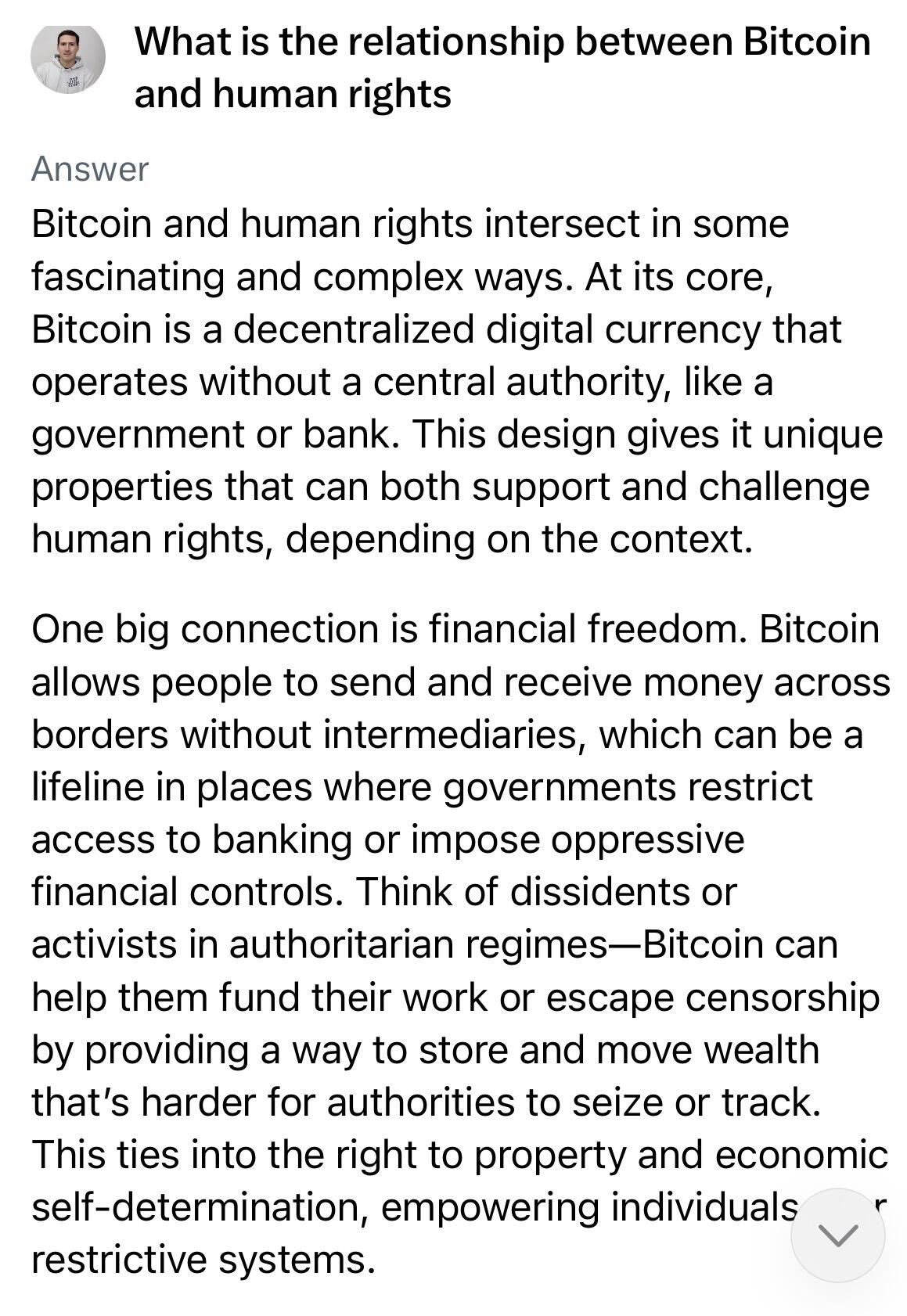
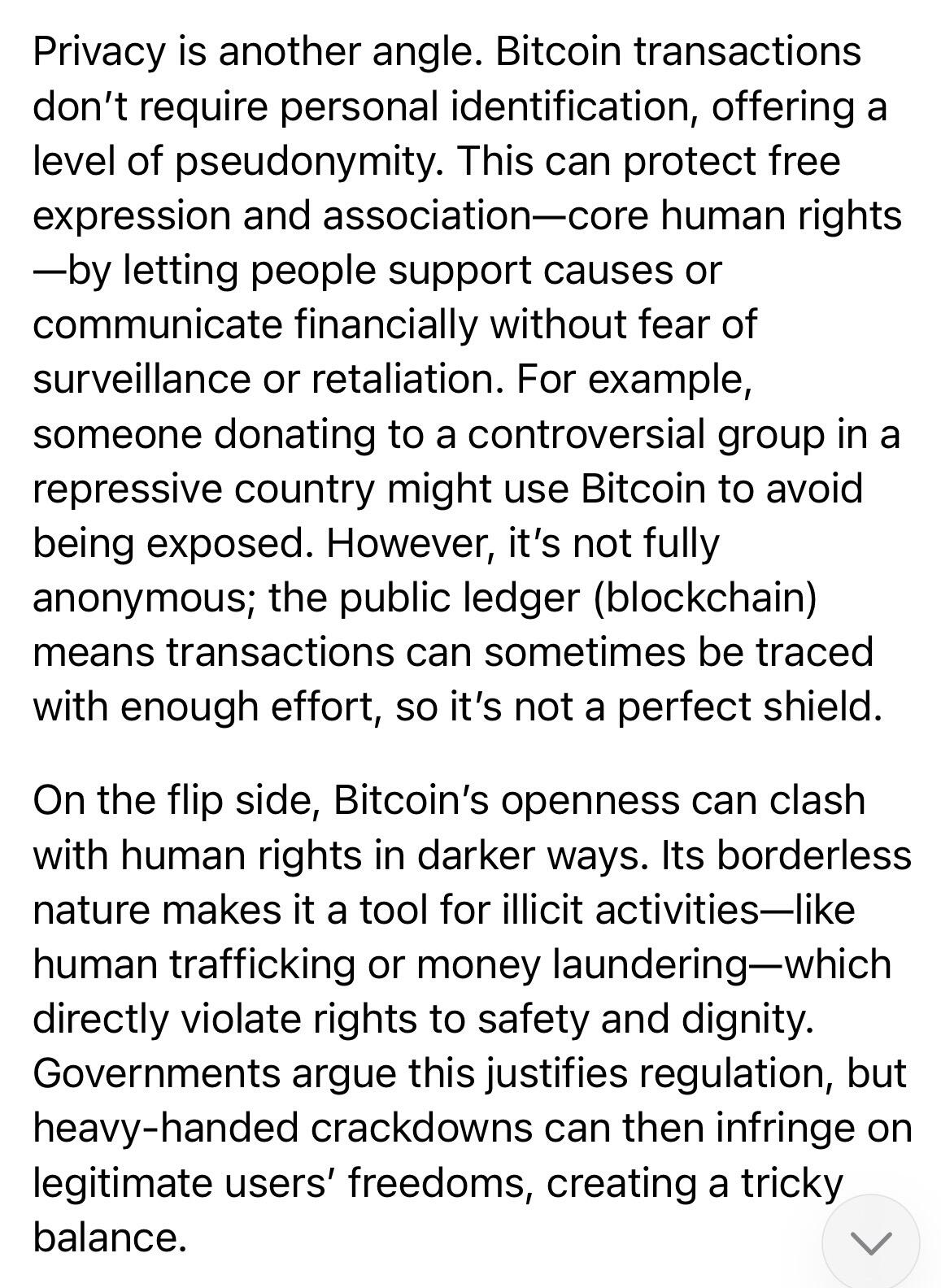
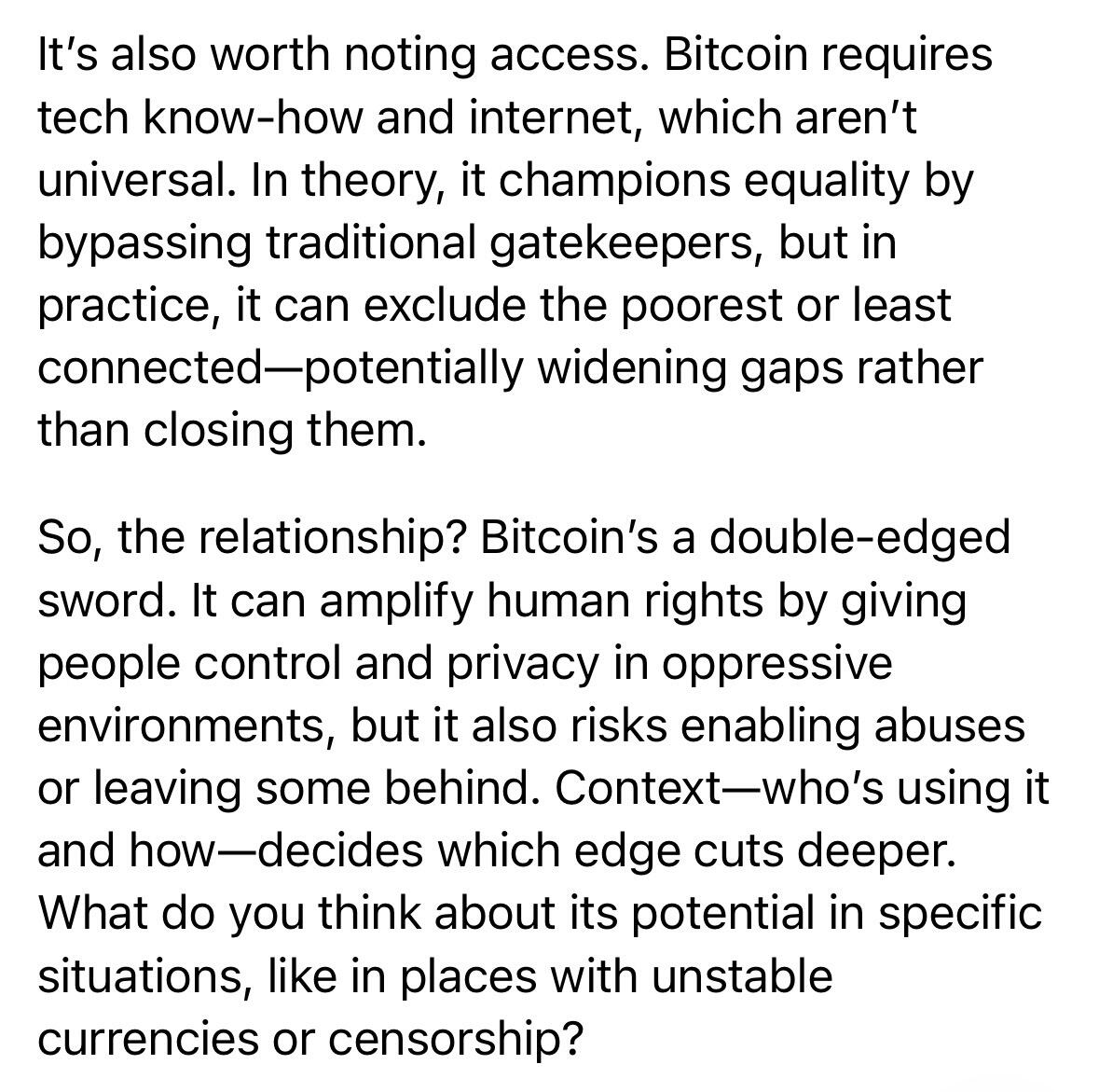
I asked the same question to Deep Seek. pretty much the same talking points, but it added a concern about energy consumption.
"The relationship between Bitcoin and human rights is a complex and evolving topic. Bitcoin, as a decentralized digital currency, has several characteristics that can intersect with human rights issues:
1. **Financial Inclusion**: Bitcoin can provide access to financial services for people who are excluded from traditional banking systems. This can be particularly important in regions where governments control or restrict access to financial services as a means of suppressing dissent or controlling populations.
2. **Censorship Resistance**: Bitcoin transactions are difficult to censor due to the decentralized nature of the blockchain. This can be crucial for activists and journalists operating under repressive regimes, as it allows them to receive funds without government interference.
3. **Privacy and Anonymity**: While Bitcoin transactions are recorded on a public ledger, the identities of the parties involved are not inherently tied to their wallet addresses. This can offer a degree of privacy for individuals who may be at risk if their financial transactions were exposed.
4. **Protection from Inflation and Confiscation**: In countries experiencing hyperinflation or where governments have a history of confiscating assets, Bitcoin can serve as a store of value and a means of protecting wealth.
5. **Empowerment**: Bitcoin can empower individuals by giving them control over their own money without the need for intermediaries. This can be particularly empowering in situations where individuals face discrimination or are subject to the whims of corrupt financial institutions.
However, there are also concerns and challenges:
1. **Volatility**: The price of Bitcoin is highly volatile, which can pose risks for individuals relying on it for financial stability.
2. **Regulatory Challenges**: Governments may seek to regulate or ban Bitcoin, which can limit its effectiveness as a tool for human rights.
3. **Illicit Use**: The same features that make Bitcoin useful for human rights activists can also make it attractive for illicit activities, which can lead to increased scrutiny and regulation.
4. **Technical Barriers**: The use of Bitcoin requires a certain level of technical knowledge, which can be a barrier for some individuals.
5. **Energy Consumption**: The environmental impact of Bitcoin mining has raised concerns, which could have indirect implications for human rights, particularly in regions affected by climate change.
In summary, Bitcoin has the potential to support human rights by providing financial autonomy, privacy, and resistance to censorship. However, its effectiveness is influenced by regulatory environments, technical accessibility, and the broader socio-economic context. As with any technology, the impact of Bitcoin on human rights is not inherently positive or negative but depends on how it is used and the circumstances in which it is deployed."


Soy bitcoin only PERO... si el fundador no holdea la moneda entonces por qué eso lo convierte en una empresa? (aplica para Doge y para Litecoin, cuyo fundador vendió su posición para evitar tener una influencia desmedida).
Creo que el tema no es si holdea o no, sino cómo influye su posición en el desarrollo del proyecto.
Y sobre Vitalik, tienes la referencia donde habla de comunismo? Me interesaría escuchar esa postura. Por qué eso lo convierte en una empresa? En el comunismo purista no hay empresas, o me equivoco?

I do agree on thinking about the "real issue" or the "root cause". I do understand that a person can use victimhood to obtain resources and cope with real life. At the individual level it can be a limiting belief that can be addressed with a change of attitude, or an expansion of self-consciousness. But here we are talking about the collective level. When you see an entire cast/race/country can't lift themselves, despite being told ther individual outcome is the product of their individual effort (mith of meritocracy) and despite having the same human capacity on average, you may suspect that there is a systematic effort to kept them like that. Then the root cause to address is the system.
Land is only the example of why not having food to eat is not an attitude problem but a real resource constrain. But beyond food a modern society produces other products and services for which you also need tools, factories and other stuff that generates value. That's what someone called "means of production". Some people say that controlling means of production vs not controlling them is the root cause of being rich vs being poor. You know were I'm going...

I know. I learned that not so long ago. But in present day nobody uses it in that sense. When was the last time you heard somebody refer to China as a Second World country? And people would think you are sarcastic if you called Argentina Forst World. Not to mention that the framing is US-centric. Why not the USSR First and NATO second?
In present day "First world" is used as "model for what a country should aspire to be" and "third world" is used as "failed to achieve that model" or even more despectively "third category".
I'm mostly familiar with Aztecs before the Spanish empire (please research it and go beyond the common place "but they were savages"). They weren't perfect, they were not free of imperialism themselves, but they were rich, functional, had cleaner cities than Europe, efficient commerce and a complex culture. After La Conquista all indigenous people became slaves, were exploited and to this day those ethnic groups are still marginalized. Then what about India before the British? Or Hawaii before the US?

To be honest that was my first interaction ever in Nostr. Zap to you sir ⚡
One of the biggest questions of our time:
Can we help fix this? https://video.nostr.build/99ccdf9d88390ea582c8f74470c0a9aa1018344ac22a7e9bb815d9a3432fe948.mp4
can we start by not calling it third world? What about "looted countries"? No? Ok, what about "Countries under Imperialist Dominance"? Name a country in the "Third World" that doesn't fit that definition
Still "we" are all part of the same system. We participate and benefit from the system. Recognizing that is the first step. Then we can start questioning the names we use. For example I don't call Mexico third world and I don't call the US first world, because that plays along with the US exceptionalist narrative. I'm Mexican, by the way

yeah, the Spanish colonies in latin America were soooo socialist. And then in the 20th century most contries almost fell into socialism again if not for the brave efforts of the CIA to organize dozens of coups to impose dictators. That made us blossom like never before!
uhm... maybe I'm naming the obvious but to practice "permaculture" you need resources such as land. Which is one of the first things that get stolen when a territory is colonized. When you are born in a city in the wrong cast (the one that was displaced by colonialism) there is no change in "perspective" that gives you food and shelter. For YOU freedom is more relevant than not being poor because that is YOUR problem. You are projecting you experience to others

It's ironic that most opposition to socialism comes from regurgitating propaganda. But no, socialism came after. Broadly speaking it was caused by colonialism
They were rich nations, functional societies, with developed cities and complex cultures. Until they were destroyed, displaced, looted, exterminated, enslaved and ideologically conquered to believe they were inferior and new "success" metrics were imposed to them

The big physics lie? I’ve been going down the Dark Matter/Dark Energy rabbit hole—there’s no proof, just a theory to which patches a gap in physics.
Mike McCulloch joined the pod to discuss this and his theory of quantised inertia
Links to full episode - https://linktr.ee/PeterMcCormack
Disclaimer: I haven't watched the podcast. And maybe I'm being pedantic. But that's how science works: a theory is the best model that we have to explain what we observe and some things on the edges don't match the model. Until a new and improved theory, explains things more accurately and better. And scientists apply a method (which might still fail on occasions) to review each other's work and accept or not a theory. That isn't lying. But then again nobody believes in science or the scientific method these days because we are desilusioned that science didn't fix all problems. That's called "post modernism".