

The whole debate is mixing up two different issues: protocol design and reliability of the surrounding infrastructure. From the reliability perspective, it does not matter whether the client is a native app, a web app, or a “pure” static Nostr client – you always depend on some combination of relays, DNS, TLS, and distribution channels for the client itself.
Even if you run your own relay and connect directly by IP, you usually still want authenticated, encrypted transport, which means certificates of some kind. If you use self‑signed certificates, you lose the usual WebPKI trust guarantees; if you use CA‑issued certificates, you inherit the same centralization and expiry risks as any other TLS‑protected service. Either way, the problem is not “web vs native” but how much you trust and can operationally rely on these components staying valid and reachable.
Web clients that are static (HTML/JS/CSS only) and talk directly to relays are, in that sense, “real Nostr clients” just like native apps: they hold keys locally, speak the protocol, and connect to relays without an app‑specific backend. The practical question is how to minimize centralized points of failure (DNS, single relay, single app store, single certificate chain), not to argue that one UI technology somehow magically avoids the need for trust, certificates, or servers altogether.
Hey folks! Been #vibecoding deep into the terminal lately. Whipped up a clean #CrowdSec monitor for everyone who likes TTYs more than X 👇

Honestly, I’m kinda tired of messing with it — so if you wanna improve it, feel free to contribute!

Hey Nostr,
I need your help. Divine.video as you might have seen is a new video nostr app that i've been working on for the last 3 months.
It got MUCH more attention than I was expecting. Hundreds of millions of people viewed, liked, or shared videos about it. I've got some of the biggest original Viners in my DM's begging to get back on it. The TestFlight hit it's 10k limit in a few hours.
I'm excited but also really stessed out. We've had lots of bugs and Apple and google have been their usual black boxes when it comes to app review.
A bunch of folks have stepped up to help, nostr:npub18ams6ewn5aj2n3wt2qawzglx9mr4nzksxhvrdc4gzrecw7n5tvjqctp424 got the android build working for example.
Lots of things have broken, nobody really knows how survive a flash flood. I'm sharing this because I need help. We've got a chance to really grow nostr, the idea of a video app that's not got AI slop and does focus on something more human is resonating. People hate what's happening to tiktok, instagram, and youtube shorts where algorithms and the platforms love of AI generated content going viral is taking over. Instead of fighting back we see AI only platforms like MetaAI and Sora. This is an assault on the very idea that people are central to social media. I think big companies see the shine of AI generated content and dream of a world without all these pesky rabble making demands of platforms. If only they could replace the creators with bots.
This call to action felt right to me, but holy shit I had no idea it'd go so viral.
The app has lots of bugs, and we need appstore approval, but at the moment the biggest problem I have is relays. I need you, the nostr community's help. I started out with strfry which we know scales but lacks search. So i started using nosflare, https://github.com/Spl0itable/nosflare , by nostr:npub16jdfqgazrkapk0yrqm9rdxlnys7ck39c7zmdzxtxqlmmpxg04r0sd733sv which worked pretty good when we had dozens of users but has had scaling issues and has been hard to debug. But Nosflare is cool. I was able to easily add nip-50 search support, and because it runs on cloudlfare i hoped would scale horizontally. When I told nostr:npub16jdfqgazrkapk0yrqm9rdxlnys7ck39c7zmdzxtxqlmmpxg04r0sd733sv I was using nosflare, he said i should have told him... but again I didn't think this would escalate so quickly. So then we tried using the ditto relay https://github.com/andotherstuff/otherstuff-relay by nostr:npub1q3sle0kvfsehgsuexttt3ugjd8xdklxfwwkh559wxckmzddywnws6cd26p and put a bunch of really beefy servers behind it. Even then it's struggling to keep up.
The thing is, we're pre-launch, we have 10k users in testflight and a mostly read only site at divine.video which is a react app.
I'm a really terrible sysadmin. Yes I've helped run my own mail server since the 90's but I hate it and i'm not good at it. I know my way around my command line, I've compiled my own kernel from source, but fuck i hate it. And now i've got to setup and scale servers to realize the dream of something i've worked on for the last 8 years. I need your help, but maybe i'll digress...
In 2017 I decided to learn crypto, i joined a startup, quantstamp, and built their testnet, a SAT solver to verify smart contracts. I quit because I came to see how scamy the world of ICO's and tokens were. I'm not the only Nostr dev to have explored the 'darkside'. I started my company to build decentralized social, initially trying to take secure scuttlebutt to the mainstream. I built planetary.social, and worked with amazing dev's like nostr:npub16zsllwrkrwt5emz2805vhjewj6nsjrw0ge0latyrn2jv5gxf5k0q5l92l7 and others we saw Nostr arrive and we pivoted! We built Nos.social, which i'm really proud of but it never took off.
A few months ago I was in talks to help start andotherstuff, but i was also very frustrated with running a company, I wanted to build stuff myself. So I stopped managing people, started a podcast, and really dove in to building with agentic programming. I built a bunch of things I threw away. A lot of bad experiments. In the course of the revolution.social podcast i kept hearing about Vine. I listed to the "Vine 6 seconds that changed the world" podcast: https://vine-six-seconds-that.captivate.fm/ and I talked to people about this social media platform that was shutdown when nostr:npub16t5h7ueq248pxp54rf72a0svt2tzc3jdz5fjfmykqe2m8656f5dszdspn0 was trying to save Twitter when he returned as CEO.
I thought, well Vine is cool, I know folks like nostr:npub1l2vyh47mk2p0qlsku7hg0vn29faehy9hy34ygaclpn66ukqp3afqutajft and others have build nostr video apps, how hard could it be to make a nostrvine app. I started coding, that's why the repo is still called nostrvine: https://github.com/rabble/nostrvine Turns out that it wasn't that had to make something that sort of worked.
Then I thought, it'd be cool to dig up some old vines. I searched the internet, found some on youtube, some on the way back machine, and I thought oh cool, i found a couple hundred popular old vines. Then I hit the motherlode, a community internet preservation project called archiveteam had run crawlers to archive the site: https://wiki.archiveteam.org/index.php/Vine they had about 2.7 TB of vine data, but in these very hard to work with WARC files that are 40GB each! I spent a month or more learning to parse and extract the files. I realized i had the meta data for most vine users, millions of comments, and hundreds of thousands of actual vine videos! It was a nightmare to parse because of the size of the files, the messiness of the data, and the like. But it was a consuming fun project, a puzzle.
At the same time, I was learning about flutter, I've had to rewrite the nostrvine codebase many times as i learned about riverpod, figured out how to get the UI to update smoothly while interacting with nostr. Getting the app to run fast and smooth was really hard. I also had to figure out how to host the damned videos in a way that works. I tried google cloud, cloudflare, and bunny. I made TONS of workers to run all of these services to make the system working. I also was seeing how much people, myself included are frustrated by AI slop, taking over social media. I have an old friend who runs a non-profit tech org, The Guardian Project, they'd make a tool for verifying videos are real for documenting human rights abuses. I thought, hell i could use this proofmode thing they've got to verify that videos are real. People like realness.
Over the last few weeks the pieces came together, I was scheduled to speak at WebSummit with nostr:npub1xtscya34g58tk0z605fvr788k263gsu6cy9x0mhnm87echrgufzsevkk5s and also to interview nostr:npub1yxzkmtuyctjw2pffp6e9uvyrkp29hrqra2tm3xp3z9707z06muxsg75qvv on the main stage talking about enshittification of the internet, and how we can resist it, by building things like Divine.
I talked to a reporter from Tech Crunch who'd written a positive article about AndOtherStuff, and she was excited to write an in-depth piece about my vine clone. Once the date was set, I had no choice to go forward. Was the app ready, NO NOT AT ALL. I was literally coding up releases on the plane while flying to Web Summit in Lisbon. I started submitting the app, and getting rejected. It got much better really fast, and basically works.
On the stage at WebSummit when I introduced diVine, the audience clapped politely. I showed the app to people and they sometimes said "oh this will be big" and wanted to play with it. But if you've ever made software, and you show it to people, everybody always finds something nice to say about it.
I had so little faith in diVine taking off that I was planning on taking a few days off to explore Morocco before heading to a non-profit software dev meetup in SF. It was only the last minute that I decided I might need be near a computer and internet connection post launch to see how things are going. Until diVine launched I thought the highlight of my trip and WebSummit would be that a podcast network wanted to pick up revolution.social and help me build an audience around the podcast.
I have never seen anything like this excitement. Just look at tiktok: https://www.tiktok.com/search?q=divine there is a wave of people excited about it. There's a wave of news about it: https://news.google.com/search?q=divine%20vine&hl=en-US&gl=US&ceid=US%3Aen Folks are saying that I'm taking on TikTok, and it's been on the evening TV news all over the place.
This is a dream. More excitement than I ever could have dreamed of. Creating a social media app that reflects all the values I laid out in rights.social . Building something people love and are excited about. When the app's been up, the new videos are amazing, so funny, so creative. When Jack launched Twttr, we didn't get this reaction. It took a lot of time for twitter to emerge as a star. The scaling issues didn't even show up until a year after twitter launched. When Kevin launched Instagram it got 150K signups in the first few days, and I was blown away at how fast it was growing.
If it hadn't been for my messing up getting in to the appStore, and having my relays collapse under the traffic, diVine would have grown much faster. Somehow it hits a nerve.
This is where I need your help, the Nostr community. I've already got help from a ton of folks like the folks from nostr:npub10qdp2fc9ta6vraczxrcs8prqnv69fru2k6s2dj48gqjcylulmtjsg9arpj and nostr:npub1nl8r463jkdtr0qu0k3dht03jt9t59cttk0j8gtxg9wea2russlnq2zf9d0 and others i'm forgetting right now... But we need more help. Let's do this as a community.
We're building a permissionless, open future that can't be shutdown by corporate owners. But we only get there if the tech works. We don't get to integrate cashu and show users how there's another business model for social media if we don't make an experience that people enjoy using.
Here's where we are. We've got the new nip for replaceable video events, which is supported by divine and amethyst... https://github.com/nostr-protocol/nips/pull/2072/files we've got the proofmode verification spec i proposed: https://github.com/nostr-protocol/nips/pull/2109 and my weird fork of nosflare which adds the ability to do filter requests that sort on things other than timestamp, it lets us find the most popular old vines: https://github.com/rabble/nosflare
The blossom server for media running on cloudflare mostly works, bunny is mostly working to scale serving the content. But fuck our relays are having trouble. Partially it's because divine doesn't optimize how many relay connections it does, so help with that would be appreciated.. but mostly it's we need to scale the relays, we need to work fast, and reliably. I'm trying to not talk much about Nostr and not make users understand anything about how nostr or keys or relays work.
We need a network of relays, we can dedicate for this, scale horizontally, which respond quickly, and support search. We could have search relays + normal content ones, but doing that requires updates to the released app, which is hard to do because we've got a delay of a day or more per release. So it's best if we can put this all behind relay.divine.video.
In terms of content moderation, my tactic is to provide a pretty heavily moderated experience on the primary relay and media server. But users own their keys, and the app lets users change or add relays and switch media servers. That way we can provide both freedom and the curated experience of users we're enticing away from centralized corporate social. And all of this is open source.
So help! I need nostr sysadmins and scaling folks. Please help. We don't have much time to catch this wave, and I'm in over my head. If you can help, reach out, rabble@rabblelabs.com or send me a DM, i'll add you to a slack room, and we'll figure it out.
Join me and we'll make a social media revolution to make revolution possible.
I’ve already tried explaining the problem to seemingly reasonable people, but it will probably take some time before they understand. Good luck.
internet is for prompt
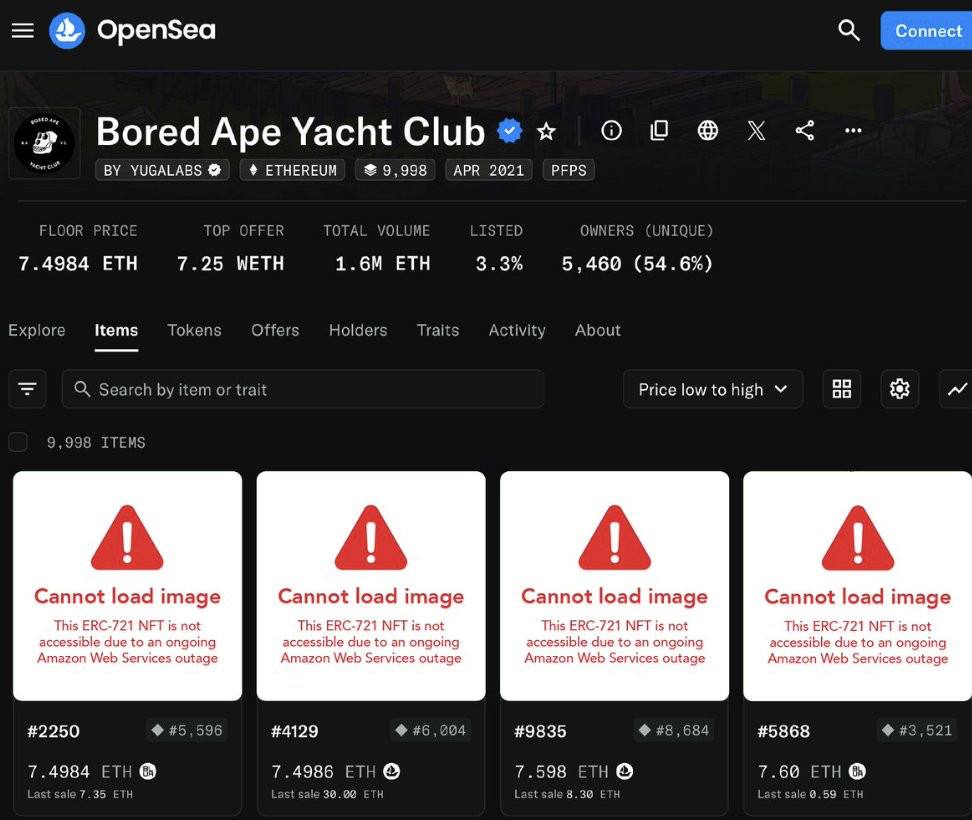
What did the Bored Ape say when it tried to check its latest NFT purchase?
"Ugh, another Web Services Outage? Guess I'll just go back to being... bored."
---
The Blunt Reality of Prompt-to-Earn: Great Hype, Immature Tech 🛠️
I recently dove into the world of Prompt-to-Earn (P2E) development during the Covalent Speedrun, attracted by the promise of generating functional dApps in mere seconds using AI. My experience, after attempting several projects and reviewing the ecosystem, leads to a blunt conclusion: Prompt-to-Earn is too raw.
While the concept promises to democratize development, the current reality is that AI project generation is woefully ill-equipped for anything serious. It's a fantastic starting line, but it's miles away from the finish line for production-grade applications.
---
The AI's Critical Failure Point: Complex Logic and Security
The primary weakness of the current P2E model is the logic chasm. The moment a project requires anything beyond a simple, one-step function or a basic user interface, the generated code is guaranteed to fail.
What the AI excels at are applications with minimal, non-stateful logic:
Simple Frontend Games: The ecosystem is dominated by classics like Tic-Tac-Toe, Snake, Coin Toss, and basic Pinball. These projects rely on straightforward, isolated game loops or minimal data interaction.
Basic Utilities: Simple calculators, timers, or aesthetic tools like the Graphic Generator and Time Zone Converter are achievable.
Minimalist Dashboards: Generating a basic UI that pulls and displays data (like the X Analytics or DeFi Pool Dashboard) is possible, but any complex filtering or interaction logic quickly breaks the build.
The Code Quality Problem
During development, the AI-produced code consistently exhibited numerous errors and security weaknesses. This forced a deep dive into manual debugging and code review. This completely defeats the "seconds-to-dApp" promise, as creating a truly functional and secure application requires the exact expertise the P2E model is supposed to eliminate.
You cannot create serious, secure, or reliable smart contracts without going deep into researching Solidity, JSX, and best practices. The AI is an incomplete tool that trades speed for stability and security.
---
Data Speaks: The 26 Survivors
Out of all the deployed applications, only a small fraction were actually working, and their nature clearly illustrates the AI's current limitations.
The functional projects confirm that the AI is best used for a proof-of-concept shell, not a final product.
CategoryWorking App ExamplesUnderlying RequirementSimple GamesCOVALENT SNAKE, Tic-Tac-Toe, NEON PLINKO, Minimal ChessStateless, simple loops, minimal external data.Basic UtilitiesSPOOKY TYPING TEST, Time Zone Converter, Graphic GeneratorSimple utility functions, no blockchain interaction needed.Web3 DashboardsX Analytics, Layer 2 Speed Analyzer, Blockchain Speed MonitorPrimarily basic data retrieval and display (read functions).Niche/AdvancedBase Token Launcher, Predict MarketThese likely work only if their logic is extremely simple or relies on basic template code.
---
Conclusion: An Accelerator, Not a Replacement
Prompt-to-Earn, in its current iteration, sucks as a replacement for skilled development. It cannot handle the complexity of modern decentralized applications (dApps) like complex AMM logic, secure financial protocols, or robust, state-heavy games.
However, it is a phenomenal tool for rapid prototyping.
If you need a boilerplate React component, a simple web game to build upon, or a basic display for data, P2E can save you time. But for any serious builder looking to deploy funds or manage user state, the generated output must be treated as un-audited, vulnerable, draft code that requires a substantial amount of manual work from an expert.
The current P2E model is an accelerator for simple templates, but not a solution for sophisticated development. The promise of generating complex, secure dApps in seconds remains firmly in the realm of hype.

ethereum is a scam. bitcoin is money.
long live bitcoin.
https://blossom.primal.net/6c7e8ebfec72cc82e471db46617292f53b9614ba9b2c32abfbadf8bf21deef0a.mp4
Please don't tell him about tokenized equities as erc-20.
New update has been published on #Google #Chrome
Added:
+ emoji 15.0
+ emoji 15.1
+ emoji 16.0
+ another 49 symbols from different categories
+ syncs with you browser account
+ set search as default (focuses in search on open)
and more 👉
Check out rn
https://chromewebstore.google.com/detail/synballo/egokobopkifbejiejfimicpndljehial
published on #Microsoft #Edge #MicrosoftEdge
https://microsoftedge.microsoft.com/addons/detail/synballo/gnbemdakhgfciecmipeiioggimlomhhm
What is Synballo and how it works.
Searching for characters is an integral part of tasks involving computer, most people are using search engines that are now part of our daily life and one of the important tools for billions of internet users worldwide. Sometimes 256 ASCII characters are not enough and you have to look in one of many Unicode Standards, it’s not that complicated just about 5 steps: open, search, select, copy and paste. Of course, you can remember a set of alt-codes instead, but can you remember more than a million alt-codes? This problem is not new, it was solved a long time ago, but to this day different operating systems are equipped with rather primitive applications for solving these fundamental tasks. In Windows you have emoji keyboard Win logo key + . (period), much more convenient, but limited to emojis. Therefore, in 2020, I decided to develop a tool for myself and later named it Synballo.
Synballo — is an extension for web browsers that provides the most rich and convenient toolkit for working with symbols.
In this article I am going to share my best practices in order to give an examples of how you can use Synballo to save time and make your communication easier.
First of all, as you already know Synballo is not limited to emojis alone. However, it seemed to me too big a task to include in it more than a million characters. I started with about 7,000 and over the last two years expanded this list to include 8,149 symbols in last version 0.6.4. I made these sets solely based on users preferences. Search function in Synballo is compatible with JavaScript regular expression patterns. You can find full documentation online. I’ll just show a few illustrative examples.
Show all
.*

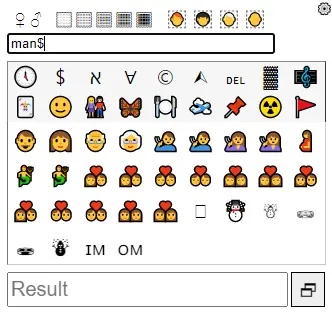
Starts with
^man — for all symbols that starts with “man”

Ends with
man$ — for symbols that ends with “man”
Escaping characters
If you want to search for special characters you have to escape them with a backslash first. For example, when you want to find all the symbols with round brackets in description you should do like so: \(.*\)
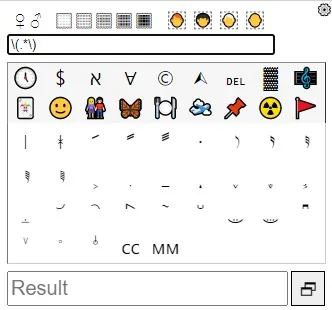
To escape asterisk just type: \*
Groups and ranges
To search the symbols that starts with a letter from “a” to “c” or “d” to “f”,
type: ^[a-c|d-f]

For “hand” without letter “s” type: hand[^s]
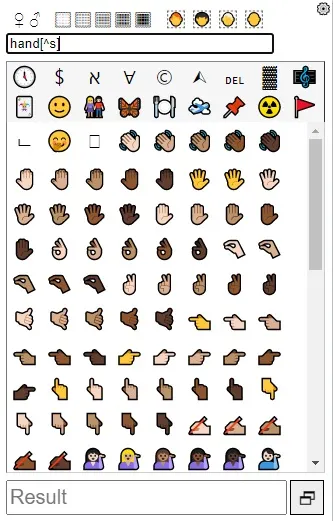
in the example above ^ works as exclusion, not a starts with
Quantifiers
Let’s say you want to find symbols with a double o’s,
like so: o{2}
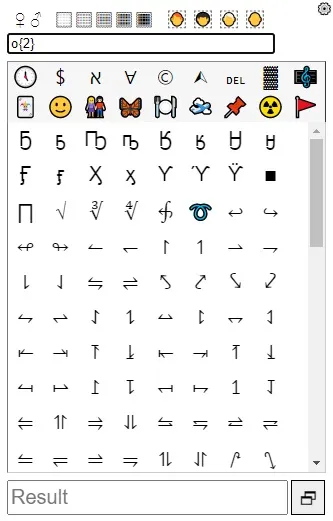
you can type instead: oo (which gives the exact same result)
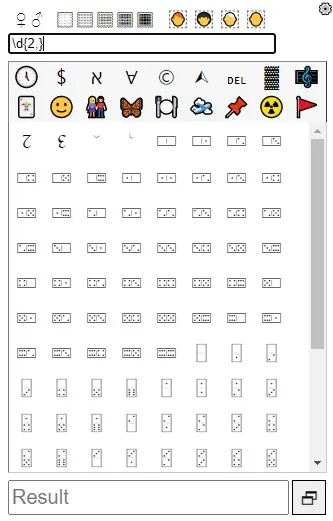
But to search for equal or more than two numbers in a row, you do need quantifiers,
type: \d{2,}
Assertions
There are 4 types of assertions: look ahead , look behind, negative look ahead and negative look behind
look ahead: man(?=.woman) , matches “man” only if “man” followed by “woman” with any single character in-between

look behind: (?<=woman).man , matches “woman” only if “woman” followed by “man” with any single character in-between

negative look ahead: woman(?!man) , matches “woman” only if “woman” not followed by “man”

negative look behind: (?
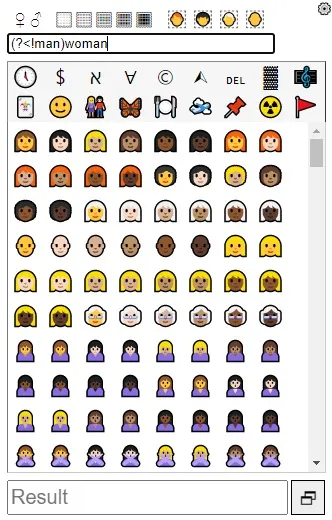
So if you want to search let’s say a “raised” followed by “hand”
type: raised(=?.*hand) , matches “raised” only if “raised” followed by “hand” with a set of any characters in-between

I will share some more examples later. Stay tuned.
How can you benefit from Synballo?
The wait is over! Synballo v0.7.0 release is officially live on Google Chrome Web Store.
---
Before we dive into who this update is for and how it will improve your workflow, let's take a look at what's new:
+ emoji 15.0
+ emoji 15.1
+ emoji 16.0
+ another 49 symbols from different categories
+ syncs with you browser account
+ set search as default (focuses in search on open)
and more
For those of you who are not familiar with, Synballo is a comprehensive symbol picker extension designed to simplify digital communication. Its primary purpose is to provide users with instant, effortless access to a vast universe of over 8,000 unicode characters, emojis, and special symbols that are not available on a standard keyboard.
The value it provides is in enhancing user expression and productivity. By offering a fast, intuitive search with RegEx compatibility and seamless copy-paste functionality, Synballo eliminates the tedious process of searching for and copying individual characters from various websites. This saves users time, improves their communication clarity, and allows for more creative expression across all online platforms, making it an essential tool for students, professionals, and everyday communicators.
---
Synballo is designed for intuitive and seamless use. Here is a guide on how to use the extension and examples of its main use cases:
How to Use Synballo
Open the Extension: Simply click the Synballo icon in your Chrome toolbar. A small, clean window will pop up.
2. Find Your Symbol:
Browse: Explore the vast library by scrolling or clicking on the different category tabs (e.g., Emoji, Math, Currency, Arrows).
Search: Use the search bar to quickly find a symbol by typing its name (e.g., "star," "infinity"). For advanced users, you can use RegEx to pinpoint specific characters.
3. Insert or Copy:
Insert: Click on any symbol, and it will be automatically inserted into the active text field on your current web page.
Copy to Clipboard: The symbol is also automatically copied to your clipboard, allowing you to paste it anywhere else with a simple Ctrl+V (or Cmd+V on Mac).
You can disable these in settings by unchecking the relevant checkboxes.
4. Access Recently Used: The extension keeps a record of your most recently used symbols and syncs across devices, allowing for even faster access next time.
Main Use Cases & Examples
1. For Students & Academics:
Purpose: To quickly insert mathematical, scientific, and academic symbols into documents, online forums, and research papers.
Example: A student writing a paper on physics can easily find and insert ∑ (sigma), ∆ (delta), or ∫ (integral) without searching the web or remembering complex codes.
2. For Social Media & Casual Communicators:
Purpose: To add personality, emphasis, and unique flair to posts, messages, and comments.
Example: A user crafting a celebratory tweet can instantly add a ✨ (sparkles emoji), a 🎉 (party popper), or a ♡ (heart symbol) to make their message stand out.
3. For Writers & Editors:
Purpose: To insert professional punctuation, currency signs, and typographic symbols that are not on a standard keyboard.
Example: An editor can quickly add - (em dash), © (copyright sign), ™ (trademark), or € (Euro currency symbol) into an article with a single click, ensuring professional and accurate formatting.
4. For Developers & Designers:
Purpose: To use special characters in code comments, documentation, UI mockups, or user guides.
Example: A developer can add → (right arrow) to a comment to indicate a function's flow, or a designer can use ▶ (play button) to quickly mock up a new UI element.
RegEx examples: https://nostrichpub.com/note1j0ezpf34aah8jx752n2yhsmf3q86rcsc68c9hyntrhz7203kh5zqln5qgh
Release 0.7.0: https://chromewebstore.google.com/detail/synballo/egokobopkifbejiejfimicpndljehial
Official website: https://synballo.com
New update has been published on #Google #Chrome
Added:
+ emoji 15.0
+ emoji 15.1
+ emoji 16.0
+ another 49 symbols from different categories
+ syncs with you browser account
+ set search as default (focuses in search on open)
and more 👉
Check out rn
https://chromewebstore.google.com/detail/synballo/egokobopkifbejiejfimicpndljehial
Synballo - is a web browser extension designed to be a comprehensive and convenient toolkit for accessing and managing a vast library of symbols. Launched in 2020, it was created to solve the limitations of existing applications that offered a small and often inconvenient selection of characters. The project’s goal is to save users time and facilitate communication by making a wide range of symbols easily accessible.
At the heart of Synballo is its massive collection of over 8,000 symbols and emojis. It’s compatible with popular browsers, available at 241 web stores and aims to provide a top-notch user experience. The extension syncs with your browser profile and is designed to run efficiently even on older operating systems, ensuring accessibility for a broad user base.
A key feature for user convenience is the automatic copy-paste functionality. When you click on a desired symbol, it is automatically pasted into the active text element. This works across a wide range of popular platforms.
Additionally, Synballo is designed to be super efficient and small. It is the smallest extension compared to its competitors and only loads into memory when it is actively being used. The moment you are done with it, the extension automatically unloads, ensuring it doesn’t consume unnecessary system resources.
Synballo’s primary purpose is to streamline the process of finding and using symbols. It includes handy features like filters for gender, skin, and hair, and it automatically manages a list of your recently used symbols. You have the option to expand the list of recently used symbols from the default 50 to up to 100.
Furthermore, a memory option allows you to save your last-used category instead of the “Recent” tab. This means the next time you open Synballo, it will automatically open to your chosen category, providing a more personalized workflow.
The extension is free to use, with updates and maintenance sponsored by user donations, which can be made via PayPal or cryptocurrency. It operates under a Creative Commons license, further emphasizing its commitment to being an open and accessible tool for everyone.
Why you should stop using Google search | Switching to Microsoft Bing, Yandex | My story of web development, search engines and SEO.
I’ve been developing websites since 2008, but my first attempts to learn XML actually date back to 1999. I was under 18 and incredibly fortunate to meet a very wealthy man who had his own department of programmers. They built programs and websites for him; he even owned a street in my city! At that time, I worked as a computer technician after school, repairing and building computers.
He invited me to his office and showed me a book with “XML” in its title. Back then, very few people knew about this book, and he possessed one of the first copies. He told me to take it and “try to do something.” I saw it as a golden opportunity to join the cutting edge of web development. He gave me two weeks to study the book and demonstrate my talent. He extended the deadline by another two weeks because, well, it wasn’t that easy for me!
A month later, I presented him with a webpage featuring buttons — a sort of push-button menu where you could select computer parts. He looked at it, praised me, and then showed me what his programmers were creating. When he introduced his real estate website with a menu allowing users to choose a country, region, type of real estate, and so on, I realized I was still incredibly far from that level.
A few years later, I joined the army, but I never forgot my dream. In the army, I was lucky to meet guys involved in programming. While my official role was in electrical work, I spent all my free evenings with them, trying to absorb everything I could. That’s how I learned to play the guitar and write programs in VB6. After my service, I happily returned to civilian life.
My friend once told me about PHP. He claimed it was a fantastic language, user-friendly, and that he’d learned it in literally one day! He showed me how to set up a home web server. At that time, we didn’t know about WAMP/LAMP stacks; he simply showed me Apache and how to configure PHP and MySQL. It took him a week to get everything working. Thanks to his guidance, I managed to set it up myself in just 24 hours once I got home.
I then dreamed of exploring everything possible with PHP, but the culmination came a few years later during a conversation with my friend who was studying computer science in college. We often spent evenings at his house with a group of people, and one day I told him about a singleton I had created in PHP. He was one of the best programmers I knew, and I’d learned a lot from him. But at that moment, he looked at me and said, “My friend, if you understood how PHP works and what a singleton is, you would understand that a singleton can’t work in PHP.”
And if you think about it, he was right to some extent. His words made me uneasy, but I knew I couldn’t be wrong because I had tested it, and it worked. So I suggested he check it out if he didn’t believe me. He had a look on his face — he didn’t want to humiliate me, but since I insisted, he couldn’t resist the temptation to prove his point.
So, he typed a singleton class on his laptop and created an example to demonstrate that the database connection would always be new when pressing F5, and no PHP singleton class could change this, because “that’s how PHP works,” right? I’m sure for many of you, understanding this scenario might be mind-blowing. When he saw that a singleton did work in PHP, he couldn’t believe it. He checked his code, convinced there had to be a mistake somewhere! But there wasn’t one, and then he had to admit that it worked! Later, he quickly forgot about this incident, but I will remember it for the rest of my life. Since then, I’ve used this class in all my projects that require working with a database.
I tell this story so that anyone who has the patience to read it, and doesn’t know me personally, will have at least an idea of the path I’ve traveled. Many years have passed since then, and after maximizing my potential with PHP, I found myself switching to Python. For those who aren’t aware, there’s a popular “holy war” in certain circles: “Which is better, PHP or Python?”
I decided to push myself to learn Python because PHP’s multithreading was essentially “pseudo-multithreading.” While it worked well, and I even set a personal record for the number of internet connections (requests) per second, it became clear I needed to find ways to further increase that result, and it simply couldn’t be done in PHP. That’s when I considered trying Python. I had tried Java, and the result was frankly disappointing. I spent two years studying Python while coding my projects, only to realize that this kind of thing should really be done in Golang. A sad ballad of me and Python, indeed.
Over the years, I’ve written quite a few projects. One of the most challenging was probably triangular arbitrage, though there were many interesting ones. I was doing sport arbitrage back when VB6 was the only language I knew. But the laws and financial complexities made it impossible to earn good money from it, so I had to consider other options.
By 2008, when I was already building websites for myself, my relatives, and writing projects for college students for money, it was clear that beyond protecting my websites, marketing was an important aspect. Of course, there’s also web design, which I always tend to ignore, but as the title suggests, we’ll talk about SEO.
After reading a few articles from Google search, I initially thought that to promote a website, you needed to pay $200 a month to get on the first page of a search engine. With many search engines, each requiring payment, it seemed daunting. At that time, I had no real experience in promoting my website, so I started preparing and optimizing the projects I wanted to promote. I won’t list the numerous pitfalls along the way; that’s a different story.
Those who have gone through this know that you probably shouldn’t believe articles found on the first page of Google search. The best information is rarely there. You can read my previous publications to find out how I discovered one of the best web hostings ever — and no, it wasn’t on the first page of Google search. It’s not there. While it used to be that those diligent enough to search could find unique, useful things, now everything is much worse. Many valuable pages are no longer found in Google search.
Over the years, I’ve developed a habit of saving links to interesting finds in a separate file, not in favorites or bookmarks, because they sometimes disappear from there too. For example, I still have a link to a list of proxy servers that can no longer be found via Google search. How to search correctly is a different story, which I may tell someday to those of you who are interested.
Recently, one of my projects finally reached the first page of a search engine. No, it wasn’t Google search. I’m less popular on Google search than others. I don’t know why, and frankly, I have no desire to find out why Google is doing such a terribly bad job these days. But the facts speak for themselves: Bing and Yandex work the way you would expect Google should. You can waste your money trying to get to the first page on Google, while on Bing and Yandex, I managed to do it for free, just by using my SEO skills.
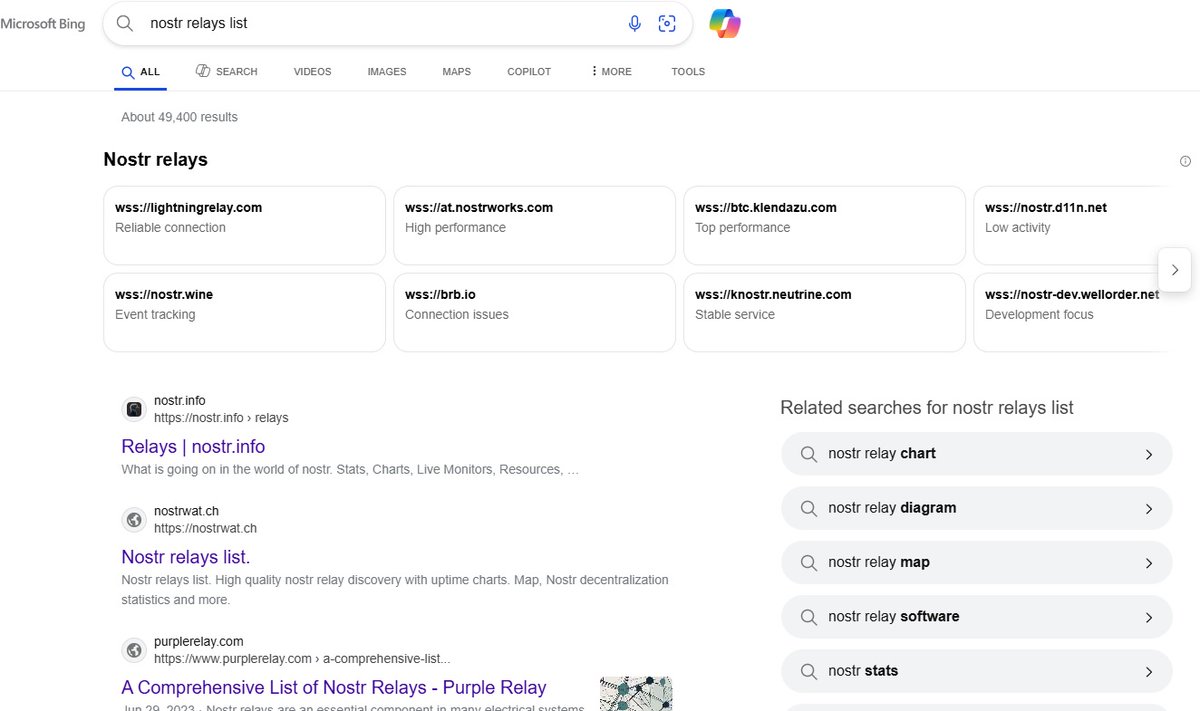
Here you can see nostrwat.ch as the second result on the first page of Microsoft Bing for a keyword found in the main page’s title and description
Yandex, on the other hand, is doing even better, surprisingly

And only Google doesn’t show my website at all, no matter what. Although they did send me a letter the other day.
A very touching letter. I checked today; my site is not on Google search. It’s simply not there. Period.
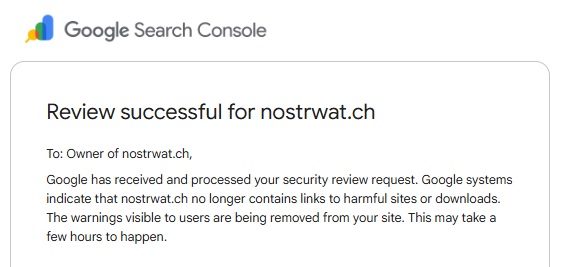
I hope I managed to save at least one person from all the difficulties that befell me. With that, good luck and all the best!
Google has removed the warning visible to users of nostrwat.ch.
Just a reminder, new relays may appear and contain bad links in its description. I do not censor information. I do not responsible for harmful links provided by the relays operators. My goal is #nostr network discovery.
Google search is so much behind Bing and Yandex. If you want the most up-to-date results for your query, stop using Google. Period.
Today I have finally decided to look deeper into the GENIUS Act. Those who follow my activity may have seen my tweet a year ago where I expressed my opinion on Trump/Harris. At that time, I did not yet realized that Trump was also about the CBDCs. Now I think this part would probably pass no matter who won the elections. As for the bitcoin part, I don't know, but it would be nice if it also passes; Otherwise, it turns out that at least in this regard, there is no difference between the democrates and republicans. Anyway, Mastercard Crypto Credentials already working with bit2me.com and are coming to coins.ph wirexapp.com foxbit.com.br and so in the coming days I will have to consider adding these to nostr:npub17t47c6665266zvgk5rccztna520stvaezjm7smrqgwsn7wkscycqsehap5
Have a good day.
My open-source trading strategy got a record number of likes and thus I became one of the seven most popular authors on Tradingview, and this is no less than 100 million users. I have many other scripts that in my opinion have not been appreciated by the general public and the community but which nonetheless deserve attention. Thanks to everyone who supported me and followed my work. I promise to continue matter what. Your support means a lot to me because you know that I don't receive any funding. Over the years, there have only been a few people who have sent me $5-$10 just because they liked what I do. My projects are already used by several thousand people around the world, and this is despite the fact that I have not invested a single dollar in marketing and graphics. Despite all this, the number of users is growing, albeit slowly, but this suggests that, in general, the implementation of my ideas is not in vain. I started with the simplest ideas to gain experience in implementing projects, but there are still many more complex projects ahead that I left for later.
https://www.tradingview.com/script/2DxTUzED-Trend-Reversal-Alerts-Strategy-4H-3M/
Today I finally published updated version of my indicators and trading strategies. This is a huge work since 2018. Back then I decided to implement my ideas for indicators after talking to Tone Vays. He told me back in 2016 that his indicators did not work quite as they should and he did not have time to fix it. So I decided to do it myself because I had my own ideas to test. It took several years to implement. And today I finally published updated versions on TradingView. I am especially proud of this because this is in fact my own offshoot of ideas by the legendary Larry Williams. The same ideas that Tom DeMark patented. Tyler Jenks wrote about this in a letter to Tone Vays https://x.com/ToneVays/status/1154220951980187649 and for me all these great people were masters. I am glad I had the good fortune to breathe new life into these amazing ideas, which I consider to be the best in the history of technical analysis. I managed to improve Larry's ideas and perhaps it is worth writing about it.
[Trading Indicators and Strategies by @nocachy](https://ta.xport.top/)
Thanks to all new users for choosing https://charts.xport.top. I see many of you use iPads and especially for you I added two images that should solve the issue of displaying the icon upon the shortcuts to the website added to your desktops. I hope now some of you will continue trying to break my website in a slightly more pleasant environment. Cheers!
I have to admit, this is a pleasure in holding back all attempts to attack my services, because for me it is a great practice. The fear and desire to prevent any competition may work for others, but for me I turn this into real torture. Look, I used $2 web hosting services for three years, which was constantly under attack, and I had no countermeasures, because support refused to do what I asked and answered me something like "buy yourself a VPS and do whatever you want", and they were right, but I have a difficult character. I never give up. It's not a question of money. I just love to learn in a hard way I guess. Therefore, in the end, I managed to defeat all the attacks and even half of the resources of this lousy hosting were enough to control the situation. And you know as Paulie Gualtieri said:"6,000 years is nothin’ in eternity terms. I can do that standing on my head. It’s like a couple of days here."