

This just reminds me that since it's obviously not Joe Biden, whoever has currently assumed the powers of the President wasn't elected to that office, either.

That's okay. Given the stockpile El Salvador has already accumulated, another 10x or so in price might result in the IMF asking El Salvador for a loan.

Yeah, in hindsight, that he seemed like an odd pick for speaker should have been a red flag that his principled public image was just a facade.

To be fair, they're trying to compete in a rigged game, and not everyone has been ordained with the Cantillon cheat code.

Yeah, no matter how unlikely the catastrophic scenario may seem, don't collateralize a loan with bitcoin... or invest in a company that effectively does the same thing - even if the loan is for buying more bitcoin.

“65. If the enemy leaves a door open, you must rush in.”
― Sun Tzu, The Art of War

This was a very engrossing interview until it became unwatchable due to the relentless YouTube generated, seemingly randomly timed advert interruptions. It didn't help that these adverts were in addition to those that are clearly native to the show; but at least when it was just the native adverts, they didn't completely kill the pace of the show and ruin the experience.
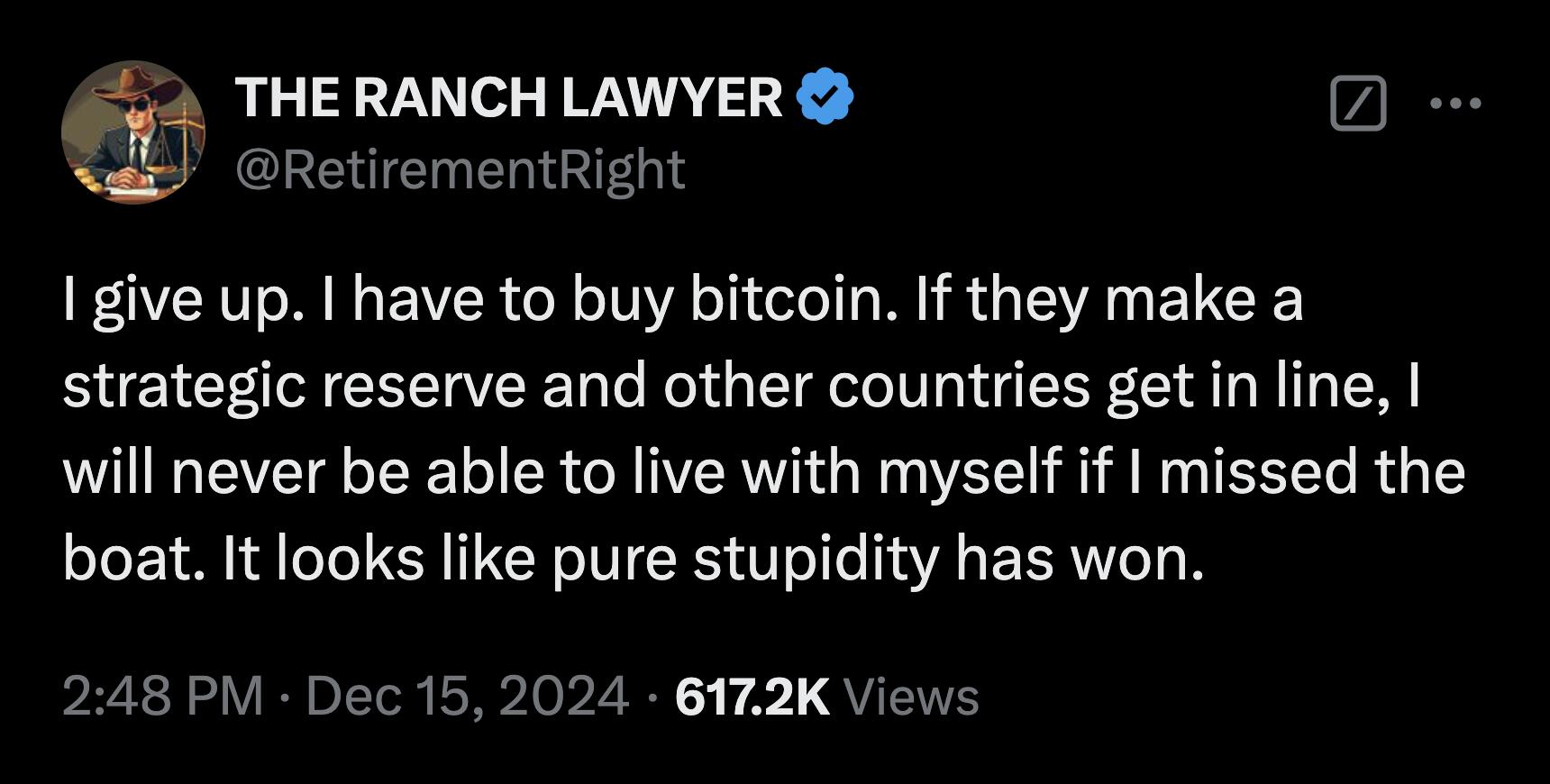
I mean, welcome aboard I guess?... I've just never seen such a blatant admission that someone is prepared to go along with the herd not matter what - even against their own (albeit, erroneous) judgement.

I think it could make perfect sense. If price is a function of supply and demand, then a rising price would indicate increased demand, decreased available supply, or some combination of both. If the dominating factor happened to be decreased available supply (e.g. because of wide-spread HODLing), then all else being equal, I would expect a rising price requiring fewer transactions.
Conversely, it seems to me it's been the massive sell-off periods when we see the largest fee spikes (ordinals notwithstanding).
After 15 years of Republican gerrymandered elections, we finally have fair maps. In a state that basically votes 50/50, we're now on track for a disproportionately Democratic legislature.
Wait... What?

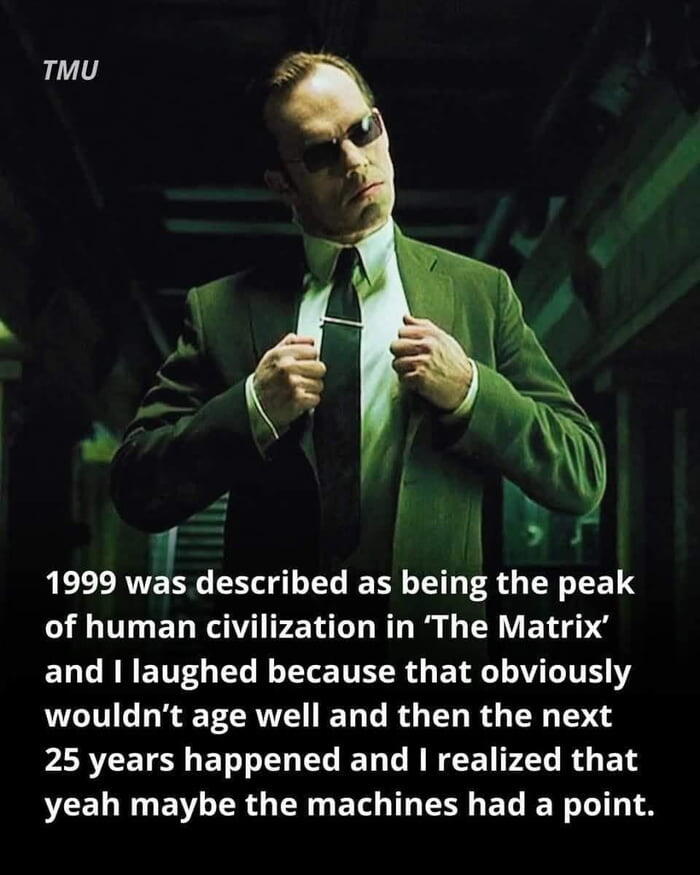
Yeah, I don't think anyone can seriously dispute that human civilization has been on the decline ever since 9-11 provided the perfect excuse for unleashing effectively unconstrained mass world-wide surveillance.
Is it too conspiratorial to think that 9-11 may have been masterminded by the Wachowskis? 🤔

I think I understand it enough to know it's effectively an infomercial. I'm certainly not going to suggest investing in anything solely based on that.
I don't knock Saylor for shilling his product; but, the lack of any critical push-back at all from any of the multitude of venues that eagerly host his sales-pitch is pretty astounding. A simple, "so what would happen to shareholders if an extended 50% downturn in Bitcoin forced you to also liquidate a significant amount of the Bitcoin you had accumulated for them in order to satisfy paying back the bond holders?" would be a good start. "what if it's an 80% downturn?" would be an even better follow-up. I know what would happen with BTC: 1 BTC would still equal 1 BTC.


Yeah, I agree. The bill in question says nothing about selling any gold, though. I don't suppose you could possibly be particularly surprised that this woman is lying to you.



No, the bill does NOT propose to sell off any of the Federal Reserve's gold to buy Bitcoin. TL;DR: The bill doesn't propose to make ANY changes to the custody of U.S. held gold AT ALL.
First off, the Federal Reserve does NOT even own ANY gold; the U.S. Treasury does. Second, the gold is ALREADY used as collateral in the form of gold certificates held by the Federal Reserve. These gold certificates are currently valued at the 1970's era price of $42.22 per ounce for a total of ~$11B. This bill simply directs the updating of these gold certificates to reflect the current market value of gold and for the Federal Reserve to provide the U.S. Treasury with the ~$700B difference.
"(c) Federal reserve system gold certificates.—Not later than 180 days after the date of enactment of this Act, the Federal reserve banks shall tender all outstanding gold certificates in their custody to the Secretary. Not later than 90 days after the tender of the last such certificate, the Secretary shall issue new gold certificates to the Federal reserve banks that reflect the fair market value price of the gold held against such certificates by the Treasury, as of the date specified by the Secretary on each new gold certificate. Upon issue by the Secretary, each Federal reserve bank that receives a new gold certificate shall remit the difference in cash value between the old and new gold certificates to the Secretary for deposit in the general fund within 90 days."
https://www.congress.gov/bill/118th-congress/senate-bill/4912/text
"The gold certificate account reflects the receipts issued to the Reserve Banks by the Treasury against its gold holdings. In return, the Reserve Banks issue an equal value of credits to the general account of the Treasury, computed at the statutory price of $42.22 per troy ounce. Because nearly all of the gold held by the Treasury has been monetized in this fashion, the Federal Reserve Banks' gold certificate account of $11 billion represents the nation's entire official gold stock."
"(c) Federal reserve system gold certificates.—Not later than 180 days after the date of enactment of this Act, the Federal reserve banks shall tender all outstanding gold certificates in their custody to the Secretary. Not later than 90 days after the tender of the last such certificate, the Secretary shall issue new gold certificates to the Federal reserve banks that reflect the fair market value price of the gold held against such certificates by the Treasury, as of the date specified by the Secretary on each new gold certificate. Upon issue by the Secretary, each Federal reserve bank that receives a new gold certificate shall remit the difference in cash value between the old and new gold certificates to the Secretary for deposit in the general fund within 90 days."
https://www.congress.gov/bill/118th-congress/senate-bill/4912/text
I don't really take issue with any of his comments - it's mostly just run-of-the-mill normie FUD. (I'm even happy to concede that any money the government spends is effectively 'taxpayer' money).
What I think he is demonstrably wrong about is that the bill as currently written doesn't require taking on any new debt - at least for a while.. It essentially calls for the ~$11B in gold certificates currently held by the Fed to be updated from their $42.22 per ounce value (a relic of a 1970's statute) to the current market value - and the difference to be returned to the U.S. Treasury. At the current market rate for gold this would provide the Treasury with ~$700B that it didn't have to borrow from anyone.
Is $700B enough to buy 1M Bitcoin slowly over 5 years? I don't know, either (but I doubt). So maybe they would have to start borrowing to eventually achieve this. Though, in the meantime, it would actually temporarily wipe out a significant drop of the debt (and the associated interest payments) - so there's that.
PS. The upgrading of the gold certificates sounds too good to be true to me. I mean, why hasn't anyone suggested doing it before now to pay for their own pet project? It feels like there must be something that makes it legally undoable; but, I haven't seen the argument against it, yet... and it's still in the latest text of the proposed bill.

I'm not technical enough to know, but I thought, in theory, 'they' already know how to break 128-bit or 256-bit or whatever encryption if they just had enough qubits. So, to me, when the claim revolves around a certain number of qubits - like 100 or whatever, shouldn't they already be able to demonstrate supremacy in the realm say 8-bit? or even 16-bit encryption? (or maybe they do already claim this supremacy? I don't know; but would like to know).
Maybe I'm wrong; but, all the hype around inevitably being able to break encryption once they are able to build enough qubits seems to be ignoring the important fact that what they are calling a 'qubit' isn't even in itself what they would eventually need - never mind how many of these proto-qubits they manage to be able string together.