
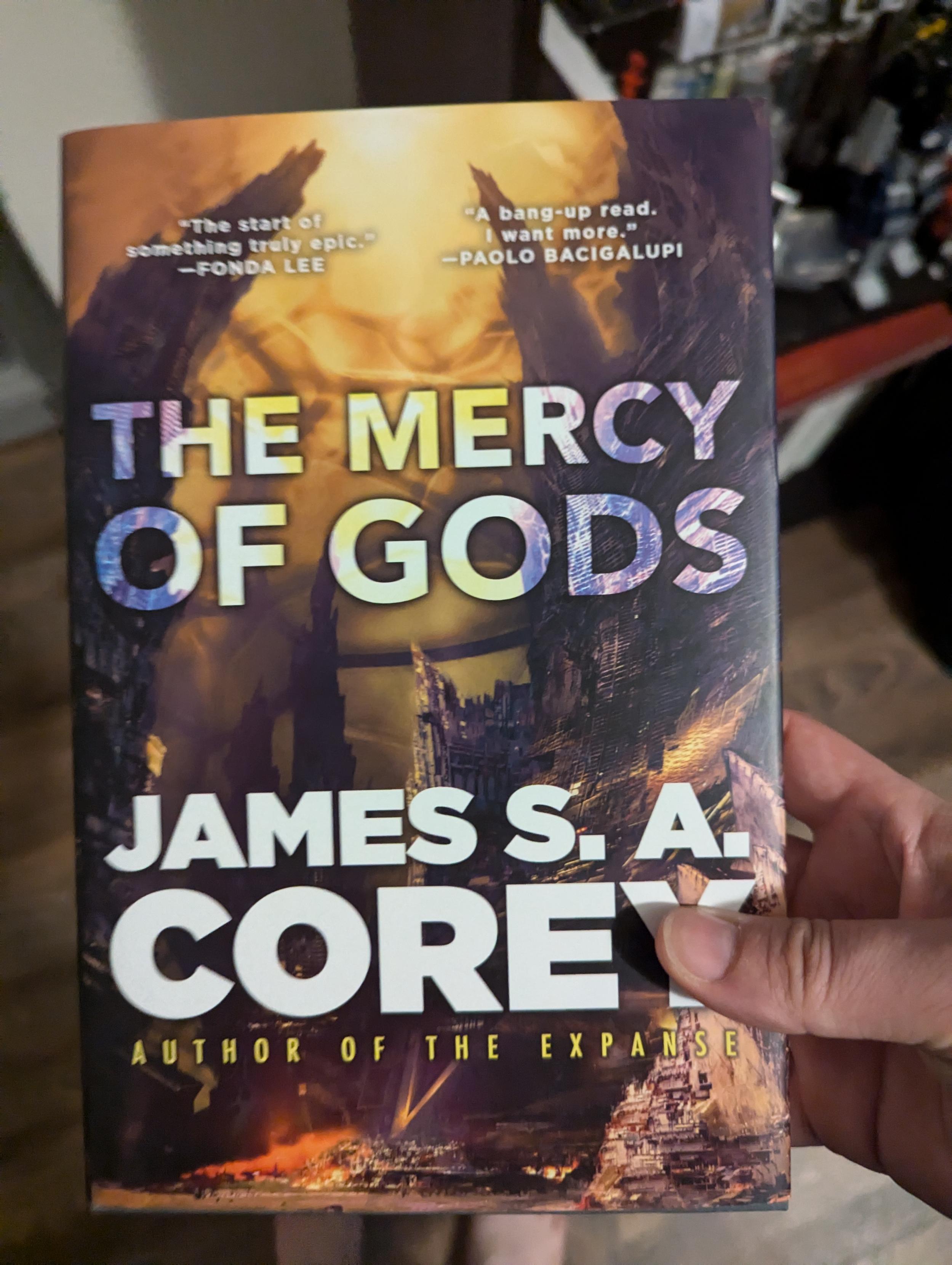
Would you say it is similar in tone to The Expanse?


This seems to be mirrored by the development in Europe where overall margins also dropped by 3% despite increasing prices from 2019-2022. interesting and detailed report from McKinsey:
EBITDAs are under pressure that's for sure.

I AM A NOSTR NOOB, TEACH ME WISE ONES
I want to love Nostr and use it more. My problem is discoverability - it’s very hard to recreate a social graph + algo that beats Twitter. I see less content here and people see my posts less, so I have fewer conversations. How do I bootstrap the nostr graph without so much drudgery?
Help nostr:npub1qny3tkh0acurzla8x3zy4nhrjz5zd8l9sy9jys09umwng00manysew95gx nostr:npub1az9xj85cmxv8e9j9y80lvqp97crsqdu2fpu3srwthd99qfu9qsgstam8y8 nostr:npub1a2cww4kn9wqte4ry70vyfwqyqvpswksna27rtxd8vty6c74era8sdcw83a nostr:npub1zuuajd7u3sx8xu92yav9jwxpr839cs0kc3q6t56vd5u9q033xmhsk6c2uc and anyone else I know in this place
I learned a lot in this thread. Thanks everyone for the tips about how to improve the Nostr experience!
Right now it's available for free so you don't have to buy it at all. you can just download it without needing to pay anything.
Thanks Mandana! I hope you enjoy it.
My bitcoin book "Walking Banks" is now available for free for everyone to download. It's a murder mystery story with bitcoin as a key plot element that follows US agent Jack Decker on his way to Beijing to catch a serial killer that has targeted an old friend.
It would make my day if you could give it a try for free, provide some feedback or review and connect with me here on Nostr.
https://www.amazon.com/Walking-Banks-Mystery-Novel-White-ebook/dp/B0DCP6BCDL/
#bitcoin #writing #books #CBDC #author #stories #fiction #mystery #novel
Here's my profile for Reason on Nostr and why it could very well change the world
Pasting a few paragraphs here, you can find the rest at the link
Feel free to spread far and wide 😉
*************
Can Nostr Make Twitter's Dreams Come True?
Twitter's founder says Nostr is “100 percent what we wanted”—an open, ownerless network
Alex Gladstein | 8.13.2024
Virtually everyone agrees that social media is broken. On Facebook, X, Instagram, and TikTok, people fear out-of-control algorithms, fake news, state actor censorship, and propaganda. Google and Meta collect vast troves of personal information on their users and receive hundreds of thousands of requests every year from governments around the world to access that data. YouTube has become arguably "the most powerful media platform in the history of humanity," yet its algorithm is an ever-changing black box to the creators that populate the platform with videos. During the pandemic, federal officials were in contact with every major social media platform, coercing them to remove content.
The problem is centralized control. We can't trust companies to run our primary communications infrastructure. Government regulation only makes matters worse because it creates new legal barriers to entering the industry, which protects incumbent players and stifles innovation.
What if there were an alternative, not owned by Elon Musk, Mark Zuckerberg, or the Chinese Communist Party? What if there were a way to control your own data to prevent companies from harvesting and monetizing it? What if you had granular control over what you see in your feed, with the freedom to choose your own algorithms? What if you owned your identity, which could be accessed seamlessly across different clients? That way, if you disapprove of the changes that Elon Musk brought to X, instead of closing your account you could take your handle and followers elsewhere.
That alternative exists. It's called "Notes and Other Stuff Transmitted by Relays"—or Nostr.
The Decentralized Solution
Invented by a pseudonymous programmer and overwhelmingly funded by grants from non-profit foundations, this decentralized, free, and open-source protocol has been quietly evolving for the past three years. Like bitcoin, Nostr is a community-run digital network highly resistant to censorship and corruption. It has 40,000 weekly active users and a growing ecosystem of clients and applications ranging from social media to long-form publishing to payments.
Nostr is only necessary because our existing internet is so broken.
Fifteen years ago, social media seemed destined to decentralize the world and give power back to the people. In 2009, we watched as Arab Spring activists used Twitter and Facebook to organize, coordinate, and help topple several long-standing dictatorships. The promise was that these new social platforms, designed by Silicon Valley entrepreneurs, could help liberate the masses.
It was intoxicating—but turned out to be a mirage. The Arab revolutions stalled out when brutal military regimes cracked down. These platforms became tools for spying and censoring their users. X and Facebook have helped journalists and human rights activists reach bigger audiences, but they haven't fulfilled their revolutionary promise.
Jack Dorsey's Shift from Bluesky to Nostr
This was a major theme at the 2024 Oslo Freedom Forum, which is put on annually by the Human Rights Foundation, where I serve as chief strategy officer. At this conference for democracy and human rights, Twitter co-founder Jack Dorsey told the audience that the problem was, actually, guys like him: The very fact that Twitter, now X, has a CEO makes it a single point of failure. Governments routinely pressured Dorsey to censor content; once the company's offices in India were raided. Dorsey says that under the new Musk regime X complies with whatever governments want.
The X network is proprietary. Known as a "silo," this construct traps a user's identity, followers, and data. X also has the power to evict anyone from the platform and delete what they've written. Several years ago, when he was still running the company, Dorsey became convinced that Twitter should become an application instead, where users could post content to an open, ownerless network. This would make it similar to how bitcoin works, where you use an application called a wallet to interact with the network, but the network itself is neutral and open.
Building a non-proprietary architecture was Dorsey's original vision for Twitter, but over time the need to maximize revenue to build a business and serve shareholders undermined that goal.
Nevertheless, in 2021, Dorsey encouraged the creation of Bluesky—an initiative bootstrapped in-house to create that open neutral base layer. But after Musk bought the company, the managers of Bluesky were afraid they would run out of money and started raising funds from venture capitalists, which undermined the vision of building an open platform. Dorsey grew disenchanted and left the Bluesky board.
At the conference in Oslo, Dorsey explained what happened next:
I asked a question: What open source initiatives should I be funding that would be helpful to the public internet? And people kept tweeting at me that I should be looking at Nostr. I found the GitHub that described it and it was 100 percent what we wanted from Bluesky, but it wasn't developed from a company. It was completely independent. Its paper diagnosed every single problem we saw and had. But did it in a grassroots and dead simple way, that felt like the early Twitter where any developer could get on and really feel it.
Escaping the 'Golden Prisons'
Nostr was created in 2020 by the pseudonymous Brazilian programmer fiatjaf, who describes it as "the simplest open protocol that is able to create a censorship-resistant global 'social' network once and for all."
Though nobody is in charge, Nostr works as promised and is thriving. "It is the solution we've all been looking for," says Miljan Braticevic, founder of Primal, one of the two dozen plus clients now available for the Nostr protocol. "Nostr is not a Twitter competitor or a Mastodon competitor. This is the biggest misconception at the moment. That's just the tip of the iceberg. Nostr is nothing less than the foundation for the new internet. Meaning almost every conceivable app we have today will be built on Nostr."
Braticevic's prediction is echoed by at least a dozen other prominent developers. Martti Malmi, the first coder to work on bitcoin alongside Satoshi Nakamoto, is now a Nostr developer. In a recent talk, he said he had started to work on similar ideas around decentralized identity in 2019, only to come close to giving up. But then he found fiatjaf's invention, which he called a "godsend."
"Bitcoin is freedom of money, and Nostr is freedom of everything else," Malmi said. "I was there" in the earliest days of bitcoin, "and Nostr is even more intense."
For something that could be world-changing, Nostr is quite simple. To join, you sign up with a mobile or desktop client, which helps you to create a public and private key pair. The public key (or "npub") is used as your identifier, and you share it with clients and other users so that people can find your posts or pay you for your content. The private key ("nsec") is hidden by the user, stored safely (just like a bitcoin seed phrase), and is your way to log in to different services. Unlike platforms like X or Facebook, no other information is required to set up and use Nostr.
This gives users a powerful range of sovereignty. You can use a client, for example, that has strong hate speech controls. Or you can choose one that doesn't have any at all. You can use a client with aggressive algorithms, just like the ones X uses today. Or you can use one without any algorithm at all. Today, when you log in to an app like Primal, you can sort your feed by what's the latest, by what's most popular, by what's most zapped, or by customized keywords. It's up to you.
Last month, the macroeconomist Lyn Alden, author of one of the best books on bitcoin, published a long essay about Nostr's potential:
[Nostr] is a simple set of foundational building blocks that, if widely adopted, could gradually reshape "the Web" as we know it. Instead of a separate set of siloed social ecosystems, we could gravitate toward a more interoperable set of ecosystems, with more of the power dispersed to the content creators and to the audience, and away from the middlemen corporations.
The Nostr network is constructed like a spider web that can morph and regenerate, making it almost impossible to censor. When you set up a client on Nostr (perhaps, Primal or Damus on iOS; Amethyst on Android; or Coracle on the web), you choose from a variety of relays to connect to. This architecture ensures no single point of failure: If you are connected to seven or eight relays, and half of them choose to censor posts, your feed remains censorship-free, as your app will display the net sum of everything broadcast from each relay. If the Chinese government decides to attack your relays—as it did in 2023 when Damus launched on the Hong Kong and mainland app store—then more can be spun up. "The enemy," said Damus creator Will Casarin, "is too numerous."
Prominent bitcoin developer and educator Gigi—who switched to Nostr and deleted his X account—says that what helped it become so resilient is that it has zero exit cost. If the Chinese Communist Party bans YouTube, its domestic users lose everything. There's no way to get back their profiles and followers. The same is true if a user voluntarily closes an account.
Gigi calls these corporate silos "golden prisons" with no escape. Nostr's spider-like architecture makes escaping easy. If one client goes down, or you fail to connect to one relay, you just find another client or connect to another relay. You keep your posts, photos, preferences, contacts, and even algorithms of choice. If you use X, you are an X creator. But if you use Primal, you aren't a Primal creator, you are a Nostr creator.
https://reason.com/2024/08/13/can-nostr-make-twitters-dreams-come-true/
Very good read! I already forwarded it to some people.
Interesting look into the political biases of the most popular LLM AI models:
https://journals.plos.org/plosone/article?id=10.1371%2Fjournal.pone.0306621
#ai #llm #chatgtp #nostr #politics #science

Maybe you could give the freelancer pool on Reedsy a try? I have never tried to hire a freelancer there myself but I have read that their website/community has some good options: https://reedsy.com/editing/writing-coach

I'm relatively new to social media in general and tried out Twitter about 1 month ago. After 3 days, I deleted my account again. So much spam, fake accounts that suddenly followed me and weird post recommendations. It was a weird experience.


I think they will get it in check rapidly. Besides,even for the stock market and the major tech players...zoom out just 1y and this is just a minor blip on the radar. We are only back to april/may levels. Nothing really major happening so far other than correcting some AI driven hype over the past months.
MDMA/ecstasy treatment against PTSD recommended for rejection by FDA.
https://slate.com/technology/2024/06/fda-panel-mdma-therapy-lykos-therapeutics-rejection.html
A pity that a bad trial design from Lykos doesn't allow to really answer this interesting question and offee a potential treatment opportunity for people that suffer.
#science #mdma #psychedelics
Interesting pre-print how Chat GTP & LLMs are changing the way scientific publications are written:
https://arxiv.org/html/2406.07016v2
Kind of understandable that especially non-English-native speakers make use of it to polish their articles. But words matter, especially when trying to describe a new finding as scientifically accurate as possible. I wonder to what extend this verbose and flowery language is then really understood by the authors themselves and whether or not those words really correctly describe their findings or not.
#science #writing #ai
Is it just me or does there seem to be an influx of bots and scammers arriving to #Nostr lately? It looks like more and more of "DM me for my cool financial trick" or "join my newsletter on how to earn money with #bitcoin mining" replies are popping up in more and more posts.
Danny and I just wrapped up the final episode of What Bitcoin Did at Bitcoin Park, recording with some of our closest friends in #bitcoin - nostr:npub1cn4t4cd78nm900qc2hhqte5aa8c9njm6qkfzw95tszufwcwtcnsq7g3vle , nostr:npub1qny3tkh0acurzla8x3zy4nhrjz5zd8l9sy9jys09umwng00manysew95gx and nostr:npub10cxz2h7n6rumfpuf49zt4uvm7skzqk5u25vesp0tzdtnkvsnwjyqaffcj3, along with special appearances, including my son.
The episode will be released on August 30th. After that, we'll take a week off before launching our new show (the worst-kept secret).
After 7 years, 860 podcasts, countless flights, and visiting about 40 countries, the time is right. Time is precious. I need to travel less and focus on Bedford, the football team, family and bringing to life everything we've discussed over the past 7 years.
I believe we're entering a new era where #bitcoin is a legitimate part of every conversation. Our new show will reflect this, so we’re building a studio in London and evolving the format where #bitcoin is the heartbeat not the headline.
Thank you to everyone who has been part of this. I couldn’t have done any of this without the kindness and generosity of so many of you, especially nostr:npub16le69k9hwapnjfhz89wnzkvf96z8n6r34qqwgq0sglas3tgh7v4sp9ffxj .
I'm humbled by it all and everyone of you.
Big love ✌🏻


Fantastic run! looking forward to your next steps.

I agree with some other comments here that it could help where your friends are coming from? Are they financially literate? Are the concerned about government overreach or censorship? Do they worry about climate change? Do they want to make a quick buck, etc. etc.?
Depending on their starting points you could gear the slides,info and discussion in different ways. They worry about climate change? Show them examples about how bitcoin mining can make transitory renewable energy cheaper and accelerate its spread. Are they concerned about social justice? Show them some slides from Alex Gladstein or what Gridless does in Africa. Do they want to learn the monetary aspect of it? Michael Saylor's talks and slides or e.g. https://learn.saylor.org/course/PRDV151 might be most useful.
It's a little bit an indirect variant of the the "proof-of-work to prevent spam" principle. When hate, provocation and antagonistic statements are free, a platform will be spammed with it as this triggers people. When there is a mechanism that shows the real appreciation of a post that is connected to real proof of work value (and not a free "thumbs up"), the valuable posts and topics will shine more.

Thanks for all your important work!