What does it mean to "successfully navigate" in these conditions? Let's unpack that.
First, crew need to have confidence they can walk away from their safe haven (HLS) and safely return within the time constraints of their spacesuit consumables. The final act of EVA should always be airlock ingress.
Once you get far enough from the airlock, you might still have an eye on the lander but you might have terrain and shadows between you and the lander. Do you have confidence you know which path to take?
Go far enough and even a tall Starship becomes obscured by terrain. Now you rely on a working knowledge of your location state based on visuals and map data. It's easy to confuse craters and shadow features and the lunar surface is devoid of scale references we use on Earth.
If there is a large shadowed region between you and the lander do you go around, wasting precious time and consumables? Or do you take a direct path into a shadowed area where it's harder to discern slope and trip hazards?
Lower in priority than safety is mission success. Your mission might have an objective to traverse to a specific crater for scientific investigation and sampling.
We know from Apollo 14 that crew might struggle with finding a target. This may be more challenging with the harsh lighting conditions of the lunar south pole.
This VR testbed provides better visuals including illumination and shadows than we can emulate in field testing. Human eye adaptation to these harsh lighting conditions is emulated by the VR software, making it challenging to see surface features in shadowed regions.

The subjects reference a book of maps, using a grid coordinate system and references to terrain and lighting features to communicate their perceived location to the Ground IV. The Ground IV views their helmet camera video feeds but relies heavily on what the subjects report.

We're executing a test series where 2 subjects in VR navigate a traverse from an HLS lander, referencing craters, shadows, and topography to reach a crater 2 km from the lander, then back to the lander.


I was thinking about the phrase "the early bird gets the worm" as I took a swig of coffee. Then I noticed something solid in my mouth and spit this thing out. To hell with being early, I'm going back to bed!

Productive day


頑張ってamigo!
There are places on Earth where adversaries interfere with GPS signals. I'm specifically thinking about early Artemis lunar missions, but wanting to leverage from those who have dealt with this in Earth situations.
I get the "why not get free money?" argument, but there are other things to consider like whether I trust the app isn't stalking my personal data, feeding me ads, or if it's just less enjoyable to interface my podcasts.

So if I use this app every single day for a year I might receive about 27,000 sats, which is about the same purchasing power as $8 according to a quick exchange check.
How much do you get per day from Fountain? From an initial look it seems like a max of 1-2 pennies per day. Doesn't seem worth it.
Anyone knowledgeable on surface navigation in GPS denied environments? Based on NASA field testing we generally see an error of around 100-200m for people determining their location using only their eyes and maps. Curious if anyone else has researched this.
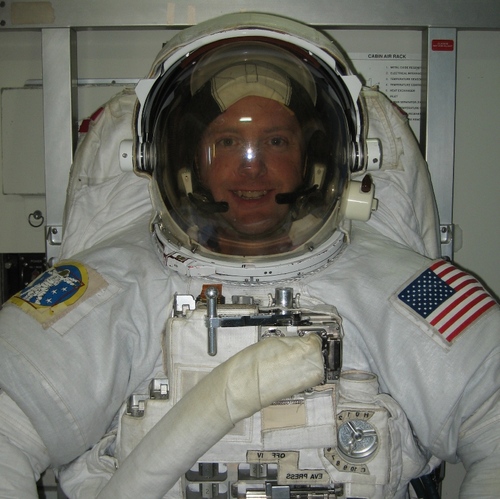
One of these people is going to the Moon #Artemis


What are your assumptions about the next time we land humans on the surface of the Moon?

Bro this salsa is hot. BTW did I tell you about how I got in on BTC at 3 cents? Bro let's hang out.
Any NASA peeps on here? Anyone interested in Artemis?