


Clownbase
Coinbase last week: flagging all crypto users as high risk because of a few fraudulent projects is discriminatory banking 🦾
Coinbase this week: Criminals use VPNs so we flag all VPN users 🫠


Thats why mints are auditable
In a KYCed ecash system sure, but it still offers transactional privacy.
The majority of debanking originates with transaction flagging, for example if you sent money to an exchange. Goes as far down as being flagged for using the wrong words, see e.g. EFF coverage here:

Just saying but debanking would become a hell of a lot harder if all banks ran on ecash

Those are good analogies as those examples can be used to enforce similar control mechanisms to a CBDC (so can btc btw), but the key difference is that govs can (and do) force their use - so actually, no. 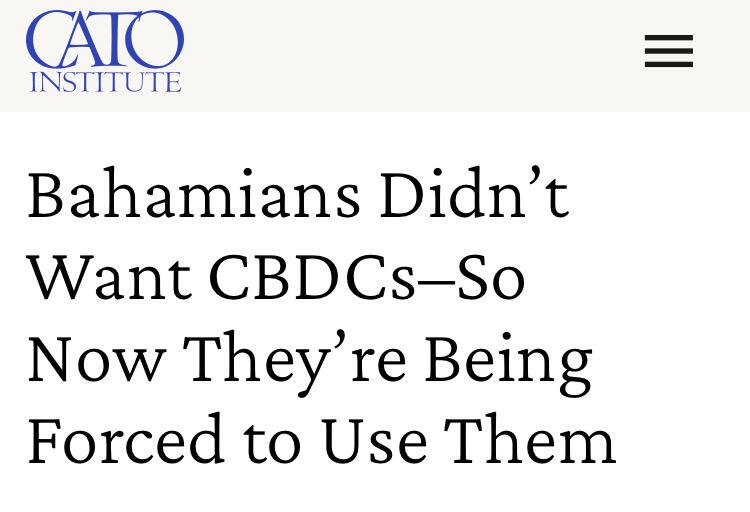
Over on the hellsite David Marcus is complaining about the government shutting down his Libra/Diem stablecoin so I thought now would be a good time to remind everyone that this actually saved you from running head first into a CBDC testflight program
There's not a lot of times to be thankful for the government, but I'm pretty sure that this is one of them


Don't say things that are wrong for clickbait?
I did watch it. The only thing that tells me is that this "documentary" was intentionally misframed.

Snippets of our fun conversation nostr:npub1yh9ep5n77pve7vm28ff90s054xcs5j3vutf7hfapl2zlal6dct8qaek5fk with nostr:npub1excellx58e497gan6fcsdnseujkjm7ym5yp3m4rp0ud4j8ss39js2pn72a made it into the documentary of nostr:npub1lr2zzf989mvf393y0tv39ara6a4vddkd6y87z784up9vl6ks6j3qtudl6a.
Pondering the question: "WFT paper handed Germany 50k #Bitcoin?"
German government is never going to financially recover from this.
Check out the full Video here:
if you guys want to solve the mystery on how "this parliament" could fumble 50k btc, you were in the wrong place – it was the prosecutors office of Saxony, not the government of Germany. Nice blending scene tho.
This Thanksgiving, please enjoy the banksters completely bamboozled by what on earth a coinjoin is.
TLDR:
1. CoinJoin and Whirlpool are types of privacy enhancers. Privacy-enhancers are anonymity-enhanced cryptocurrencies that are activated by mechanisms like hard- and soft forks. (?)
2. Mixers and Tumblers are not privacy enhancers (??). Examples of Mixers and Tumblers are Wasabi Wallet and Samourai Wallet.
3. Mixers and Tumblers obfuscate transactions by, for example: creating independent transactions via single-use addresses (???), facilitating user-initiated delays (????), and exchanging types of digital assets through cross-chain bridges (?????).
Really glad that they took the time to explain this all so well to their banking friends. I'm sure it all makes so much more sense now.
"LOOK HOW UNFAIR THE GUBERNMENT IS TREATING US AFTER WE MADE BILLIONS OF DOLLARS STICKING PRISM IN EVERY APP WE COULD FIND ON BEHALF OF OUR NATIONAL SECURITY FRIENDS" is kind of the way I'm seeing this. So yeah, I think that's pretty funny.
Tech bros whining about getting debanked will never not be funny to me.
Welcome, say the Millions of Americans that can't get a bank account because they were born in the wrong country, have the wrong last name, the wrong political affiliations, or just straight up not enough money to cover the exorbitant costs imposed by banks due to an ever increasing compliance regime.
The problem isn't CFPB, Elizabeth Warren or "the left" as Marc Andreesen and Nic Carter like to suggest.
The problem is that we have built a financial system that can be weaponized at will against entire groups of people, sentencing you to economic death without so much as needing to accuse you of a crime.
The Bank Secrecy Act is the most powerful tool in the US Government's arsenal to stifle dissent, and complaining about its symptoms just because you happened to end up on the wrong end of it is not going to change a system that's entire reason for existence is to circumvent the rule of law to protect its own interests against the interests of the people.
Let's see if they'll still speak out on the "injustice of the banking system" once daddy Trump has come to their rescue. My best guess is no.

"Legislating is Congress’s job—and Congress’s alone."
The Fifth Circuit's ruling to remove Tornado Cash from OFAC's sanctions list is a direct stab at the Government's recent regulation by enforcement strategy.
Here are the most important arguments:
1. The court has found that Tornado Cash smart contracts do not constitute a service or property, defining the contracts as tools that are "nothing more than lines of code," which cannot be sanctioned under current OFAC regulation.
2. The court has found that Tornado Cash does not own or control the smart contracts, as the developers revoked any role in the software's operation – making important distinctions between "mutable", which it defines as custodial, and "immutable" software.
3. The court recognizes that OFAC's framework may be outdated to apply to modern technologies, but explicitly states that it "declines the Department's invitation to judicial lawmaking", stating that
"Legislating is Congress’s job—and Congress’s alone." ✊
Updated story: https://www.therage.co/fifth-circuit-lifts-tornado-cash-sanctions/

A judge just ruled that Tornado Cash is to be removed from the OFAC sanctions list.
The court found that Tornado Cash smart contracts do not constitute property, finding that Tornado Cash software is not covered by the IEEPA's.
The court found that while "OFAC’s concerns with illicit foreign actors laundering funds are undeniably legitimate," "perhaps Congress will update IEEPA [...] to target modern technologies like crypto-mixing software."
"Until then," the court found, "we hold that Tornado Cash’s immutable smart contracts (the lines of privacy-enabling software code) are not the “property” of a foreign national or entity, meaning they cannot be blocked under IEEPA, and OFAC overstepped its congressionally defined authority."
This is hugely good news for anyone developing privacy software and will likely have a positive impact on Roman Storm's trial, where it is debated whether the court may criminally charge the developers of software.
s/o to all the people that fought for our right to privacy on this ❤️

(this is a developing story – we'll update this article as we go through the information available): https://www.therage.co/fifth-circuit-lifts-tornado-cash-sanctions/

We’re lucky to have you and nostr:npub1wl39ydk5rpecvtrzhq67afl9ykn2ty2xdxdkfmyan0rss3f3ma5sndznlx on our side. We will win 🧡
🩷
yeah DB nostr:npub1t8a7uumfmam38kal4xaakzyjccht4y5jxfs4cmlj0p768pxtwu8skh56yu, how about that
Here's a win for Bitcoin:
The US Attorney responsible for the prosecution of Samourai Wallet and Tornado Cash just announced that he is stepping down in December.

A few months ago I filed a FOI Request with the UK's National Crime Agency which claimed that cryptocurrency and end-to-end encryption pose a risk to National Security.
First they ignored me, so we reported the NCA to the Information Comissioner's Office, who then denied my request for filing under a pseudonym. Today nostr:npub1wl39ydk5rpecvtrzhq67afl9ykn2ty2xdxdkfmyan0rss3f3ma5sndznlx and nostr:npub1z74dj8y9xgq3lmz3eyvarzmwxwllhuzewz2exwz5j57tf6jssmss9pd4yx filed a new FOI Request to obtain information on how the UK came up with their outlandish claims.
But here's the catch: we realized that the NCA is exempt from the FOIA process, and only liable to environmental requests.
Thankfully, Freddie and BTCPolicy UK have done extensive work detailing how Bitcoin can cause a positive change in reaching the UK's sustainable energy goals and further a shift toward renewables – meaning that the NCA's criminal framing of cryptocurrencies does not just impact your right to privacy, but directly impacts UK environmental policy.
Stay tuned for the next reason they'll come up with to deny our request, because we're not backing down 🔪


If you want to support our work, please consider donating to our Geyser Fund: https://geyser.fund/project/therage