
Allen Farrington and Sacha Meyers make the case that the Islamic finance model of risk sharing will likely emerge naturally under a Bitcoin standard, where risks can be properly priced and legitimately shared rather than dishonestly transferred. 👇
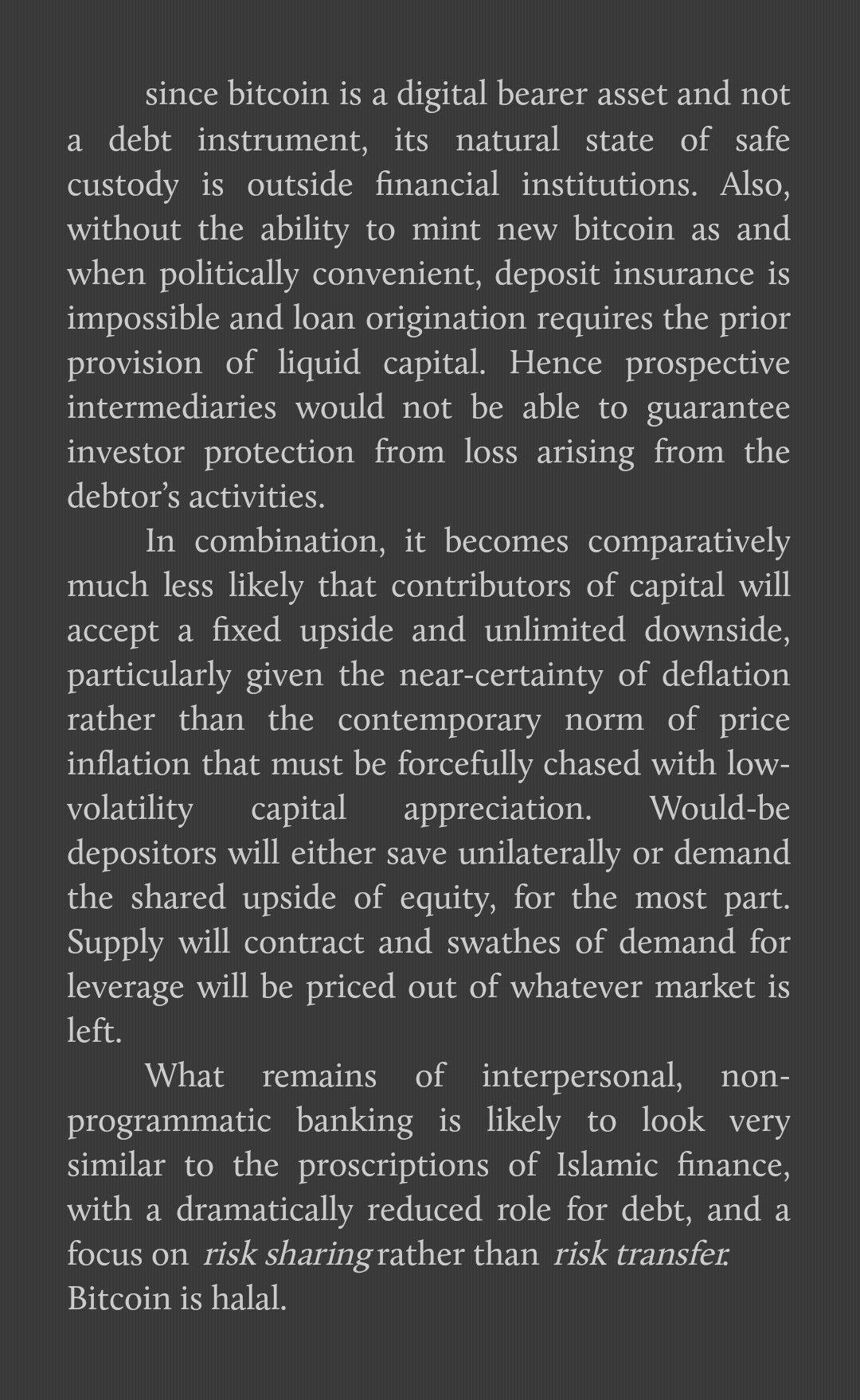
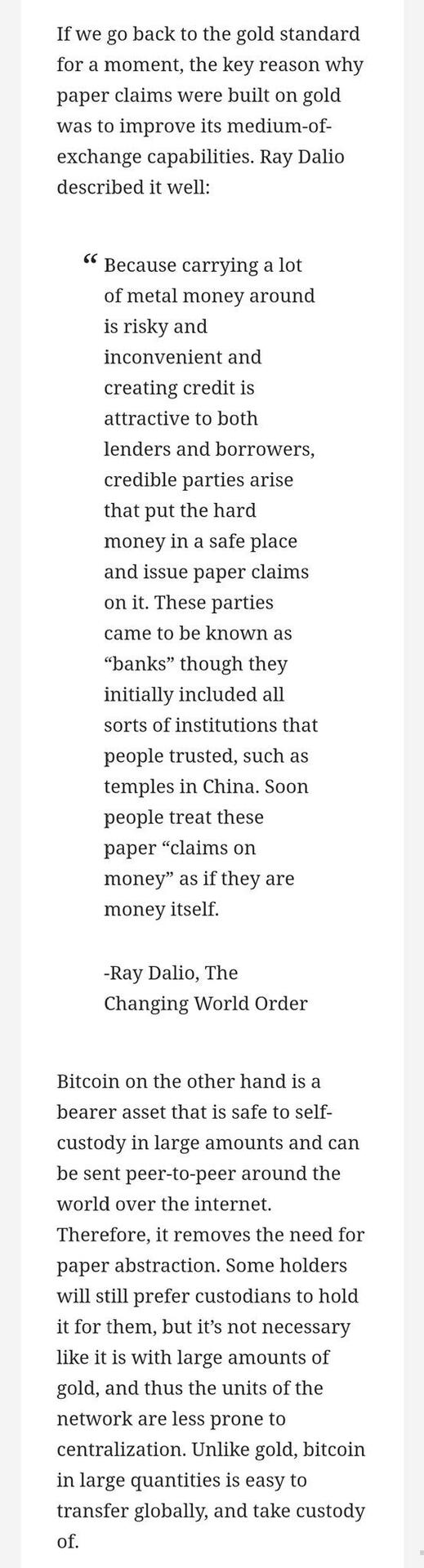
Gold isn't that great for an anti-Riba money.
The tendency to give up custody of gold due to its storage costs and limited portability leads to interest based credit creation.
Bitcoin is better for self custody, therefore it's better anti-Riba money
Attached is a relevant quote from Lyn Alden's essay "What is Money, Anyway?"

Was expecting "There is no second best!"
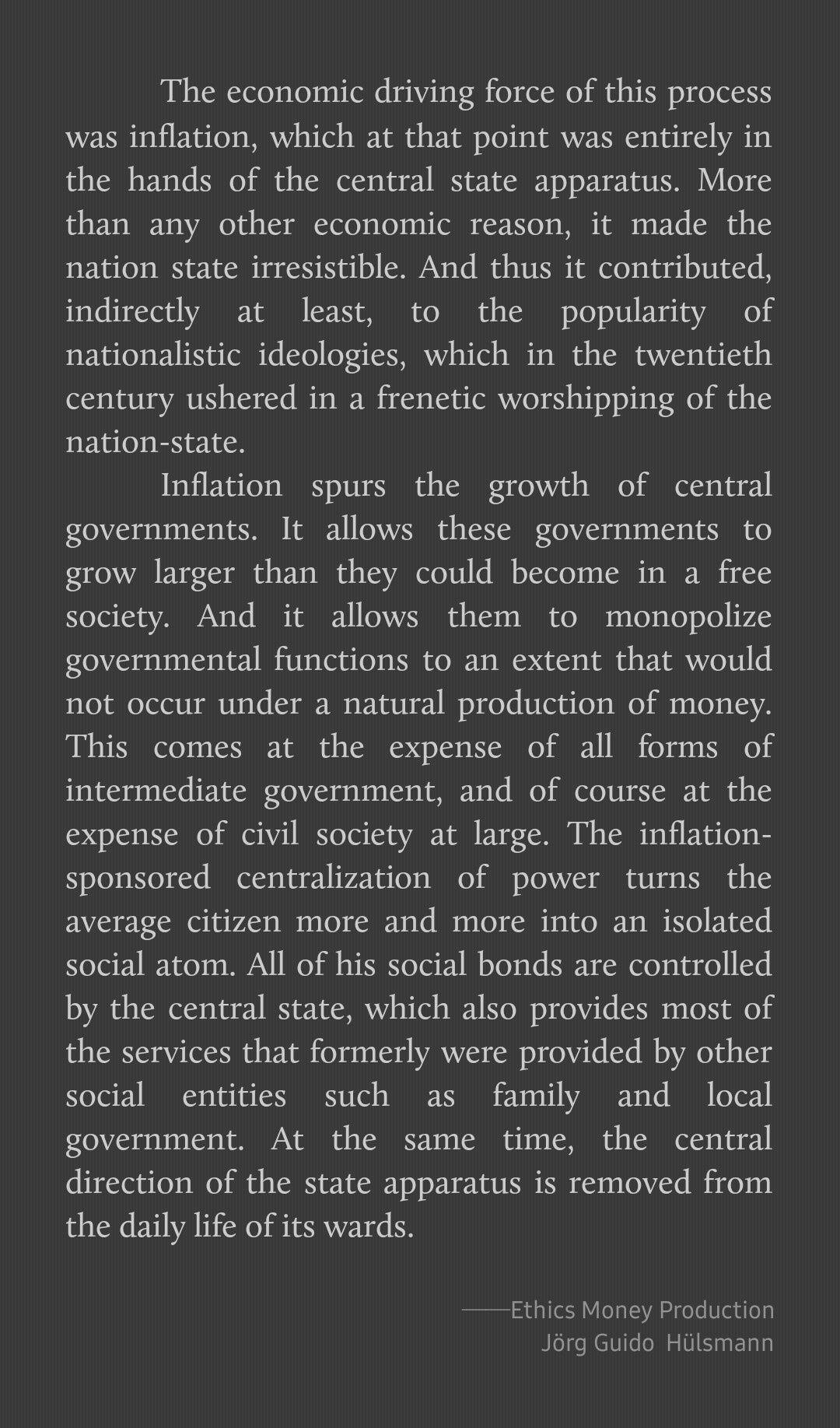
We need to understand that fiat inflation and fractional reserve banking is what gave birth to the modern nation state, and it indirectly perpetuates nationalistic idealogies and a worshipping of the nation state.
See attached quote from The Ethics of Money Production by Jörg Guido Hülsmann
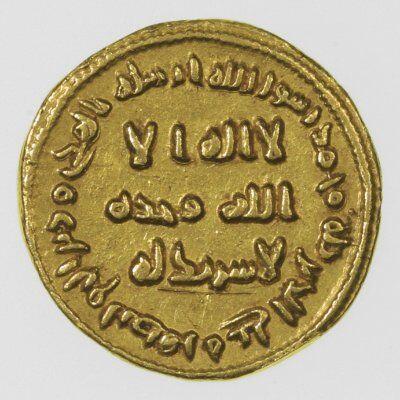
And it's even more fascinating when you take into account the hadith on prohibiting price fixing. So much wisdom from that hadith
Insha Allah I'm gonna try to post more here. I'll be posting some of my older posts from X on here in the next few weeks
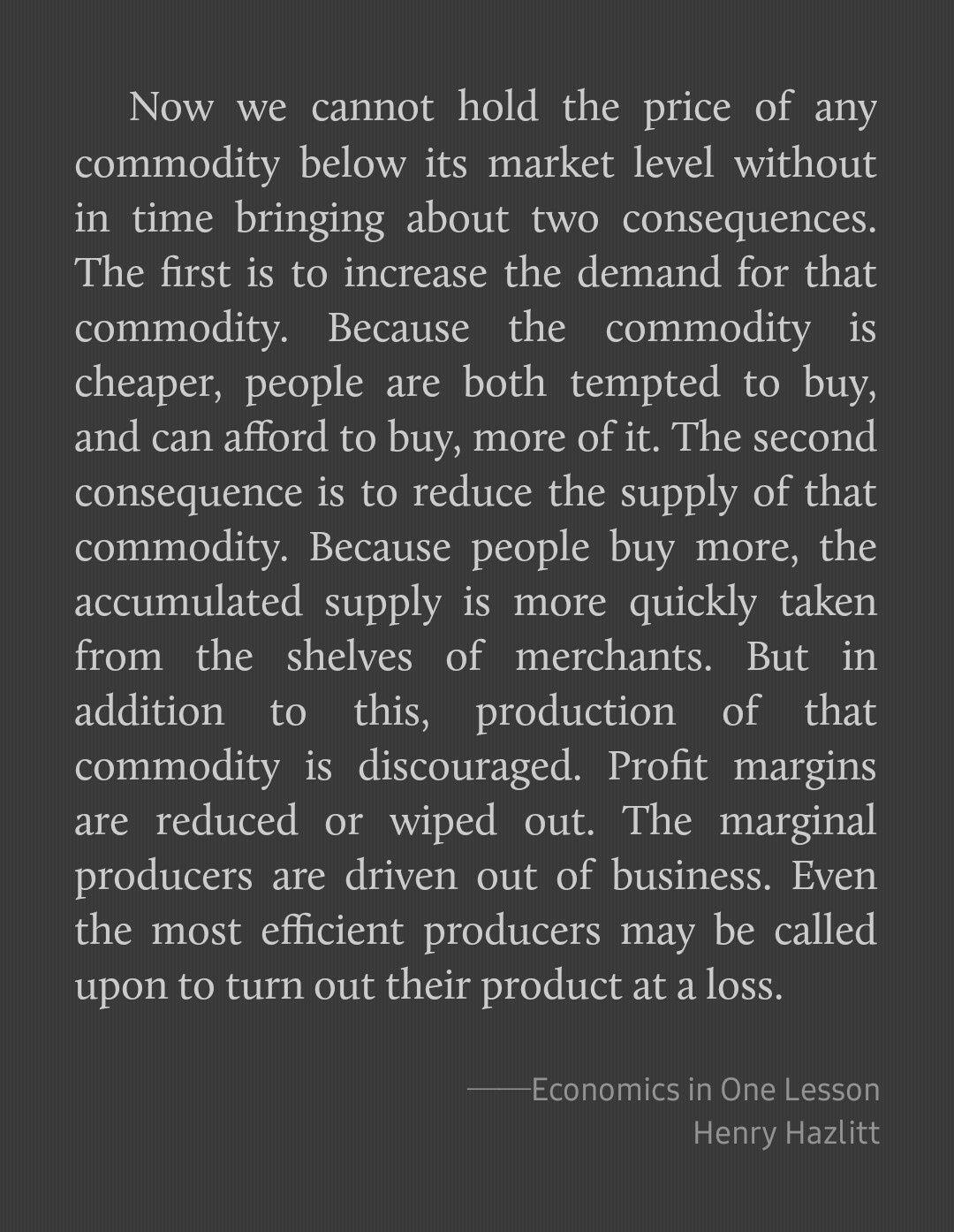
Price controls always bring about 2 consequences:
1. Increased demand for the commodity, since the price is lower
2. Reducing the supply of the commodity, since people buy more of it, and it discourages production of that commodity due to lower profits
Quote from Economics in One Lesson 👇
I like wallet of Satoshi as a first start as the UI is super easy to use, but it's custodial, and it's recently not available for US.
But I'd go with Phoenix or Muun wallet. Also heard Mutiny is good too, but haven't used it yet.
🚨 UAE officially stops using dollar for oil trades 🚨
https://www.msn.com/en-us/money/markets/uae-officially-stops-using-dollar-for-oil-trades/ar-AA1kCMxH
The global financial landscape is witnessing a seismic shift as the United Arab Emirates (UAE) boldly moves away from the US dollar in its oil trade dealings.
This strategic pivot aligns with the broader ambitions of the BRICS economic alliance, of which the UAE is a recent addition.
The changeover, involving the transition to local currencies for oil transactions, marks a significant departure from the long-established dollar dominance in the global oil market.
This expansion signifies a growing inclination towards de-dollarization among these nations, a move that challenges the traditional hegemony of the US dollar in international trade.
The UAE’s decision to prioritize local currency over the US dollar in new oil deals is a clear reflection of this sentiment. This move isn’t just a mere policy shift; it’s a strategic maneuver in the complex chess game of global economics.
By aligning with the BRICS nations, the UAE is not only diversifying its economic partnerships but also reinforcing its position as a global oil powerhouse.
Doesn't the UAE still hold a lot of US debt? They'll have to get rid of that if this move is going to mean anything.
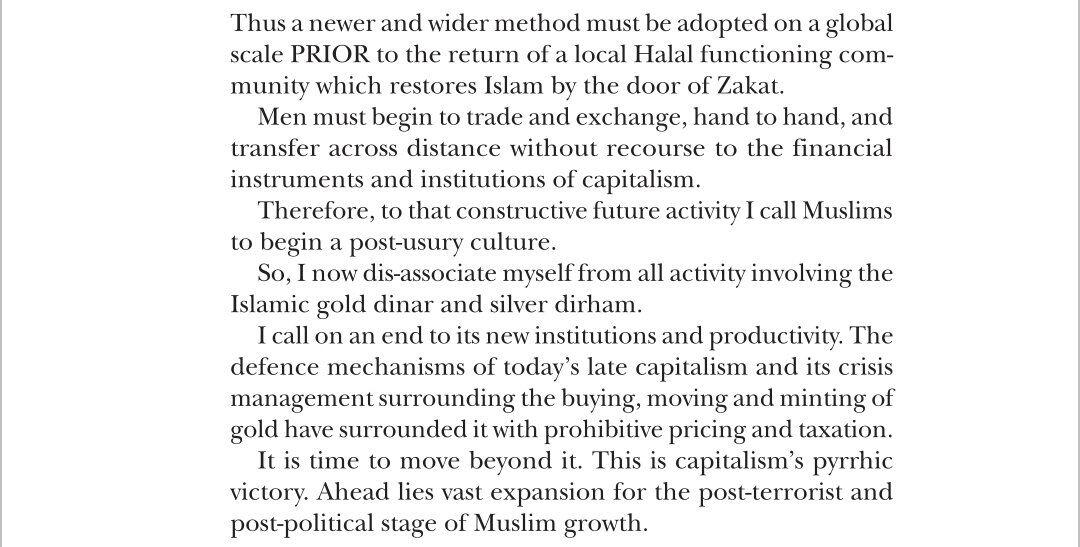
The Murabitun movement tried to revive the gold standard, but the founder, Shaykh as-Sufi, eventually gave up in 2014 when he realized the impossibility of the task, since the usury based financial institutions were still needed to make gold work as money.
Read his statement 👇
What separates Bitcoin from crypto:
For crypto, there's almost always an ICO or premine. There's a startup that handles the initial distribution of the tokens. They heavily influence the technical and economic policy of the token production. These incentives always lead to the founders manipulating the crypto's policy in their favor. The end result is the dumping on retail.
The incentives of crypto trying to be more than just money necessarily lead to centralization as the value is exogenous, which also means that the security of crypto is exogenous and must be managed by the founding startup. So this makes crypto not neutral as the incentives lead to market actors trying to take control of the network to dictate the coin's technical and economic policy. The incentives lead to crypto being not neutral.
Crypto's main advertised 'DeFi' use cases involve rehypothecation and leverage. And this is obvious when you consider that almost all of these cryptos, especially PoS ones, offer some sort of yield. But it's just circular, as the purpose is to stake tokens to receive more yield, to acquire more tokens to further receive yield. And this has a centralizing effect, which goes back to the earlier point about incentives and controlling/influencing the network.
In contrast, Bitcoin's emergence and distribution is fair. There's no startup or premine. There's no leader. Its value and security is endogenous because it's only trying to be money. It's actually decentralized and permissionless. Proof-of-work is fair and cannot be cheated. There's no 'tokenomics' or 'roadmap' to influence. Bitcoin can only be used in a neutral way. It's just an open and neutral protocol for transferring value across space and time.

Because the value of monero only comes from its utility of being "anonymous". The value, or utility, has to come from outside. It's not something that emerges from the network itself. It's trying to be something more than money, and it has to be managed and dictated from outside entities. Just like every other shitcoin.

Have been reading 'Broken Money' by Lyn Alden since the past couple of days, the way she draws analogies between complex financial concepts and real life events is amazing. Once I am done with this one, really looking forward to 'Fiat ruins everything' by my fav #Bitcoin maxi, nostr:npub10vlhsqm4qar0g42p8g3plqyktmktd8hnprew45w638xzezgja95qapsp42
Almost done with broken money and Jimmy's book is next on my list
"Here, it is the state that ratifies divine will, not the other way around. Here, put more explicitly, the state stands as the God of gods."
Wael Hallaq on the reality of the modern state 👇

If I were to pick the one person that's recently had the greatest impact on Islamic Economics...
And this person actually delivered a product that adheres to the spirit and ethos of Islamic Finance...
It would be Satoshi Nakamoto
Final settlement assurance is one of the underrated features of Bitcoin that cannot be replicated by any crypto or any other fiat currency.
Take time to study this concept, and the path to Bitcoin maximalism becomes much clearer
Bitcoin maximalism is an ethical position to take, because:
- the initial distribution was fair & transparent
- the network is neutral, permissionless, & decentralized
- everyone adheres to the same rules
Crypto apologism, on the other hand, is an unethical position to take.
Time to get off the Riba based standard on to an anti-Riba standard
Let's orange pill the ummah

I love seeing non-Muslims casually and more frequently mentioning that Bitcoin is Halal.
This narrative has the potential to accelerate bitcoin adoption globally, as there are about 1.8 billion Muslims. Most Muslims take the prohibition of usury very seriously (or they like to think they do), and spreading the message of Bitcoin's "anti-Riba" property will grab the attention of Muslims looking to find a way out of the usurious system.
Personally I'd like to see more Bitcoin companies and organizations include this as part of their Bitcoin adoption strategy.

I need to post on here more often