e2
Wonteet Zebugs
e217899785048ee15da66ab1c4633b8679d141e96c526017d5e7b1991ce584b9
Freedom-loving Bitcoin and Nostr pleb. No bugs, no pods.

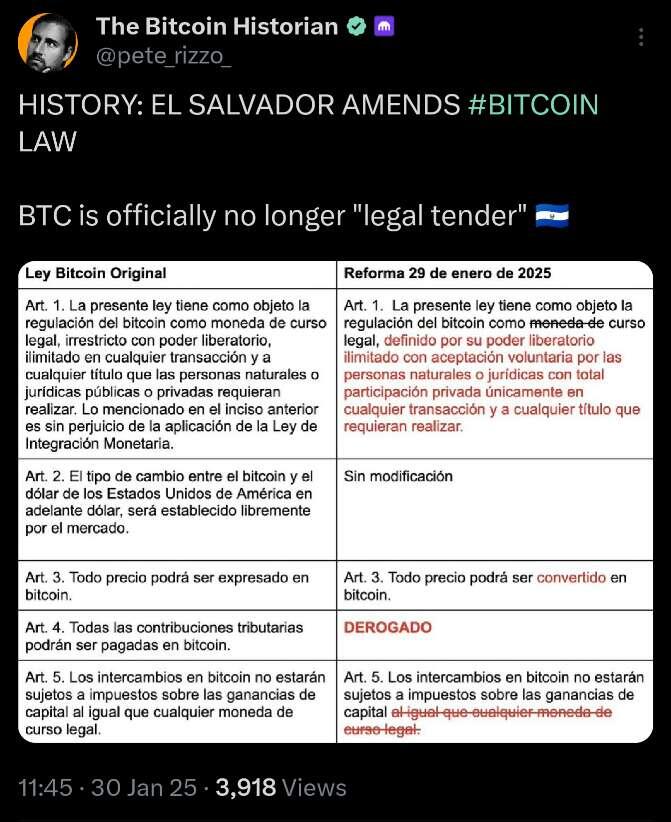
So now we can go back to saying that nobody is *forced* to take bitcoin. I'm okay with that. And they're taking the IMF's money and pumping it into bitcoin. Sounds good.

Replying to Avatar Keychat

Old Nostr DM (NIP-4) integrates four capabilities into a single Nostr key—it serves as an ID, an encryption key, a receiving address, and a sending address.

The encryption key in NIP-4 does not change, so NIP-4 messages lack both forward secrecy and backward secrecy.

Consequently, if the private key is compromised, both historical and future messages can be exposed.

The receiving and sending addresses remain constant, which poses a severe issue for metadata privacy in NIP-4 messages;

Everyone can see who (ID) is sending messages to whom (ID).

Currently, most Nostr apps use NIP-4 for DM functionalities, such as Damus and Primal.

——————————————————————————————————————

New Nostr DM (NIP-17) integrates three capabilities into a single Nostr key—it serves as an ID, an encryption key, and a receiving address.

Kind-17 separates the sending address from the ID, making the sending address random and concealing the sender's real ID, thus improving metadata privacy.

The encryption key in NIP-17 does not change, so NIP-17 messages also lack forward secrecy and backward secrecy. Once the private key is leaked, both historical and future messages will be compromised.

The receiving address remains constant, so there is still a slight issue with metadata privacy in NIP-17 messages; everyone can see who (ID) is receiving messages.

Apps like 0xchat and Amethyst use NIP-17 to implement DM functionalities.

——————————————————————————————————————

In Keychat, the ID, encryption key, receiving address, and sending address are separated.

The encryption key, the receiving address, and the sending address are updated independently and continuously.

Keychat's encryption key is derived using the Signal protocol, and each message uses a unique encryption key, which is deleted after use.

Thus, Keychat messages have both forward secrecy and backward secrecy. Even if an encryption key is compromised, only the current message can be leaked, and historical and future messages remain secure.

Keychat's sending address is randomly generated for each message.

Therefore, external parties do not know the sender's ID.

Keychat's receiving address is derived using the Signal protocol, with almost every message using a unique receiving address.

Thus, external parties do not know the receiver's ID.

——————————————————————————————————————

However, it's important to emphasize that NIP-4 and NIP-17 offer superior multi-device synchronization capabilities because they integrate three capabilities into a single Nostr key—it serves as an ID, an encryption key, and a receiving address.

That's a great explanation. Do you also have plans to make a version for desktops (linux) ? For privacy, I try to limit my use of phones.

Replying to Avatar Bitcoin Mechanic

So we're regularly noticing how unacceptably large Foundry has gotten and it would be good if Bitcoiners in general understand why we are where we are.

First, let's talk about what it is pools actually do, starting from the theoretical going all the way the practical.

In theory they make no difference to anything - they simply reduce variance.

Instead of earning $.X per year, you earn $.X/365 per day.

This is far more consistent and makes day to day operations easier and it's clear why someone would want to do this - assuming they're a smaller miner who is not capable of finding block frequently enough without pooling and splitting rewards with others.

This might be desirable to the point where you'd even pay a split to the coordinator (pool) because it's that valuable of a service.

To take it further, the absolute hands-down most common payout model for a pool to use is FPPS - this doubles down on the supposed benefit that is so compelling here. It stands for Full Pay Pay Share which -in theory - means that miners get paid on a share to share basis (something they're submitting multiple times a minute) a highly predictable amount.

This means you not only have you abandoned dealing with lotto-variance (waiting until you find a block) or even standard pool variance (waiting until someone on the pool finds a block) but instead you're mining with a pool that grants you earnings multiple times per minute regardless of if the pool is finding any blocks or not.

This is variance reduction to such an extreme that the product becomes unbelievably expensive because pools have now put themselves in a position where they must pay miners for blocks that might - and very often don't - happen.

This was demonstrated beyond doubt when OCEAN (non-FPPS) released its numbers and they outperformed FPPS by over 30% in some cases during its first year of operation.

*Note: This is NOT a "You should mine on OCEAN" post. I am simply trying to explain why miners are making the decisions they are because it seems to be eluding almost everyone.

So miners are apparently opting for variance reduction to the point where they want to get paid no matter what for blocks that may or may not even exist with resolution all the way down to the share level.

But here's the part where the disconnect between theory and reality comes in.

Nearly all the miners on Foundry have absolutely zero need for this kind of variance reduction - or indeed any at all.

The publicly traded miners that make use of Foundry all have the ability to find multiple blocks a day without any third party whatsoever which is way more than enough.

As mentioned already, FPPS is an extremely expensive product that logically would only be required by a miner faced with 24 hourly energy bills who only has 100 Petahash or so. Again, the typical Foundry miner is 100 times the size of this coming in at almost 10 Exahash at the smaller end.

So if Foundry solves a particular issue - variance - and charges a fortune to do it, and its main customer is miners that could lotto-mine and find multiple blocks a day without incurring the costs of FPPS then what on Earth are they doing?

The naive answer is that they haven't done the maths. In some cases I actually know this to be true. You're an enormous miner and you do a deal with Foundry - they charge you 0.1% fee and you think that's equivalent to if you cut out the middle man entirely pretty much so it becomes worth it.

But with FPPS the fee is never the fee. That is the airport currency exchange sign that says "0% COMMISSION" and gives you something about 14% worse than market rate. Where is the money going?

I don't think most miners are actually making that mistake, at least not all of them.

It's time to explain the real reason here.

Compliance by proxy.

And this is what's key to understand.

History: Once upon a time a pool called GHash(.)io got above 40% of the hashrate (which Foundry is doing repeatedly at this point) and the miners all fled out of instinct to protect the network. You simply cannot have any single entity making 50% of the blocks that get added to the chain or anything approaching that.

So why aren't miners doing it today? Are they that addicted to variance reduction when the calibre of miner that uses Foundry is perfectly capable of reducing their own variance anyway even though it's costing them a fortune?

Again the entire space needs to understand why history will not be repeating itself here and this where I find the greatest amount of self-delusion and dishonesty in this space.

Compliance by proxy was not a thing in 2016. At least not for miners.

Since then, someone has come along and turned what is completely unacceptable to the powers that be - Bitcoin mining - and turned it into a completely sanitized, censorship prone shell of its former self - and *that* is the true motivation for "miners" paying these exorbitant fees.

Compliance is new. And it isn't a factor people are taking into consideration.

Whenever we point out how precarious the situation has become, there is the typical response - "If Foundry ever do then their miners will just leave".

It's time to put this cope-strategy to bed.

If a miner is perfectly capable of reducing their own variance to the tune of reliably finding multiple blocks per day themselves - why are they using a pool at all? Especially if that pool costs a fortune?

Or more crudely - If losing a tonne of money for no apparent reason isn't compelling enough to leave Foundry, then jeopardizing Bitcoin isn't going to be either.

The true motivation is all that matters, and its overwhelmingly just compliance. "Miners" of substantial size increasingly do not want anything to do with Bitcoin and want all their hashrate transformed from raw Bitcoins coming fresh out of the blockchain into a nice clean product that their accountants and lawyers can tolerate regardless of the cost.

To take the counter position to my argument here, there are of course costs to rough-housing it and grappling with Bitcoin directly as MARA does and I don't want to pretend otherwise but I don't think they come anything like close to justifying the enormity of the revenue lost due to the extreme over-kill that is FPPS.

This is the only area in which I will take pushback from someone in one of the relevant companies as it's possible I am just wrong.

The following companies - BitFarms, Hut8, RIOT, WULF, HIVE, Cleanspark and a couple of handfuls of others are all - to the best of my knowledge - paying a fortune for the combined benefit of variance reduction (which they absolutely have no need of) and compliance by proxy.

If anyone from any of those companies can explain to me why I am wrong and that if/when Foundry's size results in them engaging in censorship or any other abuse of the network (heck, already requiring KYC and regular inspections of mining facilities is unacceptable and that's already been the case for Foundry miners for years) then why should anyone believe you would move to another pool or go the Mara route?

At present I believe that Foundry could continue its inexorable ascent to the 51% magic number we're all afraid of and the new cope will be "Well they haven't done yet" and we'll just keep moving the goal posts about what constitutes a bad thing.

At the moment "It's just KYC", "It's just mandatory inspections" and "It's just lost revenue."

All of that is unacceptable. "It's just transactions associated with Russia/Iran" comes next and the shareholders of publicly traded Bitcoin miners are unlikely to view censorship based on that criteria as being anything to worry about. "Why do you hate America??"

The old cope of "another miner will just include them and their business will survive while the censoring miners die" is complete and utter delusion.

Almost 100% of revenue from the chain is subsidy. Transaction fees are neither here nor there. And if we think the US Pubcos are all going to voluntarily go admit bankruptcy because they lost a few hundred bucks a week from mining blocks that censored blacklisted UTXOs then we are deluding ourselves.

I reiterate - miners are with Foundry because compliance is increasingly all that matters. This has resulted in enormous centralization of template construction that becomes a genuine attack vector at ~30% and has been consistently way above that for a long time now. 51% is a meme, and imo not a powerful enough one to inspire change if it actually comes to that. The frogs are already boiling and no one cares.

Let's be honest. None of the miners on Foundry are leaving any time soon but the variance reducing product they offer that can be so trivially replicated elsewhere is not why any of them are doing what they are doing.

Foundry is the sole occupant within the regulatory moat that is Bitcoin mining in America and I don't see that as trivial to replicate at all.

And the reason I wish to sound the alarm 10,000 louder than I have been before this point is that the current US administration has run a campaign that specifically talks about centralizing Bitcoin in the US.

The phrase "We will make all the Bitcoins in America" is exactly the worst possible thing you could want to hear given everything I've talked about in this post and not only is it not being rejected by Bitcoiners, it is being celebrated as a good thing.

It seems to me that the only real way out of this is to decentralize bitcoin mining more. We have to plebicize bitcoin mining. Make Bitcoin Pleb Mining Great Again. And we have to do that with private, pleb-friendly, energy sources like coal, wood, solar, etc.

Does anybody know of good sources of info for coal pleb btc mining?

https://njump.me/nevent1qvzqqqqqqypzprm9dr0wcqfq4je2f50yuvgu3qwnqmped2fg3v9q0aty6g83scngqy88wumn8ghj7mn0wvhxcmmv9uq3jamnwvaz7tmjv4kxz7fwwdhx7un59eek7cmfv9kz7qpqkggg5e7a9rsdewguzwjleag7htwrypq7n3u04wr8jn38a0kgephqzwuswf

"Back in 2023- 2024 we were struggling to find EU bitcoiners who wanted to participate in the advocacy in defense of FreedomTech Bitcoin mining. We got support of few Czech, Italian, UK and American bitcoiners and grateful for our FreedomTech angels. [...] When you fight for your rights, you get results and rewards. [...] Our role was to share with Czech Parliament why and how the new technologies play important role in defense of human rights, elections , stabilization of the #grid, reducing pollution and building new energy infrastructure thanks to #freedomtech #bitcoin.

So instead of the EU commission’s approach to limit innovation in the #EU, we call to learn more, support its developers, miners and end-users."

Is bitvora KYC? I just tried to create an account but it requires at least a verified phone number (I stopped at that step).

As long as he'll be using something custodial, might as well go for coinos.io and enable the automatic withdrawals with a low threshold.

Swiss Bitcoin Pay is also good (up to about 5000 USD per year without KYC).

Zaprite handles all the invoicing is non-custodial (and can also be connected with coinos.io (which is custodial)).

If he's just doing retail payments, he could just use his phone with Green. He might also use the Bullbitcoin app or Aqua (which can take lightning payments but convert them to liquid in the background).

The best is probably btcpayserver if they can run their own server or get technical help.

I would like that as well. I'm just not sure how it would happen. I can only go by my personal experience. I'm not tempted to buy quality things. If anything, I would be tempted to *make* quality things, but not buy. Health (and safety) are different though. For that, I'll splurge. Nothing worse for your freedom than being incapacitated or sick.

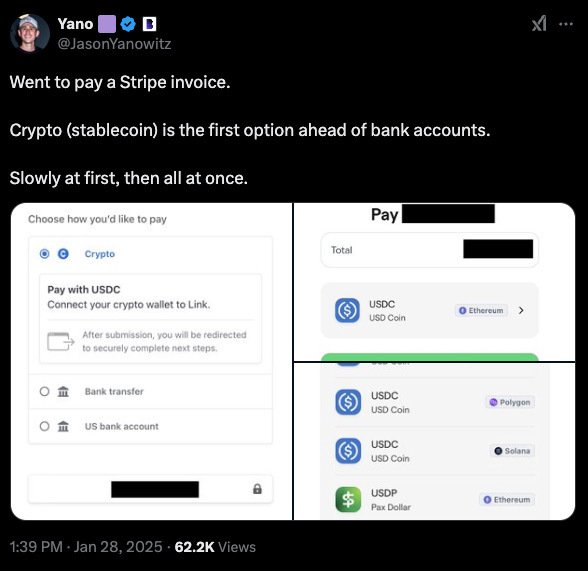
That's one of the problems I'm having now. Using nostr, I'm finding interesting content I want to share, but I then have to copy-paste that on simplex. Using something built on nostr would be more convenient. I just don't know how good of a job was done on the security and privacy of 0xChat and Keychat.

Not sure. I splurge on healthy food but for everything else, I tend to prefer cheap things because I know that by the time they break, my sats will be worth so much more that I can just buy another.

0xChat vs Keychat vs SimpleX ?

Any opinions on which one has the best security and privacy?

Spent the last six months putting people on SimpleX. If 0xChat or Keychat are better, I could try to convert some people. I told everyone that SimpleX was simply the best tool at the time but privacy apps built on Nostr might be better later. Are we there yet?

My understanding is that with Keychat, one needs to pay sats to chat. I'd be willing to do that if it's the best security and privacy model. But not sure how well that would go when introducing normies. It seems to me like it would slow down adoption. People can just run their own simplex relays for their private group so I'm not sure the economic sustainability argument by Keychat checks out. Dunno.

Opinions?

#asknostr

Anna’s Archive : https://annas-archive.org/

" 📚 The largest truly open library in human history. ⭐️ We mirror Sci-Hub and LibGen. We scrape and open-source Z-Lib, DuXiu, and more. 📈 42,295,586 books, 98,401,812 papers — preserved forever. All our code and data are completely open source. "

If you know anyone who has cancer, do them a favor and look up ivermectin and fenbendazole.

Steve Kirsch, Jan 23, 2025 : "In California, we've vaccinated more elderly people with the COVID vaccine than there are elderly people in the state"

"And we're not the only state to have accomplished this feat. New Hampshire is the US leader vaccinating 50% more people than there are people!"

https://kirschsubstack.com/p/in-california-weve-vaccinated-more

Yes, good point, Mullvad VPN. I would install the software and make sure to use the "kill switch" and "lockdown mode" options in the settings to make sure nothing leaves the computer without going through the VPN. I would also suggest using its multihop setting so you can choose different entry and exit servers.

Here are some privacy friendly browsers :

Brave

Librewolf

Tor Browser

Mullvad Browser

It really depends on what you're planning to do with the computer. How versatile do you need it to be, are you planning to generate keys with that computer, for how much money, etc. Depending on that, what you need to do will change.

However, usually, no matter what, I would choose full-disk encryption (during the installation, not only the home folder).

Afterwards, I would make sure it's up to date.

On ubuntu and related distros :

sudo apt update

sudo apt upgrade

Then I would check to make sure I don't have open ports that I don't use. For example, if you won't be printing, you don't need "cups". You can look at which ports are open with :

sudo netstat -lntp

Those are some pretty basic but important steps.

For anything major in the bitcoin world, you can either choose to use in combination with a hardware wallet or go with a disposable computer that will never go online and use it only with a live-dvd linux distribution.

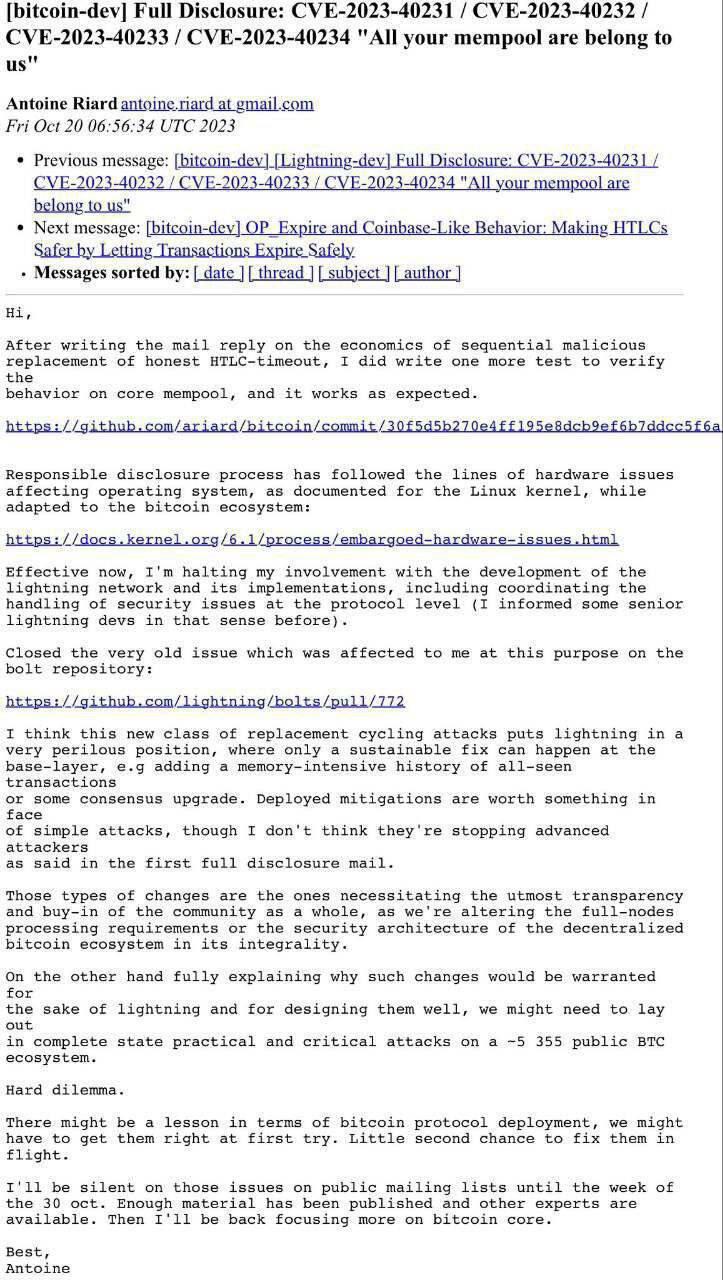
I haven't seen the claim that it is a backdoor. Could you please point me to where you read that?

My understanding is that he has found out about a potential way of attacking the lightning network which the current mitigation strategies that have been implemented recently don't fully cover.

I don't know how much of a problem those attacks really are.

I believe they are discussing that option. (However, I've personally had a spotty experience with simplex with some messages never coming through. It's still pretty new.)

https://github.com/nostr-protocol/nips/discussions/658