
Futures Flat Ahead Of Payrolls
Futures Flat Ahead Of Payrolls
US equity futures are unchanged, with tech lagging and small caps leading as traders hunker down ahead of a payrolls report that is expected to show 175,000 new workers but will https://www.zerohedge.com/economics/tomorrows-jobs-report-will-finally-capture-surge-illegal-aliens-lead-another-negative
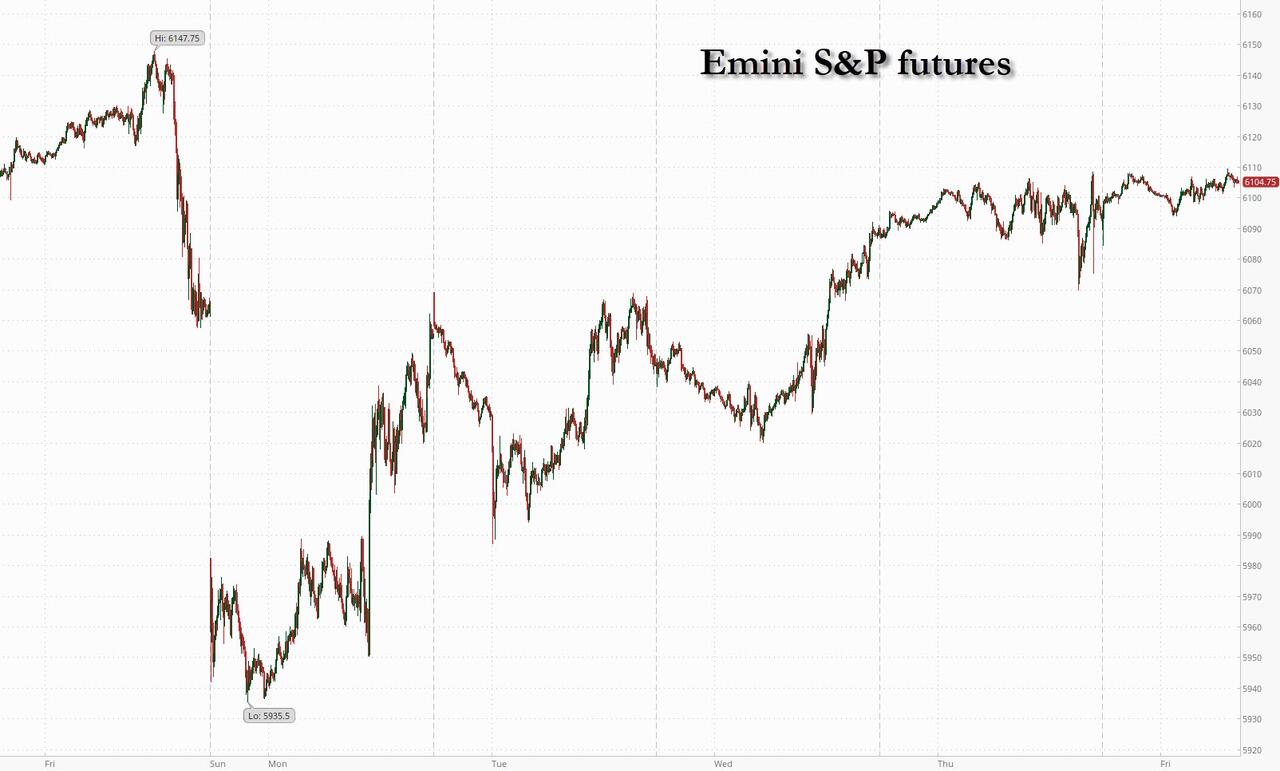
. As of 8:00am ET, S&P futures are flat with the index on track for a 0.7% weekly advance; Nasdaq futures are down 0.1%, with Mag 7 mostly lower after AMZN’s earnings disappointment last night (AMZN -2.6%; TSLA -1.5%; NVDA -0.9%); the e-commerce and cloud-computing company gave an outlook that was weaker than expected. Meanwhile, there seems to be no stopping Meta as the social networking giant is on track to extend gains for a record 15th consecutive session. Bond yields are largely flat; USD unchanged. Commodities are mostly higher led by oil (+0.8%). Today, the key macro focus will be NFP (a full scenario analysis from JPM and Goldman can be found here): the Street’s estimate is 175k; a step down from last month’s 256k print. For the unemployment rate the Street expects 4.1%.
 ?itok=Fm5EuLQm
In premarket trading, Amazon was down 3% and is leading losses for the Mag7 after warning investors that it could face capacity constraints in its cloud computing division despite plans to invest some $100 billion this year, with most of the money going toward data centers, homegrown chips and other equipment to provide artificial intelligence services. Affirm Holdings rose 15% after the financial technology company reported quarterly results that beat expectations and gave an outlook that is seen as strong. Expedia shares jumped almost 10% in premarket trading after the online travel agency reported fourth-quarter results that beat expectations. Here are some other notable premarket movers:
Bill Holdings Inc. (BILL) sinks 29% after the company forecast total revenue for the third quarter below the average analyst estimate
Canopy Growth (CGC) falls 17% after posting a wider-than-expected quarterly loss.
Cloudflare (NET) climbs 10% after the software company reported fourth-quarter results that beat expectations
Denny’s (DENN) rises 4% after Wedbush raised the restaurant operator to outperform from neutral, calling its Keke’s breakfast chain “meaningfully undervalued and underappreciated”
Doximity (DOCS) rises 24% after the healthcare-software company raised its full-year forecast
Elf Beauty (ELF) plunges 27% after the cosmetics company lowered fiscal-year projections for sales and profits, citing softer-than-anticipated January trends
Fortinet (FTNT) rises 5% after the network security software provider’s forecast for 2025 revenue topped the average analyst estimate
Microchip Technology (MCHP) declines 6% after the semiconductor device company gave an outlook that was weaker than expected
Monolithic Power Systems (MPWR) rises 6% after the semiconductor device company gave an outlook for revenue that is much stronger than expected
Nikola Corp. (NKLA) falls 35% after the Wall Street Journal reported that the company is exploring filing for bankruptcy
Open Text ADRs (OTEX) are up 4% after the software company reported second-quarter results that beat expectations. However, analysts noted concerns about its outlook
Pinterest (PINS) jumps 20% after the company posted strong holiday-quarter revenue and gave an upbeat forecast for sales in the current period
Skechers (SKX) falls 12% after the footwear company issued annual forecasts for sales and profit that trailed Wall Street expectations
Take-Two (TTWO) jumps 10% after the video-game company reiterated its plan to launch the highly-anticipated Grand Theft Auto VI in fall 2025
Webtoon (WBTN) plummets 20% after the online comics company posted quarterly preliminary revenue that fell short of the average analyst estimate
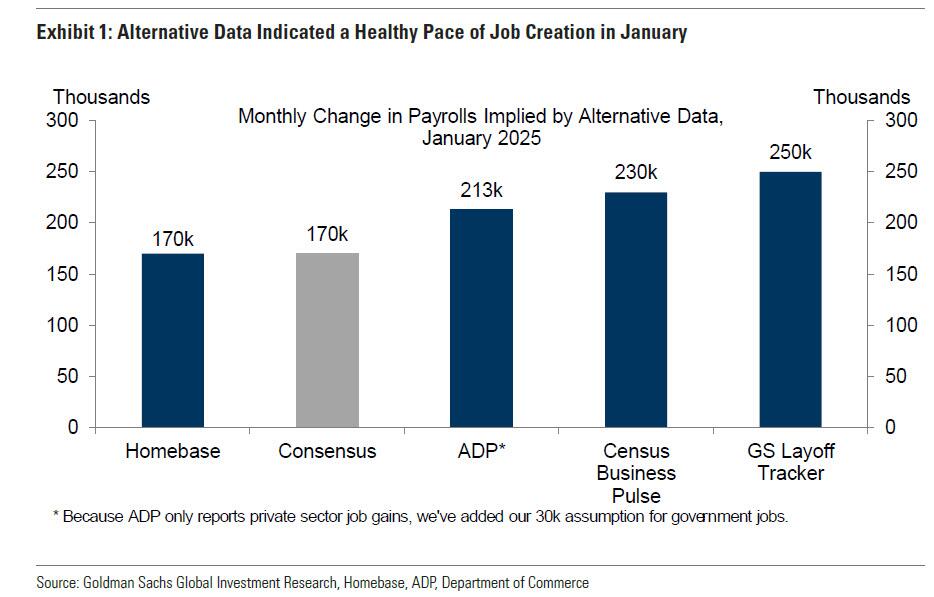
All eyes now turn to the US jobs report which is expected to show 175,000 new roles added last month after advances in excess of 200,000 in the prior two months, which partly reflected recovery from two severe hurricanes. Wall Street will be closely watching a revision to job growth for the 12 months through the previous March. Economists expect the markdown to show a labor market that’s gradually cooling (our full https://www.zerohedge.com/markets/january-payrolls-preview-small-drop-big-revisions
).
 ?itok=cv1DkVBA
"The stock market, needing a boost after a decent but lukewarm earnings season, could potentially rise if the job market shows signs of cooling,” said Florian Ielpo, head of macro research at Lombard Odier Investment Managers. An uptick in hiring might reignite concerns about inflation, he added.
In other markets news, US Treasury Secretary Scott Bessent said that he favors a strong dollar and has no plans to alter the government’s debt-issuance plans. During the election campaign, President Donald Trump expressed concern about the strength of the dollar, given that it makes US products more expensive overseas.
“The strong-dollar policy is completely intact with President Trump,” Bessent said in an interview with Bloomberg. “We want the dollar to be strong. What we don’t want is other countries to weaken their currencies, to manipulate their trade.”
European equities traded lower on Friday after some key earnings reports disappointed and before investor focus switches to US employment data. Construction and material shares outperform in Europe after a flurry of well-received earnings updates. Consumer and health care stocks provide a drag however with the Stoxx 600 down 0.1%. Here are the biggest movers Friday:
Vinci gains as much as 4.4%, the most since July, after the French construction group’s full-year report shows another quarter of strong cash flows, analysts note
Danske Bank shares advanced as much as 7.5% to the highest level since March 2018 after it launched a new buyback program and pledged higher-than-expected dividends. Denmark’s largest lender also gave a profit outlook for this year
Thule shares rise as much as 5.6% and hit their highest level since April 2022 after fourth-quarter results from the Swedish maker of car roof racks and bike trailers beat estimates
Legal & General shares jump as much as 11%, the most since 2020, after the firm said it plans to sell its US protection business and return around £1 billion of the proceeds to its shareholders after striking a deal with its longstanding partner Meiji Yasuda
Iveco soar as much as 18%, the most on record, as the Italian truckmaker says it’s considering separating its defense business in 2025 through a spinoff
Telecom Italia shares rise as much as 5% to the highest in over a year, after newspaper Corriere della Sera reported that Iliad representatives met with Italy Finance Ministry officials in the past few days to pitch the benefits of combinations in the Italian telecom sector
L’Oreal shares in Paris drop as much as 4.5%, following the drop suffered by its ADRs in the US overnight, after the beauty company’s like-for-like sales for the fourth quarter missed consensus estimates
Porsche shares fall as much as 8% to an intraday record low valuation after the German carmaker slashed its 2025 guidance in a move Bernstein called a “major concern” after the company had described 2024 as its transition year. Citi sees shares testing new low
Saab shares fall as much as 6.5%, the most since October, as Citi spots the Swedish defense firm reduced its cumulative cash conversion guidance, and says investors may not like this. Shares rose 54% in 2024
Kongsberg shares fall as much as 3.4% after the Norwegian defense firm reported full-year results that failed to enthuse investors, as analysts note some margin weakness. The pullback follows a 175% surge in the shares last year
Asian stocks advanced, with gains in Chinese shares offsetting losses in Japan, as traders awaited US jobs data that will help provide clues for the Federal Reserve’s rate path. The MSCI Asia Pacific Index rose 0.1%, erasing an earlier 0.2% loss. Technology shares including TSMC and Tencent were among the biggest boosts. Toyota Motor dragged on the gauge as Japanese stocks fell on a stronger yen. Despite recent volatility in the market amid a brewing US-China trade war, some calm has returned as traders focus on earnings reports and economic data. The Asian stock benchmark is headed for a fourth-straight week of gains, the longest such win streak in 11 months.
In FX, the Bloomberg Dollar Spot Index is also little changed. The yen is the weakest of the G-10 currencies, falling 0.4% against the greenback and pushing USD/JPY above 152.
In rates, treasuries are steady with US 10-year yields trading around 4.435%, little changed on the day, with bunds and gilts outperforming by 1.5bp and 2.5bp in the sector; front-end Treasuries lagging has 2s10s spread flatter by 1.2bp, extending a three-day move that has seen the curve drop from around 30bp Wednesday to current 21bp. Bunds and gilts outperform over early London session, but price action broadly quiet ahead of the January nonfarm payrolls print expected at 8:30am New York time; German and UK 10-year yields down 1 bp each.
In commodities, oil prices advance, with WTI rising 0.8% to $71.20 a barrel. Spot gold climbs $8 to around $2,864/oz. Bitcoin rises 0.5% and above $97,000.
Looking to the day ahead, US economic data calendar includes January jobs report (8:30am), February University of Michigan sentiment, December wholesale inventories (10am) and December consumer credit (3pm). Fed speaker slate includes Bowman (9:25am) and Kugler (12pm).
Market Snapshot
S&P 500 futures little changed at 6,102.25
STOXX Europe 600 down 0.1% to 544.29
MXAP up 0.2% to 185.64
MXAPJ up 0.6% to 583.58
Nikkei down 0.7% to 38,787.02
Topix down 0.5% to 2,737.23
Hang Seng Index up 1.2% to 21,133.54
Shanghai Composite up 1.0% to 3,303.67
Sensex down 0.4% to 77,741.03
Australia S&P/ASX 200 down 0.1% to 8,511.43
Kospi down 0.6% to 2,521.92
German 10Y yield little changed at 2.36%
Euro little changed at $1.0393
Brent Futures up 0.6% to $74.70/bbl
Gold spot up 0.4% to $2,868.64
US Dollar Index little changed at 107.64
Top Overnight News
US President Trump signed an executive memo ordering a review of funding to all NGOs that rely on federal dollars, while it was also reported that the Trump administration is to keep just 294 USAID staff out of over 10,000 globally, according to sources cited by Reuters. In relevant news, the Trump administration is being sued by government workers over slashing of international aid agency USAID.
US House Speaker Johnson said they were working to finish the final details of the reconciliation bill and could wrap up the deal by Thursday night.
In just two weeks as Treasury chief, Scott Bessent has seen plenty of turbulence. The department became a target of Elon Musk’s crackdown on federal spending — triggering protests outside Bessent’s office — and investors are on edge over President Donald Trump’s unpredictable trade policies: BBG
House republicans are torn over the level of spending cuts, House GOP initially proposed USD 500bln to USD 1tln, conservative hardliners are pushing for at least USD 2.5tln: Punchbowl
US President Trump has reportedly placed VP Vance and NSA Waltz in charge of overseeing a potential sale of TikTok: Punchbowl
Fed's Logan (2026 voter) said choices in 2025 boil down to resuming rate cuts soon or holding rates steady for quite some time, while she added that near-2% inflation with the labour market holding steady would not necessarily allow the Fed to cut rates soon. Logan also stated that a rise in inflation would signal monetary policy has more to do and cooling labour market or demand could be evidence it's time to cut rates. Furthermore, she said estimates of the real neutral rate in the US vary widely, but most have moved up substantially since the pandemic and it will always be important to take broad financial conditions into account when setting monetary policy.
Porsche AG is falling further off track from lofty targets set during its splashy stock listing, with costs mounting from executives having misjudged how eager sports-car buyers were to go electric: BBG
Private equity’s favorite tax break is back in President Donald Trump’s crosshairs. Trump on Thursday told Republican lawmakers he wants to end the carried interest exemption used by legions of private equity fund managers and venture capitalists around the country, arguing it could be used to offset the multitrillion-dollar tax cut Republicans plan to pass before the end of the year: BBG
New York-based hedge fund Fir Tree Partners — known for instigating activist campaigns against distressed companies — is returning outside capital to investors: BBG
A more detailed look at global markets courtesy of Newsquawk
APAC stocks traded mixed following the similar performance stateside where price action was choppy amid soft data and as participants looked ahead to the latest key US jobs report. ASX 200 struggled for direction as strength in tech and consumer staples offset the losses in energy and healthcare. Nikkei 225 was pressured by recent currency strength and mild upside in yields but with losses cushioned by stronger-than-expected Household Spending data which showed a surprise M/M growth and the fastest Y/Y pace of increase since August 2022. Hang Seng and Shanghai Comp were on the front foot despite the absence of any major fresh catalysts with participants potentially taking solace from the lack of trade war escalation, while the gains in Hong Kong were led by advances in tech and auto names.
Top Asian News
Chinese Foreign Minister, in response to a media inquiry regarding reports that China is exploring a potential antitrust probe into Apple (AAPL) policies related to its app store policies and fees, says "he was not aware of the situation", via Global Times
UMC (2303 TT) revenue +4.2% Y/Y to TWD 19.8bln.
RBI cut the Repurchase Rate by 25bps to 6.25%, as expected, via a unanimous vote and unanimously decided to maintain a neutral policy stance, while the Standing Deposit Facility rate was adjusted to 6.0% and the Marginal Standing Facility Rate was set at 6.5%. RBI Governor Malhotra stated that CPI has mostly stayed aligned with the target, barring a few occasions, as well as noted that growth is expected to recover and growth-inflation dynamics will open up space to support growth. He also commented that food inflation pressures should see significant softening, barring supply shocks, and core inflation is expected to rise but remain moderate. The central bank lowered its FY25 real GDP growth forecast to 6.4% from 6.6% and sees FY26 real GDP growth at 6.7%, while it maintained FY25 CPI inflation view at 4.8% and sees FY26 CPI inflation at 4.2%. Furthermore, Malhotra said exchange rate policy has remained consistent, with intervention focused on smoothing excess volatility and the RBI does not target any exchange rate level or band.
China mutual funds have reportedly been buying convertible bonds amid less supply with end-Q4 2024 fund holdings of convertible bonds reaching CNY 287.7bln, according to China Securities Journal.
European bourses (Stoxx 600 +0.1%) are mixed, with trade tentative ahead of the all-important US NFP report. European traders will also be cognizant of the ECB Staff Revision of the Natural Interest Rate. European sectors are mixed, and aside from the top/bottom performers, the breadth of the market is fairly narrow. Construction and Materials tops the pile, lifted by post-earning strength in Vinci; Consumer Products is weighed on by losses in L’Oreal (-4%) after posting weak LFL Sales in Q4 and highlighting poor Chinese demand.
Top European News
ECB's Lane says services inflation in January was softer-than-expected; 2% inflation target should be achieved "fairly soon".
ECB's de Guindos says inflation is beginning to converge to 2% in spring, services inflation remains top price concern, need prudent approach to monetary policy.
FX
DXY is a touch softer with the USD mixed vs peers (firmer vs. havens, weaker vs. cyclicals). Today is of course NFP day with headline payrolls expected to slow to 170k from 256k and the unemployment rate hold steady at 4.1%. Note, today will also see the BLS publish its annual benchmark revisions.
EUR/USD is steady vs. the USD in the run-up to today's publication of the ECB's neutral rate. Ahead of which, ECB Chief Economist Lane has suggested that it is best not to focus too much on the neutral rate. EUR/USD is currently capped by the 1.04 mark and within yesterday's 1.0352-1.0405 range.
JPY is a touch softer vs. the USD as havens lag cyclicals. Overnight, USD/JPY saw two-way price action in which it initially extended on recent declines after stronger-than-expected Household Spending data from Japan but then rebounded off support around the 151.00 level. Since then, the pair has made its way up to a 151.89 peak.
GBP is attempting to recoup some of Thursday's BoE-induced losses, which were triggered by a "dovish cut" from the MPC as uber-hawk surprised markets with a vote for a 50bps cut. Cable is currently tucked within yesterday's 1.2359-1.2509 range.
Antipodeans are both incrementally firmer vs. the USD in what has been a strong showing this week for both currencies after a shaky performance on Monday.
PBoC set USD/CNY mid-point at 7.1699 vs exp. 7.2780 (prev. 7.1691).
BoC Governor Macklem said they are facing new uncertainty with a shift in policy direction in the US and President Trump's threats of new tariffs are already affecting business and household confidence, particularly in Canada and Mexico. Furthermore, Macklem said the world looks increasingly shock-prone and the longer the uncertainty persists, the more it will weigh on economic activity in their countries.
Fixed Income
USTs are flat and are awaiting today's US NFP report, as well as the benchmark payroll revisions. Firstly, the pace of payroll additions is expected to ease towards recent averages with consensus looking for 170k; though, hurricane, wildfire, cold weather and industrial factors could all impact and weigh on the headline. Into the release, USTs hold in a particularly narrow 109-13+ to 109-20 band with yields mixed and the curve itself a touch flatter.
Bunds are contained; German export data was better than expected but sparked little move at the time. Bunds find themselves at the top-end of 133.29-49 band which is entirely within Thursday’s 133.13-61 parameters. No reaction to commentary from ECB’s Lane or de Guindos this morning, who both spoke on inflation. Traders are awaiting the ECB Natural Interest Rate release, due at 12:00GMT / 07:00 ET. Ahead of the release it is worth revisiting remarks from recent officials on where they think the Neutral Rate is, to surmise: Lagarde 1.75-2.25%; Schnabel 2.0-3.0%; Rehn 2.2-2.8%, Villeroy & Stournaras around 2.0% and Centeno >2.0%.
Gilts are contained with specifics light post-BoE and as the fixed complex is focussed on upcoming events from the ECB and US BLS. As such, Gilts are pivoting the unchanged mark in a 93.06-93.49 band.
Commodities
Crude futures overnight attempted to pick themselves up from the prior day's trough. Newsflow was light this morning but Iran delivered some punchy rhetoric in which Leader Khamenei said talks with the US are neither smart, wise, nor honourable, according to IRNA. Brent Apr resides in a USD 74.26-75.12/bbl parameter.
Spot gold remains afloat but within Thursday's ranges as the yellow metal bides times ahead of the US Jobs reports. China's Financial Regulator will allow insurance funds to purchase gold as part of a pilot project - modest upticks in prices were seen around this time. Spot gold resides in a current USD 2,855.98-2,870.73/oz parameter.
Copper futures overnight edged mild gains amid the positive risk sentiment seen in its largest buyer, with traders now looking ahead to the US jobs report. 3M LME copper resides in a USD 9,295.97-9,433.00/t range.
China gold reserves end-Jan USD 206.53bln (vs end-Dec USD 191.34bln); Gold reserves 73.65mln toz (prev. 73.29mln toz).
China's Financial Regulator will allow insurance funds to purchase gold as part of pilot project
Geopolitics
Russian Kremlin's Peskov says Russia is open to negotiations on Ukraine.
IAEA Head Grossi says the number of attacks on Zaporizhia nuclear power plant in Ukraine has increased; adds the situation is tough, via Tass
"Al-Arabiya sources: Hamas informed mediators that Israel did not abide by the agreed humanitarian protocol" and as such Hamas is "Delaying the names of hostages scheduled to be released tomorrow".
Russia's Kremlin says Russia and the US have not yet begun to discuss a possible Trump-Putin meeting and there have been no initial contacts about whether such a meeting is needed or where and how it might take place if it is, according to IFAX.
Israel's army conducted a strike in Lebanese territory on two military sites that contained Hezbollah weapons.
Taiwan announced that it detected six Chinese balloons near the island, while it also detected nine Chinese military aircraft, six warships and two official ships in the prior 24 hours.
US Event Calendar
08:30: Jan. Change in Nonfarm Payrolls, est. 175,000, prior 256,000
Jan. Change in Private Payrolls, est. 158,000, prior 223,000
Jan. Unemployment Rate, est. 4.1%, prior 4.1%
Jan. Underemployment Rate, prior 7.5%
Jan. Labor Force Participation Rate, est. 62.5%, prior 62.5%
Jan. Average Weekly Hours All Emplo, est. 34.3, prior 34.3
Jan. Average Hourly Earnings YoY, est. 3.8%, prior 3.9%
Jan. Average Hourly Earnings MoM, est. 0.3%, prior 0.3%
10:00: Dec. Wholesale Trade Sales MoM, est. 0.5%, prior 0.6%
Dec. Wholesale Inventories MoM, est. -0.5%, prior -0.5%
10:00: Feb. U. of Mich. Sentiment, est. 71.8, prior 71.1
Feb. U. of Mich. Current Conditions, est. 73.7, prior 74.0
Feb. U. of Mich. Expectations, est. 70.1, prior 69.3
Feb. U. of Mich. 1 Yr Inflation, est. 3.3%, prior 3.3%
Feb. U. of Mich. 5-10 Yr Inflation, est. 3.2%, prior 3.2%
15:00: Dec. Consumer Credit, est. $14.6b, prior -$7.49b
DB's Jim Reid concludes the overnight wrap
As we reach the end of another exhausting week where the themes at the end of it are a long way from where they were on the Monday, I have a film recommendation for you for the weekend if you’re looking to switch off, especially if you like music! It’s over 10 years old but I finally watched a film called “Searching for Sugarman” last weekend. It was a remarkable documentary that if paraded as fiction you would say was too unrealistic. It is about a musician who was relatively unknown in the US (circa 1970) and soon went back to labouring after releasing two unsuccessful albums.
Unbeknown to him he became bigger than Elvis in South Africa (selling half a million copies) but in an age of apartheid and without the internet, they knew nothing about him and the stories were that he was dead. It took 25 years for him to realise his fame abroad and for them to realise he wasn’t dead. You can then see the movie for what happened next. It inspired me to believe that my former band Vapour Trail might be bigger than the Beatles in say North Korea. I live in hope.
After Monday’s trade-related slump, film scriptwriters would have been thrown out for a plot that had markets hitting or approaching their highs by the end of the week. But that’s what’s happened, and last night the S&P 500 (+0.36%) closed less than 1% away from its all-time high, whilst Europe’s STOXX 600 (+1.17%) hit a new record. In fact, the German DAX (+1.47%) even took its YTD gains above the 10% mark, making it the only major global index to do so this year, which is pretty striking when you consider the sensitivity of German automakers to the tariff threats. Nevertheless, markets have continued to take the trade news in their stride, and investors remain sceptical that President Trump will follow through on his more aggressive threats, which has helped to support a broader recovery in risk assets since the weekend.
Having said that, the positive mood has lost a bit of ground on Amazon’s results after the close. The company delivered a solid earnings beat but this was overshadowed by slower cloud growth and weaker guidance for Q1, with projected operating income in the $14bn to $18bn range (vs $18.2bn average estimate). Amazon’s CEO noted capacity constraints in cloud computing, with plans to invest $100bn in 2025, and its shares fell by about -4% in after-market trading. If confirmed in today’s regular session, it would make it 4 out of 6 of the Magnificent 7 reporting so far that’s seen a negative market reaction. See my CoTD yesterday here that speculates whether the hyperscalers within the Mag-7 are in a "winner's curse" at the moment, where to stay in the game they have to spend mind boggling sums on Capex. Like the telcos in 1999/00 with 3G licences but obviously without the debt. This capex spend encourages share price appreciation when no-one has any doubts about eventual AI monetisation, but begins to become an issue when doubts emerge. You have certainly seen that a bit more this results season.
Of the Mag-7 there is now just Nvidia left to report on February 26th so the group have some space now. And prior to Amazon’s results, tech stocks had a pretty solid day, with the Mag-7 (+0.68%) and NASDAQ (+0.51%) slightly outperforming the S&P 500 (+0.36%). That said, the equity gains were far from uniform with equal-weighted S&P 500 (-0.12%) and the small cap Russell 2000 (-0.39%) both retreating.
Overnight in Asia, we’ve seen a mixed performance for equity markets. In Hong Kong, the Hang Seng (+1.28%) is on track for its highest closing level since October, and both the CSI 300 (+1.59%) and the Shanghai Comp (+1.32%) have also seen solid gains. But elsewhere the performance has been more negative, with the Nikkei (-0.55%) and the KOSPI (-0.41%) both losing ground, whilst US equity futures are also pointing a bit lower, with those on the S&P 500 down -0.09%.
Meanwhile in Japan, there was further strong economic data overnight, with real household spending up +2.7% year-on-year in December (vs. +0.5% expected). That’s the fastest pace since August 2022, which is helping to cement expectations that the BoJ will keep hiking over the months ahead. Indeed, the 2yr Japanese government bond yield (+3.3bps) is up to 0.79%, which is the highest it’s been since 2007. And the 10yr yield is up +2.7bps to 1.29%, the highest since 2011.
Looking forward now, today’s main highlight will be the US jobs report for January, which is coming out at 13:30 London time. In terms of what to expect, our US economists are looking for nonfarm payrolls at +175k, dipping down from the 9-month high of +256k in December. Part of that downtick is because of the Los Angeles wildfires, which occurred during the survey week, but they think the unemployment rate should remain at 4.1%. The other important feature of today’s report is the annual benchmark revisions, meaning that the previous 5 years of payrolls are subject to revisions this month. For more details, see our economists’ preview here and how to sign up for their subsequent webinar.
Ahead of the jobs report, the weekly initial jobless claims were a bit worse than expected, rising to 219k in the week ending February 1 (vs. 213k expected). That also pushed the 4-week moving average up to 216.75k, its highest so far this year. But even so, US Treasury yields ticked up across the curve, with the 2yr yield up +2.6bps to 4.215%, whilst the 10yr yield was up +1.8bps to 4.44%. That came as investors dialled back the likelihood of rate cuts this year, with the amount priced in by December down -2.7bps on the day to 44bps. That’s continued to dial back overnight, following comments from Dallas Fed President Logan that even if inflation moved close to 2% in the months ahead, “it wouldn’t necessarily allow the FOMC to cut rates soon, in my view”.
Other notable comments came in an interview by Treasury Secretary Bessent, who reiterated a preference for lower 10yr yields, which he said would naturally come down under Trump’s policies. He also said he did not “foresee any changes in the issuance (of Treasuries) for the foreseeable future” and noted that the US would continue to have a “strong dollar” policy.
Over in Europe, the main story came from the UK, as the Bank of England delivered another 25bp rate cut, taking their policy rate down to 4.5%. Significantly, the vote was a 7-2 split, with the two dissenters wanting a larger 50bp rate cut, and their latest forecasts halved the growth projection for 2025 to 0.75%, down from 1.5% three months ago. On top of that, they’re now forecasting CPI inflation rising to 3.7% in Q3, so in general the forecasts moved in a stagflationary direction.
With investors anticipating more rate cuts this year in response, sterling was the worst-performing G10 currency on the day, weakening -0.56% against the US Dollar. However, even though front-end gilt yields fell initially, they ended the day higher after Governor Bailey said he wouldn’t “put too much weight on the voting”. So by the close, the 2yr gilt yield was up +2.2bps, and the 10yr gilt yield was up +4.9bps. In addition, the rhetoric from the BoE themselves was still fairly cautious, with the summary saying that “a gradual and careful approach to the further withdrawal of monetary policy restraint is appropriate.”
Elsewhere in Europe, the risk-on tone was clear from several angles, as the STOXX 600 (+1.17%) pushed up to a new record. Those moves were also evident in the bond market, where yields on 10yr bunds (+1.2bps) moved a bit higher, and there was a fresh tightening in sovereign bond spreads as well. In fact, the Franco-German 10yr spread tightened to just 71.3bps yesterday, which is the tightest it’s been since mid-September.
Finally on central banks, today is also set to bring the ECB’s review on where they see r*, or what’s called the neutral/natural/equilibrium interest rate. In simple language, it’s the rate at which monetary policy is neither stimulating nor restricting the economy, hence “neutral”. But it’s a theoretical concept that can’t be directly observed, so economists have a range of estimates for where that is for different countries. For markets, the significance is it’ll offer an indication of how far the ECB think their current deposit rate of 2.75% is above neutral, and hence how much further they might cut rates.
To the day ahead, and the main highlight will be the US jobs report for January. Other data releases include the University of Michigan’s preliminary consumer sentiment index for February (watch inflation expectations), along with German industrial production for December. From central banks, we’ll hear from ECB Vice President de Guindos, the Fed’s Bowman and Kugler, along with the BoE’s Pill.
https://cms.zerohedge.com/users/tyler-durden
Fri, 02/07/2025 - 08:24
https://www.zerohedge.com/markets/futures-flat-ahead-payrolls
Goldman "Cautiously Optimistic" On China Tech As DeepSeek Fuels Bullish Bets
Goldman "Cautiously Optimistic" On China Tech As DeepSeek Fuels Bullish Bets
Goldman's Hailey He remains "cautiously optimistic" about Chinese stocks, noting that "AI enthusiasm sparked by Deepseek" has driven tech shares into a bull market.
On Friday, China had a solid session with SHCOMP +1%, CSI 300 +1.3%, and HSI +1.2% as technology companies outperformed on AI tailwinds.
HK shares gained 4.5% for the week, marking the best weekly performance since the first week of October. Key drivers of this bullish price action included EV, AI, and robotics stocks—all amid a week in which the https://www.zerohedge.com/markets/china-finds-leverage-ahead-trade-talks-beijing-mulls-probe-apples-app-store-practices
between the US and China escalated.
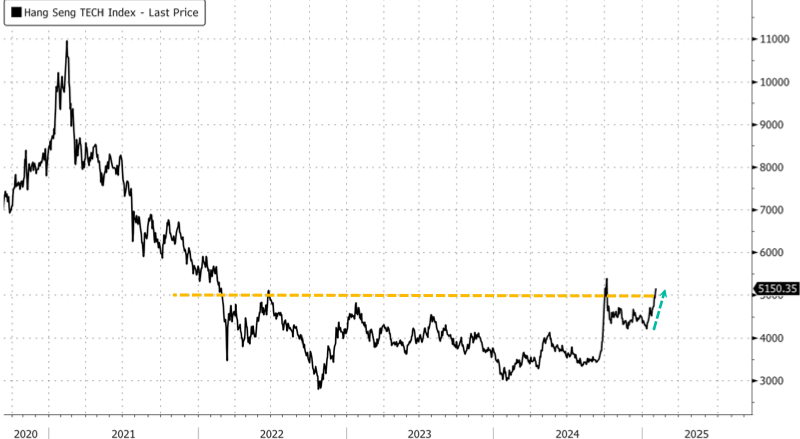
During the session, HSI saw auto stocks surge, with Geely up 8%, Li up 6.5%, and BYD gaining 5%. HSTECH rose nearly 2%, rebounding into technical bull market territory, now up 22% from its January lows. Alibaba shares climbed 1.5%, while Tencent gained around 2%.
 ?itok=9UfS8_e8
Goldman's He provided more color around "cautiously optimistic":
As China returns from one week CNY holiday, market sentiment on China asset improves as seen from the bullish price action in both equities and fixed income. Tariff reprieve, AI enthusiasm sparked by Deepseek and easy liquidity all contributed to the move.
China equities staged a meaningful rebound this week on AI optimism. HSI tech, the parameter of foreigner confidence, surged 23% from January lows. GS Asia internet research is bullish on further AI advancement and cost efficiencies. To highlight, the cost of Doubao, the most popular AI Chatbot in China, is 85% cheaper than industry average. In terms of stocks, we continue to see Tencent as best positioned in introducing To-C AI agent applications given the Weixin super-app with both social and transaction capabilities. We continue to be bullish on Alibaba (China's largest public cloud hyperscaler) and data centers (GDS, VNET) that will benefit from ongoing public cloud and AI computing demand growth from multi-year higher AI adoption. The latest piece from equity research on China AI can be accessed here.
In a separate note, Sat Duhra, portfolio manager at Janus Henderson Investors in Singapore, told clients, "This is a sector that has been ignored but like other purely domestic sectors, there are some bright spots," adding, "The recent DeepSeek announcement is a timely reminder that behind the scenes, industrial policy — for example Made in China 2025 — has pushed many sectors toward world-class status."
Deutsche Bank analyst Peter Milliken told clients, "We think 2025 is the year the investing world realizes China is out-competing the rest of the world."
"Investors, we believe, will have to pivot sharply to China in the medium term and will struggle to get access to its stocks without bidding them up," Milliken wrote.
The increasing bullishness in Chinese tech sharply contrasts with several years of bearish sentiment that weighed on shares as the world's second-largest economy grappled with a property downturn, deflation, and a demographic winter.
Any escalation in the tit-for-tat trade war between the US and China can quickly end the bull party, hence why Goldman's He is "cautiously optimistic."
https://cms.zerohedge.com/users/tyler-durden
Fri, 02/07/2025 - 07:20
NatGas Volatility Blows Out To Record For March Futures
NatGas Volatility Blows Out To Record For March Futures
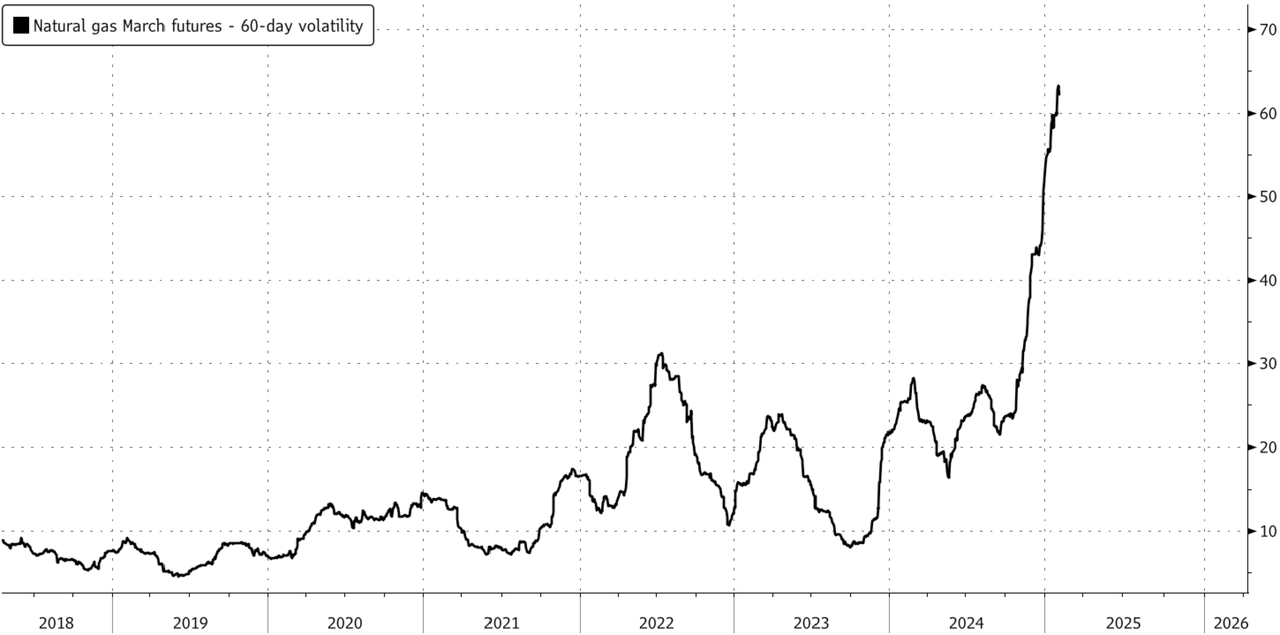
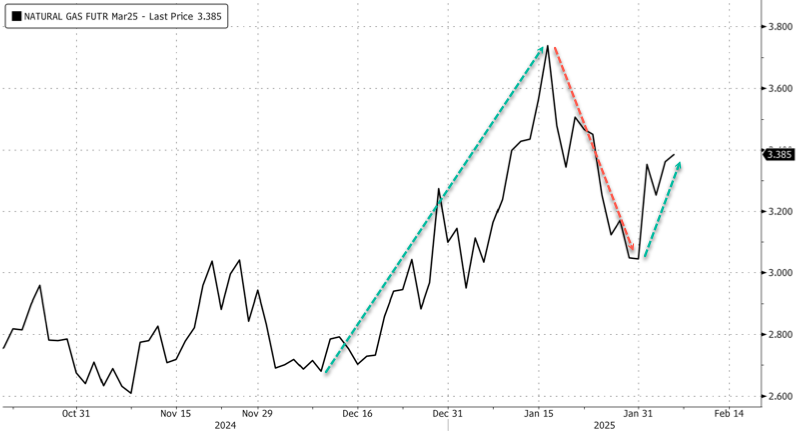
The March natural gas contract has been on a rollercoaster ride over the past month, driven by several factors, including polar vortex blasts across the Lower 48, trade tensions, rising artificial intelligence-related energy demand under the https://www.zerohedge.com/commodities/aggressive-power-surge-goldmans-powering-america-theme-may-supercharge-trumps-stargate
, and surging liquefied natural gas (LNG) exports. This heightened volatility reflects how traders are uncertain about price direction ahead of the spring months.
Bloomberg calculations based on 60-day volatility show that the March contract for NatGas has blown out to the widest level ever over what Bloomberg's Elizabeth Elkin pointed out are traders "trying to figure out the direction for gas as LNG exports, increasing demand for gas-fired electricity to run data centers and the threat of tariffs are emerging as potential fundamental movers in a market typically dominated by weather fluctuations."
 ?itok=dGks_a2i
Elkin added, "To cap it off, forecasts have swung widely over the last few weeks, making it difficult to predict how high demand will be to heat homes and businesses."
 ?itok=7j3p_frh
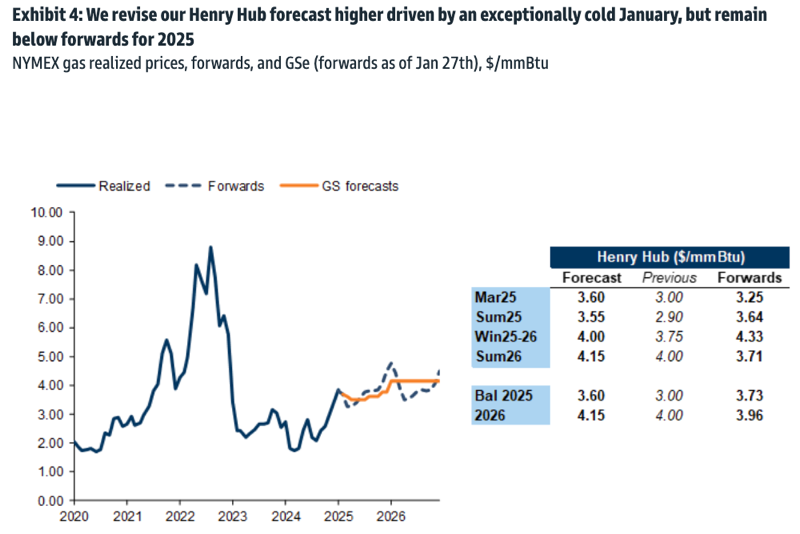
For color on possible direction, Goldman's Samantha Dart told clients early last week that she shifted her US NatGas price forecast from $3/mmBtu to $3.6 "to reflect tighter balances."
 ?itok=gVLV3Qk6
Dart also noted: "We see further upside to 2026 US gas prices."
https://cms.zerohedge.com/users/tyler-durden
Fri, 02/07/2025 - 06:55
https://www.zerohedge.com/commodities/natgas-volatility-blows-out-record-march-futures
TikTok's Actual Offense? Innovating While Not Being American
TikTok's Actual Offense? Innovating While Not Being American
,
Ten days ago the shares of Nvidia corrected 17 percent. How could this have happened to such an “owned” and analyzed company? The answer, at least as of now, is that surprise over inexpensively trained and very capable DeepSeek forced investors to at least rethink Nvidia’s long-term dominance.
 ?itok=CdCXPgRa
The news on January 26th gave investors reason to at least question whether the current face of AI would perhaps be disrupted by dynamism within the sector that its chips had helped create. It's worth thinking about Nvidia and the market meaning of DeepSeek’s surprising rollout with TikTok top of mind.
China-fearful politicians have voted to ban TikTok in the United States unless it can find an American owner. Forget for a moment that TikTok is already American owned, and simply ask the question about whether or not the same politicians would have pursued “sell or ban” legislation if TikTok were an unknown. Hopefully the question answers itself.
TikTok’s problem is that it discovered the future of social media much more effectively than its American competition. At which point it can be said that the attacks on TikTok aren’t much different from antitrust attacks over the years on American companies like Amazon, Apple, Google, Live Nation, and many others.
What’s important about those suits is that none of them took place when Amazon had the nickname “Amazon.org,” or when Apple was near bankruptcy, when Google was an unknown David to Yahoo’s Goliath, or when Live Nation was one of many cheaply priced entertainment companies trying to divine how the internet and streaming would upend the music industry. It’s just a comment that antitrust ankle biters never discover dominance in its ascendance
Antitrust is by definition a look backwards, and an attempt to penalize the businesses that had the temerity to discover a previously unknown commercial future. TikTok’s travails are a manifestation of the previous truth. Having led the needs of social media users much better than the American competition, TikTok faces a forced separation from the investors and innovators that made it great in the first place. In short, the political class is taking a page from the antitrust playbook in its attempt to wrest TikTok away from its owners on the cheap. Which requires more thought beyond the odious antitrust flavor of TikTok’s theft.
Its ascendance from unknown to the world’s most popular social media company plainly discredits the excuses bruited by politicians as they attempt to take it. Former Rep. Mike Gallagher has excused his own long fingers with op-eds at the Wall Street Journal asserting that TikTok is “controlled by the Chinese Communist Party.” No, government-controlled businesses are never this popular. Other conservatives (including Gallagher) claim the problem with TikTok is that it will gather data on American users for the Chinese Communist Party. That’s similarly an empty excuse when it’s remembered that all user supported sites attain their value from the data gleaned from those users; data that is subsequently sold.
Which brings us back to the “sell or ban” legislation from a U.S. political class that should hang its collective head in shame. As is the case with all antirust attacks, the attempt to break up and take TikTok personifies obnoxious conceit about the future of a commercial sector defined by relentless change, including change at the top.
Assuming the political class can pull off its attempted heist, rest assured that the thieving of successful businesses for innovating while not being American won’t end with TikTok. And that’s because antitrust is by its very name is once again a look backwards. See the DeepSeek surprise if you’re confused.
John Tamny is editor of RealClearMarkets, President of the https://parkviewinstitute.org/
. His next book is The Deficit Delusion: Why Everything Left, Right and Supply Side Tell You About the National Debt Is Wrong.
https://cms.zerohedge.com/users/tyler-durden
Fri, 02/07/2025 - 06:30
https://www.zerohedge.com/political/tiktoks-actual-offense-innovating-while-not-being-american
Microplastics Found In Brain Weighs As Much As A Plastic Spoon: Study
Microplastics Found In Brain Weighs As Much As A Plastic Spoon: Study
(emphasis ours),
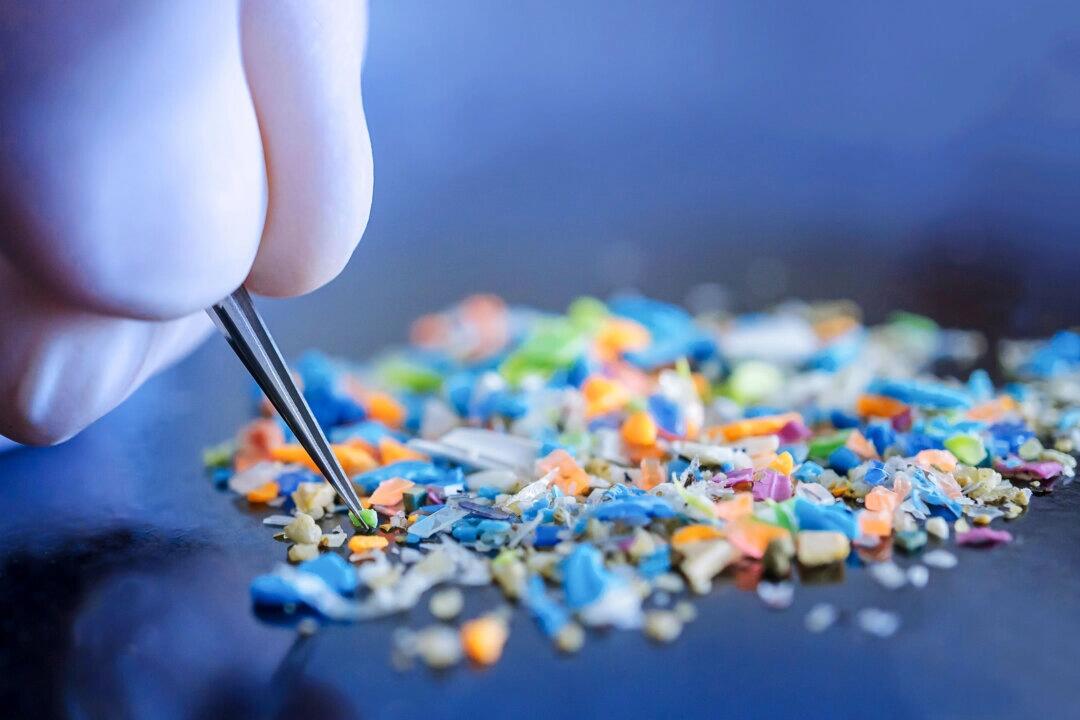
Microplastics are making their way into human brains at higher levels than in other vital organs, according to new findings.
 ?itok=sa1mGLdi
https://www.nature.com/articles/s41591-024-03453-1
published in Nature Medicine on Feb. 3, confirms that tiny plastic fragments are passing through the brain’s protective blood-brain barrier, potentially impacting health and cognitive function.
Researchers from the University of New Mexico (UNM) tested autopsy samples from 2016 and 2024. They found that over just 8 years, the amount of microplastic fragments in the brain has increased by about 50 percent. Brain samples from 2024 contained microplastics equal in weight to a plastic spoon.
Brains affected by dementia showed significantly higher concentrations of these plastic particles.
Finding such high concentrations in the brain was unexpected and alarming, https://hsc.unm.edu/directory/campen-matthew-j.html
, lead researcher and toxicologist, told The Epoch Times during a press conference.
“People are simply being exposed to ever-increasing levels of micro- and nanoplastics,” said Campen. The particles are so small, they’re roughly the width of two COVID viruses standing side by side, he noted.
The rate of accumulation “is simply mirroring the environmental buildup and exposure.” As plastic breaks down over time, it degrades and becomes small enough to enter the human body and brain.
Plastic Pollution in Organs
Brain tissue contained 7 to 30 times more microplastics than other vital organs like the livers or kidneys, making it one of the most plastic-polluted tissues yet examined.
Researchers tested 52 human brain samples from both 2016 and 2024, all taken from the frontal cortex—the part of the brain responsible for judgment, decision-making, and muscle movement.
In the brain, the microplastic concentration reached around 5,000 micrograms per gram—far higher than the liver and kidneys, which carried around 400 micrograms of plastics per gram.
The study also compared earlier brain samples from the eastern U.S. (1997–2013), which had lower microplastic levels, around 1,250 micrograms per gram. Their findings support a trend of gradual increases in plastic accumulation in the organs over time, with 2024 showing the highest levels.
To visualize the amount of microplastics in the brain, Campen held up a plastic spoon. Since the brain weighs around 1,400 grams (or three pounds), having 5,000 micrograms of plastic per gram would amount to over 5 grams of plastic in total—roughly the weight of a plastic spoon.
In deceased people with dementia, levels reached much higher levels of over 26,000 micrograms per gram. In the dementia samples, some particles were clumped together in areas with inflammation, raising concerns about a possible link between microplastics and brain tissue damage, according to the researchers.
However, while the study correlates microplastics to dementia, the study does not prove that higher plastic levels in the brain directly cause dementia symptoms.
It is also possible that the disease process itself may hinder the brain’s ability to clear out the accumulated plastics, Campen added.
Common Plastic Found in the Brain
Researchers found 12 types of plastic in the brain, with polyethylene (PE), commonly used in bottles, bags, and containers, making up 75 percent of the total. Other plastics included types commonly found in packaging, car parts, pipes, flooring, bottles, containers, fabrics, and other industrial products.
“It was notable that these are largely mirroring proportions of polymers that we do see in our environment,” https://hsc.unm.edu/medicine/departments/pathology/asert-iracda/fellows/current-fellows/marcus-garcia-bio.html
, study co-author and postdoctoral researcher at UNM, explained to The Epoch Times during the press briefing.
The particles in the brain were mostly sharp nanoscale shards and flakes. These tiny particles are small enough to cross the blood-brain barrier, although Campen says it’s still unclear how exactly the particles enter the brain.
Researchers believe that micro- and nanoplastics may enter the body through eating, drinking, and breathing. These particles have been found in various parts of the body, including arteries, hearts, lungs, blood, and placentas. A https://onlinelibrary.wiley.com/doi/10.1002/pmf2.12004
published on Jan. 30 found plastic pollution to be significantly higher in placentas from premature births.
One possible reason for the buildup, according to Garcia, is that organs like the liver and kidneys are designed to filter toxins, while the brain has more limited clearance systems.
Another theory is that brain tissue, which is about 60 percent fat, may better “trap” plastic particles.
“If you’ve ever cleaned a Tupperware bowl that had bacon grease or butter in it, you know, it takes a lot of soap and hot water. It’s really hard to get the plastics and fats apart,” Campen said. He suggests that microplastics might be “hijacking” their way into the brain along with dietary fats being metabolized.
The finding also lends concerns to plastics being used in some medical applications, like heart stents or artificial joints.
According to Campen, the physical properties of the plastic particles could be the main issue, rather than any chemical toxicity.
These plastics might obstruct blood flow in capillaries, he speculated. There is also the potential that they could interfere with the connections between brain cells. But “we just don’t know for sure.”
Bigger Picture
Despite the concerning rise in microplastics, Campen believes the data provide some optimism: The observation that plastic levels are similar in both older and younger people suggests that there may be natural processes at play to help manage or rid the body of them over time.
The researchers believe that many of these particles come from older “decades old, degraded plastics” that have been discarded and left to break down in the environment over the years, Campen said. This insight can help guide environmental policies that include older sources, rather than focusing solely on newer products.
Effective environmental policies aimed at reducing plastic pollution could help limit future exposure, Campen said. Microplastic pollution is increasing rapidly, with levels in the environment doubling https://news.un.org/en/story/2021/10/1103692
, he said, and adding that addressing the source of this pollution could help slow down this build up in our bodies.
Currently, no treatment exists to remove microplastics from the body. To help reduce exposure, Campen and his colleagues are investigating the sources of microplastics in the environment, including in soil, plants, and even meat.
“I don’t feel comfortable with this much plastic in my brain,” Campen said. “I don’t want to wait 30 more years to see what happens if the concentrations keep rising.”
https://cms.zerohedge.com/users/tyler-durden
Fri, 02/07/2025 - 05:00
https://www.zerohedge.com/medical/microplastic-found-brain-weighs-much-plastic-spoon-study
Here's What To Know About US Withdrawal From The WHO
Here's What To Know About US Withdrawal From The WHO
(emphasis ours),
On the first day in office of his second term, President Donald Trump signed an https://www.whitehouse.gov/presidential-actions/2025/01/withdrawing-the-united-states-from-the-worldhealth-organization/
to withdraw the United States from the World Health Organization (WHO), making good on a project from his first administration.
 ?itok=E5ApGGgZ
Trump’s Jan. 20 order halted U.S. funding to the United Nations body, citing the WHO’s “mishandling of the COVID-19 pandemic that arose out of Wuhan, China,” as well as other global health concerns.
Negotiations with the group about a pandemic agreement and the International Health Regulations will be suspended while the withdrawal is taking place.
Because of the 1948 https://avalon.law.yale.edu/20th_century/decad052.asp
by Congress, the United States has the right to withdraw from the WHO, but it must give a one-year notice. The resolution also requires the United States to fulfill “financial obligations” to the WHO for the current fiscal year.
The Largest WHO Funder
The United States is currently the largest WHO funder, contributing about $1.28 billion during 2022–2023, the last reported year on the organization’s https://www.who.int/about/funding/contributors/usa
. That equates to almost half of the WHO’s joint external evaluation missions for the last fiscal year.
The 2024–2025 fiscal year is shaping up similarly, with the United States serving as the largest donor by far, https://apnews.com/article/who-trump-tedros-global-health-a2eafc341cd2200e8800a2421d30bdfc
an estimated $988 million, or roughly 14 percent of the WHO’s $6.9 billion budget.
Documents obtained by The Associated Press show that the United States covers about 95 percent of the WHO’s work on tuberculosis in Europe and about 60 percent in Africa and the Western Pacific, and that the WHO’s Europe office is more than 8 percent reliant on U.S. contributions.
Additionally, U.S. funding provides “the backbone of many of WHO’s large-scale emergency operations,” covering up to 40 percent of that funding.
WHO Response
WHO Director General Tedros Adhanom Ghebreyesus https://www.theepochtimes.com/us/trump-withdraws-us-from-who-on-first-day-in-office-5795858?utm_source=twitter&utm_medium=Social&utm_campaign=ettwitter
relations with the United States as “a good model partnership” during a press briefing in Geneva in December 2024.
“[We] have been partnering for many years, and we believe that will be the case. And I believe the U.S. leaders understand that the United States cannot be safe unless the rest of the world is safe,” he told reporters.
Following the announcement of Trump’s decision to remove the United States from the organization, Ghebreyesus spoke out, asking world leaders to push the White House to reverse the decision.
The WHO chief said during a closed-door meeting with diplomats that the United States would miss out on critical information about disease outbreaks, The Associated Press reported.
George Kyriacou, the agency’s finance director, said if the WHO’s spending continues at its current level without funding from the United States, the organization would be “very much in a hand-to-mouth type situation” regarding cash flow for at least portions of 2026.
CDC Response
Officials at the U.S. Centers for Disease Control and Prevention (CDC) have ordered agency employees to stop working with the WHO, effective immediately.
John Nkengasong, the CDC’s deputy director for global health, sent a memo to agency leadership on Jan. 26 calling on staff to cease collaborating with the WHO immediately and wait for further guidance. CDC staff also are not allowed to engage with the WHO, virtually or in person, and staff members are not allowed to visit the WHO offices.
Some public health experts, including Dr. Jeffrey Klausner, a professor of medicine and global health at UCLA who works with the WHO on sexually transmitted infections, have voiced concern about halting the collaboration.
“Stopping communications and meetings with WHO is a big problem,” Klausner said. “People thought there would be a slow withdrawal. This has really caught everyone with their pants down.”
Behind the Withdrawal
The Trump administration said the WHO was not able to demonstrate independence from the “inappropriate political influence” of member states and had failed to “adopt urgently needed reforms.”
The president’s executive order also cites “unfairly onerous payments” by the United States that Trump said are “far out of proportion with other countries’ assessed payments.”
“China, with a population of 1.4 billion, has 300 percent of the population of the United States, yet contributes nearly 90 percent less to the WHO,” the order stated.
This is Trump’s second attempt to withdraw from the WHO. The president began the process in 2020 because of frustration over the WHO’s reaction to China’s coverup of details surrounding the transmission of SARS-CoV-2 at the start of the COVID-19 pandemic.
The House Oversight and Select Subcommittee on the Coronavirus Pandemic released https://www.theepochtimes.com/us/house-oversight-report-supports-chinese-lab-leak-theory-for-covid-19-origin-5769770
in December 2024 on the WHO’s response to the COVID-19 pandemic, calling it “an abject failure.”
According to the report, the WHO is accused of bending to pressure from the Chinese Communist Party and placing “China’s political interests ahead of its international duties.”
As part of the alleged failure, the WHO reportedly ignored warnings by Taiwan on Dec. 31, 2019, about “atypical pneumonia cases” in Wuhan, which it asked the WHO to investigate.
“The initial mismanagement of the COVID-19 pandemic not only potentially caused the further spread of the virus, but it created a situation where people lost trust in the global public health organization,” the https://www.congress.gov/118/meeting/house/117748/documents/HRPT-118-SSCPReport.pdf
stated.
The Associated Press and Aldgra Fredly contributed to this report.
https://cms.zerohedge.com/users/tyler-durden
Fri, 02/07/2025 - 03:30
https://www.zerohedge.com/political/heres-what-know-about-us-withdrawal-fromthe-who
USAID Is A Premier Weapon Of US Hybrid Warfare In The Southern Hemisphere
USAID Is A Premier Weapon Of US Hybrid Warfare In The Southern Hemisphere
https://korybko.substack.com/p/korybko-to-sputnik-brasil-usaid-is
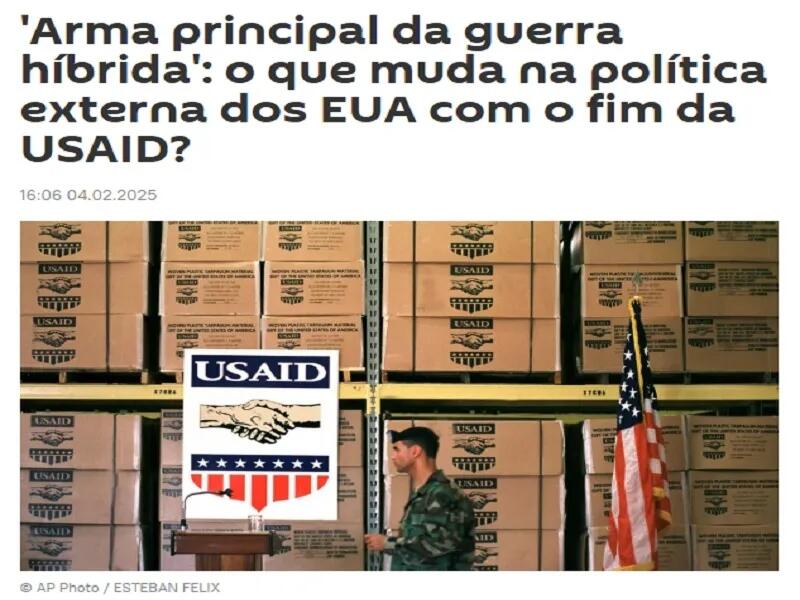
Here’s the full interview that I gave to Sputnik Brasil about USAID, excerpts of which were published in their report titled “'Arma principal da guerra híbrida': o que muda na política externa dos EUA com o fim da USAID?”
 ?itok=DW8yLSWO
1. How has USAID been used by the government of United States through the years to meddle in other countries, mainly Brazil and other countries from Latin America?
USAID is infamous for funding political programs under the cover of human rights and democracy to meddle in the recipient country’s domestic affairs. This popularly takes the form of funding movements, including media projects, for exposing alleged corruption in Latin American states. The purpose is to artificially generate a groundswell of grassroots opposition to incumbent governments that manifests itself through street protests and/or surprise election showings in order to bring about political change.
Some of the locals who collaborate with these foreign-funded political projects sometimes go on to become advisors or even figures in the more pro-American governments that replace the targeted ones. Therefore, USAID doesn’t just work to remove Latin American governments, it also sometimes provides trained advisors and personnel for the next governments. This makes it a premier weapon of US Hybrid Warfare in the hemisphere.
2. Does the end of USAID mean the end of US interference in other countries’ domestic affairs? Will they just change their method instead?
New Secretary of State Marco Rubio declared that he’s the acting administrator of USAID as it goes through radical reforms.
Per Trump’s Executive Order suspending foreign aid for 90 days, with the exception of emergency humanitarian aid, an assessment is taking place to determine their efficiency and consistency with policy. Accordingly, many programs dealing with socio-cultural issues like LGBT will likely be cut, while foreign media funding and the training of foreign political cadres will likely continue.
3. How do you evaluate Trump’s decision to end USAID?
USAID made sense from the perspective of older American interests back when it was first founded, but it was hijacked by liberal-globalist ideologues to proselytize radical socio-cultural policies that don’t objectively align with the US’ national interests. Examples of the most ridiculous programs are being shared all across X right now. Many Americans are enraged to discover what they were funding and surprised that a lot of the money also went to domestic “NGOs” for implementing these projects.
Ending USAID was necessary since that’s the only way to implement the radical reforms that the Trump Administration envisages, which are most immediately reducing government expenditures via the Elon Musk-led “Department Of Government Efficiency” (DOGE) and then realigning those that remain with policy. Many employees are also diehard ideological opponents of Trump and all that he represents so keeping them around runs the risk that they’d try to sabotage his second term like they did his first one.
What’s essentially happening is that Trump 2.0 entered power with a detailed plan for purging hostile elements of the US’ “deep state”, which refers in this context to its permanent military, intelligence, and diplomatic bureaucracies, with some also including its administrative and other ones too. USAID was a major component of the US’ power structure for decades prior to Trump’s second term so dismantling it is considered crucial for the success of his team’s foreign policy.
4. Some US politicians have criticized the Trump Administration’s reforms of federal agencies, fearing that confidential information might leak out and even describing the overall gist of what’s going on as a “serious threat to national security”. What do they fear? Is this a sign of USAID’s connection with the CIA like Musk recently talked about?
Not every USAID employee and project is connected to the CIA, but the CIA does indeed sometimes employ the aforesaid in advance of its goals due to the relative ease with which their democracy and human rights covers enable US spies to infiltrate and/or destabilize foreign countries. Those who are criticizing Trump’s reforms are elements of the US’ power structure who stand to lose from his and Musk’s campaign to expose irresponsible government spending and political meddling abroad.
Some of them do have a point, namely that innocent USAID employees might be suspected of being spies and this could lead to credible threats against them, but the Trump Administration is willing to risk those consequences in pursuit of its ambitious reform campaign. Purging USAID, the State Department, and the “deep state” more broadly is the only way to prevent them from sabotaging Trump’s foreign policy the second time around, which he envisages revolutionizing the US’ relations with the world.
Excerpts from this interview were published in Sputnik Brasil’s report titled “https://noticiabrasil.net.br/20250204/arma-principal-da-guerra-hibrida-o-que-muda-na-politica-externa-dos-eua-com-o-fim-da-usaid-38379746.html
”
https://cms.zerohedge.com/users/tyler-durden
Thu, 02/06/2025 - 23:25
https://www.zerohedge.com/geopolitical/usaid-premier-weapon-us-hybrid-warfare-southern-hemisphere
US "De Minimis" Exemption (Was) One Of The Highest In The World
US "De Minimis" Exemption (Was) One Of The Highest In The World
As a part of the tariffs imposed by the Trump administration Saturday on Canada, Mexico and China, so-called "de minimis" rules on small imports from the countries were suspended.
"De minimis" rules say that incoming goods under a certain value are not subject to import duties (and sometimes tax). As a result, the U.S. temporarily stopped accepting parcel from China and Hong Kong as many popular retailers send scores of "de minimis" shipments from these locations, including the likes of Temu or Shein. https://www.nytimes.com/2025/02/04/business/usps-china-de-minimis.html
. USPS said it was working on a solution of implementation of the new rules that would cause the least disruptions to parcel delivery.
While the rule change was explained in the case of China, but also Canada, with stopping the unregistered import of fentanyl or its ingredients to the U.S., https://www.statista.com/chart/20154/countries-applying-a-%2522de-minimis%2522-exception-of-taxes-and-or-duties/
out that most of the parcels affected will come from e-commerce platforms, with Chinese imports taking up the bulk of "de minimis" shipments. Checking the parcels to impose Trump's new additional 10 percent tariff on Chinese goods as well as any other tariffs that might apply per product category would cause a lot of extra work. However, the ability of Chinese e-commerce sellers to create large business footprints overseas while skirting many of the dues of a traditional export business has also caused discontent in the U.S. and elsewhere.
how many of the products shipped from the likes of Shein et al. are not up to quality standards, which caused complaints from consumer protection bodies.
shows that more than 100 countries around the world employ "de minimis" in order to speed up international shipping. However, the maximum value such parcels can have varies widely.
You will find more infographics at https://www.statista.com/chartoftheday/
The U.S.' $800 threshold is one of the highest in the world while EU countries impose charges on imports of much lower value (above €150 - approximately $156).
China's "de minimis" rules are also more strict, with any tax or duty under 50 Yuan Renminbi (approximately $7) considered void - this would for most products be in line with a value of $99 or less.
The country also already has a more refined approach to "de minimis" with a pre-registration and approval system for e-commerce traders in place that allows for higher exemptions at the discretion of the government.
Other countries have also posed additional hurdles to "de minimis", for example exempting B2B shipments or specific goods. Others allow neighbors or certain major trade partner to take advantage of a bigger "de minimis" allowance.
https://cms.zerohedge.com/users/tyler-durden
Thu, 02/06/2025 - 23:00
https://www.zerohedge.com/geopolitical/us-de-minimis-exemption-was-one-highest-world
Tomorrow's Jobs Report Will Finally Capture The Surge In Illegal Aliens, Lead To Another Big Negative Payrolls Revision
Tomorrow's Jobs Report Will Finally Capture The Surge In Illegal Aliens, Lead To Another Big Negative Payrolls Revision
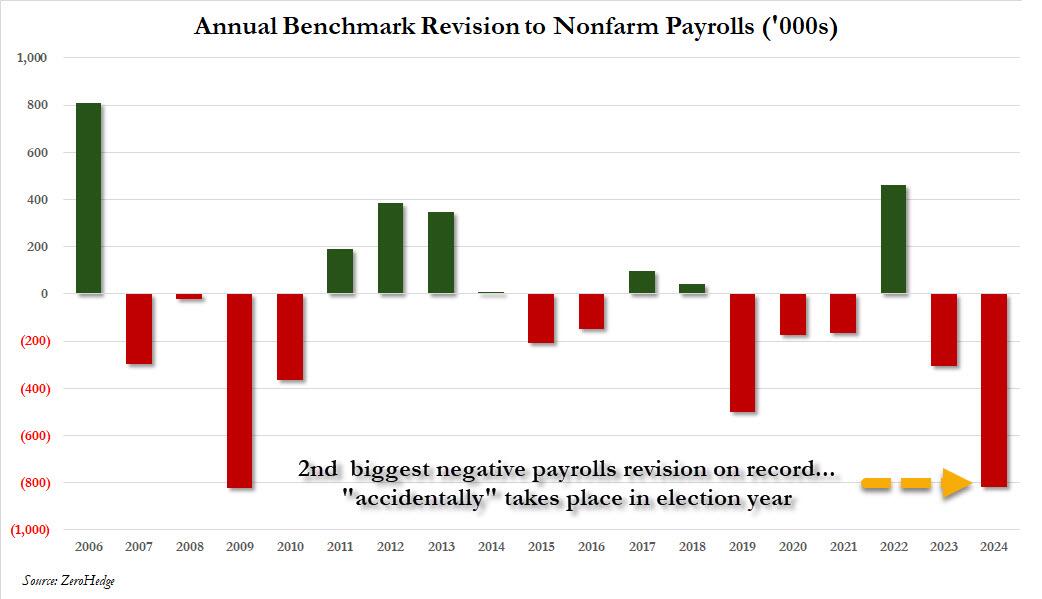
Remember last August when the Biden admin finally admitted it had been rigging the jobs number, when as part of its preliminary revision it https://www.zerohedge.com/markets/us-jobs-revised-down-818000-election-year-shocker-second-worst-revision-us-history
in the past year that were never actually added, a historical negative revision (the second biggest on record) which the Fed used as justification for its panicked jumbo 50bps rate cut just a few weeks later?
 ?itok=ZBeeov3I
Well, tomorrow that revision - along with a dramatic increase in the US population estimate by 3.5 million primarily to reflect the surge in illegal immigration - will finally flow through fully into the jobs report, as part of a bigger overhaul of the labor market by the now-Trumpian Bureau of Labor Statistics, and the results could be dramatic.
First, some background.
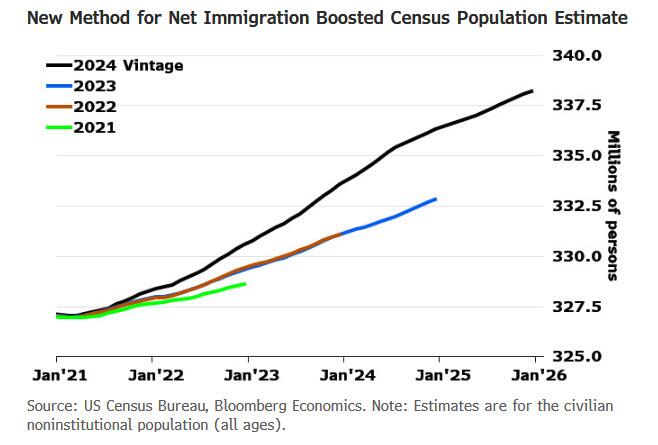
Each year the US Census Bureau adjusts the weights in the Current Population Survey – the source data for labor-force statistics like the unemployment rate – incorporating updated estimates of the population’s size and composition. In the latest vintage, the Census modified its approach to estimating net international migration - for obvious reasons, the main of which being that for the past 4 years the US effectively had no southern border - which had the effect of substantially boosting its estimate of the US population since 2020.
Bureau of Labor Statistics employment data for January (due for release Feb. 7) will reflect these adjustments, capturing the cumulative undercounting of the population relative to the last vintage of Census estimates.
That, according to Bloomberg, could lead to a large population adjustment this year which could raise the aggregate unemployment rate by raising the weight of recent immigrants, who tend to have higher unemployment rates than the general population. Overall, Bloomberg expects population adjustments to lift January’s unemployment rate by 5 basis points (which as everyone https://www.cnbc.com/2023/01/13/matt-yglesias-got-confused-about-basis-points-heres-what-to-know.html
, is not percent but rather one hundredth of a percent).
Here are the details according to Bloomberg:
The latest vintage of the Census Bureau’s population estimates raised the level of the civilian noninstitutional population for December 2024 by around 3.6 million relative to the prior vintage a year earlier.
The main reason was changes to the methodology for estimating net immigration. Historically, Census has relied on American Community Survey (ACS) data for its estimates of net international migration. But this approach posed two challenges:
First, the ACS data is lagged. For each vintage of population estimates, Census had ACS immigration information only for the previous year, so the data failed to capture very recent trends.
Second, ACS misses some migrants. This is supported by the divergence in recent years between the ACS immigration estimates and immigration totals from administrative data from other parts of the government.
To address this, Census adjusted its methodology to incorporate 75% of the difference between the sum of immigration totals from the administrative data and the ACS data. That resulted in a higher estimate for net immigration, lifting the estimate of the total population from 2020-2024.
 ?itok=M00LbS0e
Of that 3.6 million, roughly 3 million are 16 and older – the relevant population for the BLS unemployment statistics.
Historically, adjustments to the population — even relatively large ones — haven’t had much impact on the unemployment rate.In some cases the adjustments have resulted in significant changes to labor-force participation or employment rates, but usually there have been offsetting effects that dampen any change.
But for tomorrow's report there is a risk that the updated immigration estimates could lift the unemployment rate more visibly because the adjustment could increase the survey weight of workers with a higher unemployment rate.
Bottom line: Adjustments to the population controls in January’s household survey to boost the unemployment rate by ~5 bps. Together with Bloomberg's forecast of a decline in government jobs, the unemployment rate is expected to edge up to 4.16% in January from 4.09% a month earlier.
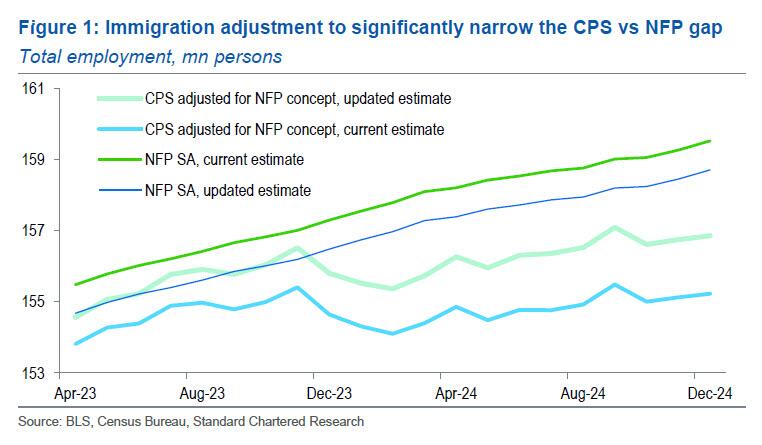
There's more: since the increase in the population will also raise the level of the labor force and employment, the updated employment level will imply average monthly job growth of around 150k-170k last year — narrowing the gap between the employment figures from the household survey and the estimates from the BLS’ establishment survey.
And indeed, Bloomberg cautions that the separate, benchmarking process in the establishment survey is likely to result in significant downward revisions to nonfarm-payrolls data, bringing average monthly job growth last year down to about 150k, from around 180k before revisions.
As Standard Chartered's Steve Englander writes (full note available to pro subs), according to the abovementioned BLS estimates as of August 2024, March 2024 NFP is likely to be revised down by 818k after benchmarking to the Quarterly Census of Employment and Wages (QCEW). However, further QCEW revisions since August make a 670k downward NFP revision more likely, so the overall gap between NFP and CPS (as of end-2024) will be reduced to about 2mn from 4.3mn.
 ?itok=OJ9dlEl0
The adjustment supports Englander's - and our - view that the surge in illegal aliens is more likely to be captured in NFP than CPS, as many of these workers were able to obtain employment authorization and work "legally" in the country. The household survey has likely understated annual employment growth by c.0.5mn during the past three years.
One problem the BLS will face is that participation rates and employment-to-population ratios for undocumented immigrants are highly uncertain. The BLS uses administrative data from other sources to bulk up population underestimates from standard Census and American Community Survey sources. However, no survey is likely to capture labor-force participation and employment among undocumented immigrants, so the BLS will probably have to make some assumptions based on legal immigrants and native-born labor-market participants. In addition, according to BLS methodology undocumented immigrants who have not been in contact with US Customs and Border Protection agents are unlikely to show up in either census population counts or BLS household employment. While these fully under-the-radar immigrants are a minority, CBO estimated them at c.800k for 2024.
An additional quirk is that the BLS puts most of its population revisions into each year’s January release (data to be released on 7 February). Its practice has been to introduce an abrupt upward or downward jump in January levels to capture the new population controls. This is arbitrary and does not align with monthly census population estimates. In practice, this means that m/m changes in population, employment, unemployment and labor-force numbers are largely meaningless, as they miss the big January shift. The 12M, 24M and 36M changes embed the population changes so they are relevant to the analysis. Ratios such as the unemployment rate, participation rate and employment to population remain meaningful on a m/m basis.
More to the point, as we https://www.zerohedge.com/markets/philadelphia-fed-admits-us-payrolls-overstated-least-800000
as the BLS subsequently admitted in August 2024, the March 2024 NFP would be revised down by 818k after benchmarking to the QCEW. However, subsequent QCEW revisions suggest a benchmark NFP reduction of around 670k. The overall gap between NFP and CPS will be reduced to 2.0mn from 4.3mn.
Of course, that's not the full story. As we also reported in December, the subsequent QCEW release pointed to en even much weaker Q2-2024 employment growth than signalled by NFP. (see "https://www.zerohedge.com/economics/biden-lied-about-everything-philly-fed-finds-all-jobs-created-q2-were-fake
"). However, the benchmark revision will not correct for the overstatement of payrolls in Q2-2024 until the second quarter of 2026, or more than a year into the future, leaving us with another year of NFP distortions!
Yes, dear readers, the full extent of the labor market devastation under Biden - and just how fabricated the jobs report truly has been - will continue to be unveiled for years to come, long after Biden himself is gone.
to pro subscribers.
https://cms.zerohedge.com/users/tyler-durden
Thu, 02/06/2025 - 22:10
Former UPenn Athletes Sue To Expunge Trans Swimmer Lia Thomas' Records
Former UPenn Athletes Sue To Expunge Trans Swimmer Lia Thomas' Records
Three former swimmers for the University of Pennsylvania have sued the Ivy League college to expunge the records of transgender athlete Lia Thomas.
 ?itok=ah4duT1Z
Alums Grace Estabrook, Margot Kaczorowski and Ellen Holmquist filed the suit on Tuesday, alleging they suffered emotional trauma after Thomas competed as a woman, destroying everything they'd worked their entire lives to achieve. The lawsuit was filed one day before President Donald Trump signed an executive order banning biological men from competing in women's sports, the https://www.foxnews.com/sports/former-lia-thomas-teammates-sue-ivy-league-ncaa-alleging-aggressive-push-pro-trans-ideology
reports.
The three actual women claim that their former school, along with Harvard University, the NCAA, and the Ivy League Council of Presidents subjected them to harassment and abuse in violation of federal laws by allowing Thomas to compete on their team.
"The UPenn administrators told the women that if anyone was struggling with accepting Thomas’ participation on the UPenn Women’s team, they should seek counseling and support from CAPS and the LBGTQ center," reads the lawsuit.
2004 grads Kaczorowski and Holmquist, and Estabrook, a 2022 graduate, say they were "repeatedly emotionally traumatized" after Thomas was allowed to compete with them in violation of Title IX, and say that school officials pushed pro-trans ideology on them the entire time Thomas was on the team.
They also allege that school administrators invited them to a talk titled "Trans 101," where they were the problem if they had issues with a "trans-identifying male" on their team.
School officials also allegedly warned them against speaking out about Thomas or they'd be labeled transphobes and risk not finding jobs upon graduation.
 ?itok=DGyNH8BW
The defendants are accused of creating a culture of intimidation that forced young women to deny biology. The plaintiffs claim that adding Thomas to their team jeopardized their opportunities, privacy, and safety.
Thomas, who competed for the UPenn Men's Swimming and Diving team between 2017 and 2020 then transitioned to the women's team, coming in first in the 500, 200, and 100-yard freestyle races - setting women's records. Thomas also broke several women's records at the 2022 Ivy League Championship, hosted at Harvard University.
The lawsuit asks a judge to declare that Thomas was ineligible to compete in women's races, and expunge his records, according to https://thenationaldesk.com/news/americas-news-now/former-upenn-swimmers-sue-to-vacate-lia-thomass-collegiate-records-lia-thomas-ncaa-womens-swimming-title-ix-transgender-harvard-ivy-league-sports-university-of-pennsylvania
.
"The Ivy League’s plan was to crown a man as a women’s champion in one of the most iconic swimming venues in America as scores of national and international journalists described the scene as a landmark civil rights accomplishment to be venerated," reads the lawsuit. "To bring its vision to fruition, the Ivy League engaged in a season-long pressure campaign to keep Thomas eligible to compete and prevent women from speaking up for their equal rights."
The swimmers' attorney, Bioll Bock, told The National News Desk that the alleged "pressure campaign" defied common sense and harmed his clients.
"The Ivy League believed that if America’s oldest and most storied educational institutions led the way, Americans would suppress common sense and submit to radical policies that steal young women’s cherished sports opportunities and obliterate biological reality," he wrote, adding "This lawsuit exposes the behind the scenes scheming that led to the attempt by Harvard University, UPenn, the Ivy League and the NCAA, to impose radical gender ideology on the American college sports landscape."
https://cms.zerohedge.com/users/tyler-durden
Thu, 02/06/2025 - 21:20
DOJ Sues Chicago, The Entire State Of Illinois, And Local Officials Over 'Sanctuary City' Laws
DOJ Sues Chicago, The Entire State Of Illinois, And Local Officials Over 'Sanctuary City' Laws
It's no secret that Chicago has forsaken its own low-income residents to virtue signal as a so-called 'sanctuary city' for illegal immigrants - to the point where local residents have been https://www.zerohedge.com/political/chicago-residents-throw-fit-over-new-migrants-dem-cities-clash-biden-admin-over-finances
."
 ?itok=ZR8egixa
Now, the Trump DOJ is suing Chicago, the state of Illinois, local officials over laws creating said 'sanctuary,' and have accused the defendants of impeding federal immigration enforcement efforts. In their complaint, the DOJ has asked a judge to declare the state and local measures unconstitutional due to the federal government's supremacy.
One of the laws challenged by the Wednesday lawsuit prohibits officials from complying with federal immigration detainers and providing certain information about noncitizens.
"The challenged provisions of Illinois, Chicago, and Cook County law reflect their intentional effort to obstruct the Federal Government’s enforcement of federal immigration law and to impede consultation and communication between federal, state, and local law enforcement officials that is necessary for federal officials to carry out federal immigration law and keep Americans safe," reads the https://storage.courtlistener.com/recap/gov.uscourts.ilnd.473062/gov.uscourts.ilnd.473062.1.0.pdf
.
Named in the case are Illinois Gov. JB Pritzker (D), Chicago Mayor Brandon Johnson (D), as well as the city's police superintendent and other city officials.
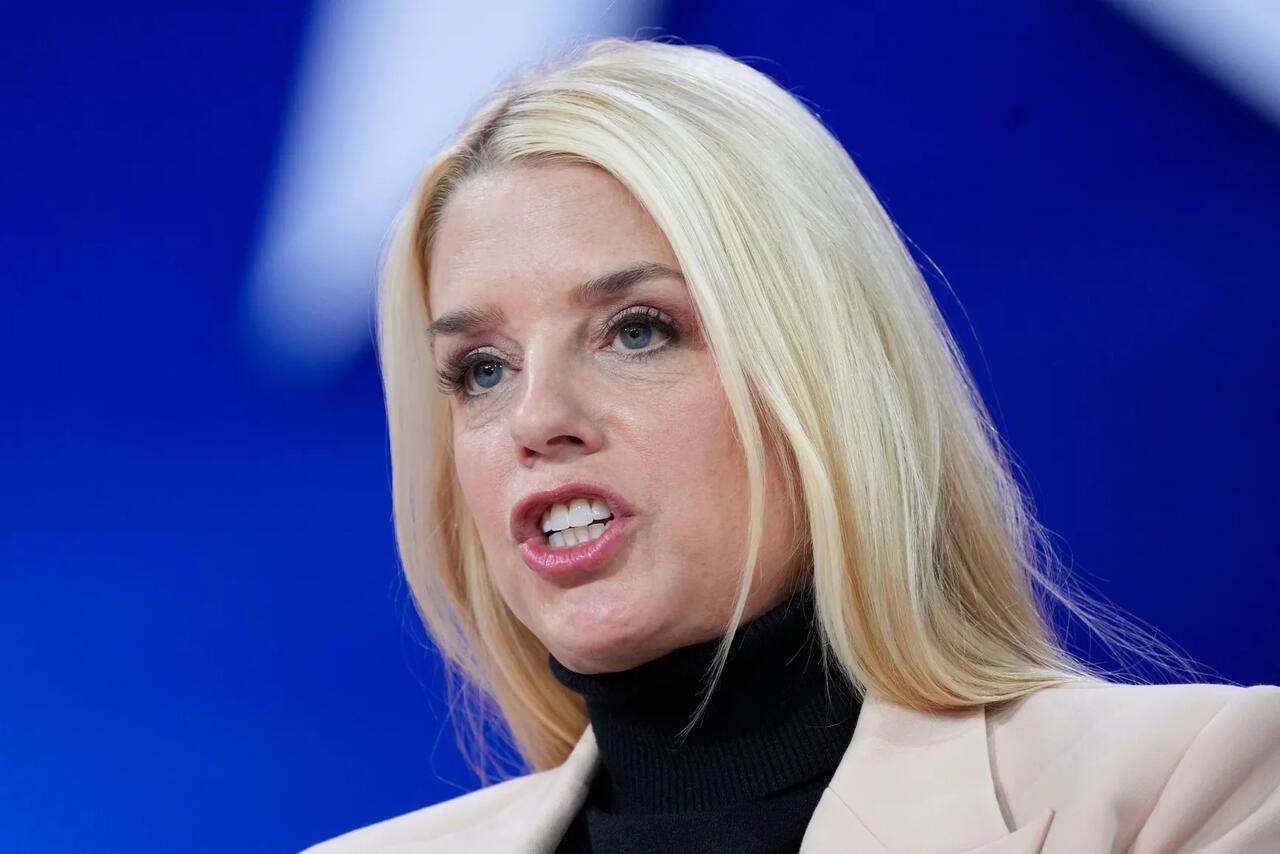
The case, filed in federal court in Chicago, marks one of the first major cases brought by the Trump administration in such a case, and comes after the Wednesday confirmation of Attorney General Pam Bondi, who issued a same-day memo restricting sanctuary cities from accessing DOJ funds.
It's also the latest in a series of moves by the new administration to halt illegal immigration and punish leftist cities and states who encourage and shelter illegal migrants - including orders to restrict birthright citizenship and declaring an invasion at the southern border. Homeland Security, meanwhile, has focused its deportation efforts on sanctuary cities.
The Wednesday lawsuit builds on a previously filed suit brought by several Chicago-based organizations, which seeks to block the Trump administration from conducting raids in the Windy City.
"Unlike Donald Trump, Illinois follows the law. The bipartisan Illinois TRUST Act, signed into law by a Republican governor, has always been compliant with federal law and still is today," Pritzker's office said in a statement.
"Illinois will defend our laws that prioritize police resources for fighting crime while enabling state law enforcement to assist with arresting violent criminals. Instead of working with us to support law enforcement, the Trump Administration is making it more difficult to protect the public, just like they did when Trump pardoned the convicted January 6 violent criminals. We look forward to seeing them in court," the statement continues.
The DOJ lawsuit cites Prizker's comments on CNN late last month, during which he said he's eager to cooperate with the Trump administration to "get rid" of criminals, but questioned whether "law-abiding" migrants should be targeted.
https://cms.zerohedge.com/users/tyler-durden
Thu, 02/06/2025 - 20:30
Is ATF Using AI-Powered Facial Recognition To ID Gun Owners?
Is ATF Using AI-Powered Facial Recognition To ID Gun Owners?
Several reports now indicate that ATF has access to and utilizes facial recognition technology to identify gun owners. In fact, two Government Accountability Office reports confirm that ATF does have access to various facial recognition systems, including Clearview AI, Vigilant Solutions, and other systems owned by other federal, state, local, tribal, or territorial law enforcement agencies.
The Government Accountability Office described the Clearview AI database as:
"A web-based facial recognition service using 30+ billion facial images sourced from publicly available websites, including news media, mugshot, and social media websites, among others."
https://www.gao.gov/assets/D21518.pdf
report found that ATF did not have sufficient accountability mechanisms "to track what non-federal systems with facial recognition technology are used by employees."
 ?itok=qZBFP6c8
According to testimony given to the U.S. Commission on Civil Rights, ATF:
"Initially used these services without requiring their staff to take training on topics such as how the technology works, what photos are appropriate to use, and how to interpret the results."
GAO scolded federal agencies, stating that they "must consider the potential impact of its use on civil rights and civil liberties because the potential for error and the potential to misidentify someone could lead to the arrest and prosecution of an innocent person."
GAO was also concerned that government use of facial recognition technology can have "a chilling effect on an individual's exercise of their First Amendment rights."
Similarly, ATF's use of Facial Recognition Technology could have a chilling effect on the People's exercise of their Second Amendment rights.
According to GAO, ATF is reported to have conducted at least 549 facial recognition searches on gun owners between October 2019 and March 2022.
GAO indicates that "as of April 2023, ATF… reported that they had halted their use of such services."
However, the most recent reports suggest otherwise.
On July 21, 2024, Senator Ron Johnson released a report detailing the attempted assassination of President Trump in Butler, PA. In the https://www.ronjohnson.senate.gov/services/files/4E6577F1-8AD2-4CB9-9FC7-5896C27A9647
, it is revealed that:
"Photos… were sent to the Bureau of Alcohol, Tobacco and Firearms (ATF) for facial recognition… The ATF was apparently requesting the photos… for facial recognition purposes. It is unclear… why ATF would be the agency responsible for conducting facial recognition."
We agree. It is unclear why ATF, the agency tasked with enforcing federal alcohol, tobacco, and firearms laws, should have access to a facial recognition system in the first place.
New Jersey Police Used Clearview AI to Identify Gun Owners
In New Jersey (a state with a firearm purchaser database, handgun registration, and universal registration checks) the government utilized Clearview AI to identify whether suspects owned guns prior to arrest.
In an interview, Attorney General Grewal said that:
"The Clearview app was used to get the name of the individual... we wanted to find out, does this person have firearms?"
Ultimately, the Attorney General ordered all New Jersey police to cease using the software because it was "racist and inaccurate."
ATF Could Use Facial Recognition Software in Conjunction with National Gun Registry
In recent years, ATF has admitted to Congress that it possesses nearly one billion gun and gun owner records. https://forms.gunowners.org/form/atf-s-illegal-gun-registry
by Gun Owners of America details that this registry is both digital and searchable.
By ATF's own admission this registry is "not searchable by name" because "ATF is the only agency that pays Adobe" to disable search functionality of ATF's PDF gun registry.
However, ATF could simply re-enable the functionality to search its digital registry by name.
Additionally, Senate appropriators are already advocating for "Law Enforcement Advanced Analytics" funding "to implement software using advanced analytics to correlate open source, commercial, and native agency data."
Translation: the gun control lobby wants to fund facial recognition technology for agencies like ATF, to monitor law-abiding citizens.
Apparently, ATF is "increasingly relying on the analysis of huge volumes of information, including open-source information" during its enforcement of gun control on the American people.
It seems as if ATF is preparing to use Clearview AI in conjunction with its illegal gun registry to identify gun owners and what firearms they own—just like the New Jersey police have already done.
And clearly, there are questions remaining as to the extent of ATF's facial recognition technology usage.
With anti-gun politicians in Congress attempting to pass legislation that removes restrictions on ATF, like the https://beyer.house.gov/news/documentsingle.aspx?DocumentID=5759
, the stage is set for ATF to have a registry of guns and gun owners, with their facial data as well.
Gun Owners of America will fight this overreach tooth and nail in both Congress and in the courts. ATF can never be allowed to maintain a registry of guns, or gun owners. As the saying goes, registration always precedes confiscation.
More on the report from GOA's Benjamin Sanderson:
. . .
https://cms.zerohedge.com/users/tyler-durden
Thu, 02/06/2025 - 20:05
https://www.zerohedge.com/technology/atf-using-ai-powered-facial-recognition-id-gun-owners
CDC Confirms Webpages Removed To Comply With Trump's DEI Executive Orders
CDC Confirms Webpages Removed To Comply With Trump's DEI Executive Orders
(emphasis ours),
A spokesperson for the U.S. Centers for Disease Control and Prevention confirmed Tuesday that multiple webpages have been taken down in response to President Donald Trump’s executive orders on gender ideology and diversity, equity, and inclusion (DEI).
 ?itok=WEowVWyS
A review of the websites by The Epoch Times shows that between Jan. 31 and Feb. 4, a multitude of CDC webpages were removed and remain down as of Feb. 4.
“All changes to the HHS (Department of Health and Human Services) website and HHS division websites are in accordance with President Trump’s January 20 Executive Orders, Defending Women from Gender Ideology Extremism and Restoring Biological Truth to the Federal Government, and Ending Radical and Wasteful Government DEI Programs and Preferencing,” the CDC spokesperson told The Epoch Times.
“The Office of Personnel Management has provided initial guidance on both executive orders and HHS and divisions are acting accordingly to execute.”
That comment came in response to a question about several CDC webpages that were offline as of Tuesday.
These include Health Disparities Among LQBTQ Youth; Interim Clinical Considerations for Use of Vaccine for Mpox Prevention; Fast Facts: HIV and Transgender People; pages for HIV data; the page for the U.S. global HIV program called PEPFAR, and others.
A page that was titled “Safer Food Choices for Pregnant People“ was renamed ”Safer Food Choices for Pregnant Women.” When the previous version is accessed, the page displays a message saying it moved to the one referencing women.
An https://www.kff.org/policy-watch/a-look-at-federal-health-data-taken-offline/
from the health nonprofit KFF, formerly known as the Kaiser Family Foundation, noted that some CDC webpages were taken down but were put back online with a message saying the webpage was being changed.
“CDC’s website is being modified to comply with President Trump’s Executive Orders,” says the message at the top of the National Center for HIV, Viral Hepatitis, STD, and Tuberculosis Prevention website.
Several other CDC pages, including one with demographic and health surveys, also displayed that message, as did the agency’s front page on Tuesday.
The CDC’s official public portal for health data was taken down entirely on Jan. 31 but went back up over the weekend with the message about website modifications. The agency’s Youth Risk Behavior Survey data was restored, too, but with at least one of the gender columns missing and its data documentation removed.
Some of the sites came back online on Monday, other data analysts said. However, it’s not clear exactly what was removed or changed.
“You go looking for something and it’s just not there,” said Amy O’Hara, a Georgetown University researcher who is president of the Association of Public Data Users. The website changes sparked “a mad scramble right now” to grab copies of whatever federal data was posted before, O’Hara said.
Researchers say datasets and summaries were affected, as were codebooks that explain different variables. There were changes to published research that used affected datasets and redactions to lists of publications about certain topics, O'Hara said.
Paul Schroeder, executive director of the Council of Professional Associations on Federal Statistics, said people looking for data may have to resort to suing for access or submitting Freedom of Information Act requests.
“The removal of several public datasets from agency websites goes against everything the statistical agencies stand for and were intended for,” Schroeder said on Monday. “Public data users are being left in the dark about what is going on.”
In the wake of Trump’s signing the executive orders, the Office of Personnel Management (OPM) https://www.opm.gov/media/0gpnja24/opm-memo-guidance-regarding-rifs-of-deia-offices-1-24-2025.pdf
a memorandum on Jan. 24 stipulating that agency heads will terminate DEI offices and positions within 60 days.
Another executive order specifically directed the CDC to stop working with the World Health Organization, and HHS placed a https://www.theepochtimes.com/us/trump-administration-puts-immediate-pause-on-fda-cdc-and-hhs-reports-and-posts-5797028
on posts and reports issued by both the CDC and the U.S. Food and Drug Administration (FDA), subjecting them to review first.
The Associated Press contributed to this report.
https://cms.zerohedge.com/users/tyler-durden
Thu, 02/06/2025 - 19:15
https://www.zerohedge.com/medical/cdc-confirms-webpages-removed-comply-trumps-dei-executive-orders
Self-Deportations And Plummeting Crossings - How New Border Policies Impact Arizona
Self-Deportations And Plummeting Crossings - How New Border Policies Impact Arizona
(emphasis ours),
Yuma Mayor Douglas Nicholls said that border crossings near his city have continued to decline since President Trump declared a national emergency at the southern border on Jan. 20.
 ?itok=O0snStfS
“For the last four days—very specifically in the last four days—we haven’t had any transfers from the San Diego or Tucson sector, which had been happening daily or near daily for the last several months,” Nicholls told The Epoch Times on Jan. 24.
“There’s some definite changes along the flow of traffic, at least in the Yuma sector.”
Nicholls said some illegal immigrants have chosen to “self-deport” rather than be put through the federal immigration system.
“Quite a few of them are actually being repatriated to their home countries,” he said, “which is why you’re seeing the reduction in numbers, because people don’t want to make the investment just to be sent back home.”
Trump Border Czar https://twitter.com/RealTomHoman?ref_src=twsrc%5Etfw
— Glenn Beck (@glennbeck) https://twitter.com/glennbeck/status/1887330372414746949?ref_src=twsrc%5Etfw
Nicholls said that the official stance is that most border crossings are related to human smuggling and trafficking, with considerable involvement from Mexico’s drug cartels.
Illegal immigrants pay cartels and smuggling organizations to cross the U.S.—Mexico border; it can cost anywhere from $4,000 to $40,000 depending on the nationality of the border crosser and the destination city. Many illegal immigrants enter the United States in debt to cartels, and spend years in indentured servitude to pay it off.
Trump took multiple border-related executive actions on Jan. 20 after being sworn in, including to kick-start the deportation of criminals and other illegal immigrants.
Immigration and Customs Enforcement (ICE) agents quickly began detaining and deporting many known criminal illegal immigrants in major metropolitan areas, including Chicago and Denver.
Nicholls said he supports the plan to deport known criminals. “I don’t know anybody who’s in favor of keeping them here. So I don’t think that that’s really caused any sort of controversy,” he said.
 ?itok=AjEHC-bG
Cost to Local Industries
Nicholls also noted that Yuma’s health care and agricultural sectors have faced financial challenges due to illegal border crossings. One local hospital has incurred an estimated $26 million in costs for illegal immigrant care, which has yet to be reimbursed.
“From a city perspective, we’ve done a pretty good job of isolating costs and not really impacting our budget,” Nicholls said.
“As a community, because of the great work of our Border Patrol and local nonprofits, we’ve only had a couple days in the last four years where migrants were released out in large numbers to the community. We’ve been able to help mitigate those impacts without dramatic costs.”
However, Nicholls said that farming operations along the border in Yuma have suffered a blow with all the illegal border crossings in recent years.
Border Patrol agents in fiscal year 2022 apprehended more than 25,000 illegal immigrants in the Yuma sector, the vast majority of whom crossed the border in an area right next to lettuce farms.
In December 2022, the Yuma County Board of Supervisors, along with Mayor Nicholls, declared countywide https://www.yumaaz.gov/Home/Components/News/News/1210/
of emergency due to the large number of illegal immigrants gathering on the U.S. side of the border.
The mayor’s proclamation has been in effect since that time.
 ?itok=lCESqv-g
In September 2023, Yuma County Commissioner Jonathan Lines https://www.congress.gov/118/meeting/house/116364/witnesses/HHRG-118-HM00-Wstate-LinesJ-20230920.pdf
before the House Committee on Homeland Security about the financial implications of an unrestricted border on Yuma’s $4 billion agricultural industry.
“The surge in illegal immigration has had a devastating effect on this critical industry in Arizona,” Lines told the subcommittee.
“The people crossing illegally travel on foot and urinate and defecate in fields and irrigation canals of the farms after they cross the border, which ruins whatever crop is growing on that particular farm.
“Farmers must abide by stringent food safety rules and this trespass and defecating in production areas renders the crops grown completely unmarketable, thus the crop is destroyed, and farmers must bear this staggering loss.
“As a result, farmers in Yuma have had to invest millions since [the Biden administration] took office in crop loss, to hire security and build fences around their farms to protect our nation’s food supply,” Lines testified.
Nicholls said that the window for lettuce from farm to market is very narrow, and consistency is essential because of the short shelf life of produce.
“You need people there when you need people there,” he said. “The 50,000 [migrant] workforce that’s required for winter harvest here is really focused on legal, consistent labor.”
Nicholls said that over the past four years, most illegal immigrants crossing into the Yuma area have wanted to be apprehended by Border Patrol. By doing so, they aimed to enter the system and obtain “some sort of status,” he said.
 ?itok=vuCCXaqz
 ?itok=L5UbjHqi
Nicholls said that city officials have not received any official information regarding troop deployments in the Yuma sector.
“What I’m tracking is a perception impact—where people assume our cities are in chaos. They’re not,” he said. “We’ve seen some negative pushback in that regard for tourism, for job attraction, those kind of things.”
Border Town Issues Order
Three hundred and fifty miles east of Yuma lies another border town: Douglas, Arizona, with a population of about 15,600.
On Jan. 27, Douglas Mayor Jose Grijalva signed an emergency https://mccmeetingspublic.blob.core.usgovcloudapi.net/douglasaz-meet-17a45ea4ed914d218a62449d58ea11a6/ITEM-Attachment-001-bb7f0869ea134ccd87ba77f7b1ab7163.pdf
to prepare for the financial impact of the president’s declaration of a national emergency at the border and the deployment of military troops.
“With the closing of the southern border, the city of Douglas will see a decrease in revenue sources from sales taxes, tourism, and other areas of commerce,” the proclamation states.
The proclamation didn’t mention that the Douglas Port of Entry remains open 24 hours a day, seven days a week for legal entry into the United States for commercial traffic, non-commercial traffic, and pedestrians.
The statement suggests that the city will experience an increase in costs to assist federal agencies in implementing the president’s executive order.
The proclamation states that although there is currently “no immediate invasion of narcotics and crime within the City of Douglas, I find it necessary and prudent to prepare for the influx of military personnel to the southern border, to take every lawful precaution available in order to protect the health, safety, and welfare of of Douglas’s citizens.”
 ?itok=zcsPk9C9
The city pledges to cooperate with county, state, and federal officials to “protect our borders from illegal entry while protecting our economy.”
On Jan. 22, the defense department announced the https://www.defense.gov/News/News-Stories/Article/Article/4037935/dod-orders-1500-troops-additional-assets-to-southern-border/
of 1,500 active-duty service members, along with additional air and intelligence assets, to the southern border to assist troops already conducting enforcement operations in the region.
The announcement was made approximately 36 hours after Trump signed an executive order instructing the Pentagon to respond to the crisis at the border.
New State Law
Communities are also preparing for the effects of Arizona’s Proposition 314, which was approved by 65 percent of voters in the November election.
This measure makes it a state crime for noncitizens to enter Arizona from any location other than a port of entry, which allows state and local police to make arrests.
The measure also allows Arizona state judges to order deportations.
State agencies must check an individual’s immigration status via the E-Verify program before allowing enrollment in financial aid programs or public welfare. It’s a crime to submit false information to evade the E-Verify program.
Under the proposition, it’s a Class 2 felony if a person knowingly sells fentanyl and it results in the death of another person.
The Yuma County Sheriff’s Office is currently awaiting further guidance from the county attorney, who is working with relevant parties to establish policies and procedures for sheriffs concerning Proposition 314.
Remote Desert Town
In the desert town of Ajo, Arizona, located 43 miles from the state’s 372-mile-long southern border with Mexico, life tends to move at a slower step.
However, resident Charlie Wolfe believes it is only a matter of time before the impact of the new administration’s border policies become apparent.
https://cms.zerohedge.com/users/tyler-durden
Thu, 02/06/2025 - 18:25
VDH: Are Trump's Tariffs Really Tariffs?
VDH: Are Trump's Tariffs Really Tariffs?
https://amgreatness.com/2025/02/06/are-trumps-tariffs-really-tariffs/
Hysteria has erupted here and abroad over President Trump’s threats to level trade tariffs against particular countries.
 ?itok=dvd-XNtR
Both American and foreign critics blasted them variously as either counterproductive and suicidal or unfair, imperialistic, and xenophobic.
Certainly, tariffs are widely hated by doctrinaire economists.
They complain that tariffs burden consumers with higher prices to protect weak domestic industries that, shielded from competition, will have no incentive to improve efficiency.
Their ideal is “free” trade. Supposedly a free global market alone should adjudicate which particular industry in any country can produce the greatest good for the world’s consumers, whether defined by lower prices or better quality, or both.
Even when “free trade” becomes “unfair trade”—such as China’s massive mercantile surpluses—many neoliberal economists still insist that even subsidized foreign imports are beneficial.
Cheap imports, Americans were told, supposedly still lowered prices for consumers, still forced domestic producers to economize to remain competitive, and still brought “creative destruction,” as inefficient domestic industries properly gave way to more efficient, market-driven ones.
But many exporters to the U.S. are propped up by their own governments.
They may seem more competitive only because their governments want to dump products at a loss to capture market share, subsidize their businesses’ overhead to protect domestic employment or seek to create a monopoly over a strategic industry.
Yet when Trump threatened to level tariffs against Mexico, Canada, Colombia, Venezuela, China, or the European Union, they were not primarily aimed at propping up particular inefficient U.S. industries at all.
Instead, an exasperated Trump threatened Mexico with tariffs for three reasons.
It refused to address its cartels’ illegal multibillion-dollar export of lethal fentanyl into the United States.
The cartels buy Chinese-supplied raw fentanyl with impunity, disguise it to resemble toxic drugs, and smuggle the product across a porous border.
The result over the last decade is more dead Americans from fentanyl than the total number of all U.S. soldiers lost in the wars of the twentieth century.
Second, Mexico had stonewalled all American efforts to stop their export of millions of illegal aliens into the United States—10-12 million in the last four years alone.
Mexico adds insult to injury by raking in profits from some $63 billion in remittances sent from its former resident citizens now residing in the United States and often subsidized by American taxpayers.
Third, Mexico grows its American trade surpluses each year. The imbalance is now a mind-boggling nearly $170 billion.
Trump threatened Canada because it has so far refused to police its side of an open and increasingly dangerous border. And it has racked up a $50 billion surplus by leveling asymmetrical tariffs on lots of U.S. products.
Canada also has refused to keep its NATO promises to spend 2 percent of its GDP on defense.
Canada’s pathetic 1.37 percent expenditure is predicated on American magnanimity. The U.S. alone protects Canada under the American North American nuclear shield and subsidizes NATO deadbeats like Canada by funding some 16 percent of the budget of the 32-nation alliance, as well as policing the international seas.
As for Venezuela and Colombia, both communist nations have deliberately emptied their prisons to send hundreds of thousands of illegal aliens into the U.S.—many of them violent felons. They do so either out of crass self-interest, hatred, or a strategic desire to weaken America.
China is a special case.
Its entire 20th-century ascendance was based on stealing U.S. technology, dumping its products on the U.S. market below the cost of production to capture market share, and forcing American corporations to relocate, offshore, and outsource—leaving our industrial hinterland a “rustbelt.”
The European Union runs a gargantuan half-trillion-dollar surplus with the U.S.
How?
Because for nearly the last 80 years, the U.S. has subsidized its defense during the Cold War and afterwards.
Europe acts as if it is recovering from World War II, so it can hit up a supposedly limitlessly rich American patron with asymmetrical tariffs.
Consider the various Trump “tariffs” leveled by an exasperated, and now $36 trillion-indebted, America.
Almost none of them meet the traditional definitions of an industry-protecting tariff.
Instead, they are the last-gasp tools of American leverage used only when decades of bipartisan diplomacy, summits, entreaties, and empty threats have all failed.
So, Trump is not a mercantilist.
Instead, he is trying to stop the multimillion-person influx of foreign criminals, the crashing of the border by millions of illegal aliens, the cartels’ export of American-killing drugs, the violation of past trade agreements, and allies from using America to subsidize their own defense.
The Trump tariffs are the last, desperate effort to reestablish global reciprocity and keep America safe.
And our “shocked” friends, allies, and enemies privately have known that all too well.
https://cms.zerohedge.com/users/tyler-durden
Thu, 02/06/2025 - 17:40
https://www.zerohedge.com/geopolitical/vdh-are-trumps-tariffs-really-tariffs
Why Mass Deportations Are Necessary And How To Keep Illegals From Coming Back
Why Mass Deportations Are Necessary And How To Keep Illegals From Coming Back
https://alt-market.us/why-mass-deportations-are-necessary-and-how-to-keep-illegals-from-coming-back/
For months before and after Donald Trump’s election win there was an army of naysayers crawling the internet claiming that he would “never follow through” on his promises and that deportations “were not going to happen”. Most of these people were leftists trying to sow the seeds of doubt. At least some claimed to be conservatives and were perhaps disenchanted with the inaction of Donald Trump’s first term in office. I know I was not expecting much back then.
In 2017 Trump’s cabinet confirmations took a decidedly swampy turn and his administration was overrun with Neo-Cons and banking elites. I criticized this outcome harshly at the time. However, I was willing to acknowledge a reasonable explanation – That Trump was being misled by advisers with ulterior motives. After all, every president has around 4000 positions to fill in their administration and most of them will defer that duty to their advisers.
Trump would go on to admit in multiple interviews that he had trusted his inner circle too much and made https://thehill.com/homenews/administration/383371-trump-admits-mistakes-with-cabinet-picks/
. They had sabotaged his efforts.
His second term is so far a 180 degree flip from his first, and Trump’s shift in focus is evident. Like most liberty movement conservatives I’ll reserve judgment. Trump’s presidency will likely be the most scrutinized in recent history, not only by his political opponents but by those who supported him. We’ll be scrutinizing everything he does with primary attention on his policy efforts. “Will he take action?” is the question everyone is asking.
The answer has been a resounding “yes”. The illegal immigration issue is of course one of the most pressing crises of our era and I would consider Trump fulfilling his promise to counter the threat a bare minimum. He has to, or he loses his entire base of support and the country falls apart at the same time. Trump’s swift move to execute mass deportations is redeeming.
For decades conservatives and right leaning independents have been disillusioned with the Republican Party because of their incessant inaction. When leftists take power in government they waste no time exploiting every advantage – The only thing that stops them from total dominance is patriot culture and the fact that 50 million+ Americans are heavily armed. When the GOP takes power they change very little.
One factor that truly sets the Trump Administration apart from all other modern Republican Presidencies is the acknowledgment of the culture war. The leftists have been waging this war for at least 50 years and GOP leaders have mostly dismissed it as trivial compared to politics. It’s the reason why we came within a razor’s edge of total moral relativism and degeneracy under the Biden Administration. The left has been normalizing the hatred of basic American principles for generations.
Part of that effort has been the introduction of open borders ideology and mass illegal immigration. I consider this a kind of “final stage” of the leftist/globalist agenda – If you can demonize western culture to the point of self hatred, then people won’t care when you saturate the west with third-world migrants and put the final nail in the coffin.
Illegal aliens don’t want to assimilate, they want to pillage and if possible to conquer. This is why you see hundreds of Mexican flags flying at every migrant protest march; they have no interest in becoming American, they only want access to American wealth. They look at the US citizenry as rubes and easy targets for plunder.
There is also the danger of cultural replacement. Many migrants from Latin American identify with the Marxist “La Raza” ideology, which asserts that America is “stolen land” that they have an ethnic claim to. The globalists know this and use mass migration as a weapon, opening the gates and making it easy for the invasion to happen. As we have seen in Europe and the UK, migrant hordes are like a mercenary army perfect for oppressing native citizens and preventing future rebellion against multicultural erasure.
The core of this process is to incentivize migrants with subsidies and jobs. And this lead me to the greater dilemma of the border crisis – Locking down the border is not so hard, but getting rid of the tens-of-millions of illegals that are already in the country is much more difficult. Making sure they don’t come back is also a conundrum.
As we’ve seen in the first weeks of Trump’s presidency, establishment Democrats are intent on interfering with deportations in any way they can (all the future power of leftists requires forced immigration to the US from socialist leaning countries). By extension, leftist activists will seek to disrupt deportation efforts using civil unrest (when the weather warms up these goblins will come out in droves, bank on it).
On top of the internal sabotage, there are many foreign governments that will desperately try to obstruct the return of so many unwanted citizens. Keep in mind that the US is seen by these governments as a dumping ground for their refuse. America is a steam valve to release the pressure so that these countries can get rid of their criminals, revolutionaries and those in poverty.
Mexico, Columbia, Haiti and others continue to argue that they can’t take their own people back because it would lead to “societal catastrophe”. Why? Because these governments have been knowingly sweeping their problem children under the rug for years, and America is the rug.
 ?itok=y9fF3zTj
At the current rate of deportations (around 1500 per day) we are looking at around 500,000 per year. At least 10 million illegals are projected to have entered the US under Biden’s watch, and that’s not counting the millions that were in the US previously. Estimates indicate that 16 million to 20 million illegals are living in America today. To expedite matters, illegals will have to be convinced to self deport.
There is evidence that this is happening to some extent. Border stations have seen an uptick in outgoing traffic into Mexico and border encounters have slowed (Texas has played a big part in the border slowdown with their Operation Lone Star). But how could the US pressure a majority of aliens to self deport and never come back?
Here are a few surefire methods…
Increased Penalties For Businesses That Hire Illegals
This is common sense, but a large part of mass immigration depends on access to the US jobs market. Our government has been turning a blind eye to low-wage migrant labor for a long time and usually, if caught, businesses will only be fined a few hundred dollars for each migrant they employ. The savings on wages make it worth the risk.
Federal fines should be increased greatly, changing the cost benefit ratio and making it less enticing for companies to gamble on illegal migrant labor. If companies stop hiring migrants then most aliens will leave the US overnight.
If an industry desperately needs foreign labor then they can hire people with work visas. The process could be streamlined for certain jobs, but there has to be PROOF that these industries cannot find American workers to fill those positions. Furthermore, migrants should not be allowed to work in the US for greatly reduced wages (this drives down wages for Americans). Companies should be required to pay the same wage they would normally pay an American citizen of equivalent skill and experience.
Permanently Cut All Government Welfare Subsidies For Asylum Seekers
A general cancellation of amnesty and “catch and release” policies might make this action a moot point, but under the Biden Administration most migrants had access to a list of welfare subsidies. These subsidies and various migrant programs are projected to cost American taxpayers https://budget.house.gov/press-release/the-cost-of-the-border-crisis-1507-billion-and-counting
. This isn’t counting state and city expenditures on illegals (New York City alone spent over $5 billion on migrants in 2024).
Housing programs under HUD do not distinguish between legal and illegal immigrants and often migrants will receive preferential treatment by landlords because of guaranteed government payouts and tax incentives. This has helped to exacerbate the housing crisis in the US, driving up rent prices to extreme levels.
Shut Down NGOs Engaged In Supporting Illegal Immigration
The shut down of the USAID department is a good start in the battle against rogue NGOs, but there’s a lot more to be done. Globalist NGOs are the worst perpetrators behind mass immigration movements and many use religious organizations as a front (the female Bishop who famously woke-lectured Trump at a church service held after his inauguration is coincidentally a https://nypost.com/2025/01/31/opinion/episcopal-bishop-lectures-trump-while-earning-taxpayer-millions-to-bring-migrants-into-us/
in exchange for helping illegal immigrants into the US).
These groups are very difficult to legally obstruct or punish for such actions. One thing Trump can do is take away the 501C3 tax exemption status of NGOs involved in encouraging mass immigration to the US; these efforts are entirely political in nature, which negates tax exemption. NGOs are also subject to lawsuits.
Ultimately the NGO problem needs to be addressed on a larger scale and as a country we need to examine the harm some of these organizations are doing. In many cases international NGO operations spend millions in foreign countries to entice migrants to cross the border, but they also run numerous programs to support migrants that are already in the US, mostly through litigation and interference with deportations. Getting rid of them would go a long way in keeping illegals out of the country.
Cut Off Federal Funding To Sanctuary Cities
Trump has already threatened this response in light of Democrat resistance to deportations, but action may need to be taken sooner rather than later. The problem is that city governments often use federal dollars as a slush fund to fill the coffers of their migrant programs. Most cities do not have the funds to subsidize migrants on their own for very long, not without making extensive cuts to other parts of their budget.
Democrats claim cutting federal funding to sanctuary cities violates the underlying principle of the Tenth Amendment, which protects states and localities from federal overreach. This is a disingenuous argument – Cities are not entitled under the 10th Amendment to federal funds without restrictions or requirements. The Spending Clause, Article I, Section 8, Clause 1 of the U.S. Constitution has been widely recognized as providing the federal government with the legal authority to offer federal grant funds to states and localities that are contingent on the recipients engaging in, or refraining from, certain activities.
There are legal restriction on the federal government as well in terms of how they refuse funds, but generally speaking cities and states cannot use federal funds to support people breaking federal law. The Constitution also specifically gives the federal government broad powers over border enforcement. Cities and states are not allowed to harbor foreign threats in the US in violation of border law. Without federal funds cash will dry up quickly in sanctuary cities and migrants will leave on their own.
Use “Griefing” Deportations For Repeat Offenders
There’s an endless supply of migrants boasting on social media this past week that even if they are deported they will simply pop right back across the border with little effort. Since border encounters have plummeted significantly, these claims might just be bluster. That said, what should the US do about repeat offenders?
Putting them in jail for months or years would cost taxpayers more money than deportations would. We could take away their future ability to gain citizenship, but this assumes that they care. My suggestion? What if we use a different method – what the kids call “griefing”.
In other words, we make the lives of repeat offenders as difficult as possible. For example, why does border patrol keep transporting migrants to cities directly across the national line where they can easily come right back? If a repeat illegal is captured, why not put them on a plane and drop them off as far away from the border as possible (Mexico is 3000 miles long) and let them figure out how to get home? There’s also the option of slowing down their processing for weeks, making them wait in lockup instead of sending them back quickly. Do this for a year and watch the the number of returning illegals drop to zero.
The Economic Time Table
In order to have a dramatic effect on price inflation in the US many millions of migrants will have to be removed in a short period of time. To save the housing market and cut product costs, demand has to be diminished and the fastest way to do that is boot out the people that shouldn’t be here. Deportations through ICE are a good start, but they are slow. Even with the expansion of agents and enforcement the only way to achieve visible results is to make self-deportation an imperative for illegals.
Most migrants will have to leave on their own. It saves the taxpayer a lot of money in deportation costs, it saves time on arrests and makes it easier for everyone to get on with the process of making America better for Americans.
https://cms.zerohedge.com/users/tyler-durden
Thu, 02/06/2025 - 17:00
Amazon Reverses 7% After Hours Plunge Despite Cloud Miss, Ugly Guidance
Amazon Reverses 7% After Hours Plunge Despite Cloud Miss, Ugly Guidance
Ahead of Amazon's earnings, UBS said that the online retailer is the "cleanest Mag7 name to own", although in retrospect it may also be the cleanest Ma7 name to sell, which is what is taking place after hours when the stock tumbled after it missed on Q4 cloud revenue and also guided well below estimates.
First, here is a big picture of what the company reported for the just concluded 4th quarter:
EPS $1.86 vs. $1.43 q/q, beating estimates of $1.50
Net sales $187.79 billion, +10% y/y, beating estimates of $187.32 billion
Online stores net sales $75.56 billion, +7.1% y/y, beating estimates of $74.71 billion
Physical Stores net sales $5.58 billion, +8.3% y/y, beating estimates of $5.4 billion
Subscription Services net sales $11.51 billion, +9.7% y/y, missing estimates of $11.58 billion
Subscription services net sales excluding F/X +10% vs. +13% y/y, estimate +10.3%
North America net sales $115.59 billion, +9.5% y/y, beating estimates of $114.27 billion
International net sales $43.42 billion, +7.9% y/y, beating estimates of $44.13 billion
Third-Party Seller Services net sales $47.49 billion, +9% y/y, missing estimates of $48.02 billion
Third-party seller services net sales excluding F/X +9% vs. +19% y/y, estimate +10.2%
So far so good (with some exceptions). But what caught the market's attention first was Amazon's AWS revenue, which came in just below estimates:
AWS net sales $28.79 billion, +19% y/y, estimate $28.82 billion
Amazon Web Services net sales excluding F/X +19% vs. +13% y/y, estimate +19%
Turning to operating results, here the results were uniformly solid:
AWS operating profit 36.9%, down from 38.1% but beating estimates of 34.7%
Operating income $21.20 billion, +61% y/y, beating estimate $18.84 billion
Operating margin 11.3% vs. 7.8% y/y, beating estimate 10.1%
North America operating margin +8% vs. +6.1% y/y, beating estimate +6.48%
International operating margin 3% vs. -1% y/y, missing estimate 3.08%
As for fulfillment expenses, these came in slightly below estimates, while the seller unit mix was slightly higher than expected:
Fulfillment expense $27.96 billion, +7.2% y/y, estimate $28.45 billion
Seller unit mix 62% vs. 61% y/y, estimate 60.2%
Of the above, the most notable highlight - as per our preview - was AWS which grew revenue by 19% for a second consecutive quarter to $28.79BN, which however was just below the sellside estimate of $28.82BN. So maybe a little weakness here similar to Microsoft.
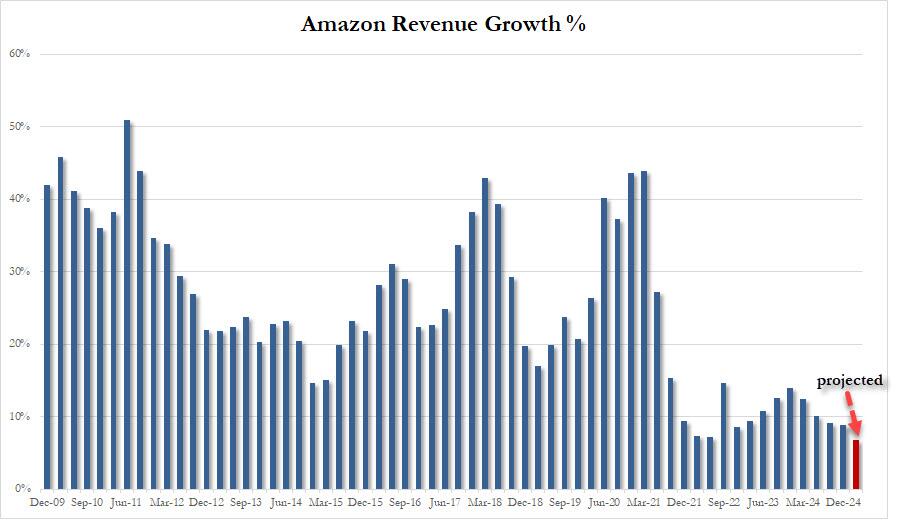 ?itok=mTjQEyU8
Still, if revenue growth for AWS was a bit light, the 36.9% margin likely offset it, beating estimates of 34.7%, but below last quarter's print of 38.1%. Elsewhere, North American profit rose to $25 billion, resulting in a profit of 6.44%, the highest since at least 2015 (although one wonders how much higher this number can rise). Meanwhile, international margins dipped to 3.03% from 3.63%.
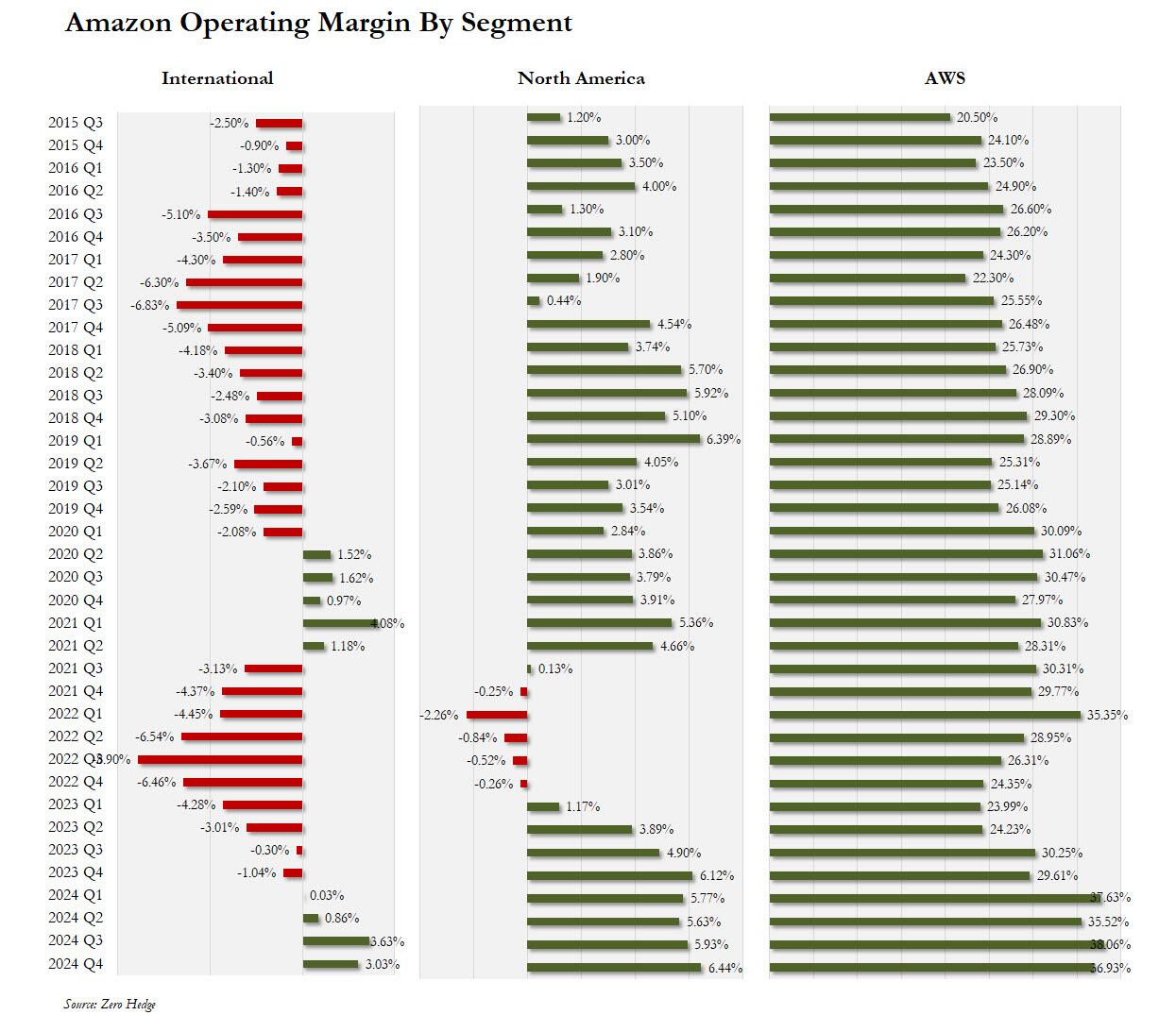 ?itok=T9gcHEoq
As a result of the jump in North American profits, Amazon's consolidated operating margin rebounded strongly, and after dipping modestly in Q2 from the previous record, rose to a new all time high of 11.3% in Q4.
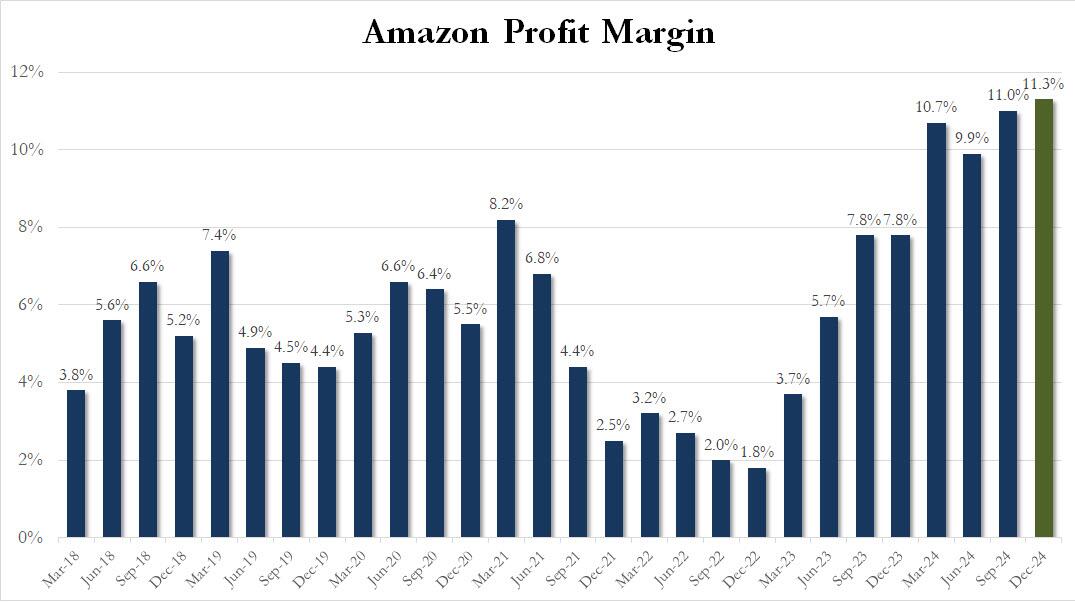 ?itok=kGzuwilr
However, while the above data was mixed to modestly solid, it was the company's guidance that led to an after hours drop in the stock; that's because the company projected profit and revenue in the current quarter both of which came in below Wall Street expectations:
Sees net sales $151.0 billion to $155.5 billion, below the estimate of $158.64 billion
Sees operating income $14.0 billion to $18.0 billion, below the estimate $18.24 billion
If accurate, that would mean Q4 revenue will grow at the slowest pace since the global financial crisis.
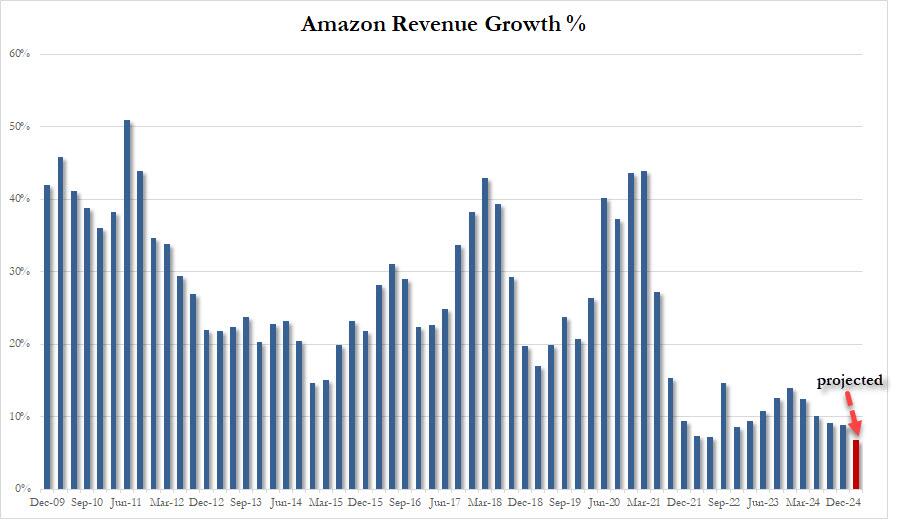 ?itok=ROnC6lXE
And while any other day the cloud miss and ugly guidance would have been enough to send the stock tumbling - as it did for a bit, sliding as much as 7% after hours, the unprecedented retail BTFD kneejerk reaction has taken the stock after hours and remarkable pushed it back flat on the session as the market plumbs new levels of stupidity.
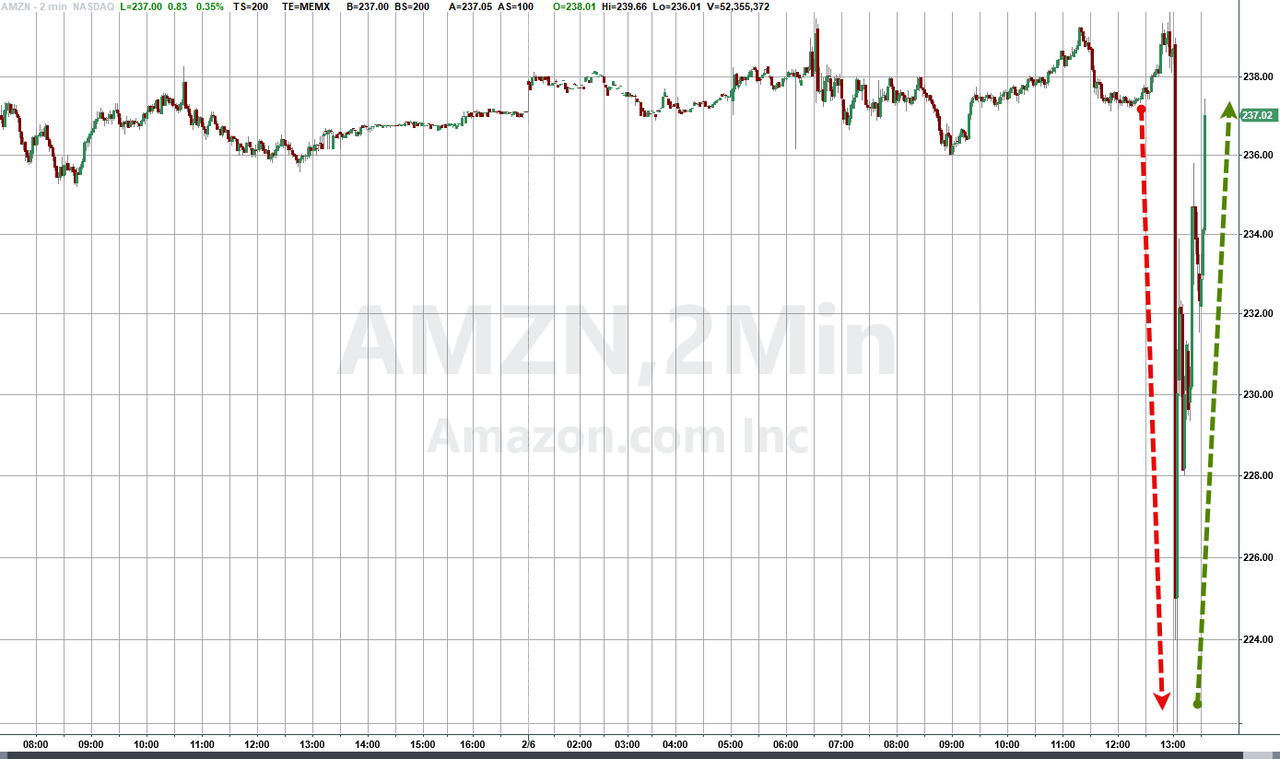 ?itok=hiQ49-by
https://cms.zerohedge.com/users/tyler-durden
Thu, 02/06/2025 - 16:38
Amazon Earnings Preview: "The Cleanest Mag7 Name To Own"
Amazon Earnings Preview: "The Cleanest Mag7 Name To Own"
Unlike GOOGL and AAPL, Amazon is a name which according to UBS investors are more active in, particularly as fears around operating margin headwinds have dissipated. The Swiss bank notes that investors remain bullish "with multiple shots on goal that the company has for margin expansion heading into 2025 driven by positive synchronous developments across its key business segments." This includes:
ongoing ecommerce fulfillment network regionalization as units growth continues to outpace shipping cost at 12% versus 8% in 3Q24;
secular growth driven by ongoing transition from on-prem to cloud given 85% of global IT spend remain on-prem; and
significant runway ahead for Prime Video with ads which continues to ramp across its global markets.
In terms of bogeys, this is what UBS expects:
Q4 AWS Growth: 18% now versus 19% post Microsoft
Q4 EBIT: $21 bn versus guide $16-$20 bn
Q4 Total Sales: small beat at the high end at $188.5 bn+ versus guide $181.5-188.5 bn (FX impact)
Q1 AWS: small acceleration around 20.5%
Q1 EBIT: $17.5 bn at the high end (FX and seasonality of retail)
Q1 Total Sales: roughly in line with Street at $158.5-$159 bn (post Microsfot, hearing this might come down to about $157 bn at the high end)
And here is the sellside consensus courtesy of BBG:
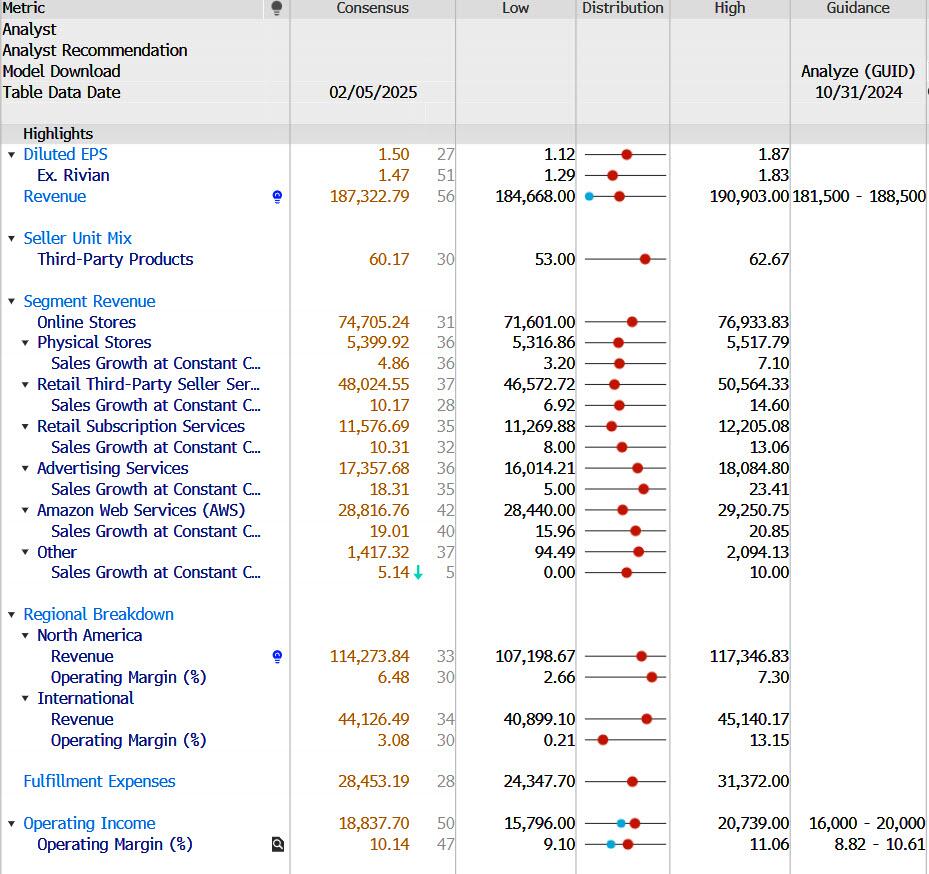 ?itok=3Bh7Klzj
UBS adds that price targets are still around that $250-$280 range, and the most important things during the call will be:
directional commentary on capex for both AWS and ecommerce;
progress on fulfillment regionalization and declining cost to serve;
state of the consumer; and
prime video advertising uptakes.
JPMorgan agrees with UBS and notes that Amazon is probably "the cleanest Mag7 name to own into Q4 prints with much less controversy than 3 months ago."
Most importantly, confidence in margins/EBIT has improved significantly: change in message around AWS margins, Kuiper very rarely discussed, sustained retail/logistics efficiencies. Most are broadly expecting ~stable AWS growth for 2025 (~20%) so no more acceleration requirements which also helps the setup. There is less of a clear valuation framework here vs other MegaCaps, but Doug’s $280 PT is based on 34x 26e FCF ($83B).
Some more specifics ahead of earnings:
Positioning Score (1 = max short/UW, 10 = max long/OW): 8
Buyside Bars: Investors looking for AWS growth of ~20% for both Q4 and Q1.
JPM's buyside survey points to expectations of Q4 net sales ~$189B (guide $181.5-188.5B) and EBIT $20B+ (guide $16-20B); Q1 guidance of net sales $160B+ & EBIT ~$19B (both high-ends).
Implied after hours Move: 8%
https://cms.zerohedge.com/users/tyler-durden
Thu, 02/06/2025 - 15:43
https://www.zerohedge.com/markets/cleanest-mag7-name-own-amazon-earnings-preview
Shares Of Tungsten Miner Erupt After China Chokes Supply; CEO Says Customers In "State Of Disbelief"
Shares Of Tungsten Miner Erupt After China Chokes Supply; CEO Says Customers In "State Of Disbelief"
The Trump administration's additional 10% tariffs on all Chinese imports took effect Tuesday, prompting Beijing to fire back with retaliatory measures, including tariffs on US goods, antitrust probes on US big tech firms, entity list additions, and export controls on critical minerals.
Focusing on export controls on critical metals, Beijing imposed restrictions on key minerals such as tungsten, tellurium, bismuth, molybdenum, and indium, along with certain metallic compounds derived from them.
spoke with Lewis Black, chief executive officer of North America's Almonty Industries, who stated his customer base is in a "state of disbelief" after Beijing's export controls on the metal used in electronics, defense systems, and machinery.
"It's the warning shot, because we cannot exist without it," Black told Lee. He noted: "Our economy, manufacturing, defense, everything, is so dependent on it. And yet, Russia, China and North Korea have about 90% of the output."
 ?itok=MyR897CQ
Shares of Almonty in the US have surged 40% in recent days. The company describes itself as "the largest tungsten mining company in the world outside of China."
 ?itok=NjulRS0X
"The question is, how much will China tighten the screw to be heard?" Black said, adding, "I think the news was bad, but I think it's going to get worse."
Beijing's willingness to https://www.zerohedge.com/commodities/warning-shot-china-bans-exports-gallium-germanium-us-tit-tat-chip-war-escalates
to the US became evident in late 2024 when it banned the export of gallium, germanium, and antimony.
Beijing's ongoing export restrictions on critical minerals should serve as a warning to America's military-industrial complex and chipmakers. Perhaps it's time for the Trump administration to ramp up efforts to expand domestic supply chains for mining and refining rare earth minerals, reducing dependence on China.
https://cms.zerohedge.com/users/tyler-durden
Thu, 02/06/2025 - 15:00
At Least 40,000 Fed Workers Accept 'DOGE Buyout' As Deadline Looms Tonight
At Least 40,000 Fed Workers Accept 'DOGE Buyout' As Deadline Looms Tonight
Thursday marked the final day for federal employees to accept the Trump administration's offer of eight months of pay and benefits in exchange for voluntarily stepping down. According to the latest figures from https://www.bloomberg.com/news/articles/2025-02-06/musk-buyout-deal-has-more-than-40-000-takers-as-deadline-nears
, at least 40,000 government workers—about 2% of the federal civilian workforce—have opted into the resignation program.
An official from the Office of Personnel Management told Bloomberg that deferred retirement applications have been steadily increasing and are expected to surge by the end of Thursday, the deadline to apply. Employees can submit their resignations by sending the word "resign" to their government email accounts.
"While a few agencies and even branches of the military are likely to see increases in the size of their workforce, the majority of federal agencies are likely to be downsized through restructurings, realignments, and reductions in force," OPM recently told federal workers in an email.
OPM added: "These actions are likely to include the use of furloughs and the reclassification to at-will status for a substantial number of federal employees."
The agency also told workers that "consolidation and divestitures" could lead to changes in "physical office" locations.
Reuters noted that federal worker unions have told members not to take the deal. The unions sued to block the offer, with a court hearing scheduled for 1300 ET. Also, Redditors on the "fednews" forum on the Reddit social media platform told other fed workers to "hold the line."
President Donald Trump and Elon Musk, a special government employee leading the Department of Government Efficiency, have been on a crusade to provide the American people with transparency regarding out-of-control spending by federal agencies. One major win for Trump has been unleashing DOGE to neuter the Deep State's unlimited piggybank, also known as USAID. The agency has since been https://www.zerohedge.com/political/usaid-website-goes-dark-trump-reportedly-plans-shift-agency-under-state-department
into the State Department.
 ?itok=A7xmooOh
Latest USAID headlines:
https://www.zerohedge.com/political/elon-musk-special-government-employee-white-house-confirms
https://www.zerohedge.com/political/politico-ny-times-propped-millions-dollars-us-government
DOGE headlines:
The Trump administration estimated that between 5% and 10% of the federal workforce could accept the offer, which would save taxpayers close to $100 billion. This is what swamp draining looks like—a mandate the American people gave Trump.
https://cms.zerohedge.com/users/tyler-durden
Thu, 02/06/2025 - 14:45