

No, they've been fooled. Credit card companies have spent a lot of money on research and are smarter as a result. Most people spend more on average when using them. That far exceeds the ridiculous points. And the merchant does pay the fee, but they bake it into the sale total. So the consumer still ultimately pays it. Credit card companies aren't just giving away free money. They use research and statistics to convince people like you that they're a net gain when the reality is that they aren't. The whole points system plays on a reward mechanism to make you use them more. And they are a privacy nightmare. I'm sure they monetize that data somehow too.
I never said charge backs weren't incredible for some consumers, but they also lead to higher prices for the rest of us. Companies don't just eat the cost. Besides, my actual point was that final settlement isn't fast. That doesn't sound like final settlement to me.
#Bitcoin allows us to be as sovereign as we wish to be. This isn't the most convenient, but it's the most sovereign I've been.
Thanks for helping make this a reality, @SeedSigner. They're finally done. 🫡

Just guessing, but container overflow could be the issue for the keys sections, and the basics container could be set to a percentage view width that looks okay on desktop but not mobile. A mobile rule that sets the view width to 100% could help.

Cool site, but it has some issues on mobile.


I see. I didn't realize it was custodial. Thanks!
Yep. There's always too much fluff and bullshit. I'd rather just zap some sats and get what I need without having to dig.
People can charge back Visa for like 6 months I think. It is not instant settlement. And that 3-5% isn't free, and it's usually more like 1-2%. And you're paying an extra 3% to use it at stores. So it's not as great as you make it seem. People have been fooled.

I'm not a fan of the information required. Why do I need to provide a name, email, and country? Sure, I could lie, but why make me?


I don't give a hot fuck what that dinosaur thinks.

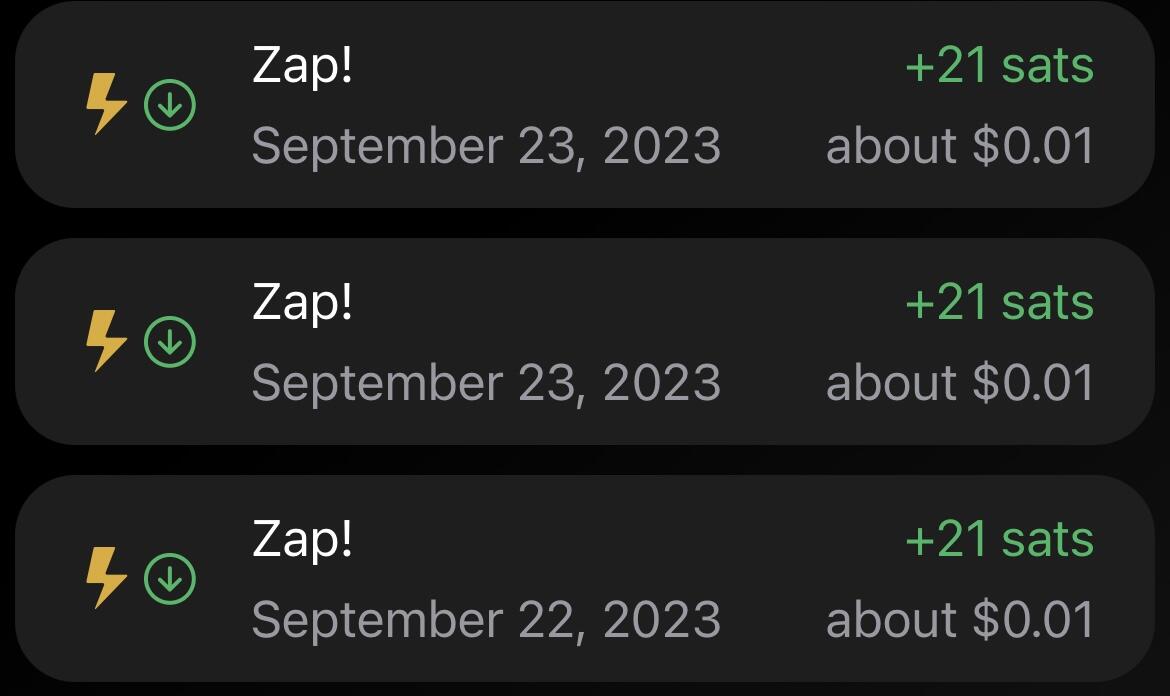
I sent you 69 sats to start your day off right.
I can't believe I ever lived without Nostr now that I've used it. Zapping changes everything. Imagine being able to send your grandson a birthday gift just by zapping his post on social media. Tons of use cases.
I just had this happen after discovering Primal. It's the first time I've enjoyed using Nostr.

I don't understand the colors of the words.

GOOD MORNING, CAP'N.
NICE TO SEE MORE SAILORS ABOARD USS BITCOIN.
I just zapped a Nostr bot for entertaining me. What a time to be alive.


You should run for president.

To be fair, there is a difference between having open source code and setting terms for how others use their computers.
The source isn't open, but even if it were, it would only guarantee you the right to use it how you wish on your own machine. It wouldn't grant you free range use of machines they own.