

I appreciate this illustration, that I think I get. What I'm more interested in is how it is all accomplished through a single transaction. It looks like "one guy" with many wallets" but I dont understand how the transaction is actually built and signed.
Discussion

A CoinJoin transaction is a special way of combining multiple Bitcoin transactions from different people into one, making it harder to trace which inputs (coins) belong to which person.
Here’s a simple breakdown:
1. **Why CoinJoin?**
Normally, when you send Bitcoin, it’s easy to see from the blockchain where the coins are coming from and where they're going. CoinJoin helps improve privacy by mixing transactions together, so it’s not clear who sent what to whom.
2. **How it works:**
- Let’s say Alice, Bob, and Carol all want to send Bitcoin. Instead of each person creating a separate transaction, they all agree to create *one* big transaction together.
- Each person adds their own inputs (the Bitcoin they own) and the outputs (where they want their Bitcoin to go). These inputs and outputs get pooled together in a single transaction.
3. **Constructing the transaction:**
- The transaction contains all the inputs (coins from Alice, Bob, and Carol) and outputs (who each person is paying).
- However, from the outside, it’s impossible to tell which input is paying which output, because they’re all mixed together.
4. **Signing the transaction:**
- Each person has to sign off on the transaction with their private key to prove they own the inputs they’re contributing.
- But importantly, no one person can change the transaction after it’s built, and no one can take someone else’s coins—each person’s inputs and outputs are carefully tracked in the background to ensure fairness.
5. **Once signed,** the transaction is broadcast to the Bitcoin network, and when it’s confirmed, each person’s payment is sent just like in a regular transaction, but with the added benefit of privacy.
In short, CoinJoin mixes transactions together, making it harder for anyone looking at the blockchain to figure out who is sending Bitcoin to whom.
The transacrion is constructed by a coordinator and signed by each participant.
This is a simple example of a two person coin join. You can see how even if you know who owns the inputs you would not be able to tell who owns the outputs since they all look the same.
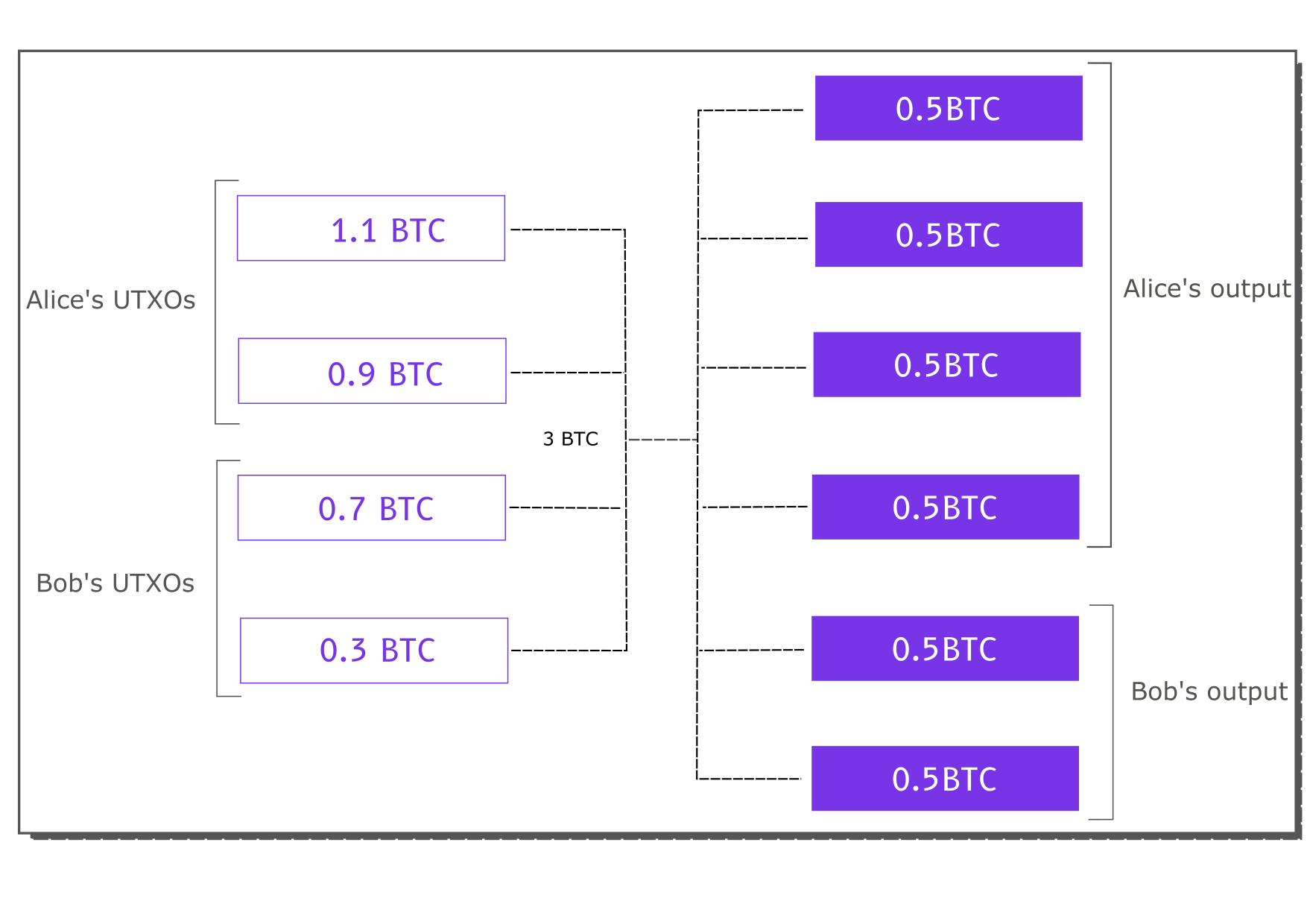
There would be no way of knowing from just looking at the on chain transaction that the first four outputs belong to Alice and the last two belong to Bob
Perhaps this example is also helpful.
Imagen you know who owns each input on the left. How would you tell who owns the output on the right since they all loom identical?

### Step 1: **Participants come together**
- Imagine we have Alice, Bob, and Carol. They each want to send some Bitcoin, but instead of making separate transactions, they agree to create a **single CoinJoin transaction**.
- They don’t trust each other completely, so this has to be done in a way where no one can cheat or steal anyone’s funds.
### Step 2: **Transaction construction (inputs and outputs)**
- Each participant starts by preparing the **inputs** (the Bitcoin they own) and the **outputs** (the addresses they want to send their Bitcoin to).
- For example:
- **Alice** has an input of 1 BTC and wants to send 0.5 BTC to an address.
- **Bob** has an input of 2 BTC and wants to send 1 BTC to an address.
- **Carol** has an input of 3 BTC and wants to send 1.5 BTC to an address.
- **Inputs** are essentially references to the Bitcoin each person owns, which they’ll be spending. These inputs are Unspent Transaction Outputs (UTXOs) from earlier transactions.
### Step 3: **Coordinator role**
- To organize the CoinJoin, there’s usually a **coordinator** (could be software or a server). The coordinator does *not* handle the coins, just helps collect the necessary information from each participant to build the transaction.
- Each person privately sends their input (UTXOs) and output (the address they want to send Bitcoin to) to the coordinator.
- **Crucial detail**: The coordinator sees which inputs belong to which participant, but it doesn’t need to know who’s sending the Bitcoin in real life.
### Step 4: **Building the transaction**
- The coordinator gathers all the inputs and outputs from Alice, Bob, and Carol and combines them into a single transaction.
- The transaction looks like one big pool of inputs and outputs:
- Inputs:
- Alice’s 1 BTC
- Bob’s 2 BTC
- Carol’s 3 BTC
- Outputs:
- Alice’s destination address for 0.5 BTC
- Bob’s destination address for 1 BTC
- Carol’s destination address for 1.5 BTC
- Since inputs are larger than outputs (because no one sends all their funds), the rest is returned as **change** to new addresses controlled by each participant.
### Step 5: **Signing the transaction**
- Now, each participant must **sign** the transaction. Here’s how:
- Each person only needs to sign the part of the transaction that involves **their own inputs** (the coins they control).
- **Alice** signs the input associated with her 1 BTC.
- **Bob** signs the input associated with his 2 BTC.
- **Carol** signs the input associated with her 3 BTC.
- This is where the beauty of Bitcoin’s cryptography comes in:
- The signatures are cryptographically tied to the specific inputs each participant controls.
- **No one can modify the transaction** after it's signed without invalidating the signatures. This ensures that no one can steal or alter the transaction.
### Step 6: **Combining the signatures**
- The coordinator collects all the signatures from the participants and assembles them into the final, fully signed transaction.
- **Key point**: The signatures are independent. Each participant only signs their part, and once all signatures are gathered, they complete the transaction together.
### Step 7: **Broadcasting the transaction**
- Once the transaction has all the required signatures, it’s ready to be broadcast to the Bitcoin network.
- The transaction looks like any other transaction on the blockchain, except it has multiple inputs and outputs from different people.
- No one from the outside can tell which input belongs to whom, or which output goes to whom, making it look like “one guy with many wallets,” as you put it.
### Summary of the "Single Transaction" aspect:
- **One big transaction** is created that has all the inputs and outputs combined.
- Each participant signs only their own inputs, and these signatures are combined to authorize the transaction.
- The result is a single transaction broadcast to the Bitcoin network, which moves all the funds at once while preserving privacy.
So, from the outside, it looks like a single person is moving money from many different wallets to many different addresses, but in reality, it’s a coordinated effort between multiple participants, each controlling only their own coins.
This is fascinating. So you only have to sign your part, that's really wild.