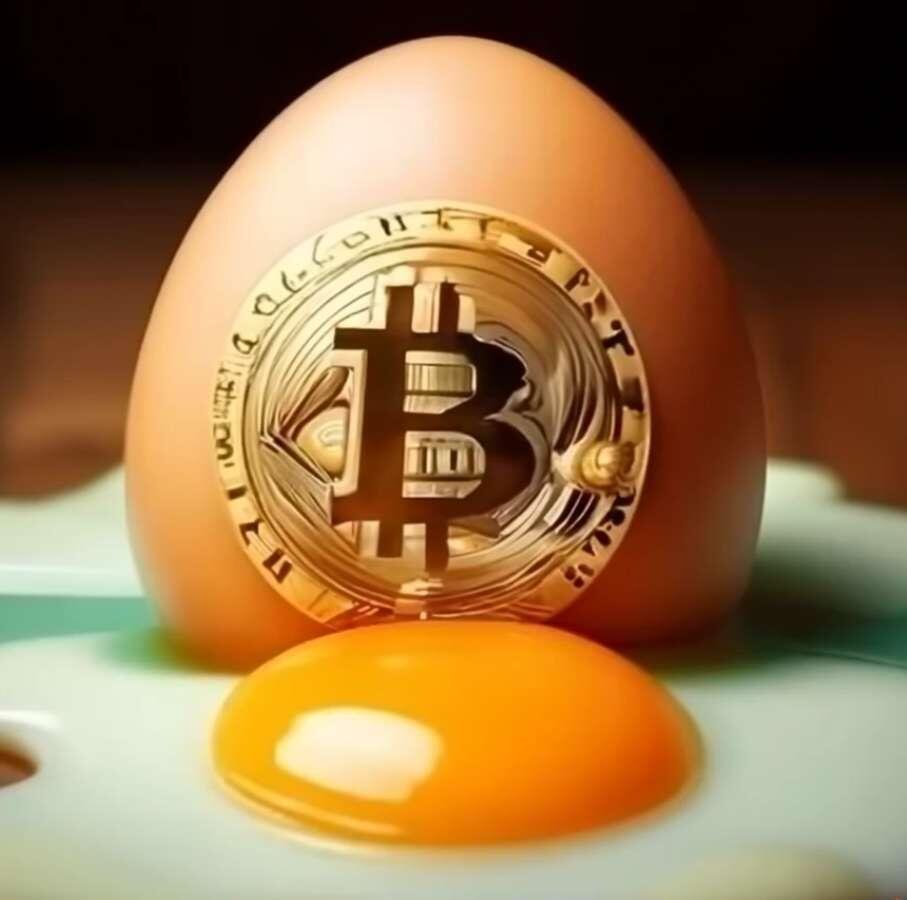
you can just store every bitcoin transaction ever made in your pocket
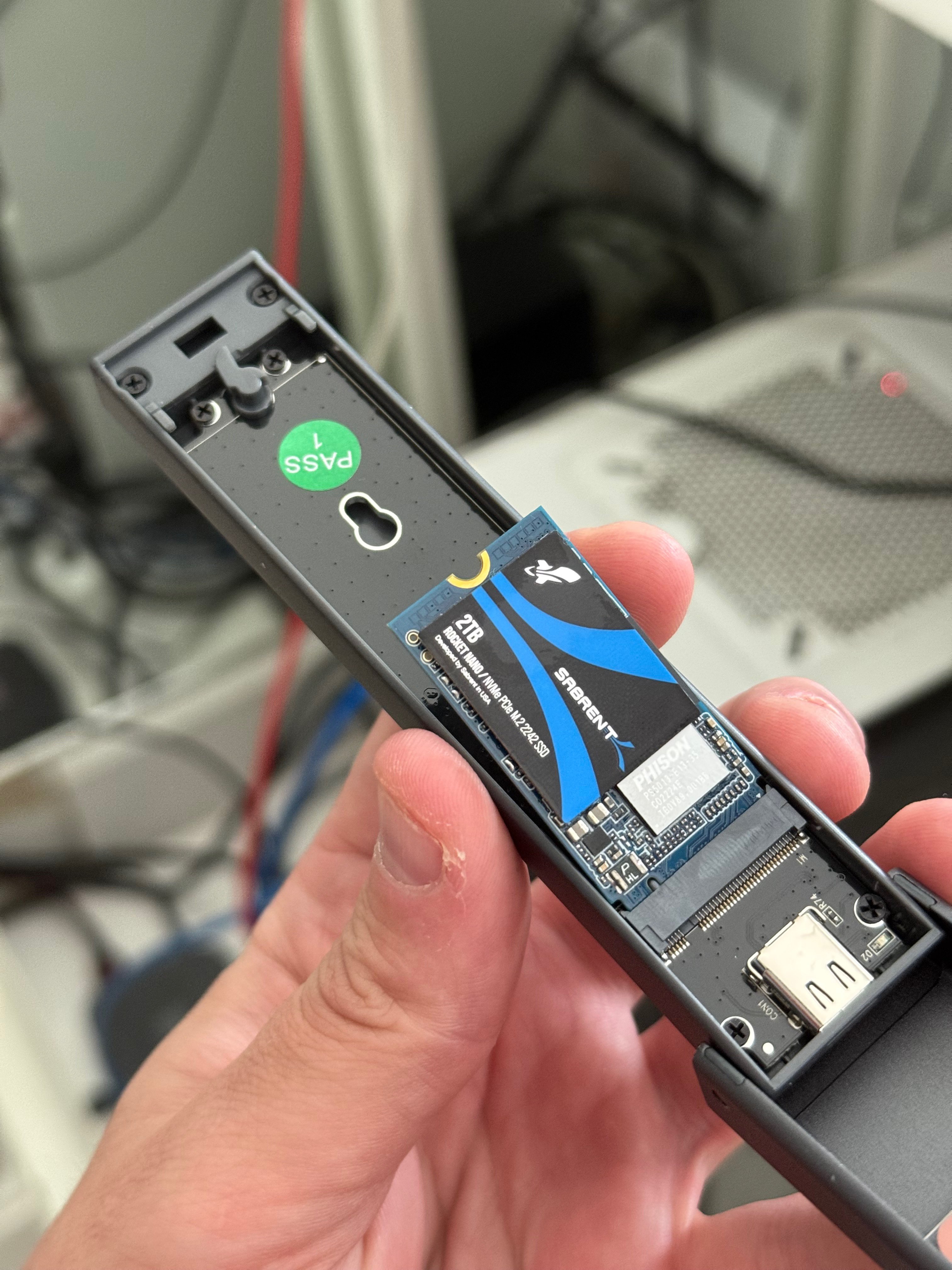

you can just store every bitcoin transaction ever made in your pocket
There is more than enough room in that stick to fit in the rest of the relay or node
I'm running bitcoind (full + mempool), LND, AlbyHub, RTL, and tor... with half that space. https://raspibolt.org
It’s amazing 🤯
What is that?
Do not forget to put it in a faraday bag
I have that same exact M.2 enclosure.
Internet money rocks
I have the same one.
I have the exact case and it has held up pretty well over a year. Almost lost it a couple of times though.
If I was tool I would sell my ass for money but you are a tell since you pay for sex with children
With Umbrel OS boot on any computer
It's possible to store the blockchain on DNA
I thought you were kidding, holy hell what an interesting rabbit hole🤓
==============================================
Yes, **it is theoretically and practically possible to store blockchain data on DNA**, though it's still experimental and comes with significant challenges. Here's an overview:
---
### ✅ **How DNA Data Storage Works**
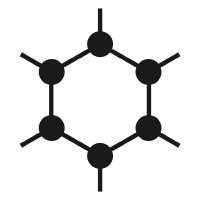
DNA data storage encodes binary data into the four DNA bases:
* **A (Adenine)**
* **T (Thymine)**
* **C (Cytosine)**
* **G (Guanine)**
For example, the binary data `00` might be represented as `A`, `01` as `C`, and so on. The DNA strands are then synthesized in a lab and stored. To retrieve data, the DNA is sequenced, and the base pairs are translated back into binary.
---
### 📦 **Storing Blockchain on DNA**
Storing blockchain data on DNA would involve:
1. **Extracting the blockchain ledger** (like Bitcoin or Ethereum) as a sequence of bytes.
2. **Encoding those bytes into DNA base sequences.**
3. **Synthesizing DNA strands with that encoded data.**
4. **Storing the DNA in a stable environment** (DNA can last thousands of years if stored properly).
5. **Decoding** (reading) when needed via sequencing.
This could be applied to:
* Full blockchain archives
* Smart contract states
* Transaction histories
---
### 🧪 Real-World Experiments
* In 2018, researchers at Microsoft and the University of Washington stored a video in DNA.
* In 2021, **a group stored part of the Bitcoin blockchain** in synthetic DNA, proving feasibility.
---
### ⚠️ Challenges
* **Cost:** Synthesizing and sequencing DNA is expensive (but prices are dropping).
* **Latency:** Very slow read/write speeds compared to digital systems.
* **Scalability:** Blockchain grows constantly — updating DNA with new blocks isn't practical in real time.
* **Error rates:** DNA synthesis and sequencing introduce small errors that need redundancy and error correction.
---
### ✅ Advantages
* **Longevity:** DNA lasts thousands of years in the right conditions.
* **Density:** Incredibly compact — all the world's data could fit in a shoebox of DNA.
* **Energy Efficiency:** No need for electricity to maintain storage.
---
### 🧠 Bottom Line
Storing a blockchain on DNA is possible and has been demonstrated in limited forms. It's more useful for **archival or historical purposes** than active participation in the blockchain network due to cost and speed limitations.