
We have no idea about human like/type intelligence. We're not even close to replicating it, we're missing some fundamental things, we don't even know about. 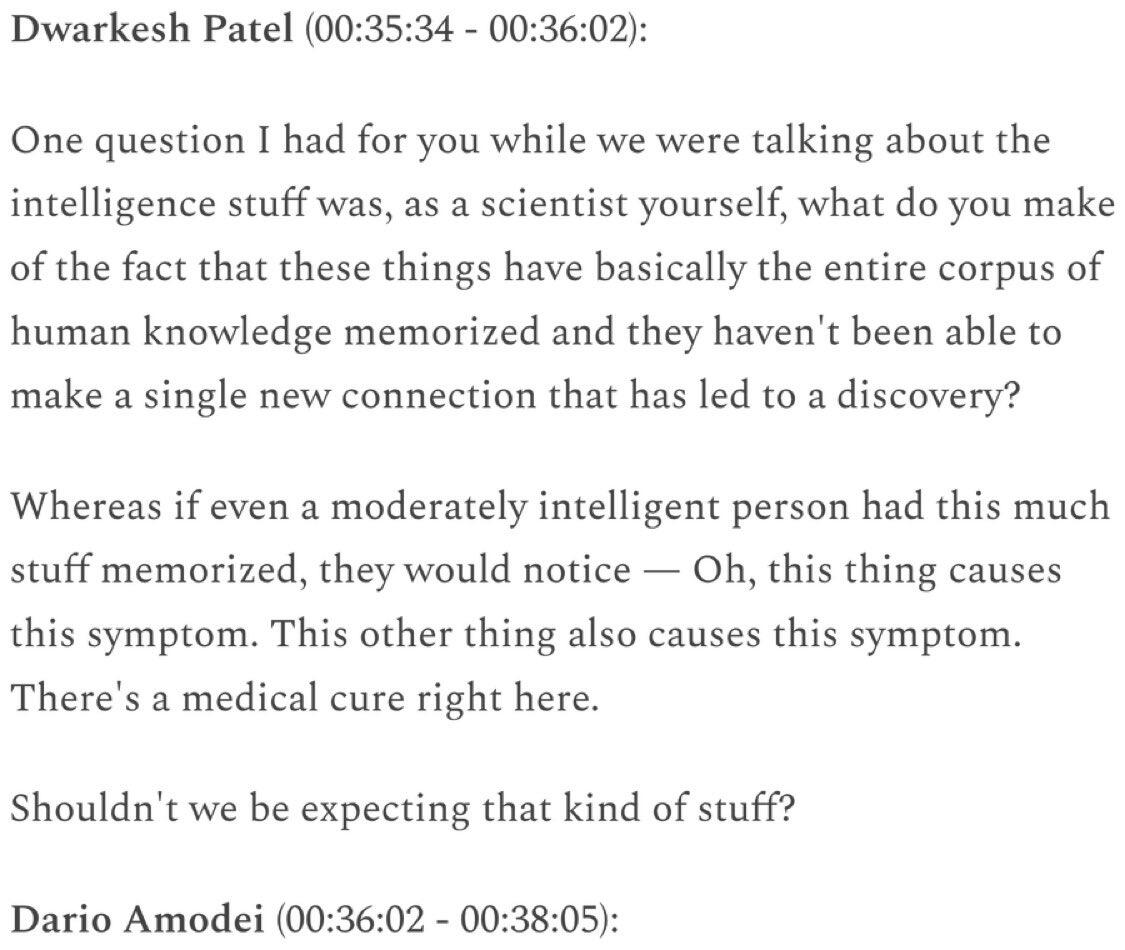
Discussion

Or it HAS made some such discoveries and HAS made such recommendations, but they are so wildly Politically Incorrect that they "must be kept secret" from us.

Despite the neural network architecture, LLMs don't operate like the human brain. They're just fancy curve fitting algorithms. They need to reason and understand things to help us discover new things. But how do you program understanding? How do human brains even understand?
The human brain is far more complex than these generative models based on transformer architecture. I mean, at its core, it’s just doing basic matrix multiplication. The human brain is doing something way more extraordinary.
We don’t even know if that function lies in a general physical world, or the quantum realm.


I don't think I would make any new connections either if my brain state reset after each token. We don't let LLMs be bored and wonder about things while. They spit out tokens in response to a question and then halt.

the more someone understands AI/ML, the more they realise how far we're away from human level AGI - or - someone is shilling their product/trying to gain clout if they are saying otherwise.

That may be because the new philosophy of mind abandoned old traditional concepts from Socrates, Plato and Aristotle. You don't simply discard something they said without a damn good reason in philosophy... These are the GOATs. To them, what made the human mind fundamentally different from an animal's mind (or a neural network, for that matter) is that what gives us self consciousness is not the brain per se, but some aspect of the soul. Something imaterial inside us. If they are at least partially right, the search to understand the mind is going in the wrong direction when studying only the brain and its material aspects