
3-4 mining pools control > 75% of the hashrate.
A disgusting shame.
Until further notice, Bitcoin is NOT censorship resistant. 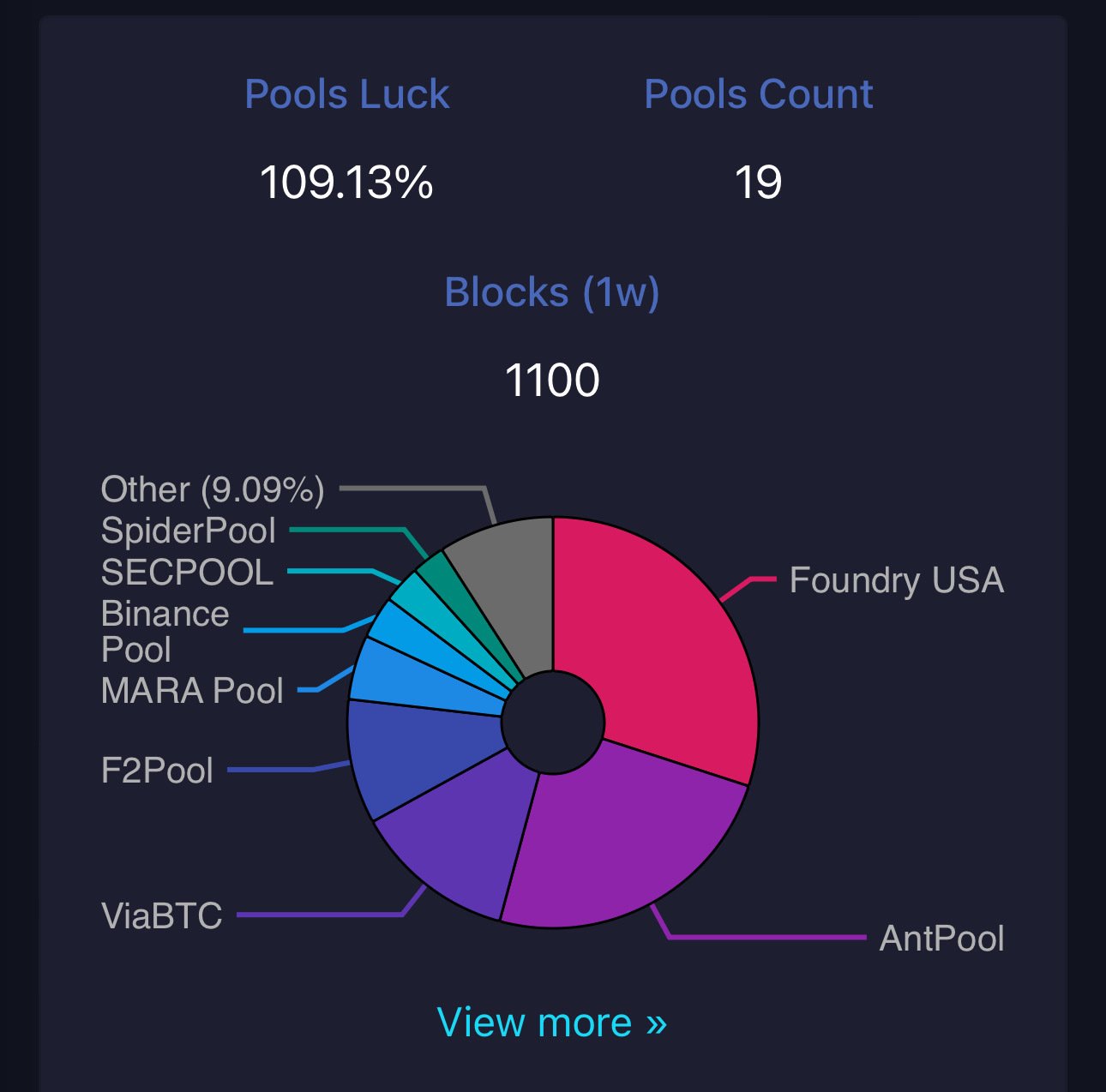
3-4 mining pools control > 75% of the hashrate.
A disgusting shame.
Until further notice, Bitcoin is NOT censorship resistant.
Not true and this will always be the case.
Then bitcoin will always be a censorable network.
Feel free to give me your sats and start shitcoinig then.
My point in being critical is because I care deeply about bitcoin. I need it to be here for my children.
I am most critical of the things I care most about.
I’m not a shit coiner…
My point is that it's not a valid critique.
Fair enough…but I’m not comfortable with the current state of mining centralization…and many developers, including Luke, Matt and others agree it is an issue that needs to be addressed…
https://theminermag.com/news/2023-12-28/bitcoin-mining-pool-block-reward-antpool-hashrate/ 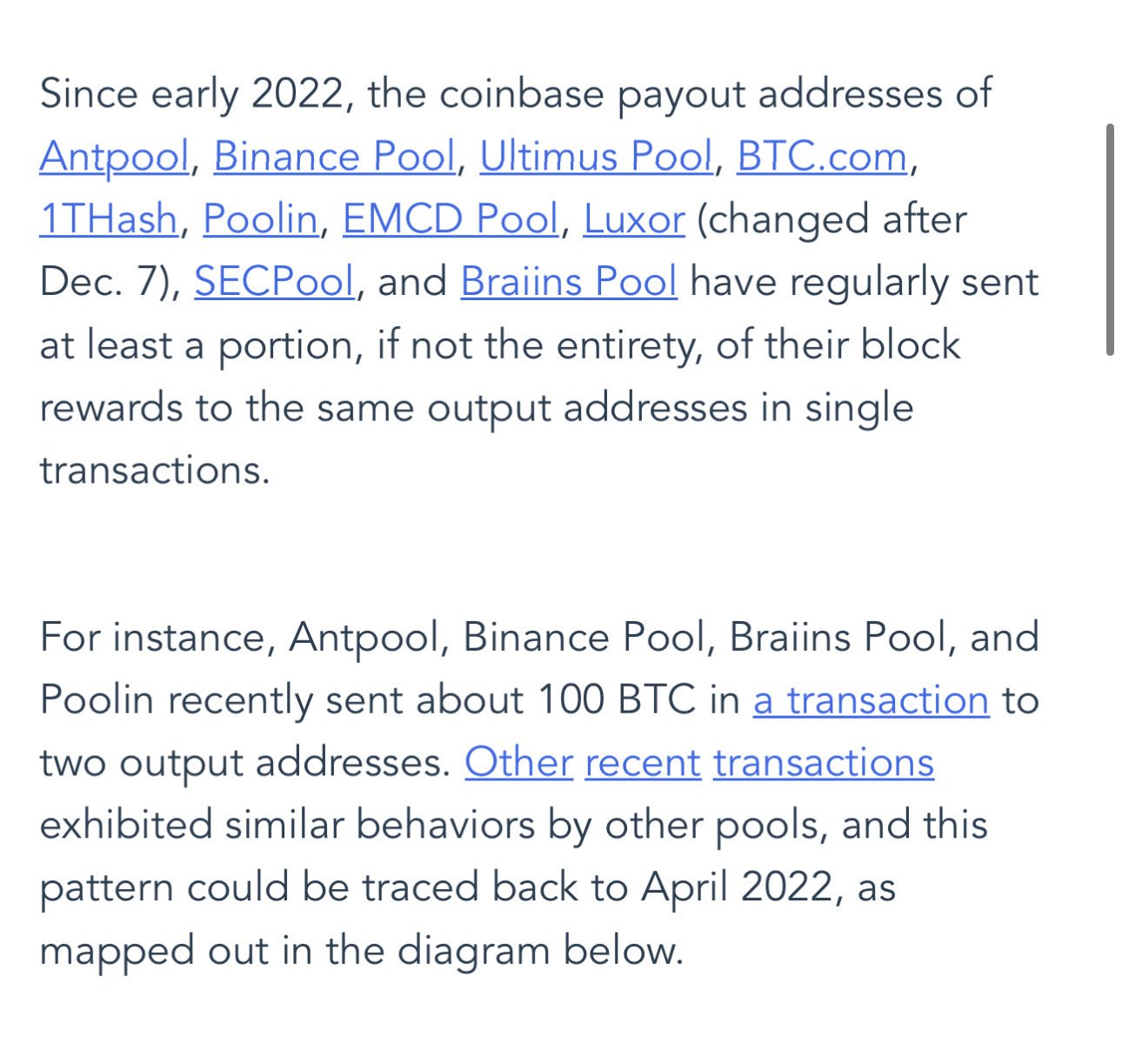
These pools are made up of thousands of individual miners that can direct their hash elsewhere if there is a problem. Just because pools are big does not equate to centralization. There will ALWAYS be 1-2 big pools as people will ALWAYS mine with a pool that gives them the most sats for their hash. It takes a miner 5 seconds to switch pools. If there is a censorship problem or a pool near 50% people will point somewhere else. This has happened over and over again. Bitcoin mining does not have a centralization problem just because some pools are big.
Mining pools are not miners though. If one pool is censored/shutdown the individual miners’ hashrate can easily migrate to another one and keep hashing.
To a point, but it’s more complicated than that.
For example, why don’t individual miners recognize the current issue and, at minimum, move hash to a different pool?
How much of that hash rate is pooled?
What happens when a pool goes against contributor wishes?
What's stopping other miners from coming online?
Bitcoin is censorship resistant
What do you mean “against contributor wishes?”
Many of the miners couldn’t care less about block template construction and are only interested in fiat gains.
Many hashers have no “wishes.”
Why do the miners choose these three pools? What are the incentives to do so?
Great question.
Ok, censor a transaction
So weak. But It’s the type of comeback I would expect from an employee of a publicly traded mining company.
A company that is required to prioritize fiat gains over the health of the bitcoin network.
Are you suggesting 4 pools controlling 75% of the network is good for bitcoin?
“Oh, but individual miners can just move their hashrate…”
Not true…
You said it’s not censorship resistant, can you point to a txid that is currently being censored?
I cannot, however...
Imagine you are playing a game of Russian Roulette with a 6 round revolver. You spin the cylinder, put the gun to your head, and pull the trigger and NOTHING happens.
Now imagine somebody claiming the game is safe (secure) because you survived a single round. This represents a FALSE sense of security.
This is similar to the current state of bitcoin and censorship resistance. Just because no transactions are being censored today does NOT mean the system is immune to censorship.
Four pools could neglect the work done by the other 25% of miners and cooperate to harm bitcoin's "censorship resistance."
We should try to solve this potential problem before the censorship begins.
Do you disagree?
The metaphor is incorrect, because if a txid is censored, it just sits there in the mempool. Bitcoin is not destroyed, it’s not over, the transactor can simply CPFP/RBF until greedy miners defect.
the problem I see in this reasoning then is how many generations? and how high a fee? with centralized mining, this is definitely a threat.
I don't think we're in doomsday scenario yet. and my guess is we'll see more mining pools rising to the occasion in the coming years, with governments and corps taking more of an interest. we'll have to see.
I’m not good at price predictions 😂.
Game theory seems to be that censors won’t bother because the fee to overcome would be relatively low.
Not if the people doing the censoring can build on top of their own blocks?
Might just take longer to accumulate censored transactions in the mempool
Or we could just recognize the current issue and work to solve it prior to any 1-2 entities having the power to censor.
There’s a lot of hypothetical problems to be solved
Mining being centralized is not a hypothetical problem. It is the current state of things.
Fortunately, those who have monopolized the hash-rate have not harmed Bitcoin.
Transactions being censored is a hypothetical problem.
Mining can’t be monopolized, it’s the most competitive industry in the world.
Anyone can fabricate arbitrary centralization metrics and declare a hypothetical of theoretical censorship-resistance, for example 100% of hashrate is on planet Earth.
nostr:npub185h9z5yxn8uc7retm0n6gkm88358lejzparxms5kmy9epr236k2qcswrdp you were (are?) extremely concerned about mining centralization and the risks it poses to Bitcoin. Pierre doesn’t seem terribly concerned.
Would you review this thread and help me better understand both of these view points?
If I recall you even suggested a nuclear option of changing to another hashing algo if we cannot fix the situation.
Pierre, I respectfully disagree with your position.
Your claim was “Until further notice, Bitcoin is NOT censorship resistant.” I think you’ve appropriately backed off that claim to a more nuanced “there’s a risk of Bitcoin maybe not being censorship resistant in the future”
The production of the hardware and the hash rate are both centralized and represent a threat to bitcoin.
If you’re right they’ll get attacked, and if I’m right they will decentralize in response to that attack. That’s what I mean by anti-fragility of censorship resistance.
You’re welcome to pour resources into pre-emptively tilting at windmills, but I have to pushback when someone claims that Bitcoin is not censorship resistant when they have no censored transactions as evidence.
Thanks Pierre. 🙏
One of the primary value propositions of bitcoin is censorship resistance. If it loses this feature, people will lose confidence and the network will suffer.
75% of the hash-rate can disregard the other 25% and build on their own blocks.
Are you suggesting the current state of mining centralization is fine? No issue?
Censorship resistance is a dynamic, anti-fragile process, not a static feature. If there is censorship, people will pay higher fees to overcome it.