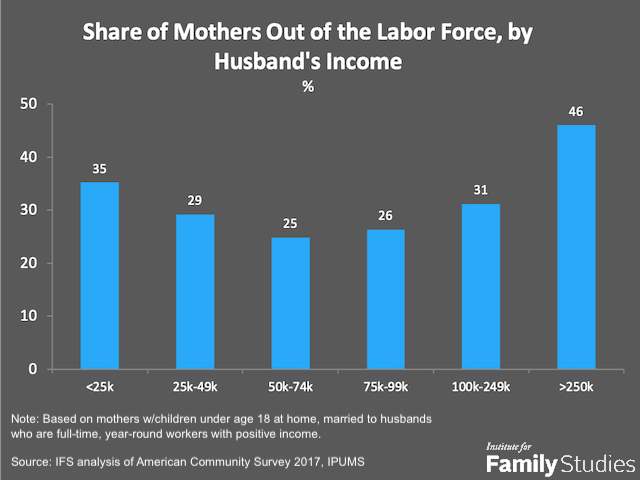
Many people competing for the same jobs drives wages down. More than half of households are dual-income households.† This increases the labor pool, which drives down prices.

Ironically, it would seem that, if more families switched to one parent being the primary breadwinner, it would drive up the cost of labor and make single-income households a more sustainable proposition for more families.

The knock-on benefits from the additional time and attention the now stay-at-home or part-time working parents could give their children would have a generationally positive impact on well-being and prosperity.

† Bureau of Labor and Statistics: https://www.bls.gov/opub/mlr/2020/article/comparing-characteristics-and-selected-expenditures-of-dual-and-single-income-households-with-children.htm

Reply to this note

Please Login to reply.

Discussion

We are single income. Mom stays home. We were doing great before Biden, but this Democrat economy has got us teetering on the edge of a cliff now, just like the Carter and Obama years.

Lots of respect 🫡

The inflation has really been eating at people's quality of life lately. That and other things, I'm sure.

Wives went out to work, en mass, to mask inflation in the 1970s. And now you sometimes have marriages with 3 or 4 jobs, again to deal with Inflation.

Rat race.

Most women have always worked (at something other than homemaking), outside of the postwar Americana Era, but it used to be more life-stage related and a lot of women worked in family businesses or side-gigs.

I see more of that, as people view work more flexibly and resumes become more random.

The "get hired by big company at 20, work full-time until 65, then retire and get a gold watch" Era is basically over.

Single earner households are slightly less maritably-stable than with one full-time worker and one part-time or side-gig worker, tho. Too little redundancy, perhaps, or too much boredom, once the kids are grown.

Homeschooling probably reduces that effect, but I don't have stats on that.

Well, I guess anything practical or intellectual, that the SAHP is doing, will reduce that effect.

Homemakers who run a tight ship in the household and volunteer, or have extensive vegetable gardens, or enjoy taking online classes and joining book clubs, etc. seem to reintegrate well into the main workforce.

So, maybe we're looking primarily at some underlying effect of personality.

Well... I can only speak anecdotally, though I came from a single earner household, but most families weren't raised in a fairly wealthy household environment like mine was. Although, I have known some wealthy families who were quite dysfunctional, but far from all or even most I would say. 🤔

Maybe it was because there was always quite a bit to do around our house. My mum was always busy caring for the garden and such and she's still an avid reader.

Women who are alert and industrious tend to stay busy, regardless of where they are. They have an inner drive.

I'm not denying that. I'm questioning the accuracy of such statistics when dictating the levels of marital stability of single-income in relative to dual-income households.

It's been a shift.

Used to be the other way around, but the middle-class women who used to be homemakers usually work now, and they took their marital stability into the working demographic.

The statistics make sense, though. A woman whose whole existence is keeping a home and raising children will come to be dissatisfied, especially as the kids grow up. A part-time side gig or other similar projects help give a sense of self that can endure changes in a growing and maturing family.

Yeah. It doesn't even need to be that much, just something to engage her mind and keep her from feeling trapped and bored.

wen little mini laeserins?

I have two teenagers, already. That's enough. 😂

well, you has midi laeserins then

True enough. My mother kept herself occupied with the rather large garden we had, a LOT of reading, piano playing (something my daughter also loves), teaching me how to play chess and typical household duties, of course.

Switching wouldn't drive up wages that quickly, as those are contract-based (sticky and slow to change) and employers can respond by increasing automation or relocating production.

But it tends to immediately lower costs and spending for each household, which would quickly have a deflationary effect on consumer goods pricing, which would reduce the income needed, which would again drive down prices...

Deflationary spiral.

Would probably also lower public outlays, for instance, for after school programs and childcare subsidies, health and medicine, and etc.

And expand the possibilities for where one family can live and work.

So, that would be 3 deflationary effects.

To be honest, i'll prefer to be a stay at home wife. But this has slowly become known as a lazy job and that I should entrust the government to education my children so I can earn money for the family.

Most children are probably better off having more time with their parents and less time in a government school. The simple reason is that each child gets more individual attention. A parent's ability to teach might cap out around middle or high school, but the educational quality for those early formative years is likely to be as good or better with homeschooling.

Having one parent at home full time, or working part-time, leaves that parent more time to manage the household, which introduces serious efficiencies and savings over time.

I'm not opposed to this. But parents are just part of the rat race often to work until they can't to support the family. How many stories have you heard men joining the military to support their gf, wife and children? (Benefits are super good) whereas the public sectors have miniscule pay, and benefits unless you work at some top 300 forbes job. A person that cut hair or one that bakes bread should be able to save regardless of their job but inflation makes it impossible.

I think there are a lot of contributing factors, not least of which is corporate greed. Shareholders demand ever-larger margins and ever-increasing growth, which leads companies to try to extract more value out of fewer employees for less money.

In a just economy, not every job would be able to support an entire household, but most jobs would, and stability, rather than growth, would be the primary corporate priority.

If you're a shareholder watching stability would ever be boring.

"Exciting" isn't always the best for the common good, though.

Wild take: reducing the individual work hours to 20 a week would also make labor more scarce and thus force wages up up.

Sure, having many people work relatively few hours per person is significantly less efficient than fewer people working long hours but as with everything, there's also a tradeoff: efficiency vs xyz.

Not every job can be done in 20 hours per week. Some can, though, and in such cases we should pay people for output rather than for time. That would make certain career fields more conducive to family life, because a hard-working breadwinner could do all his work in under 40 hours, and have more time left to spend with his family.

Most of the time, if you take into account buying work clothes, eating out lunch, transportation, and child care, especially when a family has multiple kids, the financial benefit of the 2nd income is very small and sometimes even negative (depends on # of kids and income of 2nd parent).

I've never thought of the effect on pay in the workforce because I've normally only looked at it from the point of view of a single family. If many families make this choice, you are correct.