Summary TL;DR
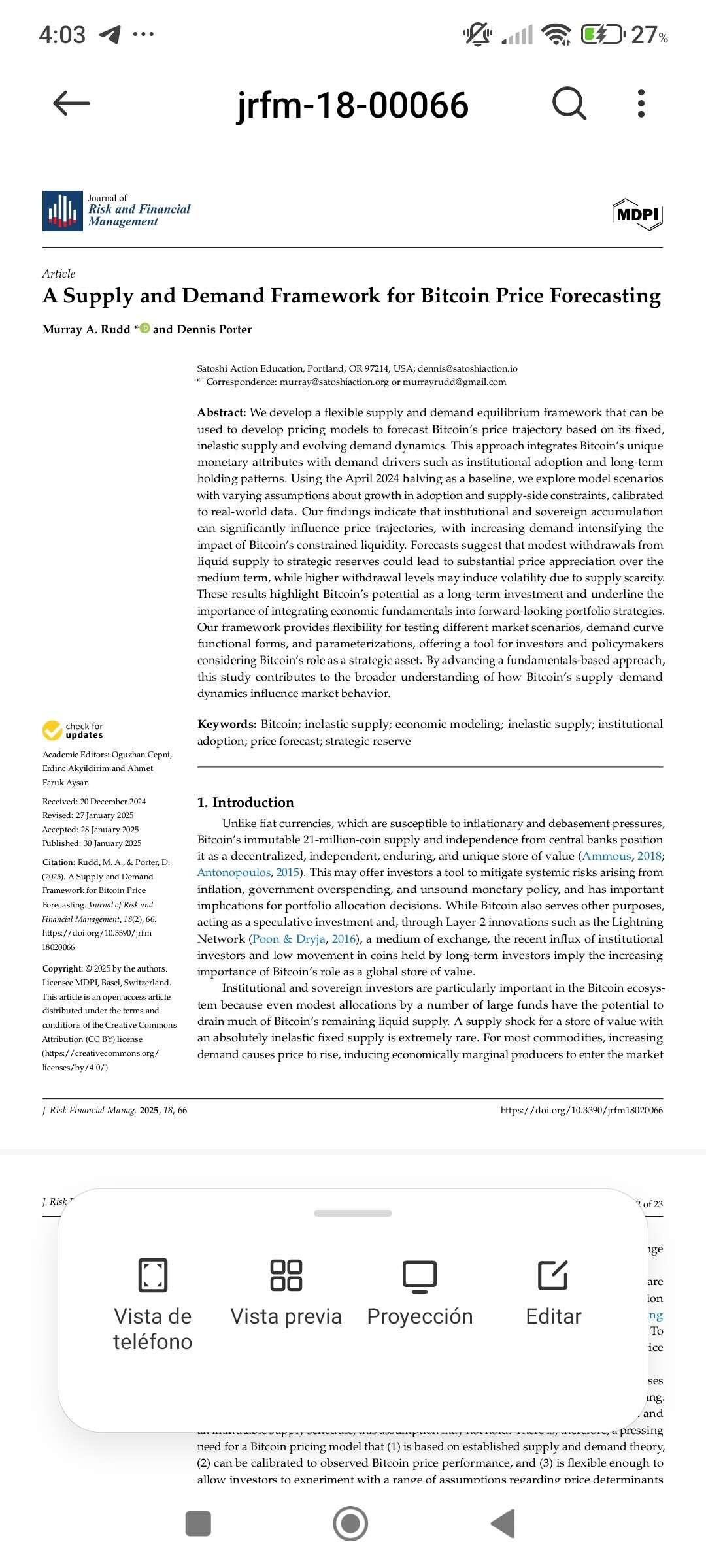
Summary of “A Supply and Demand Framework for Bitcoin Price Forecasting”
Authors: Murray A. Rudd & Dennis Porter
Published in: Journal of Risk and Financial Management (2025)
Objective
The paper presents a supply and demand equilibrium framework for forecasting Bitcoin’s price, emphasizing its fixed, inelastic supply and evolving demand dynamics—particularly institutional adoption and long-term holding. The model aims to provide a fundamentals-based approach to predicting Bitcoin’s price trajectory, as opposed to relying solely on historical trends.
Key Takeaways
1. Bitcoin’s Supply Constraints & Market Dynamics
• Bitcoin has an immutable cap of 21 million coins.
• Halving events reduce new supply issuance (~every 4 years).
• At the April 2024 halving, 93% of Bitcoin’s total supply had already been issued.
• A large portion of Bitcoin (~45%) is dormant (lost, HODLed, or in strategic reserves).
• Institutional & sovereign accumulation is removing liquid supply, intensifying scarcity.
2. Bitcoin Price Forecasting Models
The study critiques existing models and proposes a new approach:
Model Type Strengths Weaknesses
Stock-to-Flow (S2F) Links scarcity to price Doesn’t account for demand dynamics
Energy-Based Valuation Uses mining costs as a price floor Ignores demand-side factors
Macroeconomic Models Considers inflation, interest rates Overlooks Bitcoin’s internal market forces
Network Models Links adoption growth to price Assumes all users equally impact price
Power Law Models Describes Bitcoin’s historical scaling Not predictive of future demand shifts
Statistical Models Short-term price prediction Ignores supply constraints & fundamentals
Proposed Solution: Supply-Demand Equilibrium Model
• Treats Bitcoin as a commodity with a perfectly inelastic supply curve.
• Price determined by shifts in demand, particularly from institutions.
• Flexible structure allowing for different scenarios and parameter adjustments.
3. Bitcoin Supply & Demand Model
The authors develop a Constant Elasticity of Substitution (CES) demand function, using:
• Fixed supply curve: Bitcoin issuance is pre-determined and cannot expand with demand.
• Demand variables: Institutional adoption, sovereign accumulation, and market liquidity.
• Price elasticity assumptions: Bitcoin behaves like a store of value with decreasing elasticity over time.
4. Results: Projected Price Trajectories
Impact of Demand Growth & Supply Withdrawals
• Modest withdrawals (1,000–2,000 BTC/day) drive significant price appreciation.
• Aggressive withdrawals (>3,000 BTC/day) could exhaust liquid supply, causing a hyperbolic price increase.
• Institutional demand shocks (e.g., ETFs, sovereign reserves) could amplify scarcity effects.
Forecasted Bitcoin Prices (April 2036)
Demand Growth Multiplier (D) Price w/ No Withdrawals Price w/ 1,000 BTC Withdrawals/Day Price w/ 2,000 BTC Withdrawals/Day
1X (Baseline Demand) $62,160 $75,203 $106,410
10X (Moderate Adoption) $638,890 $772,947 $1,093,690
20X (Institutional Surge) $1,279,701 $1,548,217 $2,190,667
30X (Sovereign Reserve Race) $1,920,511 $2,323,488 $3,287,645
40X (Bitcoin Becomes Global Reserve) $2,561,322 $3,098,758 $4,384,623
• At a 10X demand multiplier, Bitcoin’s market cap could surpass gold’s (~$16T).
• At 40X demand, Bitcoin could exceed $91.4T in market cap (~6X gold’s value).
• Price volatility expected to increase as liquid supply diminishes.
5. Portfolio & Investment Implications
• Institutional investors should prepare for supply shocks.
• Bitcoin’s future price path is highly sensitive to demand-side factors (ETF flows, sovereign adoption).
• Long-term HODLing may become more attractive as liquidity shrinks.
• Bitcoin-backed credit products (e.g., MicroStrategy-style leveraged accumulation) could accelerate price appreciation.
6. Model Limitations & Future Research
• Assumes fixed demand elasticity (may evolve over time).
• Uncertainty around lost coins & true circulating supply.
• Future models could integrate stochastic simulations or Monte Carlo analysis.
• Potential need for regulatory intervention to manage volatility risks.
Conclusion
This study presents a fundamental economic framework for forecasting Bitcoin’s price, highlighting:
• Bitcoin’s fixed supply makes it unique among assets.
• Institutional accumulation could trigger supply shocks.
• Demand-side factors will dominate future price movements.
• A strategic reserve race (corporate & sovereign) could cause hyperbolic price appreciation.
Key Takeaway
Even modest increases in institutional adoption, combined with Bitcoin’s supply constraints, could drive substantial price appreciation over the medium term.