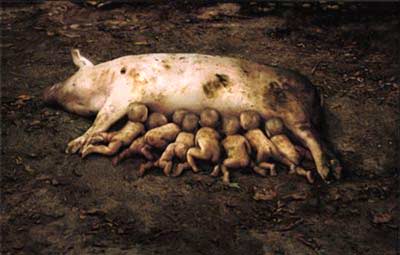
Being an individual is rare.

Of course everyone is an individual, but most will not identify themselves this way.

Most will choose to identify with their racial/cultural group ahead of their status as an individual.

The person who realizes the harsh truth that they are but one lone human in a sea of humanity is special.

They are unique.

They are bounded by nothing.

Which allows them to do anything.

Reply to this note

Please Login to reply.

Discussion

Even eat in restaurants 😉

I paraphrase Amos Oz when I say this: No man is an island. But everyone is a peninsula.

Because we are in fact connected whether we want it or not

“The smallest minority on earth is the individual. Those who deny individual rights cannot claim to be defenders of minorities.”

— Ayn Rand

I remember this comedy show we went to one time the guy was going on about "black people are like this and that..." We were sitting in the front row and her turns to me and says "you're black... You know what I mean.

" I responded " I'm Ian... And Ian doesn't know what you mean." Ruined his set for a solid 5 minutes.

I frequently find myself in interactions like that. Which is frustrating.

“Well you’re a white male so you think x, y and z”

I don’t think any of those things.

“Yes you do”

No I really don’t.

Assuming is a dangerous weapon

Gm hodl đŸ«Ą

GM

Ayn Rand was onto something. đŸ«Ą

if in a good way

your friends & family

tell you, “you’re weird”

you’re probably living right

If you have never been called crazy, you have never really lived.

The smallest minority in the world.

As a cis straight white heteronormative male, I approve of this message.

What is that in English? Auto translate seems to have become stuck.

It's woke English. It's kinda new, so the auto translation may not be up to date on the lingo.

95% of people can't handle that they are individuals with responsibility for themselves.

That's why they'll do anything - really anything - just to follow other people, no matter how insane or cruel.

And we can inspire them to be themselves. Many role models are needed, we can do this

But we aren't lone individuals. We were made unique in God's image: unified in our ends but granted freedom to pursue them.

Identifying with a subordinate racial or cultural group introduces competition, but there is no competition in the group of the children of God.

We are born into a family with unbreakable bonds; God willing, we die surrounded by the new family we create. These bonds allow us to become who we are meant to be.

Whether one believes in God or Gods or the lack thereof, recognizing all of humanity as a single unified group who can universally benefit by prioritizing the greatest good for the greatest number of people is the path to a very beautiful world indeed.

Prioritizing the greatest good for the greatest number of people is the path to genocide.

Is it better to kill 1 million people to help 9 million have great lives or let 10 million have mediocre lives?

Believing in God and that humans are made in his image requires respecting the individual's dignity. Yet, our purpose is toward communion with God and each other. Both extremes of individualism and collectivism fail to see this distinction.

This would fall into the philosophical argument of the trolley problem I think. Is it morally superior to intervene and save 5 people who will die, if it means your actions directly cause the death of 1 other person who would have lived?

It's a thought provoking question. But, for this Utilitarian Humanist anyway, the greatest good for the greatest number would not lead to genocide in any sense. I do not see how genocide stems from that. I do know definitively however that religious believes are the cause of a not-insignificant number of genocides. So I very much disagree that religion prioritizes the individuals well being and prevents genocide.

When trying to maximize the greatest good for the greatest number, how can you justify leaving 10 million people with mediocre lives when you can give 9 million great lives?

Can you share some of the religious genocides? I'd like to learn about them.

You can't be serious dude.

I don't know why you think I'm not serious. My first question is a philosophical question. I'm curious if you actually believe the goal you state. If you want to achieve the greatest good for the greatest number, we should definitely give 9 million people great lives instead of 10 million mediocre ones.

For the second question, I'm curious about what this video is leaving out: https://youtu.be/1FE0HgS01do

I will say this.

When people disagree on something, and that something is fundamental to how they see the world in a sense of good/evil, they will often resort to extreme measures to enforce what they see as 'good' and remove what they see as 'bad'.

This doesn't apply only to religion, this also applies to any group identity that is concerned with another group that they see as wrong. Things get especially bad when the opposing group and it's beliefs are seen as irredeemably evil.

Think opposing sides in any international or intranational disagreements, religious conflicts, or political conflicts, and so on. If the two sides cannot come to common ground through open communication, founded upon mutually agreed upon independently verifiable truths that unite them, they will often escalate until violence breaks out. This occurs due to disagreements themselves, regardless of the subject matter of the disagreement.

Whether or not we agree on which events are genocides, or just plain violence against other people, there are countless events throughout history in which religion or religious ways of thinking was either a primary or secondary factor that exacerbated the situation.

Religions and religious beliefs are things which humans do not and cannot ever agree on. Why? Because they are things which self admittedly are grounded on things that require faith to believe in.

If religious beliefs do become independently verifiable truths, then they no longer require faith and just become shared truths of humanity. For instance nobody worships the sun these days because we now understand what it is: a ball of nuclear fusion that radiates energy at the center of our solar system, to which our planet is gravitationally tethered. It doesn't hear or answer prayers, it has no consciousness and doesn't even know we or itself exists at all.

Things that require faith are things that have no independently verifiable ways of determining their truth. If there are no independently verifiable ways of testing any religious beliefs, then we will never be able to find common ground in them.

Without a way to find common ground, we self organize into groups who disagree on details that have no concrete agreed upon answer.

These groups will come to violence if they cannot find common ground, and that isn't possible with faith based beliefs.

The only common ground religions have is when they group together against another group with alternative viewpoints in which they disagree.

For this reason the world can never be peaceful until it grows out of the cradle of religious thinking. Not because religious thinking itself is bad, but because it is just a branch of the type of irrational thinking that breeds conflicts through disagreements on things for which there is no obviously verifiable truth.

Show me a religion that doesn't require faith and is purely based on independently verifiable objective truths that everyone agrees on. There aren't any, because that's not how religion works.

Religions are a type of organization that train people to just accept things that they're told on faith, to be subordinates. They make people who are willing to bow to authority figures who often claim they have been given this authority by an unseen being. This leads to good people being willing to do things they otherwise wouldn't, such as assault or even murder others.

Until we find a way to separate humanity from unverifiable beliefs, and discourage blind obedience and subordination authority figures of all kinds, the world will never have peace.


I doubt there is a single "independently verifyable objective truth that everyone agrees on".

There are always some crazy people who will disagee with even the most obvious truths out there. And throughout history there were many cases where both the majority and the experts have been proven wrong.

So instead we should focus on verifyabiliy and objectivity.

Nothing in life is verifyable to the same degree for everyone. If I don't run my own node I can't verify if I actually own any Bitcoin. If I run my own node I still trust in the source code to be honest with me. If I learn to read the code I still have to trust that my computer is actually running that code and not malicious softare inserted by an attacker. So ultimately verifyabiliy breaks down to something being highly probable and it is often impossible or highly impractical to fully verify something as truth.

I guess the best approach is to verify as much as reasonable and to be open for new evidence to present itself. And that is exactly what the early christians did. They heard about some guy who was crucified and came back to life. So they verified as much as possible, they spoke to eyewitnesses, checked the existing scriptures and came to the conclusion that god raised him from the dead. The greek word "pistis" which is often translated as "faith" was originaly understood as "being persuaded/convinced by argument".

So contrary to your claim christianity is actually based on verification instead of bindly following an idea no one can agree on.

A good analogy is getting a loan. When a lender makes a loan with the faith that the borrower will pay him back, it is not that he is blindly handing money out because we can't objectively agree that the money will be paid back. Instead, the lender's limited reason points to trust that the borrower will repay the money. Faith in the action is not below reason by being contrary to it, but it is above reason: the lender can't know the future, but he commits to an action based on his reason from the past.

The most popular religion explicitly teaches the opposite: “But I say to you, Do not resist one who is evil. But if any one strikes you on the right cheek, turn to him the other also.” (Matthew 5:39)

I'm glad you agree religious people aren't the only ones that can be disagreeable. It's undeniable the atheistic communist governments have resorted to extreme violence against their political opponents.

I could respond to much of what you said about religion, faith, and reason; however, many well-established sources exist for good arguments. Pope St. John Paul II’s encyclical Fides et Ratio (Faith and Reason) is a good starting point.

I want to focus on “independently verifiable objective truth” because you made an excellent point, except, in its essence, religion is a description of truth.

Now, I think understanding truth requires deeper thought. Take the question: does the universe have a beginning? Some people take both sides of that question, neither of which is independently verifiable because (a) we can't go back in time to see if the universe began, and (b) if it's infinite even if we could go back in time, we would never know if there is no beginning or we just haven't gone back far enough. So what do we do? Say, because it's not independently verifiable, we can't know anything about the creation of the universe from our reason. Some modern skeptics take that position, saying we can only trust our senses to derive objective truth. But why should we trust only our senses and not our reason? We know our senses are deceived all the time. So how do we find the truth?

(Aside: I'll make one point about faith and reason. Properly understood faith is not infrarational like you and many others suggest. Instead, authentic faith is suprarational. Faith never contradicts natural reason; it points our reason towards things beyond our limited understanding of reality.)

Your commitment to truth is admirable, and even though you may disagree, it is actually at the heart of Christianity: “What is truth?” (John 18:38). I hope that in your pursuit of truth, you take the time to read the preceding passage in the Gospel of John and contemplate what it means to seek the truth.

To complete the note, I’d add this to follow the last statement:

“I have the right to do anything,” you say—but not everything is beneficial. “I have the right to do anything”—but not everything is constructive. No one should seek their own good, but the good of others.

‭‭1 Corinthians‬ ‭10‬:‭23‬-‭24‬

đŸ€™â€ïž

Being a part of a "group", such as racial or national identities, brings a lot of baggage and guilt by association. Actually joining groups who identify with certain specific views also brings a lot of pressure to conform to the views of the group.

The lotteries (genetic and otherwise) that determined what I look like, sound like, who I'm related to, which part of the planet I live in (and by extension what language I speak, the religious/political/social views of the people around me that I was likely brought up to believe, the type of economic system used and my economic status within it), do not represent who I am or my views as an individual.

We need to stop grouping each other, and focus on the individuals within each of us.

I am who I am. For better or for worse, I get to choose the type of person I am.

You are free! Thanks for shining ☀

Our purpose is to individuate. The older you get, the stranger you become, until eventually you realize that you will die alone, surrounded by people. You are the singularity which has no comparison; a lonely artwork. From blackness you began and into blackness you will return. But during those moments of growth, you embrace the struggle, trust the pain, and learn the hurt. It is what gives a tree knots, an old man warts, and a body a soul.

You might be alone, but don’t feel lonely. Isn’t that the beauty?

People with no achievements to be proud of often seek a sense of identity in their sex, race, age group, political party or economic model. - Unknown internet user

Let’s stop identifying

yet i find myself as lost as never before (...) but i tend to agree, any kind of collectivism should be avoided always

Being lost brings you sooner or later to a state of confusion, this brings you to a state of humbleness đŸ„°

Man I wish there was a cultural group I could fully identify with.

Stop identifying, you are free

Fuck culture - be free