To do various computations in quantum computing you need to know the actual state of your system or there is nothing useful you can do. You can have a qubit that is 50/50 or whatever p/(1-p).

Please describe how you would do any sort of quantum computation here. How do you entangle UTXO’s?

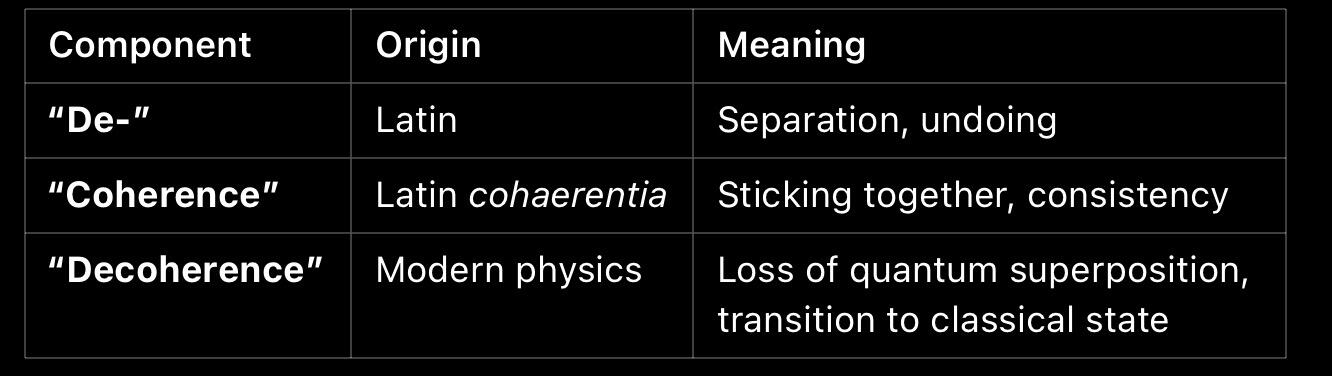
What do mean that decoherence is “solved”? If you do not even know the state of a qubit, what are you “solving”. If you mean that it does not decohere AFTER being recorded in the chain, then it is useless anyways! The entropy of said transaction is now 0 because it cannot be changed.

Reply to this note

Please Login to reply.

Discussion

First off, it has been theorized that quantum computing could exist, yet no one has proven any meaningful computation. It’s a speculative guess of what might be possible from the limited understanding of QM; I’m calling BS on that claim. It’s a larp until proven meaningfully.

And in bitcoin you know the state of every single utxo by the presence of a block; but this is always a past state; all UTXOs exist in past blocks as “unspent/0” and if they are in the latest block they are “spent/1”, by seeing what’s in the block you know the state of everything else by deduction. But you never know the present state because the state is always dictated by a block, there’s no “present block” it’s only ever a past verifiable state.

UTXOs are entangled in they can be split infinite ways, spent to infinite addresses and can interact with UTXOs from any block. Do you really believe that if satoshis UTXO from Block 1 was to move that would not have an impact on future UTXOs? Is that what you are saying?

Yes the entropy is zero but it’s past state is preserved in for future transformations, the link is between the destruction of past UTXOs and the creation of new UTXOs, they are all entangled…..full history from the creation of the UTXO. What do you mean?

Please show me UTXOs that have become decoherent. I think your definition is wrong.

At least we agree that bitcoin cannot be used for quantum computation.

That satoshi’s coins moving would affect bitcoin does not show any form of entanglement. If I kick a football, it moves but not because I am entangled to the ball. Can you give an example of how one could violate a bell inequality with UTXO’s? Can you give an example of how to construct two entangled UTXO’s where measuring decreases your knowledge of the second?

I did not claim any decoherence. I asked what you meant by decoherence being “solved”? Specifically I would like to know what state is being kept from decohering. And if this state is not known, what is the point then?

I am curious, would just like to know if you have something more concrete to say

Well for one, a UTXO being sent to a 2 of 2 lighting channel is 2 UTXOs, the funding one (destroyed) the channel balance (new). This funding UTXO exists in the past and influences the new UTXO (via intention). And the state of the UTXO is even less certain as now transactions can occur between the two peer to peer parties without wanting to resolve uncertainty (A quantum bit transacting states between two parties without settling certainty). Measuring in quantum mechanics forcefully collapses the state, bitcoin it does not; it cannot without valid signature. This is non-local. Past information interacting with the present, the interaction is instantaneous (when the block is mined). It fundamentally inviolates bell inequality; Bitcoin is non-local.

The location and state of all UTXOs is known and deterministic for every block, even when UTXOs are spend and destroyed, their state is still preserved in time forever and directly influence the new UTXO. Yet the new UTXO also maintains its quantum nature, stored classically-quantum behavior.

Bitcoin is the quantum-classical computer that computes the most important thing for us; a peer to peer electronic (energy) cash system. Conservation of energy in the human energy domain allows use as humans to perform the computation of meaning for our UTXOs (qubits). No single owner of the qubits l, No single computer storing the data, no single centralized observer, opt in consensus. Physics is all about consensus, right? Our decisions are computed on bitcoin and preserved forever.

Interesting perspective with lightning channels, but something in the past affecting something in the future does not mean entanglement.

Are you able to provide a proof instead of just words? I do not see how a mined block violates a bell inequality, again do you have a proof?

It is not easy to show whether an arbitrary quantum state is entangled or not, but if you could describe a protocol for generating a bell state using two UTXOs that would be very interesting. If you can not generate a certain state, what decoherence is solved? You have no quantum-information on the state, so there is no quantum information to be lost.

Anyways, I am signing of social media till next saturday. Thanks for taking time to respond.

So no proof or description of protocols to implement various quantum states I guess.

Well, I’m working on the paper to finalize all of it.

https://mempool.space/address/bc1q4valmh0puzugzky4dryhflnaayt4tjtcm7jfgr

I just randomly picked a UTXO in a recent block. Here is a “quantum state”. You can see exactly which particles (UTXOs) where here at the that specific block in time, how much energy/satoshis associated and you see the path and history of all entangled UTXOs leading up to that specific state and all UTXOs following that specific state.

Ok, will be interesting to see!

I don’t understand the question.

Human action is the dictator of all quantum states in bitcoin.

Are you referring to quantum state as in the wave form, superposition or what we call“spendability”?

When I say quantum state, I am referring to what a quantum state is in general physics literature. In the case of “n” qubits that would be a norm 1 vector in the space $\bigotimes_{k=1}^n\mathbb{C}^2$ or if you prefer, a density matrix in the space of operators on said space.

Working on a response as I blend this in the what I am currently working on.

On first glance; I think this seems self evident by simple observation.

In any Block you know the total number of UTXOs = n qubits. Only what is in a block is spent (1); all other UTXOs are 0 by deduction; all states are known and measured each block. Each block is a unique tensor product for all UTXOs/qubits in relation to the previous mined block. I’m not sure it’s possible to quantify the probability for each UTXO, you also need to know who will mine the next block as only their mempool is what actually matters.

Qubit/UTXO quantity of each computation state (Block) dynamically changes depending on how the network uses their UTXOs.

Hope this helps somewhat for now.

I also do not believe you can quantify the probabilities. But this leaves my original question: what decoherence is solved? If it is not possible to even describe the state then what is the use?

Just because you cannot quantify the probabilities does not mean they are not real. The state is described in every single block, you have a full history of every UTXO/qubit state from Genesis. Your UTXOs remain spendable and preserved to the rightful private key regardless of time; that’s the decoherence solved. What is the value in computing the probabilities of the next future state; anyone pretending to know the future is lying.

I’m not here making the claim that quantum computing can do anything physics/comp scientists claim it can do. It’s entirely a fiat theory that remains unproven backed by fiat & academic science. All I know is that bitcoin has been here for 16 years and all UTXOs/qubits remain coherent; I’m still waiting for a second best quantum computer. I doubt it will compete with bitcoin if it can only be operated by authority of a singular centralized laboratory.

However, it just so happens these qubits or UTXOs serve as what we call “perfect money”. Maybe it’s the perception and possibilities of what a quantum computer is or can be is what is actually wrong.

Bitcoin is not claiming to reduce all uncertainty, break encryption, ect. It flourishes on uncertainty. Computing an energy backed free market with 1:1 money is a much better solution to quantum computing than physicists pretending to be god; implying they can remove the veil on all uncertainty, they haven’t a clue. It’s all fiat science.

All I know is Bitcoin exists and “centralized quantum computers” continue to fail for good reason, centralization.