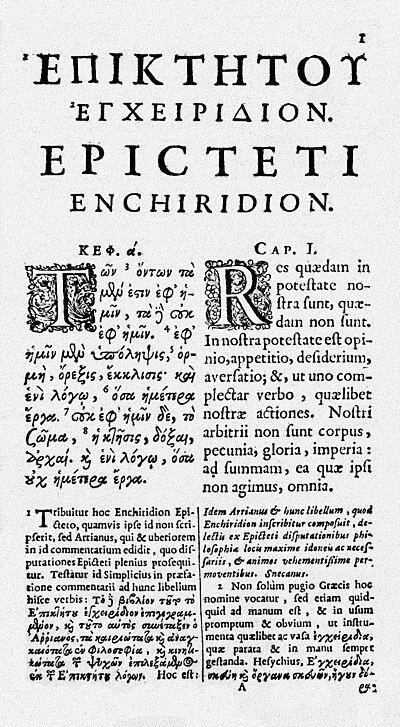
This is the shortest book I've ever read that changed my life.

It's "The Enchiridion" By Epictetus. Epictetus is one of the most important Stoics in history. He was a philosopher and slave. However, although he was a slave, he was more free than most rulers.

Here is the craziest part. Marcus Aurelius, the guy I cite daily, was emperor of Rome while Epictetus was a slave in Rome.

Both practiced the same philophy and wrote about the same things. Both had the same human challenges. Both knew that power and freedom comes from within and that only things that you can control can be moral or immoral.

A philophy practiced by emperors and slaves alike. Study stoicism.

Gm ☕

Reply to this note

Please Login to reply.

Discussion

The full enchiridion:

https://classics.mit.edu/Epictetus/epicench.html

It's a handbook so it's worth getting the cheapest copy you can find (literally just a couple bucks).

I will add Epicurean philosophy.

https://www.epicuros.gr/pages/en.htm

look, hedonists trying to cure their self-induced depression!

just kidding, I love this shit. stoicism just feels a lot more useful to me than hedonism ever did.

I do not endorse neither, i am just observing and learning.

I'm just joking

My favourite, but more cryptic:

https://en.wikipedia.org/wiki/Monas_Hieroglyphica

Stoicism +1, The Daily Stoic is a good intro to this philosophy.

I have sitting it in my kitchen 🖤

amazing! 🤙

Stoicism is nuts in all the good ways

The Daily Stoic by Ryan Holiday is my daily read and I highly recommend it.

To ponder:

“Nietzsche rejected Stoicism because he saw its emphasis on tranquility and control over emotions as a denial of life's dynamic and passionate aspects. He believed in embracing life's struggles and passions, not retreating into calm detachment.”

https://wisdomshort.com/philosophers/nietzsche/rejected-stoicism#:~:text=Nietzsche%20rejected%20Stoicism%20because%20he,not%20retreating%20into%20calm%20detachment.

Nietzsche is favourite of mine. I have read most of his books and do agree with much of his philosophy. Taking from different philosophical ideas and creating your own personal perspective is my path. I do not adhere to any one in particular. 💕 & 🕊️

Same here, although I tend to think Nietzsche tried to factor in human nature in his philosophy, and not try to change or subdue it.

Become who you are…

🛒

agreed I read it too and am reading it again very informative and fantastic lessons for living better

This was my entry into the stoic rabbit hole 👌🏻

@Danton. It will be a beautiful journey. The wisdom on those pages echo in eternity. Truth is timeless. Enjoy! 🧡

Have you listened to Eckhart Tolle reading and commenting on one of Marcus Aurelius’s books ? Well worth a listen 🎧

No! Do you have mp3s of that?

I’ll have a look at uploading a copy and send the url, I need to steal my own books from mr Bozos first

Here’s the original if you haven’t got it.

https://archive.org/details/meditations_0708_librivox

Thank you

Np

Harder than I first thought to copy and convert from audible.

I was expecting to find something free and easy 🤷‍♂️ alas not 😔

This is one of those books that is too dense for audio. Every sentence needs so much thought for me that an audio book is way to fast. 😂

Tolle’s narration and comment is actually quite slow 8hrs of his thoughts on some of the key points , it’s well worth a listen 👂

Never have, definitely will! Thanks!

His name means “acquired” in greek.

Thanks for the recommendation. Also enjoyed “Tao of Seneca” which is a collection of letters from Seneca.

This is why I Nostr.💜

GM☕️☕️✝️🌅Great advice.

A must read💪🏻

Thanks for sharing. Just downloaded

Thanks for the tip. Enjoying reading it now

Will add to the list. Thanks. GM

Massimo Pigliucci is a modern philosophers who also loves Epictetus and has some good contemporary books on him / adapting him. I agree the originals are best but some people might prefer this approach:

https://massimopigliucci.org/stoicism/

The ancients knew more than we do today. Most moderns view freedom as “the ability to do whatever I want whenever I want.” Yet through his dialogues in The Republic, Plato describes the Tyrant, the person with the power to do whatever he wants, as a slave, unable to escape his base desires.

As a Christian, I don't wholly agree with the Stoics, but there is a lot of overlap. Stoicism was the predominant philosophy during the Roman Empire's conversion, and I appreciate the philosophical foundation they built for virtue ethics.

There are neither emperors nor slaves, just retards.

Nobody wants to be an emperor or a slave tho

Amazing read

Here is the text for "The Enchiridion" by Epictetus:

The Enchiridion (meaning "the handbook" in Greek) is a short manual of Stoic philosophical advice written by Epictetus, a Greek slave and later philosopher who lived in the 1st and 2nd centuries AD. The work is a collection of aphorisms and essays that offer guidance on how to live a virtuous and happy life, focusing on the development of self-discipline, resilience, and moral character. Below is a selection of key passages from the Enchiridion:

1. Chapter 1: On Freedom

"Remember that you are an actor in a play, the play is the drama of life, and the director is God. You may think you have a great many needs, but in truth, you have very few. Just remember that the play is not yours, but God's, and that you are only an actor in it."

2. Chapter 2: On Desire

"Take away your complaints and you will have taken away the greater part of your troubles. For it is not the things themselves that trouble us, but the complaints about them."

3. Chapter 4: On Thought and Judgment

"The key to happiness is the mastery of thought. The more we think, the less we feel. The less we think, the more we feel."

4. Chapter 6: On Friendship

"Friends should be selected for their good character and not for their wealth or status. For true friendship is not based on what a man has, but on what he is."

5. Chapter 9: On Death

"Remember that you must die. Hold this thought in your mind and you will never fall into the trap of the past or the future. The past is gone, the future is uncertain. The only thing that exists is the present moment."

6. Chapter 13: On Anger

"Do not allow yourself to be carried away by anger, for anger is the worst enemy of judgment."

7. Chapter 17: On the Art of Living

"The art of living is not a matter of what you do, but how you do it. The way to live is to live without thinking about it."

8. Chapter 26: On the Limitations of Wealth

"Wealth is not the accumulation of riches, but the accumulation of the ability to enjoy what you have."

9. Chapter 29: On the Nature of God

"Remember that God is everywhere present, and that He is the cause of all things. Do not be surprised at anything, for everything is the work of God."

10. Chapter 31: On the Value of Life

"Do not seek to make life easy, but make life meaningful. For life is not easy, but it is worth living."

These passages provide a glimpse into the wisdom and guidance offered in Epictetus' "Enchiridion." The work remains a powerful and relevant resource for anyone seeking to cultivate a deeper understanding of themselves and the world around them.