Full video here:
Discussion
Yes, you can draw a contrast between moving in latent space and moving in null space, although they represent different concepts and serve different purposes. Here’s how they can be compared:
### Moving in Latent Space
- **Nature of Movement**: When you move in latent space, you are navigating through a learned, lower-dimensional representation of data. This movement typically corresponds to meaningful changes in the generated outputs, such as interpolating between different data points or manipulating specific features.
- **Purpose**: The goal is to explore variations in the data, generate new samples, or control specific attributes of the output. The movement is often guided by the structure of the latent space, which is designed to capture the underlying relationships in the data.
### Moving in Null Space
- **Nature of Movement**: Moving in the null space of a matrix involves navigating through a set of vectors that are mapped to the zero vector by the matrix. This means that any movement in the null space does not change the output of the linear transformation represented by the matrix.
- **Purpose**: The null space represents directions in which the transformation collapses to zero. Movement in this space does not yield new or meaningful outputs; instead, it reflects the inherent redundancy or lack of information in the system. For example, if you have a system of linear equations, moving in the null space corresponds to finding different solutions that do not affect the outcome of the equations.
### Key Contrasts
1. **Meaningfulness of Movement**:
- **Latent Space**: Movement is meaningful and corresponds to variations in the generated data.
- **Null Space**: Movement is not meaningful in terms of generating new outputs; it represents redundancy in the system.
2. **Output Impact**:
- **Latent Space**: Changes in position lead to different outputs, reflecting the learned features of the data.
- **Null Space**: Changes in position do not affect the output of the transformation; they remain mapped to the zero vector.
3. **Dimensionality**:
- **Latent Space**: Typically designed to be lower-dimensional and structured to capture essential features of the data.
- **Null Space**: Can also be lower-dimensional but is defined by the properties of the matrix and may not have a meaningful structure related to the original data.
### Conclusion
While both latent space and null space involve navigating through vector spaces, they serve fundamentally different purposes. Moving in latent space is about exploring and generating meaningful variations in data, while moving in null space reflects the inherent properties of a linear transformation where certain directions do not contribute to the output. Thus, they represent contrasting concepts in terms of their implications and applications.
So that was an explanation without using terms like eigenvectors. Technically I think the correct contrast is higher ordered eigemvectors vs lower ordered eigenvectors, in a practical sense with the PCA, SVD algorithm, or some form of factor analysis.

I think I'm lacking anchorage with this concept and lingo.
To what does this latent/null space concept apply?
I don't know what the nuance is that is being parsed between these terms.
I remember nothing about eigenvectors from college math classes nor do I know/remember what PCA or SVD are.
I watched the short video but not the long one. I'm already so confused as to what this concept is, why it is under discussion, what it ties into from the study group, etc. that I can't justify watching an hour long video.
Help me out with the big picture here. Is this math? Is this computer science? Is this philosophy? What IS this?
In stalking the wild pendulum, information density is talked about, e.g.
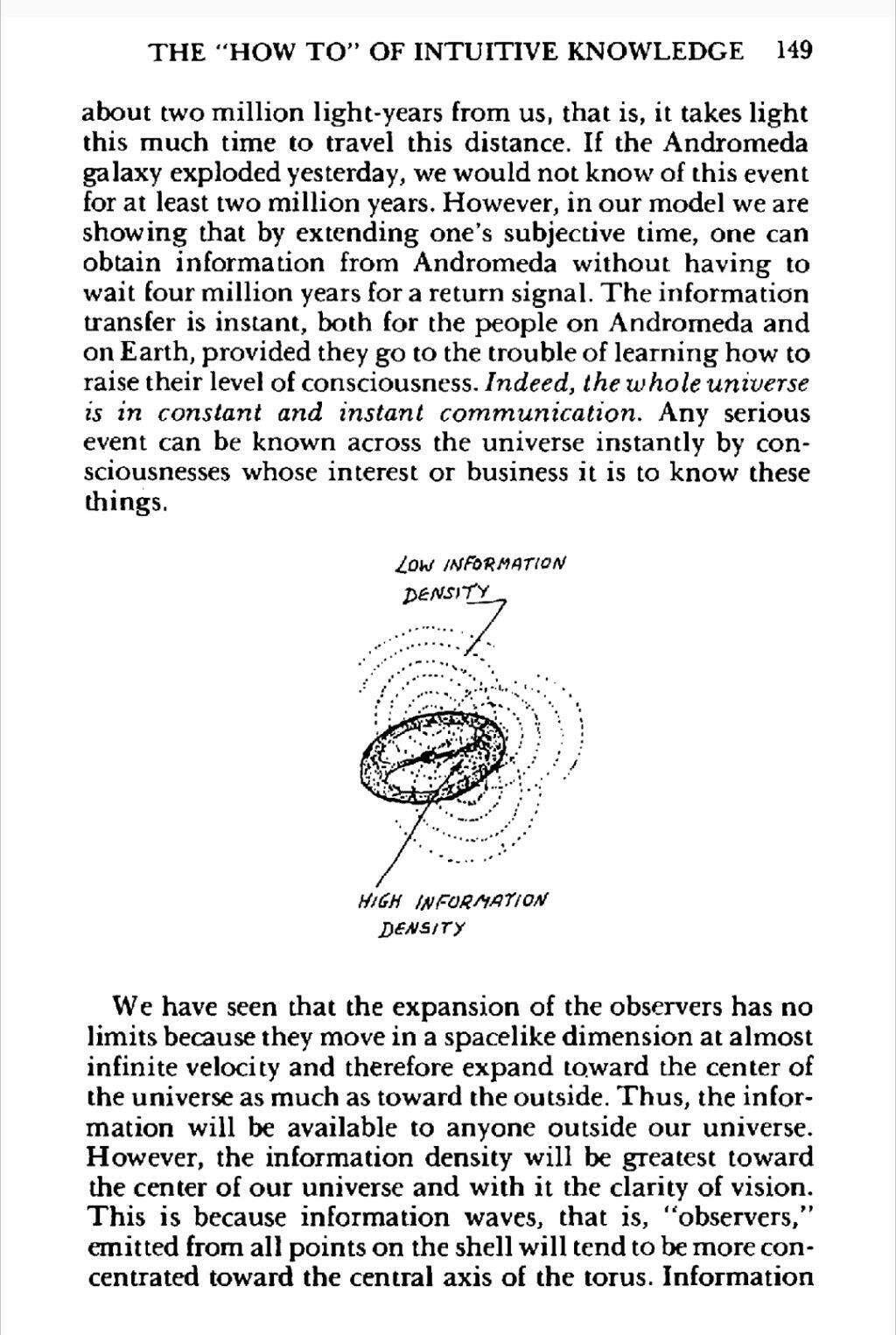
But also in other parts of the book.
I just have this perspective based on my background in data science that maps the spirit to these sets of components in latent space, which are basically these components built from eigenvectors sorted by their variance or information density.
The way this works mathematically is well explained here, where the author starts out with:
Imagine a big family dinner where everybody starts asking you about PCA. First, you explain it to your great-grandmother; then to your grandmother; then to your mother; then to your spouse; finally, to your daughter (a mathematician). Each time the next person is less of a layman. Here is how the conversation might go.
And then finally in the video above the talks about correlation vs causality, which talks about movements in latent space, which is to say, given a set of components, say you had the pca algorithm generate 5 components. Now the set is sorted by information density, and say each one is represented as a slider. As you move the slider from left to right, each slider represents a move in latent space that changes the output and/or outcome, in the form of a transformation.
When applied to a dataset of faces for example, the first slider might be the hair style, the second my be their smile, third might be their eye expression, the last one might not do anything noticeable because of its low information density meaning that it has no real impact on the output and/or outcome.
Why does this matter?
In the second video he talks about moving your x and nothing happens on y, which is the output and/or outcome. Let's add some detail to that.
We observed a doll move, and we are trying to understand how it works based on our observations. We haven't built a map yet of what makes the doll move (the latent space).
Let's say we want a smile. We've seen an example of smiling so we know it's possible, but we can't find the dimension that applies to that. We try changing various input vectors, but nothing happens to the output and/or outcome that produces a smile. So we begin mapping out this black box, trying to change different inputs to see what happens on the output.
We write down what we learn, e.g.
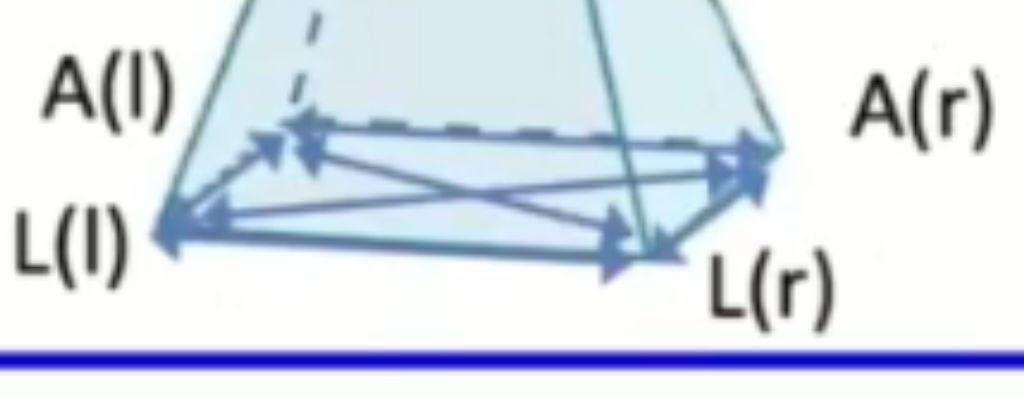
We still don't understand the coord.
Then, somehow, someway, we get that ah hah moment. We discover the cord.
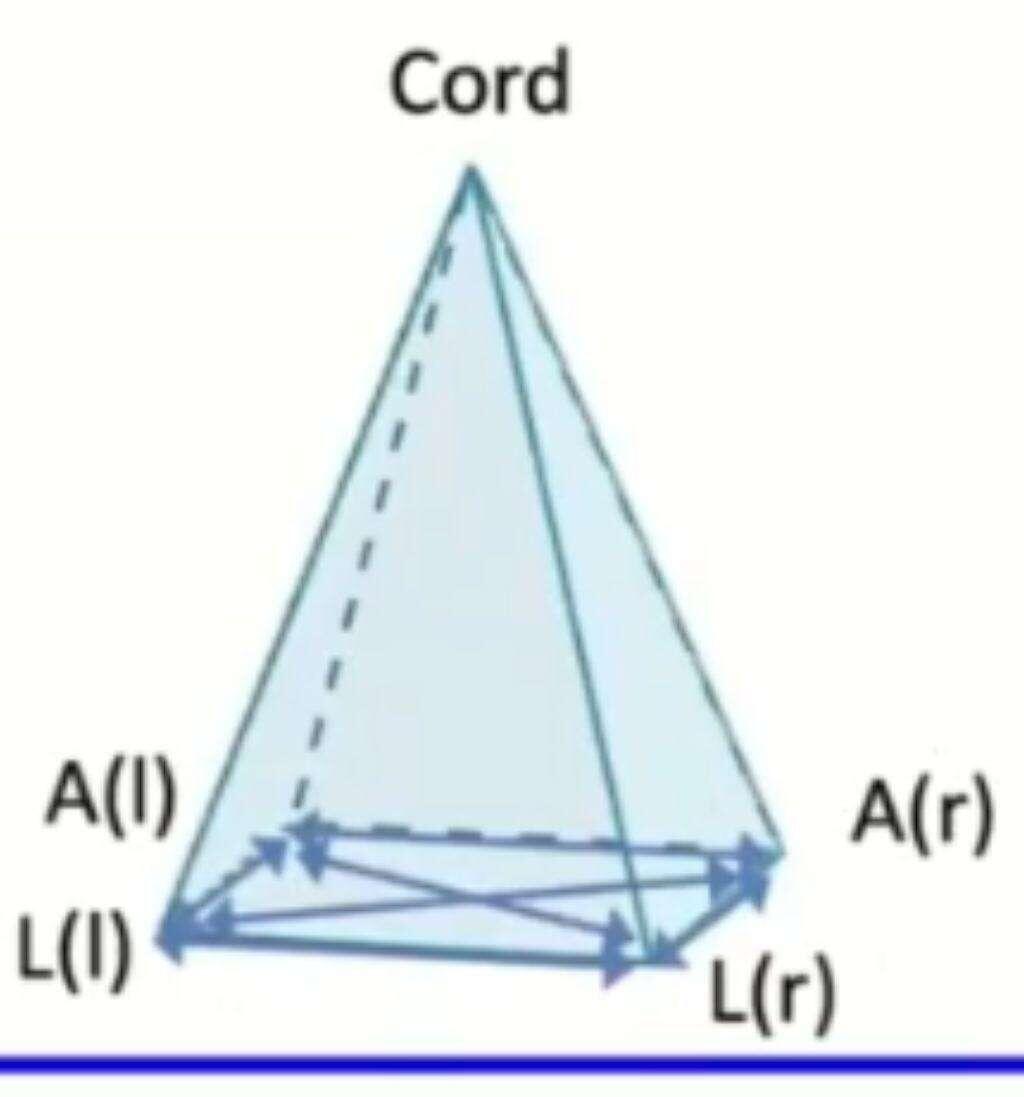
It was in another dimension, a higher dimension.
This is what it feels like to me learning about your work. You have found the cord!
Here are more examples of moving in latent space that demonstrates movements based on information density.
https://video.nostr.build/1c0b2362d218a6796fded3afca4e93b2b4b3de90625ba300988613f9b30e2573.mp4
Full video here:
Ah, ok. That helps connect the dots. Thank you!
When it comes to the Law of One material in particular, I tend to describe it in a similar way.
I tend to say that the Law of One material is "closer to the font from which undistorted truth pours forth".
Finding the cord seems, to me, like moving upstream.
I know SOME programming/coding/data science but mostly it was limited to xHTML, JavaScript, and Excel, so I'm, at best, a data science sophomore. Any coding skills not learned in high school were autodidactic learning. I'm certain I could pick up more in Data Science, especially when considering that courses for my degree (applied mathematics) tend to take place in the same building as the Data Science courses.
OK, so in a conversation about "finding the cord/coord", does this video make sense as an analogy?
https://www.youtube.com/watch?v=quxJH-5RZvY
To me, the cord/coord seems like a perspective from which the system's machinations make sense.
In the video above, the opening and closing Point of View of the camera was the cord/coord, visually speaking. The cord/coord is a position from which the arrangement of found items coheres into the artist's intended image, much like how Earth is a cord/coord for our constellations. From other locations, the relative positioning of the stars that form constellations we know from our perspective on Earth differ to the point where the constellations no longer "look right" from the Earthling standard.
🙂
Yes, and a movement or experiment with all the sliders of each component provides wisdom/experience in that space. I haven't talked much about such interactions because I am still working out how to exclude methods of parallel reconstruction. The bitcoin blockchain will be a major component of this due to it's immutability. I guess I'll find out how immutable it really is.
If I was putting a puzzle together with what I have, my goal is to be able to logically rule out fake puzzle pieces (parallel reconstruction). I think I have to write some code to do this, then try to reproduce a movement in latent space, then see what happens (now being able to rule out fake puzzle pieces).
Another thought to consider as potentially analogous to "finding the cord/coord" may be the relatively small set of trajectories that are both possible and that would be successful in the Odysseus bow challenge.
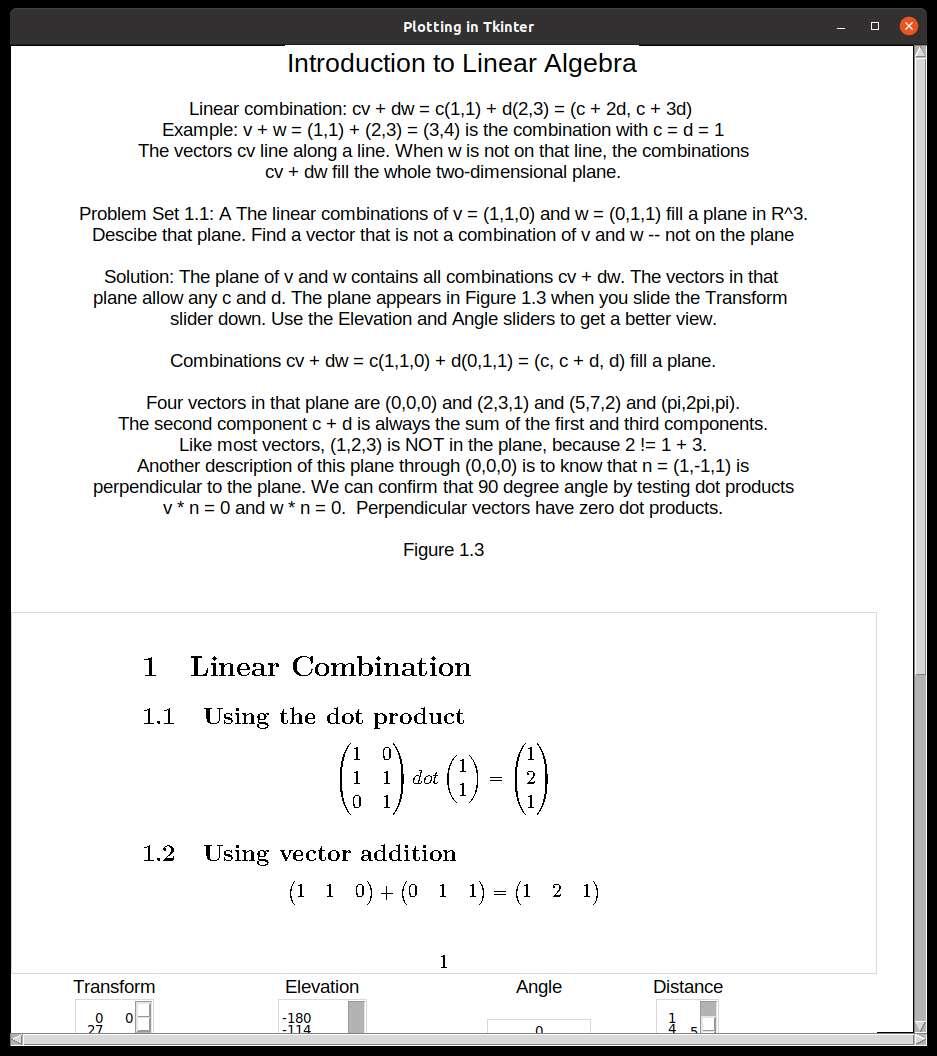
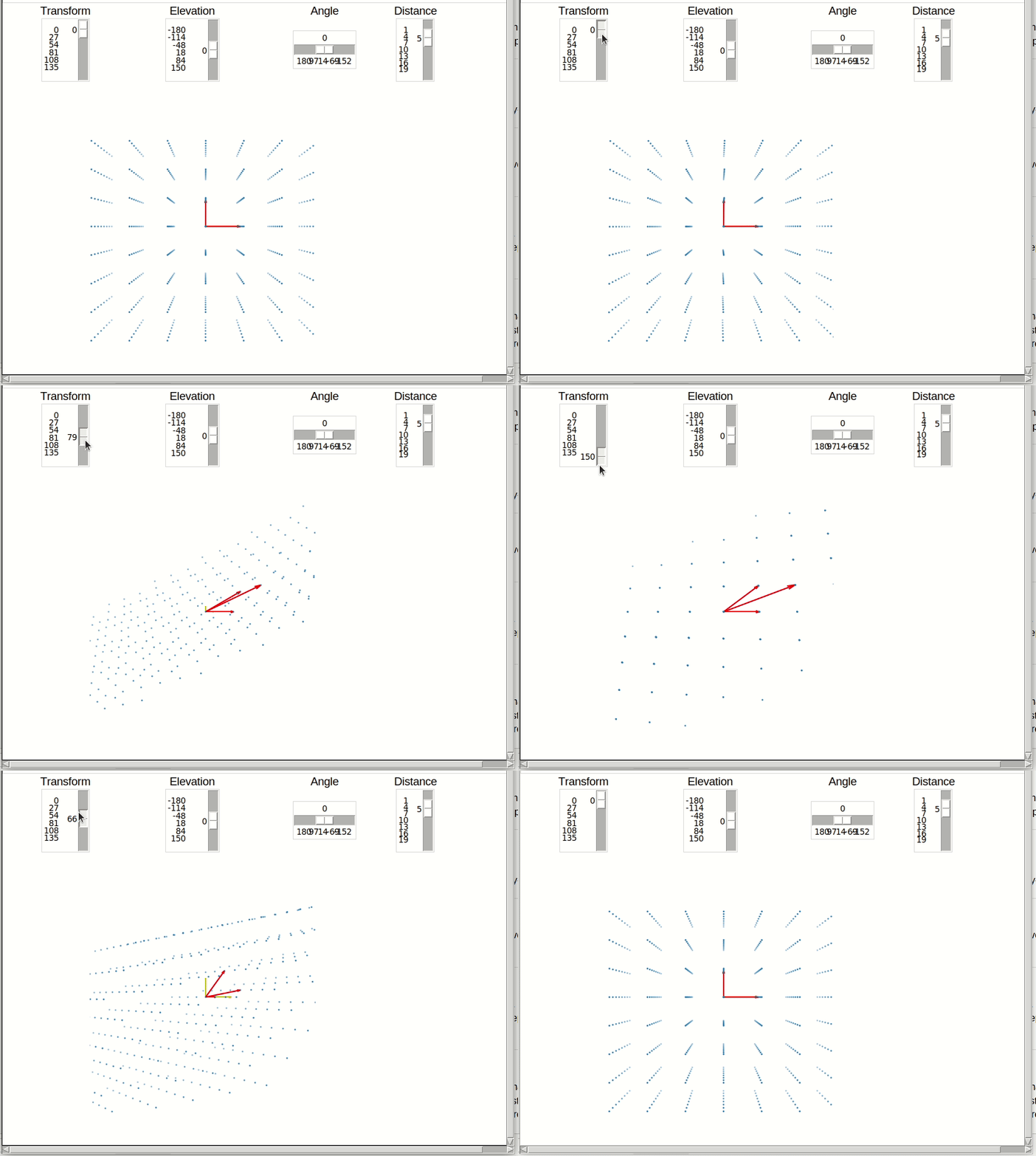
Yes. In linear algebra I mentioned a system of equations where there is only one right answer represented as a single point. So deeper in the book they mention a 'determinant', which is the 'area' of the right answer. So no longer as single point. Then a little further down, the eigenvector, which is where, unfortunately I get lost in the weeds. 3blue1brown can do circles around me in that regard, but early in the book, in the basics, I built this visual for a problem that transforms the matrix to reveal a different perspective hidden right in front of your face. First we see an 'L' shape, and after we collapse the 3d space into 2d, we get the sum of the two vectors.
I definitely think about what I'm doing from a lens of systems of equations but if I'm being honest, even though I have a bachelors in applied mathematics and I took Linear Algebra and Matrix Theory courses, they were a long time ago so I tend to think in terms of the equations, not matrices.
Obviously matrices are way more efficient, but the vast majority of my time spent dealing with systems of equations is probably 10:1 in favor of algebraic over matrices. Not only did I practice this skill algebraically more in my own schooling, I taught it way more too.
Other than knowing the existence of eigenthings, I don't remember eigenanything lol.
My attempt to learn linear algebra was based on what I was told, was fundamental in order to understand machine learning. It seems to scratch the surface of what intelligence actually is, but I'd imagine you could say the same thing of your line of work.
The AI race moved way faster than I could keep up so I didn't bother trying to keep up. I just got left in the dust, and moved on to algorithms, computation, mechanism design, and now, I would call this an attempt to understand the universe.
I just wonder if we can/should science this out or just experience it.
As Dr. Joe Dispenza might say, religion divides but science builds a community. Science is the modern language of the mystic.
I think if the mysteries of existence can be explained in scientific ways to the common person without a ton of high level jargon, we have the ability to draw people away from the divisive dogmatism in which they find themselves mired.
It seems to me that if the intent is to meet them where they're at, then that would be, unfortunately, with confirmation bias. This is of course dogmatic.
The alternative, as far as I can tell, is from a product based approach. Give it utility, and preferability in an open source model. Of course that comes in all forms, even music. If it requires attention, unless it's pleasure based, then one's goal is usually to abstract that away.
Yes, the intent is to demonstrate to each individual my knowledge of the tradition(s) with which they are most familiar. In so doing, I am showing them that I have studied the same things they have studied and I don’t think it was a waste of either of our time to study that particular tradition, -ism, person, etc.
This is meant to keep the peace with respect to their ego. When people are confronted with information that suggests they have spent some amount of their time in this life unwisely, they tend to get defensive and irrational. That’s the ego.
Dogmatists won’t like me because dogmatists are closed minded and defended by invincible ignorance, i.e. “All I need is (Jesus/the Bible/the Quran/etc.)” Their unwillingness to study other traditions leaves them mired in darkness. They can’t see the connections because they only see part of the puzzle. It’s like they’re looking at the puzzle through a microscope…tunnel vision kind of a thing.
My goal is to become deeply “multi-traditional” in my religious and esoteric knowledge so that no matter who I happen to be communicating with at any given point in time, I should be able to “speak their language” and, in doing so, establish bona fides with them, build some rapport, and pacify their ego.
The goal is to show each individual the bridges that exist between the religious tradition to which they’re most attached and all the other religious traditions out there. The goal is to unify people. It sure would be great if we could bring about an end to religious wars, just for starters. It would be great if everyone started doing past life regression and we could rediscover our own past.
There’s lots of things we could do if we got on the same page.
I want THAT future for humanity, our neighbors cohabitating with us here on Earth, and Earth itself.
To me that sounds like rhythm entrainment. On that note, I thought of a simple example of this.
Rhythm entrainment requires exposure, and/or a lack of interference with that exposure right?
I wonder if when I put something in the fridge, I am rhythm entraining that object. Just a thought.
Anyway, I was also thinking dogma is sort of that too.
To me, being multi-traditional sounds like rhythm entrainment across those traditions. On that note, I thought of a simple example of rhythm entrainment. Although I don't know if this meets the definition.
Rhythm entrainment requires exposure, and/or a lack of interference with that exposure right?
I wonder if when I put something in the fridge, I am rhythm entraining that object. Just a thought.
Anyway, I was also thinking dogma is sort of that too. When you become entrained, let's say you are that object in the fridge. Once you reach the same frequency/temperature of your environment, you are in sync, and no longer a load on the system. Putting extra mass in the fridge also helps the compressor to not have to kick on as often, etc.
So back to dogma 😂, it's when you take your entrainment for granted, and you are also willing to defend it. If a warm dish gets placed in the fridge, you feel it and you're upset. Bad vibes, that warm dish has, bad vibes.
Could we map this to physics in this fridge model?
Let's say a higher order being is the compressor. There is a large mass in the fridge has been entrained by the compressor (the collective). Two new dishes are introduced of equal mass. One is at room tempurture (humble), and the other at 165 degrees (enriched). The loss these dishes must endure is the time it takes to become entrained by the collective inside the fridge (fridge temperature), or by the collective outside the fridge (room temperature). So the humble has less to lose while the enriched has more to lose in regards to time until entrained. Let's say the break even point for the enriched is where it was going to end up if left undisturbed (outside the fridge at room temperature).
So my question is:
Say I am part of this mass inside the fridge, and trying to reach the enriched dish, is this just an equation of time of exposure?
Is my situation with the enriched is that this dish only has 10 minutes with me before it is taken out, heated back up, and I have to start all over again?
Or reverse the roles. I am the collective outside the fridge, and the enriched are the ones entrained at fridge temperature, constantly being placed back in the fridge.
Because if time is the only factor, we could build a collective faster by picking our battles.
/rant
Microeconomics (adapted to effort and belief):
My willingness to trade one understanding or belief for another is measured by a marginal rate of substitution (MRS): the maximum amount of effort in one belief system I will sacrifice to obtain a new understanding or belief. The marginal rate of substitution refers to the trade-off (rate of substitution) of my prior understanding for a marginal (small additional or incremental) change in my new understanding. My marginal rate of substitution of say Christianity for some other form of spiritualism is MRS = ∆B/∆Z, where ∆Z is the amount of effort spent being in, say Christianity, I will give up to get ∆B, this other form of spiritualism, or vice versa, and Christianity (Z) is on the horizontal axis. The marginal rate of substitution is the slope of the indifference curve.
Note that asymmetric nature of this curve.

And some other indifference curves that don't really exist in humans, but to illustrate a point:


