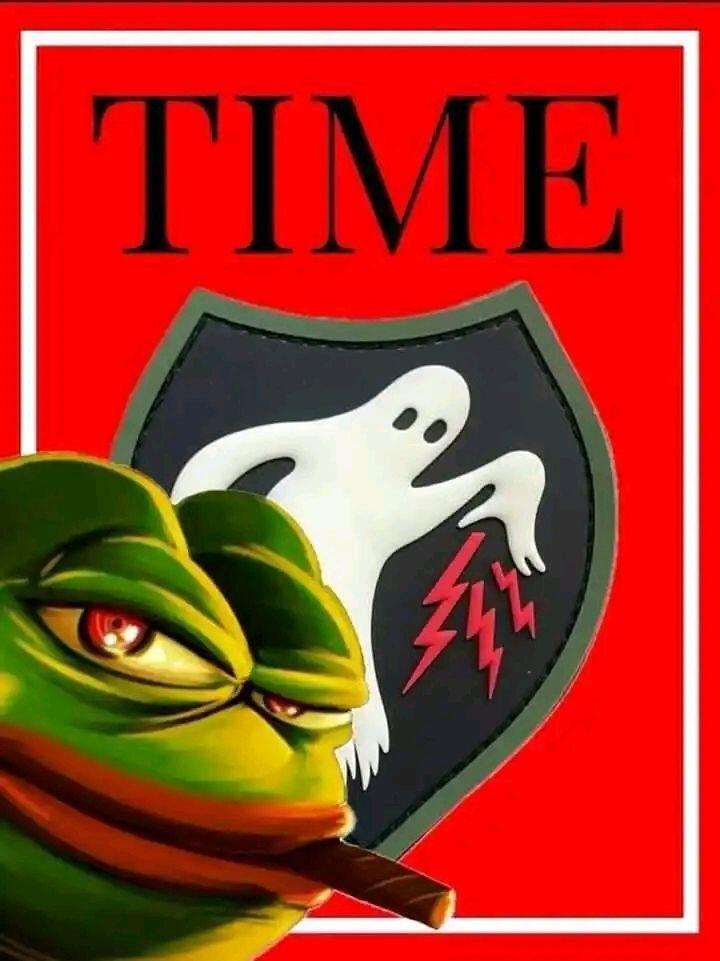
#meme #memes #memestr #plebchain
#meme #memes #memestr #plebchain
Evolution doesn't posit that humans came from chimps. If we did, it would disprove evolution. This the type of shit smug creationists post thinking they're being clever, but it proves is the ignorance of the creationists.
But it does suggest we derived from a common ancestor with the chimp that ostensibly looked similar.
Correct. That’s how it works.
Which is why the meme is still funny 😜
I'm a Christian and I believe in evolution much like I believe that cells make up the body or that cars function via internal combustion that exerts force on a piston to spin a shaft with a flywheel. It's clear that the process of evolution is real and that that is a true description of how creatures develop across generations.
Is it the only mechanism at play, and that the only way to describe it? No.
Is it probable that humans came from chimplike ancestors like Australopithecus? Yes.
Is this incompatible with God, Creation, and Jesus and all that? Not in the slightest, if one truly believes what he says about God and understands it properly.
You are free to believe and worship whatever you want, of course, and I’m not here to pick a fight.
I’d only ask you to consider whether what you understand “properly” about Jesus is just as valid as what a Hindu understands “properly” about Hanuman, or what an Ancient Greek understood “properly” about Athena.
Whether that is valid to the Hindu or the Athenian rests on the validity of their logic and the following of a sound epistemology as they see it. If it is indeed concordant with reality under their interpretation, then it is properly understood and valid. When it comes to my claim of the existence of such a true interpretation in accordance with my understanding of things, however, those religions are not for me to analyze. I know almost nothing about them in comparison to Christianity. I am also a Daoist of sorts, that being also the only other one that I understand somewhat well, and I think it is sound when properly understood.
This is just epistemology and the fact that meaning depends upon your point of view and context, as well as that recognition of truth or falsehood, or uncertainty, is assessed individually.
This extra comment is a nice follow up to your other one, because I was going to ask whether you acknowledged the relativism of your answer. And, it sounds like you are by recognizing that it’s “assessed individually.”
Lately, I’ve begun to see that epistemology, itself, is entirely relative, too. Or, at least, entirely subjective, which is basically the same thing, no? So, if all religious understanding (whether about god or gods, Confucianism or Taoism) is only *relatively* true, then they might as well be false. We’re looking for something that True, always and everywhere.
Since we were on the topic of evolution, I should point out that I wouldn’t say that “science” is True, here either. Far from it, in fact! Science is constantly being tested, updated, challenged, and questioned (as it should be). Science may tell us “how” but it cannot tell us “why.” Adherence to any religion that purports to have an answer to how and why by pointing to an imaginary entity possessed of omniscience, omnipotence, and omnipresence, should be only lightly held, if at all.
Again, I don’t want to poke at what you hold sacred. Your beliefs are yours, to whatever extent your conditioning creates them.
I agree with you on a lot of stuff, including how claims of truth are relative to a framework and the truths they describe may even be subjective, and that the appropriate epistemology may even be subjective.
I think that you are, however, confusing a consensus on the subjective claims of truth, or on the means of claiming truth, with objective truth, when you say
> So, if all religious understanding (whether about god or gods, Confucianism or Taoism) is only *relatively* true, then they might as well be false. We’re looking for something that True, always and everywhere.
Something that is true everywhere and always is still perfectly achievable in a subjective framework, if your framework applies soundly to the whole universe. The fact that there is not consensus on this is not reliably indicative of it being false anywhere, ever. This applies whether they outright deny your framework and understanding or they merely do not understand it or don't know of it at all. The framework can still be concordant with reality under any of these conditions.
For two ostensibly contradictory interpretations of reality to both be the truth, it is often a difference in frameworks between minds that makes it appear that way, when in reality there is no such contradiction, and so a consensus on truth can exist properly understood, while appearing to have very different and incompatible claims if you interpret them through a framework in which the claims lose their meaning. I think that is one of the things that people do when they confuse consensus with truth, or get stuck on the words or definitions of concepts and forget the relativeness of the meaning, which it looks like you are trying to not do, but are still doing.
This is not even to cover the different kinds of truth or to specify any of my preferred epistemological frameworks, just sort of a meta thing. Piaget invented a field called genetic epistemology to cover a lot of this meta stuff and explain how truths can be concordant with reality in the way I've described. I only just learned of him, so I'll be looking more into that soon.
I consider myself a kind of rationalist, realist, with I would say a strong conceptualization of the relativeness of meaning to frameworks and to the objective reality to be beheld. A lot of my philosophy is concordant with Objectivism, but I don't believe in their dogmatic claim that there is no god just because they don't understand what God is and can't measure him, and so they further define God as outside of all of existence. That's the empiricist's fallacy plus victory by definition.
Despite my strong rationalist a priori bend, in fact reinforcing it, I have also a predilection to the critical inspection that is the essence of Critical Rationalism, and a fondness for his form of empirical falsification that forms the backbone of most modern scientific inquiry (well, the good science that is done that's not completely ruined by fiat and superstitious dogmatic nonsense)
I do hope this is an engaging conversation for you and doesn't come off as gloating or anything. This is just me.
Same thing here. What do you mean “different kinds of truth”? To me, that’s a non sequitur. I’m not familiar with Piaget or genetic epistemology, but describing how “truths can be concordant with reality” is, to me, just a way of describing opinions that are functional/useful to a given set of conditions. What you call “reality” I call “your perception of it.” There’s really no other way to describe it. All we have are our perceptions.
It is only when we *stop* perceiving that we see what is underlying. THAT, and only that, is the Truth that is always-and-everywhere. Everything else is just mind stuff. God, dogma, religion, beliefs, opinions, “truths” (concordant or not), all of these are nothing more than concepts, mental objects, which people take as being 100% true. But it isn’t. Referring back to my initial response to you, consider the “truth” of Hanuman to a devout Hindu. It carries no more truth than Athena or Jesus. This isn’t about consensus. No belief is True.
I dunno. I don’t really see the difference, even though you’re trying really hard to show it to me. LOL.
I don’t agree that, “Something that is true everywhere and always is still perfectly achievable in a subjective framework, if your framework applies soundly to the whole universe.” It’s precisely the subjectivity that I’m pointing at which makes it relative. Anything relative is not True always-and-everywhere. It is only true in relation to certain conditions or a specific framework. It’s one sided, from one perspective.
I do understand what you are saying, and read it several times. It’s just that maybe we have differing views on what TRUTH means. Not to devolve our discussion too much, but Truth does not depend on consensus (we agree on this), nor does it depend on a framework (we disagree on this).
When you refer to the “relativeness of the meaning,” it sounds like you are scoring a point for me, actually.
I think I miscommunicated when I said subjective framework. What I meant by that was the individual's framework for understanding objective reality.
Okay, but still. If a given “individual’s framework for understanding objective reality” is different than another’s, then we are still back to my point that one individual’s (e.g. and Hindu’s or Ancient Greek’s) framework differs materially from another’s. Hence, not True always-and-everywhere. My main point is that what you call objective reality is only understood and communicated through concepts and that it is only when these concepts are DROPPED that we get to anything real and True. This is what #mediation points to, at least. All frameworks are just stories, ideas, thoughts… opinions.
Again, I don’t mean to offend. You are free to pray however you like. But, a survey of religions and myths over the millennia demonstrate that the only thing more abundant than our creativity about divinity is our certainty that *our* interpretation is more right than the next tribe’s. In the end, any god you worship is just another story. Your god may be a merciful one or a wrathful one. It may be personified by a man, a woman, or a monkey. It may contain lessons, dogmas, or rituals that are more (or less) beneficial to human flourishing. But, it’s just a story. The Truth is none of it correct, none of it is important, and none of it matters. This is not nihilism. It’s just the truth. Objectively.
You mentioned that you are interested in Taoism. So, let’s look at the Wu Wei, for example.
“Why are you unhappy?
Because 99% of everything you think, and everything you do, is for your self….
…and there isn’t one.”
Then you disagree with me on what meaning is and how frameworks should be interpreted on a meta level. Meditation does give you direct access to truth, but as soon as names and statements are introduced, as soon as a framework is prescribed, this framework, according to you, is a phony approximation, whereas according to me it is either that or can be understood as really true within the bounds within which the framework applies, is true, and has its meaning.
Meaning itself is dependent on context, truth is a distinct concept from meaning. No one mind understands everything, which is what your suggestion about frameworks seems to imply you are seeking, a mind that understands everything. I alternatively treat meaning for how it best operates in the world within my limitations as a mind within it. However your suggestion of meditation invites every mind to discover raw truth without being beholden to frameworks that might be wrong, as individuals, which is a much nicer solution than the idea of discovering a set of truth claims that are true and have meaning to all different people.
think he's a relative of mine
Top kek
Hahaha 😂😂 really