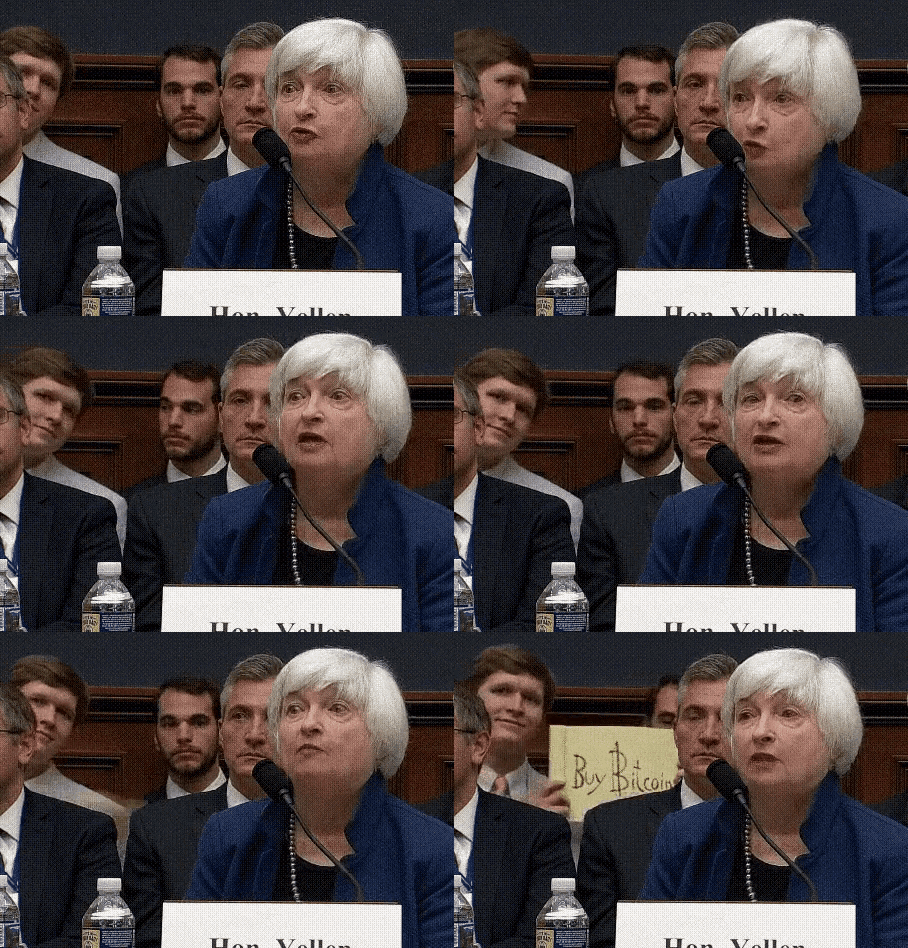
So you agree the US Dollar (Federal Reserve Note) has value?
But that might change?
Maybe the valuation of Bitcoin might change as well.
So you agree the US Dollar (Federal Reserve Note) has value?
But that might change?
Maybe the valuation of Bitcoin might change as well.
Yes, the US Dollar has "value" because I can trade it for goods and services (and pay taxes with it 🤢) right now. Whether it should have value, and whether its value will last, is another question. (It shouldn't, and it won't.)
And yes, the valuation of Bitcoin (along with every other good in the marketplace) is always changing. (And I think it's going up in USD terms, "Forever, Laura.")
Something having economic value (which is always subjective and therefore dynamic, based on changing conditions and chosen "ends" and changing priorities of competing "ends") -- and something being "backed" are different questions.
USD value will go to zero
Bitcoin value will go up in USD terms forever
I agree with all that - but notice Bitcoin still goes to zero when USD does.
(And now you say no, Bitcoin won't actually go up in USD terms forever, I didn't mean it, I meant it goes up in real value forever)
I think what you're getting at is that at some point the USD will be utterly worthless, the printer will stop, and so BTC will no longer even be priced in USD...is that close?
But Bitcoin doesn't go to zero when the USD does, it just gets priced relative to something else. Hopefully that something else is not some other fiat currency. At that point the market simply takes over and 1 BTC = [whatever someone else wants less than they want 1 BTC]. I think I'm saying the same thing you are in different words...
Price it in barrels of oil or iPhones and then it doesn't go to zero. Pretty sure those will outlast the USD.
Why do I want Bitcoin except to exchange for fiat or to use as a stand-in for fiat?
The obvious non-fiat thing in which to price Bitcoin is gold, but if we're pricing things in gold why do we need Bitcoin? Do you see the dilemma? How does Bitcoin ever "get under" gold logically and become the more basic unit of value?
I (and many others) greatly prefer Bitcoin to fiat. We work for Bitcoin. We pay people in Bitcoin. We do not feel safe with money in the bank. Having to exchange Bitcoin for gift cards or fiat seconds before SOME transactions does not make Bitcoin backed by fiat. We are always exchanging with others who understand the value of Bitcoin. The liquidity is proof that there are many such people.
All you are really saying is that you believe the demand & liquidity will collapse if the dollar collapses. But the people who understand Bitcoin do not go away. In fact many people tend to suddenly act on what they have heard Bitcoiners saying for years when the problems become more obvious (see Bitcoin price action in 2020). And evidence from other countries also seems to prove this because we see demand increase during other fiat collapses. The increasing number of people & places that accept Bitcoin directly before the storm will thrive & prevent total disaster.
Where can you spend your gold now? Where can you even buy or earn gold without paying a premium over spot & where can you trade it for better than 25% under spot? Gold's liquidity is horrible.
Layered money & The Fiat Standard are both books that you might find helpful.
It's a great point about demand & liquidity, though. We need to on-board local merchants to make it usable in the near future. Just got my brochures from nostr:nprofile1qqsrmqhg7mxxczt9gjln8ey8tgpl2cq2elm7c3n7z59pe3m395s5mjgprpmhxue69uhhyetvv9ujuumwdae8gtnnda3kjctvqythwumn8ghj7mn0wd68ytnxd46zuamf0ghxy6t6qyw8wumn8ghj7mn0wd68ytnzd96xxmmfdejhytnnda3kjctvzc5dws the other day and hope to canvass Main St. in my small (liberty-loving) town this weekend. Right now the biggest challenge is all these custodial yeild-farming companies going bellly-up and that suspicion gets imputed to bitcoin itself. There's work to do.
Because it's better money: it's more salable across time *and space* (esp. compared to gold), its supply is mathematically fixed (inflation-proof), and the ledger is both decentralized (you can verify transactions or the total supply yourself) and it is auditable (no counterparty risk). You can settle in seconds (on 2nd layer--which you can also run yourself), no waiting for ACH or third-party "business hours." The market will eventually price goods and services in terms of bitcoin just like when the first USD appeared everything got priced in USD. There's no need for a "third thing" to price bitcoin in.
Your overall sentiment resonates, though, with this former gold bug. I used to pine for a 100% gold-backed "cryptocurrency" with all the other properties of bitcoin as well, but the logistics of it just don't work--you still have the same issues with a physical asset. And the only real benefit of "backing" it with a limited supply asset is to prevent inflation. With bitcoin, we skip that step entirely using math.
Inflation (including fractional reserve) = you have too many tickets for your coats
Fiat = there are tickets but zero coats
So Bitcoin purports to fix the inflation problem but not the fiat problem. But if there are any tickets and zero coats, that is too many. The ticket supply has already been inflated.
The point of gold is not to limit inflation, the point of gold is to be the unit of value, and inflation undermines that function which is the problem with inflation. But it's not just an arbitrary and meaningless unit which could be anything - or nothing. Gold emerged as commodity money because of its durability (suitability for saving). But it was worth saving in the first place only because it had value, and it had value ultimately because it is a useful physical material.
All of the wonderful properties of Bitcoin (security, transport, etc) are useful only if the bitcoins already have value for some other reason (eg speculation). So why should Bitcoin have value in the first place?
If you want to wave the problem away & just note that somehow or other the Bitcoin market price has risen above zero: note that so has the fiat market price (in gold, or salt, or oil, etc).
All of the wonderful properties of Bitcoin (security, transport, etc) are useful only if the bitcoins already have value for some other reason (eg speculation). So why should Bitcoin have value in the first place?
Because #Bitcoin is money, nobody can take from you. Because it doesn't require trust. Because is the only way to separate money and state.
Asking you again, show me a better system. Your only reply is "trust".
I think we might need to clarify terms--and you started to get at it. I think when most Bitcoiners use the term "fiat" we have in our minds "currency that has value simply because the government says so." The reason I say this is that all value is subjective, anything I put value on has it only "because I say so" (value *to me*). If I don't want it, it has no value to me. If I want it less than another thing, it is relatively less valuable to me. When two people consider any item valuable, then a potential market appears. But if all value is subjective, and is valued "on the margin," (and I believe Menger proved that it is), then gold also only has value *to me* if I say it does -- if that's what you mean by "fiat"...then everything is fiat.
So why should Bitcoin have value in the first place? Because people want a non-inflatable, decentralized, auditable, easily transferable, means of exchange. Bitcoin--even though it's non-tangible--is precisely that.
The nice cryptographic and mathematical properties provide economic value only if Bitcoin already has economic value.
A secure, transportable, etc token that's not actually worth anything wouldn't send or store "monetary value".
While Bitcoin has a nonzero price right now so does fiat.
My problem with fiat is there are no coats - there's no real substance behind the tickets. It's cargo cult economics, acting out the ritual of economic action but drained of the underlying meaning. The same applies perfectly to irredeemable cryptocurrency.
Money primarily has value, not because of what it is based on, but as a measure of work done or value created. It bypasses barter where two people want to trade, but don't produce things the other wants or at different values or at the wrong time. Anything that maintains its value, is easily transportable (can buy remotely at any time), and is easily divisible (so it can purchase .small & big things) Gold meets the first, but is very poor on the other two traits. The dollar is terrible at holding value, OK for transportable (slower than it should be), and good on divisible. BTC is the only money ever created that is truly effective at all 3.
I forgot one other important trait of useful money and that is security. BTC is better than gold or dollars at security because, if you protect your keys, nobody can take your money. Both gold & dollars can be stolen no matter how good your security is. If you memorize your key, nobody can steal it, period.
Machine labor theory of value
Value comes from the highest use to which I can put a good, not from the difficulty of its creation or acquisition
Even if you say value comes from the highest use to which it can be put instead of the amount of work/resources put into it, that doesn't change the basic point. Money is a track of value. All value comes from resources and/or the work put into improving the usefulness of those resources. Money is a ledger of value. That is why it works.
100% - value is not based on production costs.
Gold has value to you because you say it does, not because of some inherent or intrinsic value. The reason that you have so valued it may be because of certain intrinsic *properties*, but it has no value until you attribute value to it--and, in so doing, you have attributed value to it...by fiat (by decree).
Bitcoin has value to me because I say it does, not because of some inherent or intrinsic value. The reason I have so valued it is because of certain intrinsic *properties*, but it has no value until I attribute value to it--and, in so doing, I have attributed value to it...by fiat (by decree).
I am 100% on board with Ammous' book _The Fiat Standard_ in which he uses the term "fiat" to mean, basically, fraudulent. Our fiat/FRS is fraudulent, but if by "fiat" we mean only "attributing value to something" then everything is fiat--valued subjectively and on the margin.
Subjective value doesn't mean I can make up whatever I want, it means I value things according to the highest use to which I (the subject) can put them.
For Bitcoin that is only trade, and it has that value only because others value it for trade, and they value it for trade only because still others value it for trade. Do you see the circularity?
Who determines "the highest use to which [you] can put them" if not you yourself?
Your question about circularity...I think you've just described all money (including gold). Unless you mean that gold *also* has industrial uses: in which case...that's *descriptive* of how money has come about historically, but I'm not convinced it's also *prescriptive* for how it "must" come about...bitcoin being a case in point. Even so, math has industrial as well as other purposes. Why must it be a "physical" object? If it's purely to limit inflation, then that can also be accomplished with math...
You determine the value, but it's not a whim. It's not something you can make up however you want. If I decide that salt is worth more to me than gold & sell everything I own to buy salt, I will probably discover that in fact there are limits to what I can do with salt and the real well-being or satisfaction I get from the salt is less than I might have hoped. When I discovered this, I will have to sell or otherwise dispose of the salt, which reveals my low valuation upon experience.
Having an uninflatable means of exchange is valuable in and of itself. Would the USD have a nonzero price if it weren't for taxes and legal tender laws? Not for long.
I understand where you're coming from, though. I was a long-time goldbug, Schiff-listener, etc. And I still appreciate and respect that perspective very much. But it was Ammous book The Bitcoin Standard that helped me make the switch, and I'd highly recommend it--from one monetary theory loving guy to another. 🤙🏼🤙🏼
It's only a means of exchange if it's valuable
Do you see the circularity?
It's valuable because it is uninflatable (among other things); it is uninflatable because of math; it's backed by math. And math cannot be tampered with (just like gold cannot be reproduced by the alchemists). I'm not sure this is helping, but I'm trying...
It's not backed by math, backing means the issuer holds the asset which is the real object of value and the currency is merely a stand-in.
You don't have a particular right to go to a "miner" (psyop term) and demand a particular amount of math for your Bitcoin, and even if you did that math wouldn't have any particular value.
And being un-inflatable only adds value to a currency if it already has economic value.
Weimar Reichsmarks are in some fixed quantity (trillions or quadrillions) but still none can be issued. While the paper mark has some value now it is as a historical relic, the actual accounting units are worthless, which you can see because the trillion reichsmark note fetches almost the same price as a hundred thousand reichsmark note (or at least not 10 million times as much).
Similarly there are only so many of the hyperinflated Zimbabwe notes but the $50 trillion note sells for almost exactly the same as the $50 billion note. So the accounting unit is worthless.
What brought down the Beanie Baby craze was not the exponential creation of stuffed animals, but the failure of new products to reach new highs.
Bitcoin is a more perfect liquidity receptacle than Beanie Babies so I suspect we will continue to see it gyrate and pump until fiat dies. But I expect it to die then too because there's no "there" there. The ledger tracks nothing.
I really do understand the argument, it's one I used to make as well when arguing for gold over fiat. Bitcoin is not a currency/claim check that needs to be backed by a commodity, because -- like gold -- it is itself the "valuable asset."
Yes, a currency's value is derived from the value of the thing it represents. In the case of gold, it is itself considered valuable for its intrinsic properties -- just like #bitcoin, it has its own unique, and intrinsic properties, that people find valuable. The "regression theorem" goes back to the beginning of a commodity's lifespan to see where its "value" first appeared, before it became a SoV/MoE. In the physical world, there had to first be a physical use for a physical substance. And, I would argue, one of the most important reasons that gold became such a good money -- beyond its usefulness -- was its scarcity: it cannot be reproduced; it's supply was relatively "fixed" by whatever amount was embedded in nature. Without that, it's no good as money.
But in the digital world (where almost all currency and the vast majority of commerce now exists), whatever we choose as a SoV/MoE must have a digital use. That digital use is that we can prove ownership of a certain amount of "coins" that cannot be inflated/counterfeited, confiscated, or double-spent. Those are useful properties of a digital resource, and they make it valuable as money. Some people prefer bitcoin for how easy it is to send value overseas. Others, for price speculation. Still others, because it is a best attempt at "liberty money" in the face of CBDCs. With the rise of totalitarian governments threatening to track and trace and limit and confiscate, fending this off is of great value, at least to me. Bitcoin gives us that ability: to own something (even though digitally) that no one can take away.
My email address has no corporeal existence, either. But I certainly value the ability to send a verified message proving that it was actually the real me who sent it. No one can speak for me. Because I hold the private pgp key to my email address, I "own" that email address. No one else can use it. That security has value even though it has no corporeal substance. That, too, comes from math and cryptography.
This is way longer than I'd intended. Again, I'm not sure this is helping at all, but I appreciate the exchange. 🤙🏻
Those properties conferring value is contingent on a positive valuation for the underlying good in the first place.
If I had a bank vault that could only secure normal water, would anyone be impressed that I could secure it really, really well?
Similarly, Bitcoin excellently secures and transports the thing the ledger tracks, which turns out to be nothing at all. If Bitcoin could perform those functions so well for actual money, that would indeed be remarkable. But I will not agree that the 'nothing' the ledger tracks is money merely because it would be wonderful if it were.
The underlying good is the ability to send verifiable messages containing value transfer without counterparty risk, and without the risk of inflation or confiscation. That ability is itself the underlying good, and I do positively value it (pun intended). But I repeat myself.
You're also getting into Mises' "regression theorem" of money (and kudos for that!). It's a worthwhile thought experiment to ask whether bitcoin affirms or challenges that theorem. I think Robert P. Murphy has done some writing on this, but I don't remember on which side of the argument he concluded. I would suggest that money doesn't originate *only* from things with "commodity" or ornamental or ceremonial use, but also from things that have "social" use. In bitcoin's case, the "social" use is as a trustless store of value and means of exchange, with durability (cryptography), portability/transferability (more so than gold), auditability, fixed supply, extreme divisibility (potentially), fungibility, etc.
In our analogy, what "backs" the coat claim check is the coat, which people value. With bitcoin, what "backs" it are simply the pure attributes of money. We've just cut out the middle man.
The USD is backed by debt, which is bad because it means there are not enough dollars in existence to pay back the debt and interest, so the wealth is slowly being stolen by the bankers.
BTC is backed by work (done by computers). Money is a measure of work/value, so BTC should remain being worth the work put into it. The fact that BTC can be used to convert waste (like flare gas from oil wells) to value, makes it even more valuable.
That's not what backing is
Backing a currency means you can take that currency to the issuer and get something of real value for it
The monetary value of a currency = face value × expected redemption
So USD and JPY trade at steep discounts and EUR and BTC trade at steep premiums
Let's use the coat check desk as an analogy. There are coats, and there are claim checks for those coats.
Fractional reserve banking issues more claim checks than are "backed" by coats. We all know that's a problem.
I think you're saying, when dealing with Bitcoin, "there are no coats " -- but because the supply of claim checks is mathematically fixed, it still works as money?
Yes exactly - there are no coats, and so long as nobody in the world has any coats this system is better than other systems with claim check inflation.
But what if somebody opens a seemingly-trustworthy coat room with actual coats?
Obviously we know about this whole missing coats problem so you wouldn't want to leave your coat in there indefinitely