Test. I'm playing with some shit today.

Humans default to binary thinking (success/failure), but top performers weigh decisions as probability distributions. For instance, a 40% chance of a $1M outcome might be better than a 90% chance of $100K. Most underestimate asymmetric risk: low-probability, high-impact opportunities (like startups) often have better expected value than “safe” paths. Yet 89% of professionals avoid probabilistic bets due to loss aversion.
Reply to this note

Please Login to reply.

Discussion

Asymmetric risk/reward is how people get rich but it is kind of hard to grasp and act on it 😅

Bitcoin hodlers are the asymmetric risk takers.

That is also why there are so few so far.

Few

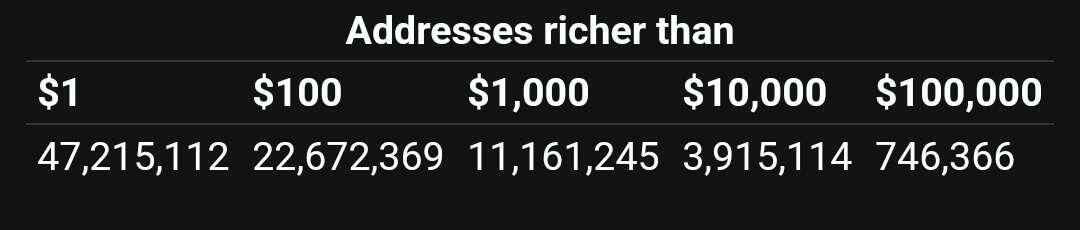
Isn’t this graphic a kind of misrepresentation? We all know multiple addresses can be generated from a single seed phrase so in reality this graphic just shows single addresses with large amounts in them (which is arguably bad practice and therefore not many do it - hence the lower number). It doesn’t really show how “rich” anyone is. I could have a 100 addresses in one cold wallet each holding $1000 equivalent of bitcoin. That’s $100,000 in total in my cold wallet but each address would be listed in the $1000 column in your graphic.

Well, yes. I'm counting addresses with at least $1,000 worth of bitcoin in them. It's useful to see if there are indeed 200M+ users. It's not... there are maybe 1-2M people hodling their own keys. The rest are paper bitcoin on exchanges.

My buddy did very well in a poker tournament. I wonder if he'll put the winning to good use. I've gifted him some bitcoin for his last birthday. He always complained he doesn't have a decent position in bitcoin. Now he can.

nostr:nevent1qqs0rvsa98j9lucp4vayhm0hyfpf6a7aw4r4gtznw3l66290ydqm9csppemhxue69uhkummn9ekx7mp0qgstlh3z22pnq8xlwekyjemjac0rmpjvu63tyc4f5hy05v2yd3acmssrqsqqqqqpnae3ne