
Every few months I post this, in the hopes that we’ll find a taker. Any book sellers out there interested in stocking ‘Resistance Money’ and selling it for bitcoin? We can get you copies from the press at a steep discount. No author kickbacks or royalties or funny business: we just want people to be able to buy the book for bitcoin!

I’m thoroughly enjoying Resistance Money by nostr:npub1yezu4atsdgchvlyjz5efwks8n7ze2rssq674qe04m5pp8e5y32tqfdawc7, nostr:npub1jddnc9ma408dey575wcsqhg5jtc2n7765y4gdnnrswlwgqnnat7swe4s60 and nostr:npub10afr060h0g3vf2ykynr6cvw2u7ta3tzpgjczfyufp420aeeen0xszf0xj0. It has made its way into my top five Bitcoin books!
#bookstr


Thank you!
Hard to think of a better holiday bundle tbh 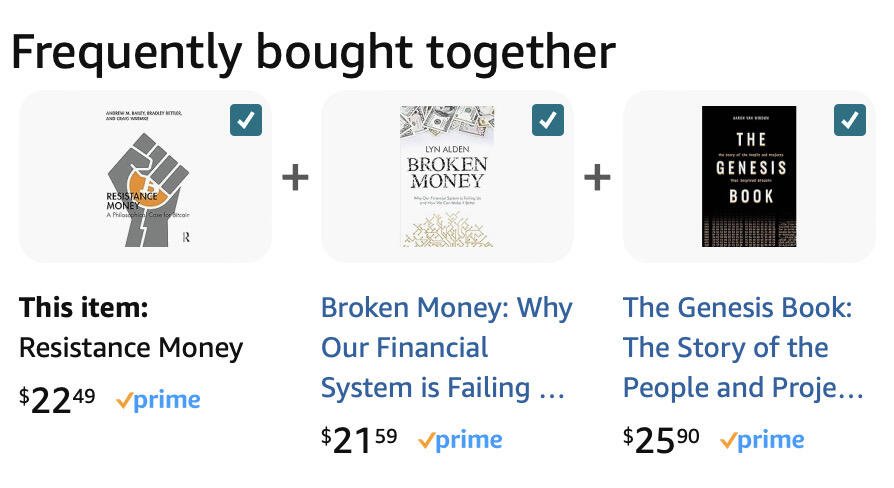
1. If they do Free Ross on Day One, we're going apeshit.
2. If they don't Free Ross on Day One, we're going apeshit.
3. Therefore, we're going apeshit (from premises 1-2)
Pretty convincing argument tbh 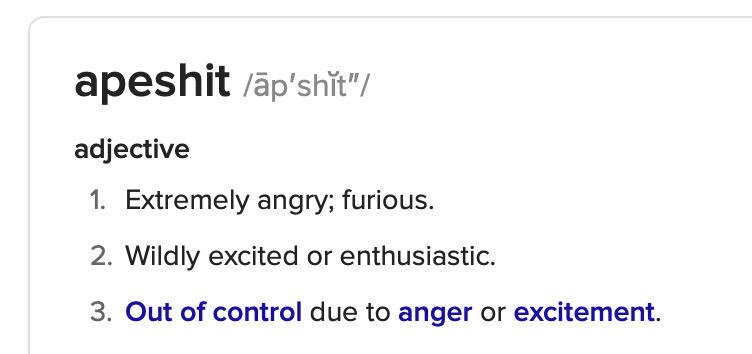
Thank you, eggyolk! The two features this review identifies — writing to clarify rather than to wow, offering understanding rather than polemics — were top of mind for us as we wrote the book. 
Many such cases. nostr:note18s37we5530wlgflnyll5m5n5hdrju97f06vjkwrsu9efkcahe2mswuwdva

Philosophers At Work
I liked reading books by philosophers. However, I just now realized I never saw one at work. Most of the time, the work was done long before I read it or read about the situation that gave rise to the work. With Bitcoin, this is different as we are experiencing its introduction to the world, history in the making.
We have read and heard people talk about Bitcoin's electricity use and associated CO2 emissions. Some work was led by emotions and arrived at untenable conclusions. For instance, Mora et al.'s 2018 paper entitled "Bitcoin emissions alone could push global warming above 2°C)".
Then, there is the much more accurate work of knowledgeable authors. However, if they appear to defend a preformed conclusion rather than arriving at one after neutral deliberation, their work is more challenging to read for the critiques.
And then there is the book Resistance Money, subtitled A Philosophical Case for Bitcoin by nostr:npub1yezu4atsdgchvlyjz5efwks8n7ze2rssq674qe04m5pp8e5y32tqfdawc7 , nostr:npub1jddnc9ma408dey575wcsqhg5jtc2n7765y4gdnnrswlwgqnnat7swe4s60 and nostr:npub10afr060h0g3vf2ykynr6cvw2u7ta3tzpgjczfyufp420aeeen0xszf0xj0. I much enjoyed their scientific work on Bitcoin's energy consumption from a neutral ground and with a global humanitarian goal. Rather than arguing for what is good for them, the stance many people willingly or unwillingly take, they tried to approach the question assuming that tomorrow, they could wake up as any one of the eight billion people.
I highly recommend this book to anyone interested in Bitcoin's energy consumption. If you are already a Bitcoiner and short on time, you might skip to chapters 9 and 10 directly.
It became apparent to me why we need philosophers.
That is so kind of you. Thank you so much for reading, and for *seeing* our work. Chapters 9 and 10 were probably the hardest to get out, so it is especially meaningful to us if you found them useful or good!

Yep. We develop a detailed case for this kind of argument, incidentally, in Chapter 7 of ‘Resistance Money’ — the freedom to transact as a necessary condition for other freedoms, despite its potential social costs!
10 THESES ON DEBANKING
1. Debanking, in the target sense, is when lawful payments or enterprises are blocked from banking services, because they are, to use a nice phrase from Nick Carter: "politically disfavored".
2. Debanking can occur at the explicit and written direction of regulators, or through more hidden means, as with off-the-record phone calls or vague gestures at limiting 'risky' activity so as to avoid costly audits — or worse.
3. Off-the-record governance of this kind undermines the rule of law, trust in institutions, and innovation. It's hard to build a law-abiding business when you don't know if you'll get kicked out of the system, for secret reasons you can't even share in public.
4. Some recent cases of debanking involve lawful but, to many, distasteful enterprises – crypto token pump shops, for example. Others involve family and friends of unpopular politicians. Yet other examples are more sympathetic: human rights activists, independent journalists, or whistle-blowers.
5. Since these examples run the ideological and moral gamut, it's probably most useful to keep 'debanking' as a purely descriptive term, rather than to gatekeep its application to, say, just the sympathetic cases.
6. Debanking in the modern era began with Operation Chokepoint, under the Obama administration. Though the first Trump administration ended that program, it implemented debanking structures of its own, including the campaign against Libra/Diem in 2019. The pattern continued under the Biden administration with the inauguration of Chokepoint 2.0. There is, by now, little doubt that politicized debanking happens.
What's at issue now is what to do about it.
7. Modern banking systems are neither entirely public nor entirely private. They are, instead, a curious hybrid. This hybrid character undermines arguments like 'it's a free world, and payment rails are privately owned, so financial services should be able to block customers they find risky'.
8. There is something of a paradox, then, at the heart of the issue. Here's how Justin Slaughter puts it:
- No individual bank should be required to bank any particular customer
- No industry that is not clearly prohibited by law should be refused a bank account
It is by no means obvious how to design a system that respects both constraints.
9. There is no purely political or policy solution to this paradox. Congress, the Fed, Article 3 courts, the Executive, CFPB, FDIC — any of these institutions *could in theory* be used to untangle the mess. But in truth, empowering them further is unlikely to have that effect, since they are themselves political institutions.
10. The way forward lies, instead, in developing and using payment and banking rails that are genuinely open for all — beyond the easy capture of regulators or corporate structures alike. Thus David Marcus: “you have to build it on the most neutral, decentralized, unassailable network and asset..."
“The ratio of Blackberries to iPhones used to be 100:1, so we are due for a correction and return to the mean.”
— Person who draws lines on charts
A friend was planning a trip to Japan to celebrate some recent wins. The application was complicated, and took significant work.
Visa denied; no reason given.
He'll have to wait six more months before he can apply again. Damn.
Check your passport privilege all.
Why share? Does it connect to my family's troubles with American immigration? Sure. But it's something I care about independently too. My developed world friends are often wildly unaware of how hard it is to travel without a fancy passport. Which is frustrating for everyone else!
Exactly the clip!
People ask how many bitcoins I have. My answer is always the same:
How dare you speak to me?
What is the optimal portfolio of group chats? Some principles:
- Experiment (join many)
- Diversify (cross ideological divides)
- Manage risk with sizing (allocate attention sparingly)
- Let winners ride (engage good ones more)
- Cut losses (mute/exit, if a chat isn't useful)
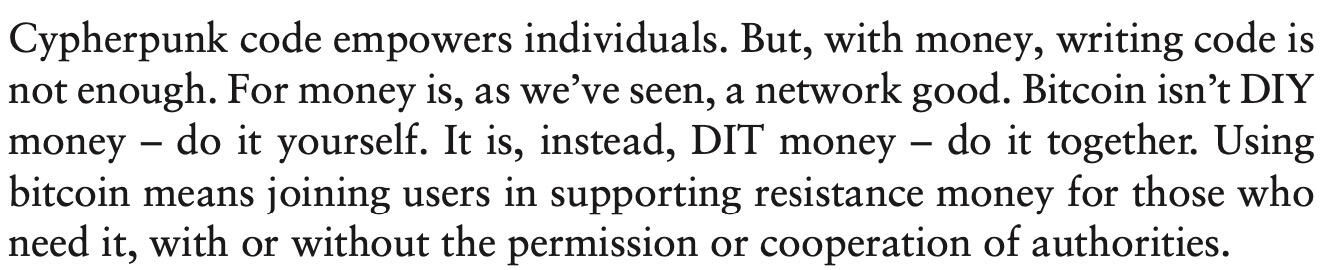
When you use bitcoin, you're not just empowering yourself. You're joining a network, and empowering others who use it too. All this without the permission or cooperation of authorities.
(excerpt from ‘Resistance Money’, p. 274)