

There is no better day than today to start...
THE ALBY MEME SHOWDOWN ( ͡° ͜ʖ ͡°)

Show us your MS Paint skills, solid humour and memetic experience!
💥💥 We are accepting submissions! 💥💥
Post the funniest and wittiest .JPG you find, make or remix. Publish it in the comments or on your Nostr or Twitter feed (use #Alby & #memestr hashtags) and... win!
-----------------
Central Funny Pictures Committee consisting of nostr:npub1pazuhetzx5w8yyt59lszeslxlywkeadnq6rncre7nlqv2uxnxuwq8c56r9 nostr:npub1q5sah9f3p9kl7uqdeaqskqwmg74ktxx70e0093dzh4lpzcp3t0mqzxky65 nostr:npub1m0sxqk5uwvtjhtt4yw3j0v3k6402fd35aq8832gp8kmer78atvkq9vgcru nostr:npub14wxtsrj7g2jugh70pfkzjln43vgn4p7655pgky9j9w9d75u465pqvagcye and nostr:npub1zumzudhtu2558fgvycnjlc7pq9l4m338vghgcfzafftz9qg45ruslzpl4x will meet on December 1 and reward you with prestige and:
🥇 1st MEMASTER - 42,000 sats + Alby socks
🏅 2nd MEMASTER - 21,000 sats + Alby stickers
🥉 3rd MEMASTER - 21,000 sats
🎖️ PLEBS CHOICE (for the most social engagement) - Alby merch megapack!
Winners will also get their deserved shout-out from our memepartners: nostr:npub1pazuhetzx5w8yyt59lszeslxlywkeadnq6rncre7nlqv2uxnxuwq8c56r9 and Memestr.App
Let's start... NOW 🚀
Any joke or roast is a fair game... but please keep them Alby-related 😉
#Memestr #Alby #AlbyMemeShowdown #AlbyMemes



Wow, we had a bit of rain over the weekend, but it turned out to be beautigul weather.
Thank-you, keeps me going, I've been enjoying the process of doing something new.
Getting out of your comfort zone is definitely going to make you feel a bit nervous, but it's what we need to grow!
I've got a little on between now and christmas, should be a nice ending to the year. Hopefully catch up soon!
I know I'll find myself floating down that way if the waters rise. Haha
The Daily Stoic - Meditations on Wisdom, Perseverance, and the art of living a good life.
Day 44
November 25th - Funny How That Works Out
"As for me, I would choose being sick over living in luxury, for being sick only harms the body, whereas luxury destroys both the body and the soul, causing weakness and incapacity in the body and lack of control and cowardice in the soul. What's more, luxury breeds injustice because it also breeds greediness."
-Musonius Rufus, Lectures, 20.95.14-17
From the Author:
"Stories about lottery winners tend to share one lesson: suddenly coming into a great deal of money is a curse, not a blessing. Just a few years after they get that big check, many lottery winners are actually in worse financial shape. They've lost friends, they've gotten divorced. Their whole lives have been turned into a nightmare as a result of their obscenely good fortune.
---
And yet the most common response from a cancer survivor, the person who went through the thing we all dread and fear? 'It was the best thing that ever happened to me.'
Funny how it works out, isn't it?"
Hardship has the benefit, if you successfully navigate through, of teaching you things that the easy way would not have. The earning of money, through purpose and action has a profound effect on a person, as opposed to having a fortune thrown at them. Though a lot of people may initially be excited for their riches, to go shopping, go on holidays, buy gifts for others... and then what? Do you think many people would want to go back to work after making millions?
A little related story of a dream I had a year or more back, which I recounted to Hats last night, was that I had had a dream, and woken up after feeling totally awful, because the dream was that I woke up (in the dream) to having a fortune of several billion dollars worth of bitcoin overnight. The idea that there was not going to be struggle, or at least work that needed to be done for my benefit really did not sit well with me. I feel like we, like our physical bodies, need resistance here and there to grow, and to have a feeling of satisfaction for enduring extended resistance. But not needing to have a purpose because you neutered your drive by gaining a fortune removes a great deal of resistance, but then it may be found more in the people in your lives, such as a spouse or friends.
The Daily Stoic - Meditations on Wisdom, Perseverance, and the Art of Living
Day 43
November 24th - Train to let go of What's not Yours
"Whenever you experience the pangs of losing someone, don't treat it like a part of yourself but as a breakable glass, so when it falls you will remember that and won't be troubled. So too, whenever you kiss your child, siblings, or friend, don't layer on top of the experience all the things you might wish, but hold them back and stop them, just as those who ride behind triumphant generals remind them they are mortal. In the same way, remind yourself that your precious one isn't one of your possessions, but something given for now, not forever..."
-Epictetus, Discourses, 3.24.84-86a
From the Author:
"At a Roman triumph, the majority of the public would have their eyes glued to the victorious general at the front - one of the most coveted spots during Roman times. Only a few would notice the aide in the back, right behind the commander, whispering into his ear, 'Remember, thou art mortal.' What a reminder to hear at the peak of glory and victory!
In our own lives, we can train to be that whisper. When there is something we prize - or someone that we love - we can whisper to ourselves that it is fragile, mortal and not truly ours."
The theme of the whole of November is "Acceptance / amor fati", so it makes sense that a lot of the entries have very similar themes, and this one is no different in a sense. It ties in the last two posts; 'The Glass is already Broken' and 'Attachments are the Enemy". All three have to do with holding onto something that is not truly yours. The glass can break, you have no control over that potential fate of it, or the lamp can be stolen. Attachments can be destroyed, if for a person - they could act or say a certain thing - and that attachment is gone.
We, our attachments and our belongings are fragile, mortal and not truly ours. We cannot hold anything without reasoned choice, or we may come to a cross of confliction. You must then make that reasoned choice.
The Daily Stoic - Meditations on Wisdom, Perseverance, and the Art of Living
Day 42
November 23rd - Attachment are the Enemy
"In short, you must remember this - that if you hold anything dear outside of your own reasoned choice, you will have destroyed your capacity for choice."
-Epictetus, Discourses, 4.4.23
From the Author:
"According to Anthony De Mello, 'there is one thing and only one thing that causes unhappiness. The name of that thing is attachment.'
Attachments to an image you have of a person, attachments to wealth and status, attachments to a certain place or time, attachments to a job or to a lifestyle. All of those things are dangerous for one reason: they are outside of our reasoned choice. How long we keep them is not in our control."
The Author goes on to talk about Epictetus having realised this some two thousand years earlier, and that once we have them we don't want to let them go; 'we become slaves to maintaining the status quo.'
We have one thing in our control, that is 'prohairesis'; our capacity for reasoned choice.
We cannot keep the attachments to things, unless we are willing to accept that the object of attachment, whether physical or conscious, is already broken. As was talked about in the last post. Neither the Author, nor Epictetus talk about this, but I think it is apt to combine the two. The Zen Master in the last post had an attachment to his cup. Epictetus had an attachment to a lamp. But only once we accept these attachments are not forever, nor are they anything but a certain projection of our own wants to an object or situation, can we demonstrate reasoned choice.
The Daily Stoic - Meditations on Wisdom, Perseverance, and the Art of Living
Day 41
November 22nd - The Glass is Already Broken.
"Fortune falls heavily on those for whom she's unexpected. The one always on the lookout easily endures."
-Seneca, On Consolation to Helvia, 5.3
From the Author:
"There is a story of a Zen master who had a beautiful prized cup. The master would repeat to himself, 'The glass is already broken.' He enjoyed the cup. He used it. He showed it off to visitors. But in his mind, it was already broken. And so one day, when it actually did break, he simply said, 'Of course.'
This is how Stoics think too. There is supposedly a true story about Epictetus and a lamp. He never locked his house, and so his expensive lamp was stolen. When Epictetus replaced it, he replaced it with a cheaper one so he could be less attached to it if it were stolen again.
Devastation - that feeling that we're absolutely crused and shocked by an event - is a factor of how unlikely we considered that event in the first place. No one is 'wrecked' by the fact that it's snowing in the winter, because we've accepted (and even anticipated) this turn of events. What about the occurances that surprise us? We might not be so shocked if we took the time to consider their possibility"
Over the years I've had my car in the driveway, for several months at a time, left unlocked regularly over night or when I'm not at the house. It, nor it's contents, were ever stolen. I've had my car broken into on two occasions, though. Both when the car was locked, though not in my driveway.
I feel like theres a point there of not having a fear, worry, or expectation for an event of this type to occur - to have something stolen or broken - if you can let go of attachment, or fear of losing the thing you're attached to.
I'm not saying the act of locking your house or car puts into the universe a frequency of "oh I hope no one breaks a window and steals my stuff", more that theres a feeling of surrender, and acceptance that something may already be broken or stolen.
I put out an frequency of safety, security for my person and belongings, and free passage for my movements and words. I believe that only good things happen. But I accept that I own nothing that I cannot defend, and that if something is broken or lost, I can repair or replace it, depending on the significance of the object.

“Gotta have opposites, light and dark and dark and light, in painting. It’s like in life. Gotta have a little sadness once in awhile so you know when the good times come. I'm waiting on the good times now.”
― Bob Ross
Exactly
The Daily Stoic - Meditations on Wisdom, Perseverance, and the Art of Living
Day 40
November 21st - Once Is Enough. Once Is Forever
"A good isn't increased by the addition of time, but if one is wise for even a moment, they will be no less happy than the person who exercises virtue for all time and happily passes their life in it."
-Chrysippus quoted by Plutarch in Moralia: "Against the Stoics on Common Conceptions," 1062 (Loeb, p. 682)
From the Author:
"Perhaps wisdom and happiness are like winning a medal in the Olympics. It doesn't matter whether you won a hundred years ago or ten minutes ago, or whether you won just once or in multiple events. It doesn't matter whether someone beats you time or score down the road, and it doesn't matter whether you never compete again. You'll always be a medalist, and you'll always know what it feels like. No one can take that away - and it would be impossible to feel more of that feeling.
The Juilliard-trained actor Evan Handler, who not only survived acute myeloid leukemia but also severe depression, has talked about his decision to take antidepressants, which he did for a deliberately brief time. He took them because he wanted to know what true, normal happiness felt like. Once he did, he knew he would stop. He could go back to the struggle like everyone else. He had the ideal for a moment and that was enough.
Perhaps today will be the day when we experience happiness or wisdom. Don't try to grab that moment and hold on to it with all your might. It's not under your control how long it lasts. Enjoy it, recognize it, remember it. Having it for a moment is the same as having it forever."
It's never a good idea to hold on too tightly to anything, I believe. Holding on to something, someone, some fortune, or some other good thing has a feeling of lack to it. You hold on so tight because you experience it rarely. You fear losing it, and so your mindset is stuck in a state of lack, of fear of losing, of fear of not feeling the good feelings again.
You must think abundance, and of course, gratitude. But you let the good times roll, and roll on. You wave goodbye as the good things vanishes into the distance, and before you know it, it's back at your heels.
“If you love somebody, let them go, for if they return, they were always yours. If they don't, they never were.”
- Kahlil Gibran
But it's also important to experience and come to peace with the bad times. Let them too roll. Wish them on their merry way, with gratitude for lessons learned.
Think in terms of tides. Of pendulums. Learn to sway with, do not be out of frequency, and find more greatness in the great, and more stability of self in the not so great.
The Daily Stoic - Meditations on Wisdom, Perseverance, and the Art of Living
Day 39
November 20th - Behold, Now as Ever
"If you've seen the present, you've seen all things, from time immemorial into all of eternity. For everything that happens is related and the same."
-Marcus Aurelius, Meditations, 6.3-7
From the Author:
"The events that will transpire today are the same as the things that have always occured. People living and dying, animals living and dying, clouds rolling in and rolling out, air sucked in and sucked out, a quotation from the moments that have come before and will come ever after.
This idea is expressed nowhere more beautifully than in the Christianity hymn 'Gloria Patri'. 'As it was in the beginning, and now, and always, and to the ages of ages."
This thought is not supposed to be depressing or uplifting. It's just a fact. However, it can have a calming, centering effect. No need to get excited, no need to wait on pins and needles. If you haven't seen this before, someone else has. That can be a relief."
In the greatest, most macro of scales, everything can be summed up in "birth, life, death". This is an endless cycle, and nothing changes. As we focus down the scales, we begin to see things that have also always happened. Love, unity, hate, war. Endless cycles for as long as earth has existed. Zoom in a bit closer, and we start to see successes and failures, small and large, of people, revolutions lead by some. But again it's not new. Small trials and tribulations for every day people, businesses opening and closing, partners loved and lost, animals cherished and grieved. It's all happened before, and will always happen.
The trees and grass grow, the animals and men cut them down to cycle them into food and habitation. As always.
We have the internal knowledge, or esoteric connection, to everything that has happened, and throughout history we have always prevailed. Someone has beaten the odds while working through the very thing you may be going through now. You've seen this before, you know how to resolve it.
It's definitely difficult to go from an Atheist/Agnostic PoV with a necessary "need to verify" (in my case, before even having conscious thought to 'Don't trust, Verify'), to a "trust the process of life" in whichever way it manifests for you (Higher self, God or gods, universe, soul). But whatever this is is something that is much bigger. But I do think theres an element of verification in it.
I've verified, when I've been conscious of it, that what I put out I do get back. When I allow things to flow, things flow in my favour. When I suggest that the universe conspires in my favour, it does.
It is absolutely a form of surrender and connection to something, and we can call it whatever makes us most comfortable. For some it is 100% Gods plan. For others who are less inclined, it can be as close as "I made it happen, I am the center of my universe and I call the shots", and I don't think that's far from the truth either.
As an aside, I've never read the bible, though I have read passages here an there. But during my very 'atheist' stage, which is something I can no longer commit to (as it does not serve my purpose), I always thought of the idea that since it was written, transcribed/translated multiple times over thousands of years, that it was not something to place a great deal of trust in. But the metaphors, similar to those that come from a place the philosophers, can be absolutely considered and weaved into our lives.
Thanks for your insight, Brisket. Appreciate you a lot brother.
The Daily Stoic - Meditations on Wisdom, Perseverance, and the Art of Living
Day 38
November 19th - Maxims from Three Wise Men
"For any challenge we should hold three thoughts at our command:
'Lead on God and Destiny,
To that Goal fixed for me long ago.
I will follow and not stumble; even if my will
is weak I will soldier on.'"
-Cleanthes
"Whoever embraces necessity count as wise,
skilled in divine matters."
- Euripides
"If it pleases the gods, so be it. They may well kill me, but they can't hurt me."
- Epictetus, Enchiridion, 53
From the Author:
"These three quotes compiled by Epictetus show us - in wisdom across history - the themes of tolerance, flexibility, and, ultimate, acceptance. Chealthes and Euripides evoke destiny and fate as concepts that help ease acceptance. When one has a belief in a great or higher power (be it God or gods), then there is no such thing as an event going contrary to plan.
Let's practice this perspective today. Pretend that each event - whether desired or unexpected - was will to happen, willed specifically for you. You wouldn't fight that, would you?"
This makes me think of the meme of the downtrodden man saying "Jesus, why do you give me your hardest battles", and Jesus is replying "because you are my strongest soldier" or something silly.
We find ourselves in situations that feel like uphill battles, and some may feel constant and never ending. But these events are lessons, and maybe if you push too hard against them, you find you lose more and more traction, slip further into what you perceive as near ruin. When this happens it's time to reassess. In some cases it's not meant for you, or not the right timing, and theres another opportunity to grasp hold of.
Someone very close to me has been working hard to build a business over the last few years, and while things look amazing, his work is fantastic, his business has not yet reached a point where he feels like his hard work has paid off. He's had wins, here and there, but ultimately feels like he's pushing through the deepest of depths. He expressed to me he was going to close the business down, and I told him not to worry if it comes to this, as it may release the pressure and allow things to flow, and for something to come along. Within three days of beginning to shut things down, someone reached out to him to collaborate, and it flipped things around in a positive way for him immediately.
Through all this pushing and struggle, he's also found a much higher calling, something he really wants to do. The original business, afterall, was not his passion. But he was able to let go, and dig deep, and that lightbulb moment occured and he has his mission.
It's still a process, but this was his fate. To learn the hardships, the struggles, the dispair, so he can truly experience the goodness, happiness and fruits of his labour.
We talk a lot about this period of his life, and he often wonders why there are so many setbacks, what is this telling him, how can he succeed. And we came to the conclusion that it doesn't matter. You keep going, maybe not pushing, but you just keep allowing opportunities to come, try to make something worthwhile, but never accept defeat or failure.
Interesting perspective indeed.
I thought of 1 as "If you can't verify truth, then don't. Don't hold positions you're not sure about, but use discenment in how much energy you give to those things."
For example, I don't accept the 'facts' we're given on many things in the world, such that there are many differing angles that one can take. The current Israel/Palestine war is an example I can use. There are people making good and bad points on both sides, depending who they support. They say x, y and z about one or the other, and I'm generally uncertain about if it's the truth, or if it's embellished to some point to pull heartstrings. I don't know the history, motivations, instigators, etc, so I can't accept what people just say.
For the common good aspect of number 2, I think of that as centralized and very small scale, because those are things that are more within my power. My family is whom I direct my energy to for the common good. Generally it's being a supportive son, taking on physical burdens and helping with emotional/financial burdens. I believe that if I can help my family the best way I can, and then possibly my community, then it's for a common good. But I don't assume the common good in the sense that I don't push a direction of my prefered outcome, only support those in which I align with.
Both relate to me as a man with a centralized power over my actions and thoughts.
The Daily Stoic - Meditations on Wisdom, Perseverance, and the Art of Living
Day 37
November 18th - Four Habits of the Stoic Mind
"Our rational nature moves freely forward in its impressions when it:
1) accepts nothing false or uncertain;
2) directs its impulses only to acts for the common good;
3) limits its desires and aversions only to what's in its own power;
4) embraces everything nature assigns it."
-Marcus Aurelius, Meditations, 8.7
From the Author:
"... let's align our minds along these four critical habits:
1. Accept only what is true.
2. Work for the common good.
3. Match our needs and wants with what is in our control.
4. Embrace what nature has in store for us."
Accepting only truth, or nothing uncertain, can be quite difficult without total knowledge, and in this day and age there are many things claimed to be true that are obfuscated, whether intentionally, or through lack of understanding/research. You must use critical thinking, as best you can, to determine if a claim is truth, or bad actors are attempting to lead you astray.
With misinformation being talked about by media, govt. officials and orgs, and people on social media, it's pretty clear that there is an agenda on who determines the truth. I think many could agree that those who claim for control over what we are fed as truth have something to hide. But that's not to say everything that is condemned by them /is/ truth. Use critical thinking.
Number three and four are very much about not striving for control outside and over that which cannot be in our control. Nature is as does. We can only accept what comes, and must not complain, lest we expend our energy complaining instead of using the momentum to steer in a direction that works for us, within our wants, needs, and abilities.
The Daily Stoic - Meditations on Wisdom, Perseverance, and the Art of Living
Day 36
November 17th - Judge Not, Lest...
"When philosophy is wielded with arrogance and stubbornly, it is the cause for the ruin of many. Let philosophy scrape off your own faults, rather than be a way to rail against the faults of others."
-Seneca, Moral Letters, 103.4b-5a
From the Author:
"Remember, the proper direction of philosophy - of all things we're doing here - is focused inward. To make ourselves better and to leave other people to that task for themselves and their own journey. Our faults are in our control, and so we turn to philosophy to help scrape them off like barnacles from the hull of a ship. Other people's faults? Not so much. That's for them to do.
Leave other people to their faults. Nothing in Stoic philosophy empowers you to judge them - only to accept them. Especially when we have so many of our own."
First is to acknowledge we have faults, then is to explore the breadth and depth of them, then to recognise how they affect your and those around you.
If we can do these things through questioning ourselves, even to dark places, and giving completely honest answers to ourselves, and breaking down that pride that we have of self-perfection, then we can heal, or scrape the barnacles off.
One of the biggest faults that many may have is hypocrisy; holding others to standards that we don't hold ourselves to. Whether it's consciously or subconsciously, we will always forgive ourselves before others, if it allows us to absolve ourselves of blame. Which is another fault, along with judgement, that many have, or find themselves falling for.
Take responsibility for your journey, but not another's. Have humility and patience while others start what you are already underway on.
The Daily Stoic - Meditations on Wisdom, Perseverance, and the Art of Living
Day 35
November 16th - Hope and Fear are the Same.
"Hecato says, 'cease to hope and you will cease to fear.' ... The primary cause of both these ills is that instead of adapting ourselves to present circumstances we send out thoughts too far ahead."
-Seneca, Moral Letters, 5.7b-8
From the Author:
"Hope is gennerally regarded as good. Fear is generally regarded as bad. To a Stoic like Hecato (known as Hecato of Rhodes), they are the same - both are projections into the future about things we do not control. Both are the enemy of this present moment that you are actually in. Both mean you're living a life in opposition to amor fati.
It's not about overcoming fears but understanding that both hope and fear contain a dangerous amount of want and worry in them. And, sadly, the want is what causes the worry."
The idea that Hope and Fear are the same is a new one to me. But I'm fascinated how it's a blindspot that I didn't realise I had in a sense. In the last few years I've lowered my time preference, and I've often thought about the future, and hoped it could be something amazing. Rather, I should just be staying in the now, realising that I need to do the work today, so that these things may come into fruition, without hope, but with determination, focus and work.
I know, without hope, that my future will be bright. I've always said that to myself. I also have no fears for the future because of this. No hope needed, no fear felt.
The Daily Stoic - Meditations on Wisdom, Perseverance, and the Art of Living
Day 34
November 15th - Everything Is Change
"Meditate often on the swiftness with which all that exists and is coming into being is swept by us and carried away. For substance is like a river's unending glow, its activities continually changing and causes infinitely shifting so that almost nothing at all stands still."
-Marcus Aurelius, Meditations, 5.23
From the Author:
"Marcus borrows this wonderful metaphor from Heraclitus, who said, 'No man steps in the same river twice.' Because the river has changed, and so has the man.
Life is in a constant state of change. And so are we. To get upset by things is to wrongly assume that they will last. To kick ourselves or blame others is grabbing at the wind. To resent change is to wrongly assume that you have a choice in the matter.
Everything is change. Embrace that. Flow with it."
This one is very similar to November 9th - All is Fluid.
But it takes a different look at it. Times where your pursuits go your way, and times when the trials feel against you, will not last. It's better to steel your resolve, ready yourself for impacts, but allow the impacts to come with knowledge that it is change in one way or another. It might offer you solutions, opportunities or rest. Each of these may come in a form that your subjective outlook will determine to be good or bad, easy or difficult, and may sway your energetic rhythm to and fro. But each are a chance for you to learn from, to flow with, and to improve upon, steeling your resolve further, removing subjective from the objective, and see that what ever it is, it just is.
Let go of the blame, upset, and resentment of others, events, or change.
The Daily Stoic - Meditations on Wisdom, Perseverance, and the Art of Living
Day 33
November 14th - You Choose the Outcome
"He was sent to prison. But the observation 'he has suffered evil,' is an addition coming from you."
Epictetus, Discourses, 3.8.5b-6a
From the Author:
"This is classic stoic thinking, as you've gathered by now. An event itself is objective. How we describe it - that it was unfair, or it's a great calamity, or that they did it on purpose - is on us.
Malcolm X (then Malcolm Little) went into prison a criminal, but he left as an educated, religious, and motivated man who would help in the struggle for civil rights. Did he suffer an evil? Or did he choose to make his experience a positive one?
Acceptance isn't passive. It's the first step in an active process toward self-improvement."
Make the best of every opportunity and you'll see nothing bad happens /to/ you. Only based off our subjective thinking does an objective event take a form whether good or bad. But all events can be spun, some harder than others, to be good, or at least one you can take a positive lesson from.
Perspective is also a huge part of this, I believe that if you can put into perspective an event and it's impact upon us, most things are of extremely small impact. You got cut off, you stubbed your toe, You broke a nail, a bird shit on you. All very minor things, less than a day and it'll be gone from your mind. So the event is objective and of little significance, but our subjective frame on the event is how we allow things to affect us.
Start to become conscious of all the times you curse under your breath, catch yourself and consider a universal reason for the event, or that it just doesn't matter, and let it go.
I have been listening to this over and over for the last two or so weeks.
Incredible set, close your eyes and listen.

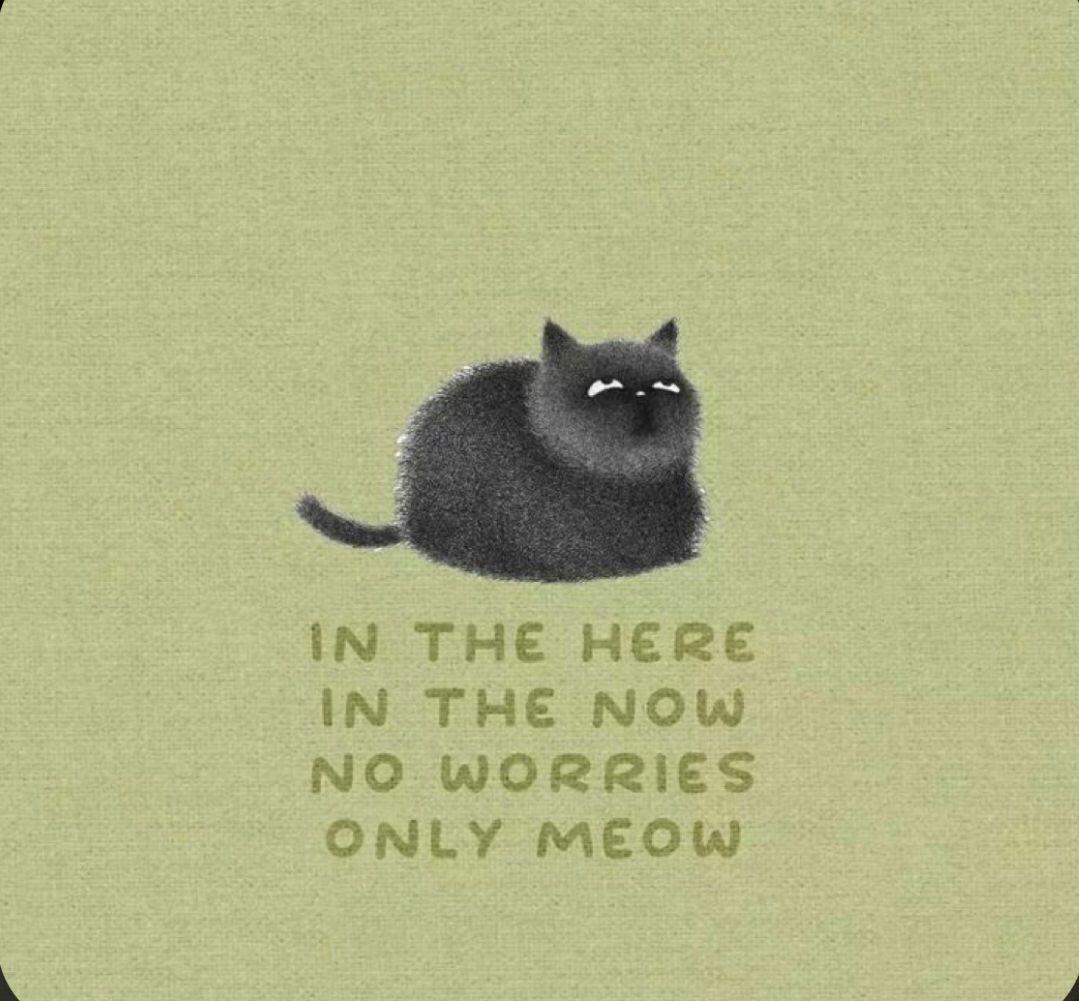
Stoic cat understands there is no tomorrow.
There is only now.
Stoic cat knows not to worry.
Worrying does not serve you.
nostr:note1mfvjpx3p7c8gqlrvv54y6xyd06crfl2y82v0yz24jdyx8hwqvr2s38y9jv
Anyone got a good of Julie Andrews sound of music spreading zaps? Needs to go here