
hikes > panels nostr:note1a4z0a0nsn4tmzsyr6383n5s4evp5x4ccd29836a0rymtjfrz6rksuqm8ln

Yeah, if the receiver phone has an internet connection receiving on phoenix works relatively well while the app is in the background. I guess async solves for the cases where the phone is offline for extended periods of time. But since zaps are mostly not mission critical, but tipping for shitposts, it might work fine without async payments.

nostr:npub185h9z5yxn8uc7retm0n6gkm88358lejzparxms5kmy9epr236k2qcswrdp are we correct to assume that hosted channels would require async payments (and broad bolt12 adoption) to allow self-custodial zaps?
Well users can swap to onchain self-custody with integrated boltz. But I agree it’s not as seemless as hosted channels.
Lol, yeah. I see liquid as my pocket money where I can side-step onchain fee spikes like we had during the halving. I’m not religious about any particular tech though and will use whatever has the best trade-offs and UX. If we can solve zaps with self-custody tech, that would be ideal obv.
Yeah cashu can iterate on the application layer more quickly. But choosing the initial mint is still an unsolved UX challenge. And mints get shut down constantly. I actually considered fedimint for stashpay, but chose the least worse option with Liquid (which is more likely to be there tomorrow).
Yeah, async payments would require broad BOLT12 support if I understand correctly. Basically the sender LSP would hold the payment until the receiving device came online.

You could use ecash to do LSP fee credits. Before StashPay I thought about building a mint just for fee credits that LSPs could integrate. But I got stuck on the regulatory part. You’d have to prevent users from spending until they have enough sats to open a channel. And there is a loss of privacy, since you couldn’t keep track of amounts to stay within legal limits. Otherwise you’d just end up hosting a mint for folks and custody their funds without limits.
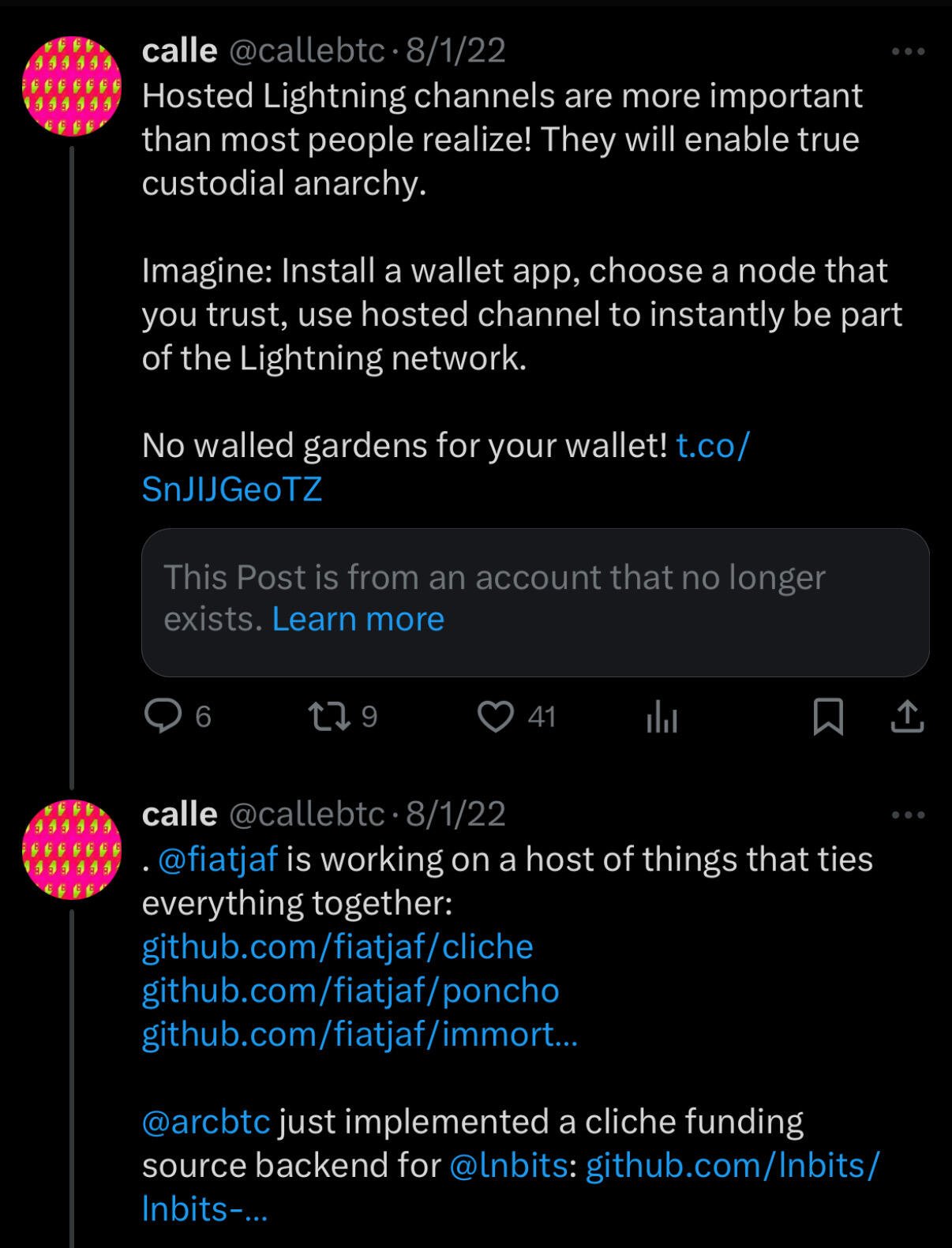
I like the idea of hosted channels. Solves low values payments. What are the regulatory implications for an LSP that custodies the sats until they end up in self-custody?

I’m reading through nip-60. I guess it makes sense since zaps are public anyway. So the best practice is probably for users to have two ecash wallets… one for public zaps and one for private payments?
Is the selected mint stored in relays?
Updated the StashPay website. I’m pivoting away from the freelancer focus and making a minimalist wallet for everyone.
I’ve realized I care more about exploring peer-to-peer payments UX than building a B2B business.
I’m also considering turning Onion Mill into a non-profit to get more people involved via grants. But for now I’ll continue to self-fund my work. I kinda like being an independent voice.

Hey Nostr,
been a while heh. we’ll try to fix that… eventually.
Meanwhile, we just released our Ark wallet SDK!
It’s still at a very early stage but you can now interact with an Ark server, on signet.
Details 👇
https://blog.arklabs.to/introducing-the-ark-wallet-sdk-d1c77ce61cfc
Congrats! Nice and simple api. Lightning payments will happen via boltz swaps I presume? Will SDK users be able to configure the swap server?

Very exciting indeed! Should make the SDK more attractive in the ecosystem.
And my pleasure re the issue. I know how annoying it can be to get issues asking for things in open source projects. Sometimes a few kind words make all the difference.
Very excited to see this PR merged: https://github.com/breez/breez-sdk-liquid/pull/639
Thank you to Roy and the nostr:npub1jugar2agq6369p0l86razavs9shj2p6pscxecevs8j94ap37hkqsjlfc28 team for being open to feedback and enabling use of the SDK without an API-key again.
Onwards ⚡️
There are no failures, only iterations. Keep going.
💯 living below your means and stacking sats is so much easier to implement for young people than trying to get on the housing ladder (or should say housing bag?) nostr:note1ntcvn9wsnn8kt02p2a048zjevh77t034q56mcu2s9ens8y4mxaus5ujwfv

Congrats to both the Breez team and Egodeath. Such an important piece of infrastructure ⚡️ Thank you for making the cost of building wallets deflationary 🙏🏼
Really important post Preston! nostr:note10gnf3eqrfcmf4rjsv4r03ss3rqaqgreg3mz79hv972gmqchg97jqyqeu0f
If only we had auditable full reserve tech connected to Lightning 🤔
I wonder if that id unique to Uvita. Costa Rica seems expensive in general https://nomads.com/costa-rica
*is

Yeah, both have their strengths. ecash is better for smaller payments like zaps.
Lightning/liquid swaps are cheap enough for medium sized payments though. I’ve had lower fees with Boltz swaps for payments over 10k sats than fedimint.
There is nothing inherently more decentralized about ecash mints over submarine swap servers. Both are fundamentally lightning nodes that can be run over tor by a community member.
Ecash has better privacy but also requires trusting the community member(s) with custody. The swap server on the other hand delegates custody to a diverse set of options that users can chose based their desired trust trade-offs.
Discussing FATF isn’t as popular as CBDCs since your favorite onramps already all comply. But this interview of a nym who works on the rules is definitely worth a listen. It’s chilling and inspiring at the same time. nostr:note1nfhp8jn3at70yx20w8hh8l2svp2mqf8mdktf36ns4qlssj6zvxzqyvauet
"There's a difference between knowing the path, and walking the path" — Morpheus

Appreciate your message and apology. No offense taken. I’m just expressing a trend I’ve been observing on Nostr and in Bitcoin. And yes, we need to meet people where they’re at. Change happens slowly. Anyway thanks again and enjoy your Sunday 🙏🏼

I’ll zap you 100 sats if you make the decision for me based on a list of 10 best features of each.
😂😂😂 
All is well
Depends on the size of the payment. Monthly invoices for freelance work have been cheapest on-chain for me for the past two years. Even in high fee environments it’s lower than the 1% (plus on-chain fee for splicing) when receiving to a self-custody Lightning wallet.

I would strongly recommend this book
It hasn't gotten a lot of attention but is definitely worth it
The thesis is simple
Just as the dollar moved from being based on gold to being based on oil (the petrodollar), it is today in the process of moving to a new base of Bitcoin, with the help of stablecoins
But thankfully the book doesn't end there with that dark outcome
It heavily implies that through proper engineering and layering and technologies like ecash, we can defeat the fiat system
https://store.bitcoinmagazine.com/products/the-bitcoin-dollar-book
Putting it on the list. Thanks. In nostr:npub1s5yq6wadwrxde4lhfs56gn64hwzuhnfa6r9mj476r5s4hkunzgzqrs6q7z ‘s recent pod, Paolo says Tether only buys short term treasuries (3 months) due to duration risk and needing to liquidate Tether quickly. Wouldn’t the US need a buyer of longer term bonds to replace China and Japan?

Yes, I can recommend the book “The Great Depression: A Diary”
by Benjamin Roth … it’s written by a lawyer who lived through the 1930s and he makes observations about the markets and politics. Very interesting!

Fees have been low enough for monthly invoices that on-chain works fine for now. Though I’m excited about migrating to BOLT12/BIP353 once offline payments are possible for self-custody Lightning.
nostr:note1vp4q69xwmzn6jjpqkk7wd45fqegjp9g6vu25luxjptnxntjavypqwt034r

NO REST UNTIL THE BITCOIN STANDARD IS GLOBAL. 🫡
https://cdn.satellite.earth/dfdcef07bb503c78044f72fe5337e88e2a8d0545f2f92518d2ef9e1f5c075546.mp4
🍺 > ☕️
This talk by Moxie confirmed many lessons I learned while working on Email and PGP. A must watch for anyone building on federated protocols. nostr:note1pzg4uwlreewd068rez2rzna7eekrwsyqeygeqmg4g5yzp7lpy0ws0xeyu2

In Damus I can mute people in my replies. Dunno if the mute list is just saved locally though.

Are reproducible builds possible for zapstore itself?

At least on Android we have reproducible builds. It‘s mainly on iOS where we need to trust app store binaries :/
https://github.com/signalapp/Signal-Android/tree/main/reproducible-builds