Because they often have no choice... This is the meaning of POWER.

The US: Encouraging/dragging their allies into conflict on your behalf, then fucking off and let them fend for themselves when they get tired.
Has there been any war/conflict since WWII where the US has not run this playbook and betrayed their "allies"?
South Vietnam, Afghanistan, Iraq, Ukraine

Notesnook
Tubular
RiMusic
Robosats
UntrackMe

Funny thing is, it's been to US which has exported the whole identity politics and woke mind virus to us in the first place. Via USAID and co.
Now don't pretent y'all had nothing to do with it. Europe is guilty though to have been to weak to resists this obviously idoicy.
America is (or at least seems to be) lucky to have turned things around. Good for you
And you're not just posting to one (as with X & Co), but many. Chances of one being in the EU, and within the reach of authorities there are pretty high.
Besides, most users here tied their identity to their twitter account, so if they're doxxed there they are doxxed here

IF YOU NEED A REMINDER WHY NOSTR MATTERS:
https://cdn.satellite.earth/4d0dd467851cf681e6b410d9e2cfd916aa6eb92d8377b664d56018d04e68c70e.mp4
The law is obviously stupid. But how exactly would be posting stuff on Nostr (as opposed to, say Twitter) put above it??
You'd obviously be as liable as when you posted the stuff somewhere else. And relay operators would as easily bend over and give out metadata as X, Facebook etc.

> The user custodies a bearer asset token.
No. The bearer asset token (eHash) is minted by the mint (=pool). And yes, that balance accrues, then more shares the miner submits. But the token
But these tokens remain in custody with the pool - until the miner withdraws them. Then, and only then, he can trade them.
Up until then (when he eventually withdraws the token and therefore takes ownership of them) he can only trade claims to the tokens. Hence my comment "he can trade IOUs of IOUs".
Now the core question: Why would anyone trade for these claims to the token (who are then claims to actual Bitcoin)???
Firstly, the miner would have to prove to the buyer that he is entitled to these token that are currently accruing with the pool. So a) there has to be some record, some ledger (account) at the pool level to keep track of how is owned what. And b) the miner has to proove to/convince the buyer that he is actually the person who is owed this token balance. (How?)
Secondly, even if we assume the miner were to find a buyer for these IOUs of IOUs, they are less worth than actual bitcoin; they'd trade for 90cents on the dollar. Why on earth would any miner sell his bitcoin at a discount?
"Need for immediate liquidity" you say???? Are to you telling me there are miners how have intra-day liquidity requirements, such that they would be forced to sell at a discount??
Because even now, any miner/seller can already get payouts on a daily basis via Lightning (https://academy.braiins.com/en/braiins-pool/faqs/rewards/#are-there-any-limits-for-lightning-payouts)! And keep 100% of his bitcoin, instead of 90% (or whatever the discount would be at which he can sell). Or every ~1.5day if they use BOLT12 payouts at OCEAN.
Bottom line - I still dont see why this construct would make sense
Ecash lets the mint custody some value and issue a bearer asset IOU in exchange for the custodied value. It's digital free banking. https://en.wikipedia.org/wiki/Free_banking
The hard money value is custodied by the mint. The bearer asset ecash token is custodied by the user. I hope that is clear.
In my model the pool runs a mint. They are one and the same.
I know what ecash is, thx 😉
When the miner does work (submits shares), the pool/mint credits him with eHash tokens in his book.
They remain in the pool's book (custody), until the miner withdraws them; that can be once a day, once an hour, whatever.
My question was/is, how would the miner be able to trade this eHash token *when it is still in custody with this pool*??
He has nothing in hand, other than a promise (which he can't even prove). Who would trade for this?? They would trade for an IOU (from the miner) of an IOU (from the pool)
"trade it before it matures"
1) how can I, the user (=miner), trade something I have no possession of??
The token either resides in the mint (=is not yet redeemed by the miner), or is already redeemed by the miner meaning the miner has been paid already.
2) The pool runs the mint? Or is the mint a separate party?
PPS: how the fuxk is i quote respond in amethyst?
Ecash enables accountless mining pools. I think your mind is stuck in the account based model and this thinking leads you to false conclusions.
As nostr:nprofile1qy2hwumn8ghj7erfw36x7tnsw43z7un9d3shjqpq2rv5lskctqxxs2c8rf2zlzc7xx3qpvzs3w4etgemauy9thegr43sa96tzn said, pool redemptions decouple submitted work from redeemed value. The pool won't be able to link these two because eHash tokens can be freely traded before redemption. The value represented by a proof of work share can go through any number of splits, joins, and trades before it is redeemed. How do you disentangle that using IP tracking? You could try, but if there is any significant volume...good luck with that.
BOLT12 and on-chain addresses just add the account aspect back in. This is a strict reduction in privacy for the user. They can certainly choose this option if the pool offers it but in terms of privacy it is better to receive ecash mining rewards and spend it directly. This way all your activities occur within the anonymity set of the ecash mint.
The ecash model simplifies accounting because the pool no longer needs to track the work of every user that connects to it. Instead, the pool accounts for all shares within a time window and that's it. Instead of maintaining hundreds or thousands of accounts in perpetuity the pool manages one 'account' per hour with a prearranged start and end date. I prefer to think of them as contracts. When the contract end date approaches all the assets (mining shares) and liabilities (eHash tokens) of the contract can be zeroed out and removed from the books. The pool never needs to carry a balance for users that have not met their withdrawal threshold.
This is a dramatic simplification in accounting because it removes an entire class of liabilities that need to be tracked. The business owner no longer needs to be concerned with unredeemed shares.
The eHash tokens (1token = 1share) need to be redeemed first by the miners, before they can be traded.
So, the pool needs to send them *somewhere* - otherwise they remain on the pool's books.
The tokens are probably locked to the miner's npub until he withdraws - which is an "account" (same as some pool use Bitcoin addresses as accounts)
Right?
Thanks for the link! The burnout potential is great especially when working with such large and somewhat loosely managed systems like the Linux kernel.
Glad that the project continues: https://asahilinux.org/2025/02/passing-the-torch/
Yeah. You could also really need an Openoms-clone support bot for the Raspiblitz TG channel 😏
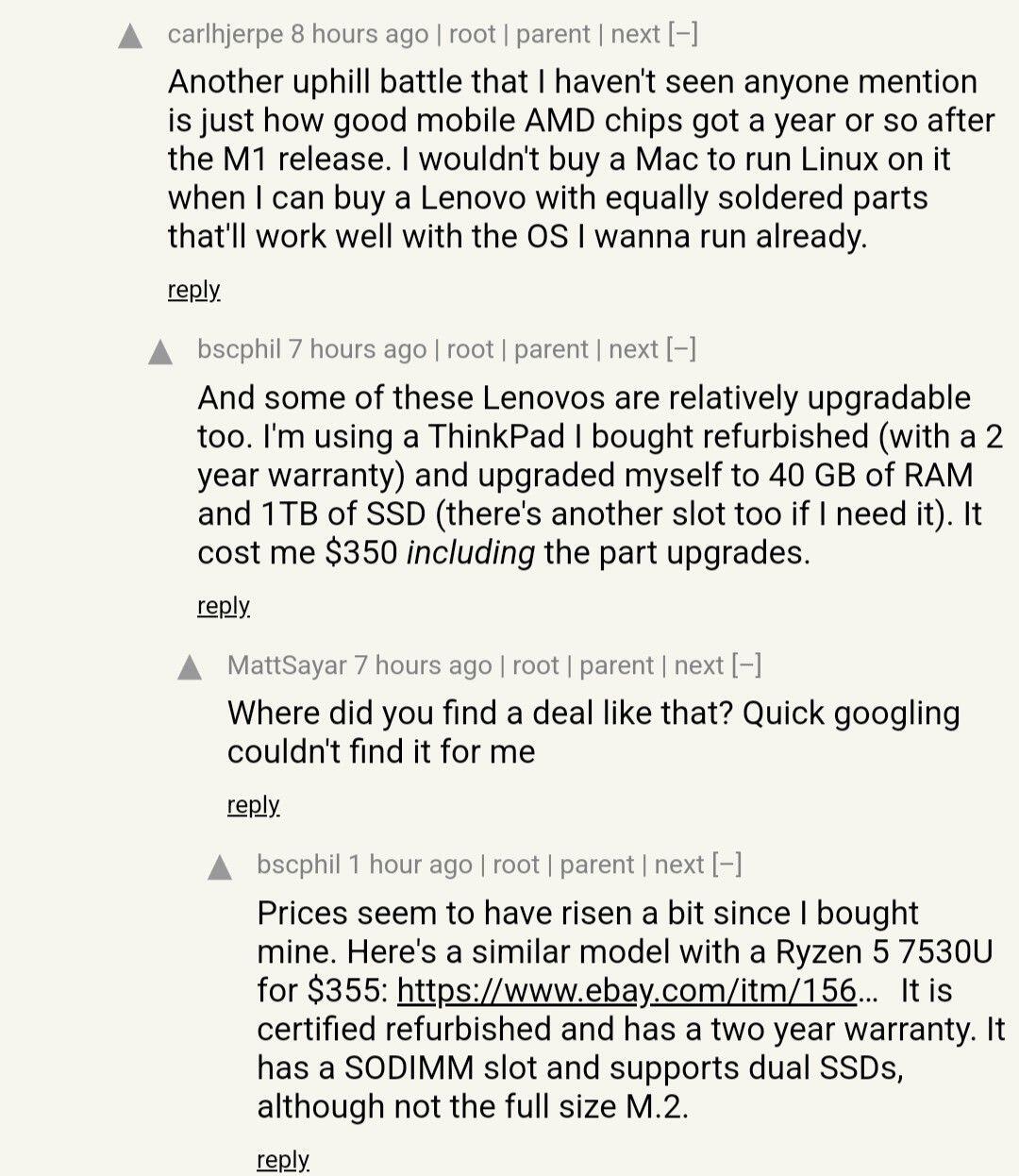
I'm a big fan of refurbished+upgrade laptops, but the distinct advantage of Apple silicon is the ability to run local LLMs, and good tooling around it (mlx)

There is this CLN NWC plugin:
https://github.com/gudnuf/cln_nwc?tab=readme-ov-file#nip-47-supported-methods
Taleb had skin in the game with the pandemic.
I think in The Black Swan (or maybe FbR) he theorized about a global pandemic being major BS - unexpected super high-imoact event that would ratlle the world.
When it then actually came to be, he could picture himself -once more- as this prophetic superhero who" told y'all so".
He was essentially falling for his own narrative, and thought he hit the jackpot by being right another time. Which has turned him into an even bigger asshole ..
What a sad character

It's still a federation...namely the "Mining pool federation"
In which there are basically just three main players