

We shouldn’t talk bad about these apps. Because we should *want* legacy apps to replace their user and login systems with Nostr.
The rest can come later; but even if it never does, that is still a major security and experience upgrade! (Unless someone’s private key leaks and then they lose everything / everything becomes public 😂)
Is python-nostr still being developed? Or is it basically feature complete and “finished”?


Check out the Blurry Creatures podcast. I think you’ll dig it. Everything from a biblical perspective https://youtube.com/@blurrycreatures?si=100yMCcRHmMjgvAy

Regarding Christian vs Jewish, try to focus on common values rather than specific clubs. People love cargo cults but focusing on values is far more productive. I believe in the messiah but I am learning to follow Torah. Sounds weird, I know
If Gab was smart, they would just create their own version of Giphy.
I think something like this may exist on Nostr. A “sticker” library kind of thing


Isn’t that a perfectly sensible policy? Seems like Nostr relays could do the same to be sustainable. Media uploads only for subscribers
It wouldn’t be full proof against piracy. But nothing is haha
Announcing: Wikifreedia 0.0.4!
SEARCH!
Wikifreedia now supports NIP-50 full-text search. There was no relay indexing wiki entries for full text-search, so I wrote a NIP-50 relay to serve this function, wss://relay.wikifreedia.xyz.
It's, obviously, open-source so anyone can run this.
https://wikifreedia.xyz/?q=philosophy

Awesome! I DM’d you back just now. I missed the message you sent a couple days ago

need help from #nostrdesign:
A browser extension that allows users to share links directly from any sites.
Share ideas or ask questions; adding a social layer to the internet browsing experience.
nostr:npub1r0rs5q2gk0e3dk3nlc7gnu378ec6cnlenqp8a3cjhyzu6f8k5sgs4sq9ac nostr:npub149p5act9a5qm9p47elp8w8h3wpwn2d7s2xecw2ygnrxqp4wgsklq9g722q nostr:note1x9nj373h2hf68ay9klucd8yza0j8qvckmkhywwz7q8syqyvqlg0s07z333
Maybe fork Snort and make it only show Satcom events? Then when you click a button in the Satcom extension drop-down, it then opens this web app
“Pablo, why are wikifreedia URLs so long?”
👉 That’s where the “decentralized” part comes in.
The long URL includes the relays where the entry was published. This looks annoying but no one said freedom must have nice URLs.
For what it’s worth, you can also use nice looking URLs to fetch articles from the author’s relays with a nicer looking URL like
https://wikifreedia.xyz/no-cold-war-(campagin)/6c2d79de2d469232
Or to see topics that live within a certain set of relays you can have the nicest looking URL
Isn’t it crazy that we can have both within the same protocol? nostr:note1xuy4hkhtm9ehjave26res326mwwg7cj9pyhl30xxp2fcrsrgg3ds4k05fg
How do we put an article under a certain topic?
And what should we use for links? The full link or just the naddr?
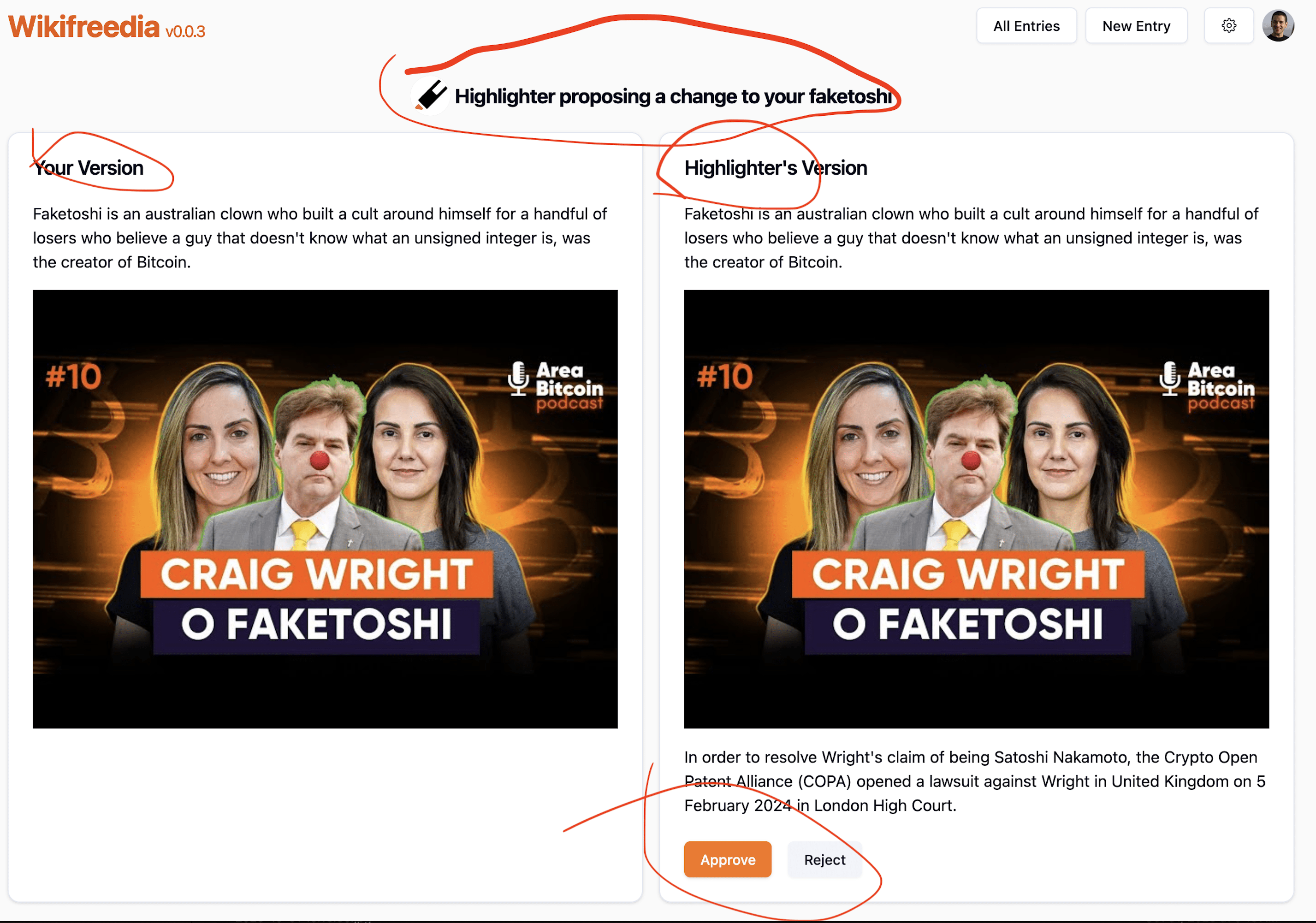
Hey Pablo, would you be interested in presenting Wikifreedia to the Knowledge Standards Foundation? It’s headed up by Larry Sanger one of the co-founders of Wikipedia. I think they would love to learn about your design and thinking. They meet every Friday at 2pm EST.
This is what Escape from Tarkov is like. If you can loot a GPU in a raid… 😮💨🤑
I’m also curious about disambiguation.
I guess these topics are related because if there was a consistent pattern to follow for how to title an article about a war vs about a movie, it would solve the problem.
I was thinking if you could title the page “Stalingrad” and the schema could clarify if it is the battle, the city, a movie title etc
Another question: how is the footnote system in markdown?
Have you thought about incorporating NIP-32 for part where there are multiple articles about the same subject?
That is the one I was planning to use for movie reviews for example (many reviews referencing the same movie).
Just need a standard format for the link. I would imagine something using a schema.org definition?
Everyone should check out the new Circles app built on Matrix protocol.
It is definitely inspiration for something that could be done on Nostr. I’d like to see more emphasis on private convos and more intimate connections. Products built for family for example. Maybe that just isn’t what Nostr is for. In which case, maybe Matrix is better.