6b
DJ
6b1d5928a3e5ceaaab80eb4c2a875405a44604be80026914ee294cd9aca01b1f
Nostrich

Building walls not to keep immigrants out but to keep emigrants in. Guess who pays for it... I thought Canada already had steep exit taxes on deemed dispositions of assets when people broke residency.

Canadians have had ample warning for this. Plenty of Canadian expats dot the globe saying SITYS to those who get stuck with this mess.


Replying to Avatar Guy Swann

A couple of things here to clarify the importance of full nodes:

First

----------------------------------

The concept and purpose of running a node is very much like the idea that everyone should be able to own a gun to defend liberty.

- It doesn't mean everyone will.

- It doesn't mean individuals can "fight off the government goons" with a handgun.

- It doesn't mean the state isn't more powerful than one person with their gun.

- It DOES mean that to conquer an entire nation of determined, gun owning people who want their liberty requires *active* and *direct* attack, because collectively enough people are armed that popular resistance actually stands a chance against tyrannical governments (who are naturally cowards)

The logic for anyone and everyone running a node who is capable is shockingly similar here.

Second:

----------------------------------

"Have we ever retroactively fixed a 5 year old "error" in the chain? No. Will we ever, no. Do you ever think, I wonder if that transaction from 2016 is still valid, I had better check?"

It isn't really about knowing that every transaction that other people are conducting is valid, it's about ensuring that *the #bitcoin you own* are REAL bitcoin. Bitcoins are created, are defined, and exist entirely and *solely* by a set of rules being followed for how they are created and how they are validly transferred. HALF of the supply of bitcoins was created prior to 2013. If you aren't confirming that the blocks that mined your coins into existence followed the rules, then you don't know if you are following an honest network.

--- The prime example here is Bitcoin Dark, which forked off and created 300K extra coins in the "privacy pool balance," then waited almost a year and a half to withdraw the from the privacy pool and since almost no one ran a full node, it went unnoticed except for a bitcoiner who actually ran full nodes for tons of forks out of curiosity and publicly posted when his node saw the bizarre transaction.

--- You could easily argue that no one needed to care about what happened 15 months ago on the chain... and every one of them was getting scammed specifically because they didn't.

IF we don't have the chain & valid link that traces all the way back to when your coins are created, you have abandoned the triple entry accounting breakthrough.

Third

----------------------------------

It isn't about simply making sure people can keep up with the chain when it comes to cost. It's also about ensuring *real* consensus is maintained (again requiring proof that the bitcoins being transferred are also real) across all borders, against any and all attackers, through any firewalls, on public and private networks, AND can recover after a disaster or massive failure on the network or in the software. Even if cheap SDDs are 50TB, if it takes 6 months to sync the chain, and there is either a direct attack, or a major bug that corrupts the data and forces a reset and sync-from-beginning on 60% of the nodes, that threatens the security and decentralization of the entire global monetary foundation for half a year *at best,* while what may be more likely is that having only 40% of the nodes, just becomes the new normal, and we never go back to the security we once had.

Last

----------------------------------

This is about securing the *trend* of decentralization indefinitely into the future.

It will require constant and deliberate attention and work to ensure it. We will have constant and recurring layers and degrees of centralization in the market, in the technology and hardware around it, in service provision, in some layer on top of Bitcoin that we become overly dependent on, AND on the base layer as costs rise and incentives to run nodes are low. But when an attack arises, when this centralization threatens the censorship resistance, or permission-less nature of the network, we will suddenly and aggressively remember how important it is to run nodes - and it will always be a part of any attempt at defending and repairing those critical re-centralization trends to run a full node, verify everything, and ensure the broadcast layer cannot be squeezed out of existence. That it can be reached to any and all participants no matter where they are in the world.

So the real question is:

Will this get *easier* to secure and protect in 5 years, or will it be *harder*? Because if it is harder, we have a problem, because how much security and decentralization do we lose exactly? 10%? 20%? What happens when we compound that every 5 years for another 50? If we have set it up to become more centralized in an irreparable way, slowly and incrementally, then that's the surest way to guarantee we end up on a system that only a handful of people run and who can dictate or defraud the whole world as to what is a "real" bitcoin and what isn't.

----------------------------------

There are a number of other nuances here because running (and communicating) a full node history isn't merely a problem of hard drive space, in fact, that's the least of the problems and the one that scales the best... while it is still a problem despite. The bigger problems are the computation, the RAM requirements, the speed of data indexing/recall/verification, the bandwidth to download and broadcast the information that is coming to-and-from the base layer, AND of course to then do all of the computation and verification of the *numerous* layers on top of it that we will have to use. Remember that layers themselves are just another trade off, and it's not as if they cost nothing to run. It is merely that they cost *less* to run than scaling on the base layer.

So in short,

you can't really make this short, so read the whole thing.

------------------------------------

Also, I actually kind of like your final argument and position on the "you don't even vote in your own republic" is pretty good, but I think it works *in support* of the full node argument, it doesn't replace it.

nostr:note1v6gsv74asffdtv027m7gxhrtq8c8dfta0xff2ypgz7t0zdjqrg3qw6fzta

Well said. It's Also worth keeping in mind that liberty is always the goal. Bitcoin is just another tool to help attain that goal. As with any other means to secure liberty, it's never as easy as many people think at first. Freedom isn't free.

Going forward, more devs should be more anonymous and have better opsec, but this is still a valid concern for now. Maybe it's also effective to exploit rivalry between certain nation-states. But that all could just turn the devs into assets to be captured or killed in the shadows rather than tried in corrupted systems of so-called law and justice.

Ideally, governments should fear backlash of many individuals when treading on the rights of a few, but we seem far from that balance of power presently.

Isn't that still the case in Canada? At least people can travel for care if they can pay.

They now drive plug-in EVs, using batteries made from ingredients harvested using child/slave labor, storing electric energy generated by burning coal, etc. But they really try hard to sound like they care about ethics and claim moral superiority.

Referencing the $20T projection, the latest US "defense" spending authorizations were just a mere drop in the bucket at $95.3B in addition. With interest, it's probably in the 12 figures, but that's nothing among friends.

For posterity, this refers to Guy's Take on Read_816 of Bitcoin Audible, IIRC nostr:nprofile1qqstnem9g6aqv3tw6vqaneftcj06frns56lj9q470gdww228vysz8hqjqcma4

FWIW, El Dorado was supposed to be in South America.

part of a causal relationship πŸ˜‰

To be fair, there are many similarities between the two places.

Imagine being an IT worker having to implement that ban. But when the US gov't leans on platforms to take down news, it's merely exercising it's own free-speech rights to protect Americans and to save Democracy!

Gigi gives some (of many) examples of how this freedom was lost, quickly, by those who took freedom for granted. It's easier to defend the freedom you already enjoy than to win it back once it's been taken away. Don't get complacent! Guy's advice is spot-on in Read_811.

He's got "bitcoin" as in BSV. Maybe enough to buy a subsistence allowance of dog food.

Yep. Another way to look at it is where that $1 bought 1 million sats, and now it can only get 1400. Wonder how many people who took that advice then still hodl the same coin now, or if it all got lost/burnt/stolen/spent in the last 10 years.

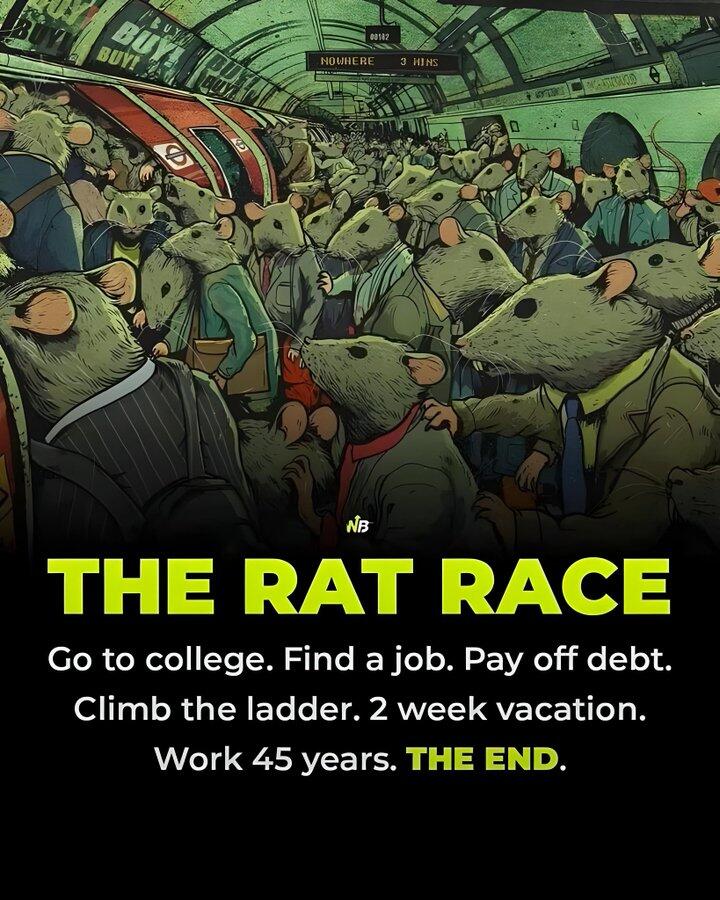
For many American rats, that two weeks of vacation time may be the total for all working years.