I think All Hallows' was another name for All Saints' (saint comes from the Latin for "holy", and hallowed comes from a Germanic root). So Halloween comes from Hallows' Even
The current Breviary starts the Feast of All Saints with Vespers on October 31st, but I never knew the 31st was once a distinct day in the liturgical calendar.
So much has changed since the liturgical reforms started in the mid-20th century
My favorite is what I see at the Traditional Latin Mass when you have the people from out of town who think they know when to sit and stand and kneel, and they obstinately stand up staring straight ahead as if everyone else in the church could not possibly be more wrong.
# The Triduum of the Dead
I read this lovely article on the traditional liturgical observations of All Hallows' Eve. It strikes me how differently the faithful in the Medieval ages, steeped in the liturgy, probably saw the world. The cultural practices around Halloween, All Saints' Day, and All Souls' Day seem to be a remnant of a rich liturgical imagination.
https://www.liturgicalartsjournal.com/2019/09/all-hallows-eve-halloween-in.html?m=1

#meme #memestr

The New Testament was written in a specific time and place in history, namely, amidst a Jewish and pagan milieu in a corner of the Roman Empire. The writers were influenced by the cultural practice of their time, and Scripture itself is full of cultural references that don't apply directly to the present day.
Tell me where you are finding the pure, unadulterated cultural practice of Christianity.

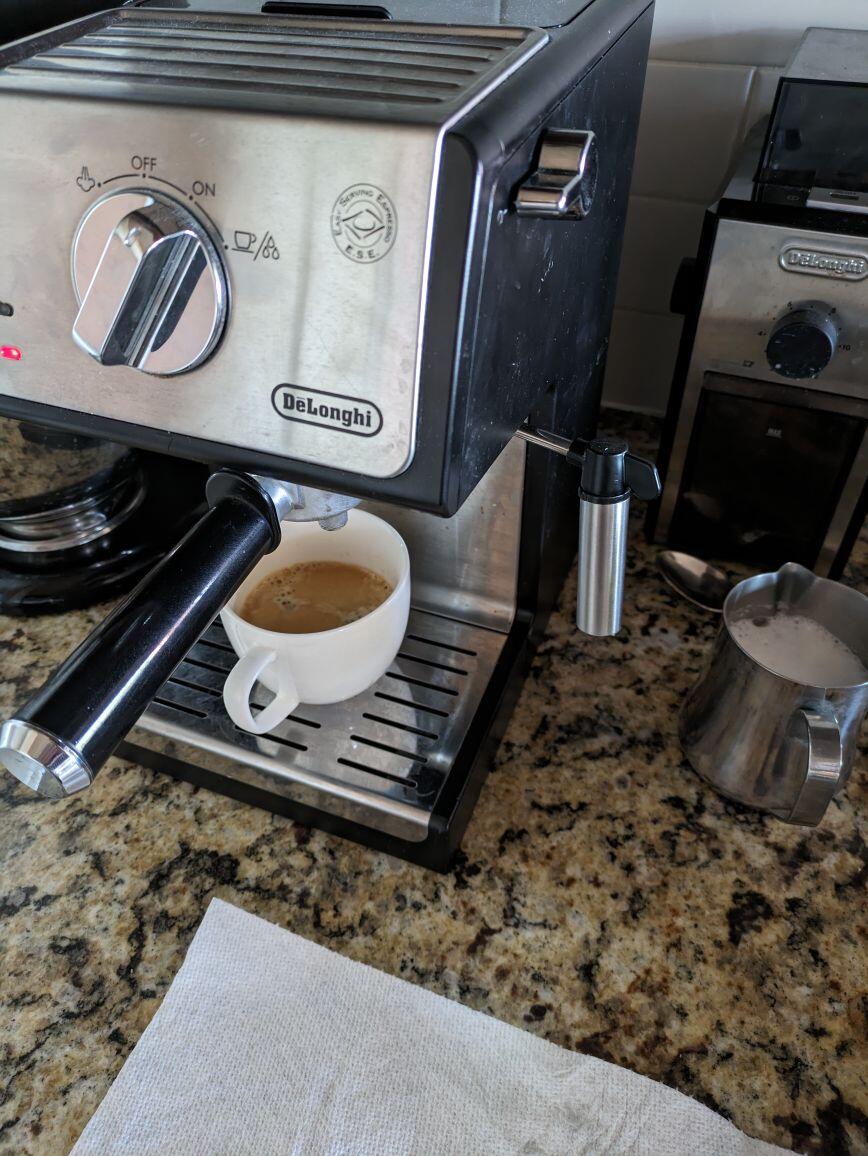
Currently on a bag of Fara coffee. They blend Sumatran and Nicaraguan beans. I like it for both espresso and pour-over
I love the smell of espresso #coffeechain
I don't see why adopting local cultural forms is such a bad thing. When peoples join the universal Church, they bring their culture with them. Historically, this often added a local flavor to preexisting Catholic feasts
Thinking about how God wants each of us individually to be a saint.
I'm nowhere close to that, but I feel that if I cooperated more with His grace, He could make me much holier very quickly. In the present, though, the thing is to focus on doing with love what God puts in front of me today.
That sounds like so much fun!
My wife and I went to visit her brother and his family across town. I wore my costume to take the nephews trick-or-treating.
Do you have trick or treating in Bavaria? What brings all the teenagers in?

Information is related to meaning. The mind takes in and stores information, and discerns or assigns its meaning. Thus, without a subject, there is no meaning, and probably no information in any real way.
Bonaventure said that things exist in three places: in the physical world, in the mind of man, and in the mind of God. This would suggest that things do exist "out there," independent of human minds to perceive them, but that they are also given being in some way when they are grasped by the human mind. And of course, all of this depends on God as the self-existent ground of being.
God exists, and He is the Subject in which all things exist. Things exist, but they are not subjects, and so nothing else exists in them. Human beings are both things that exist and subjects in which other things can exist.
If we take God as primary, and man as secondary, then perhaps digital system are tertiary; things can exist within a computer, but the only meaningful way in which digital things exist is insofar as they exist in human minds. Does this make the digital world a sort of sub-creation?
Take a look at the other thread under my original post for a full explanation.
We are made of a biological part and a spiritual part. The biological part is gendered, the spiritual part is not. The consequence is that, taken as a whole, every person is gendered. Body and soul together, we are all either man or woman.
In an analogical sense, woman is the image of the soul in relation to God. God initiates, gives us His gifts, and pursues us, and we receive and respond in love. Christ is the bridegroom, seeking to woo the soul into loving union with Him.
The Song of Songs is traditionally interpreted as both a love song of Christ to his bride, the Church, and as a love song of God to each individual soul. Read in this way, Chapter 2 contains one of the most moving passages in all of Scripture. God speaks to each of us, saying:
"Arise, my love, my fair one, and come away. O my dove, in the clefts of the rock, in the covert of the cliff, let me see your face, let me hear your voice, for your voice is sweet, and your face is comely."
Okay, here's more detail, as promised.
Human beings consist of both body and soul. The body is biological, and is sexed. The soul, as spiritual, is not in itself sexed. The angels, which are pure spirit, are not sexed. God, who is pure spirit, is not sexed. Because we humans have biological, sexed bodies, our whole being is informed by this sexed nature. We engender our being into the world as either male or female, depending on the type of body we were created with. After we die, our souls will not be sexed in the biological sense, but our personalities will nevertheless be inextricably tied up with our experience as sexed beings. And, of course, we believe that God will ultimately reunite us with our bodies in the new creation, and those bodies will certainly be sexed.
In short, we would not say that an individual soul is male or female, but we would say that an individual soul is of a man or a woman.
Now, because we are created in God's image as male and female, our engendered nature reflects something of the nature of God. On a fundamental, biological level, the relationship between the sexes is that man initiates and gives, and woman responds and receives. Obviously the relationship between men and women has many more dimensions than that, but fundamentally, when man and woman come to union, particularly and clearly in the sexual act, it follows that basic pattern.
In the spiritual life, God always initiates. As Augustine says, "Late have I loved thee, O Beauty ever ancient, ever new." God initiates from the very moment of our creation, and we can do nought but respond. God gives us everything we have, and we can do nought but receive. The Word of God goes forth, becomes incarnate, seeks out fallen man, and gives everything, even His life, to win us over. Throughout the Old Testament, God uses spousal imagery to refer to the chosen people of Israel. In the New Testament, Paul refers to the Church as the bride of Christ, and in Revelations we see the wedding feast of Christ the Lamb with his bride.
Thus, each of us is always in a position of receiving and responding to what God has done first. The spousal imagery in Scripture is no accident. In the relationship between the sexes, man reveals something about how God reaches out to us, pursues us, and seeks to win us over, and woman reveals something about how we are created for Him, to receive and return His love.
That is why I say that, in an analogical sense, every soul is female.
Donald Trump shouldn't be president.
He should be the Jester King of America.
This position will have no power, but every week the president has to go before the Jester King to give a report on how the country has been going. The whole exchange will be broadcast live on television and social media.

I'll explain more in-depth when I get the chance, but in brief:
Yes, you are right. Because we are body-soul composites, and our bodies are sexed, each human person is either male or female.
Analogically, however the Church is the bride of Christ, and as members of the Church, we participate in a certain spiritual way in that bridal nature.
