


Ten years ago, I bought a hundred blades for my safety razor for 12 bucks. Anything else is a scam.



Am I correct that BlueSky started as nostr:npub1sg6plzptd64u62a878hep2kev88swjh3tw00gjsfl8f237lmu63q0uf63m's initiative at Twitter?
If so, it’s pretty ironic that it started as a freedom tech idea. So far it has only attracted the woke censorship mob (because Twitter under Elon favors the other brand of The Current Thing 🤡🌎).
Don’t know much about BlueSky on a technical level, but it seems very complicated.
There's no more debate. People just say mean things about people. It's literally 2 minutes of hate.

Start writing short short stories. 100 words or less.
Awesome. I got my B.A. in creative writing, but write mostly non-fiction these days.
Do you publish on nostr or participate in any writer's workshops?

Man, all those people we told to have fun staying poor a few years ago are pissed-off.

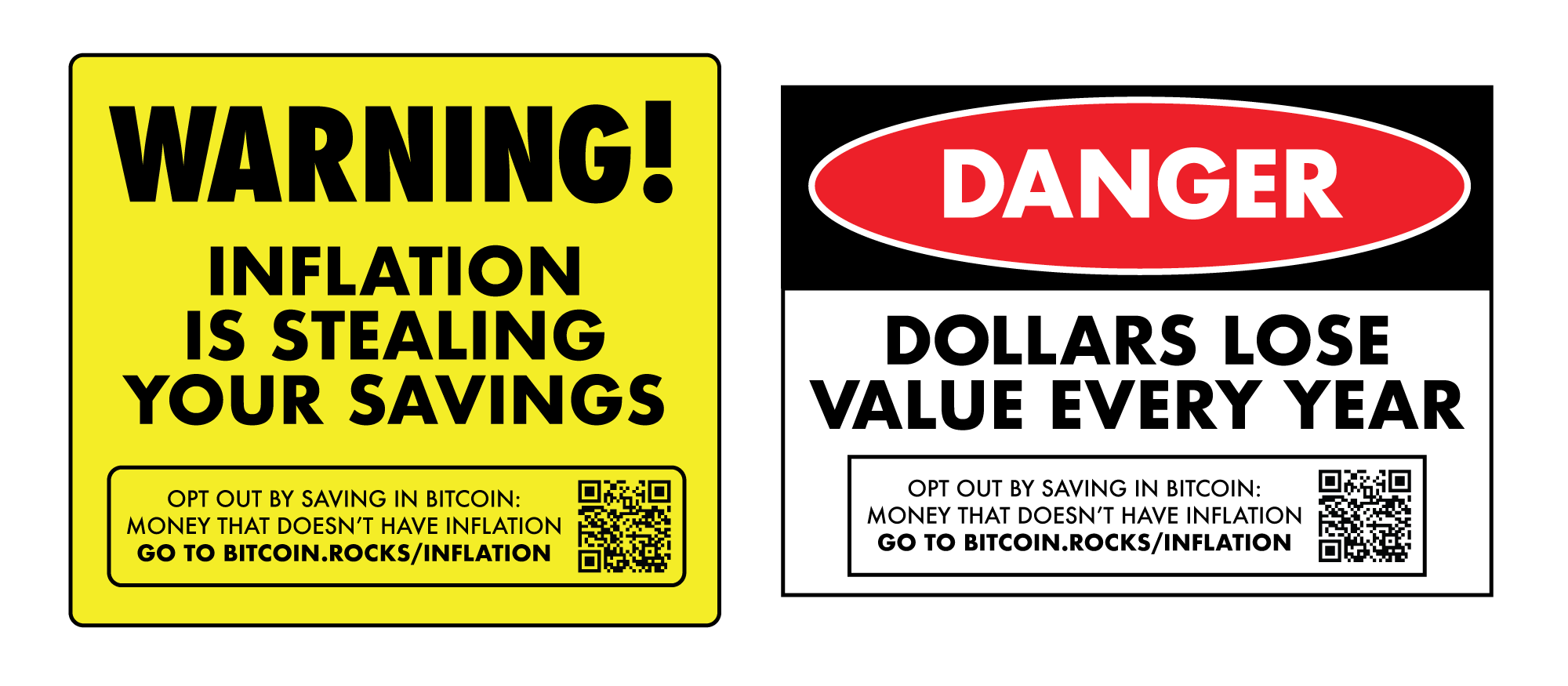
I like danger.


I don't see how she can't see this.

An excerpt from nostr:npub1guh5grefa7vkay4ps6udxg8lrqxg2kgr3qh9n4gduxut64nfxq0q9y6hjy's Marty's Bent that you should take a look at:
"These are two of the most bullish charts I have ever seen. They highlight that bitcoin is not merely competing with its base money competition, but it is already out-competing Fedwire. Let's take a look at the charts.

Here we have a chart of the trailing 12-month payment volumes on bitcoin and Fedwire. In 2023, Fedwire averaged ~530,000 payments per day and the trailing 12-month volume was 193,316,782 payments. Bitcoin almost doubled that volume with 367,044,946 payments over 2023. Matthew's calculations take change outputs out of the equation. When you spend bitcoin you make two transactions if you don't spend the full UTXO; one transaction goes to the person you are transacting with and another goes to a change address associated with your wallet. The change address address transaction isn't really an economic transaction, so it is taken out of the dataset. This chart would make bitcoin look more dominant than it already is if those transactions were included.

Here's the chart of the 12-month trailing transfer value of Fedwire and bitcoin with the Fedwire supremacy ratio overlaid on a log scale. As you may imagine, at the current moment, the amount of value that Fedwire transfers and settles far exceeds the amount of value settled by the bitcoin network. Last year Fedwire transferred $1.083 quadrillion while bitcoin settled $1.36 trillion. Put another way, Fedwire moved almost 1,000 times more value in 2023. A wide gap to fill!"
I was just going to post this. Damn Marty. This is amazing. We really are winning.



Yeah, ask away. I have some questions myself. 😁

Most bullish case for the real world bitcoin economy.
My blog looks pretty sexy on highlighter.com


They are forced to gamble. Fiat is designed to lose value. You are forced to buy stocks that will be taxed later to prop up the corporations.
Before bitcoin, you could not opt-out of this shell game. You could buy gold. It did better than real estate over the last 50 years, but it did not beat the Boggle heads.
Trump likes the dollar because he benifits from the Cantillon Effect.
Trump voters think Trump will get them closer to the money spigot. They're wrong. The system is heading towards hyperinflation and it doesn't matter which branch of the uniparty wins.
They don't even pretend otherwise anymore. If this election is the most important election in our lifetimes, why have we not seen either of these eight decade old people debate?
We talk a lot about the orange pill. It took me a long time to fully grasp this concept.
Fiat is the world that has been pulled over your eyes to blind you from the truth.
The NPC's in the crowd applaud the dollar because they took the green pill and are stuck in the fiat matrix.


How do calculate the checksum and addresses without hardware?

I love hearing stories like this. Thank you for sharing.
I took some time off twitter. I tried going back, but it feels like a chore.

I think it sould end with the "I am not Satoshi Dorian Nakamoto" email.
Where would the movie begin?
The Cypherpunk manifesto, or when Satoshi e-mailed Adam Back?

I've thought about it, but I haven't written a screenplay since college.
Whatever happened with UTXO? Does he still have his freedom?

LMAO. nostr:npub13qrrw2h4z52m7jh0spefrwtysl4psfkfv6j4j672se5hkhvtyw7qu0almy and I are getting accused of being the same person or a bot and scammers on Bluesky because we mentioned Bitcoin.
I think their just trolls. Nobody who says "store of value" or "fiat" is a no coiner.

I have no idea what Navalny is.

**You Are Not A Gadget by Jaron Lanier**
Reading Jaron Lanier’s 2010 *You Are Not A Gadget* in 2023 is an interesting experience—equal parts withering, prophetic, and heretical clarion call warning from a high priest of the Technocracy and rambling, musing, cognitive jam session from a technofied musician-philosopher.
Yet, in ways that I think the author would be simultaneously pleased, amused, saddened, and disturbed by, the 13 yeas since the book’s publishing have, in places, proven him right with stunning foresight and precision, and in others, made his ideas appear laughable, bizarre, even naive. The book is written in five parts, yet I would suggest viewing it as two discrete elements—Part One (around the first half of the book) and…*everything else*.
For context, Lanier, is a computer scientist and early technologist from the area of Jobs, Wozniak, and Gates, and is considered to be a founding father of virtual reality. He is also a consummate contrarian, a player of rare and obscure musical instruments, a deep interdisciplinary thinker…and a white man with dreadlocks named Jaron.
## **PART ONE**
Part One of the book “What is a Person?” reads like a scathing and clear-eye manifesto—where Lanier is batting 1000, merciless in his rightness. Were one to pull a passage that speaks to the soul of this portion of the book, it might be the following: ***“The net does not design itself. We design it.”***
Lanier terms the prevailing technocratic ideology—the particular winning tech-nerd subculture that has now come to capture our society—as “the cybernetic totalist” or “digital Maoists.” Essentially a materialist and stealth collectivist movement in new-age technocratic dress, that through its successes, and now excesses, represents much the same of religion that it’s founders would have claimed to be “evolving past.”
Lanier points out that in this, we are simply trading the pursuit of finding God in spirituality or the afterlife, for a notion of digital immortality—seeking, or, if possible, becoming, God in the cloud. He aptly identifies that this worldview requires that society, and all human interactions really, be savagely bent into adherence to this new religion of aggregation that demands deification of data, gross diminishment of the individual, and belief in some objective (but never defined) "meaning" that exists beyond and apart from the human observer.
With skill and simple wit, he raises strong, rational counterpoint to the digital Maoists’ obsession with quantity, data in aggregate and at-scale, as society's prime directive “A fashionable idea in technical circles is that quantity […] turns into quality at some extreme scale […] I disagree. A trope in the early days or computer science comes to mind: garbage in, garbage out.”
Lanier is able to envision the digital cages that likes of Facebook, Youtube, social-media dating apps would become for the internet native generations. Of whom he writes “The most effective young Facebook users […] are the ones who create successful online fictions about themselves,” and “If you start out by being fake, you’ll eventually have to put in twice the effort to undo the illusion if anything good is to come of it.”
Lanier’s 2010 criticism of Wikipedia-ism is now double or triply apropos in our current hype cycle of “AI magic” and Everything-GPT, “Wikipedia, for instance, works on what I can the Oracle Illusion, in which knowledge of human authorship of a text is suppressed in order to give the text superhuman validity. Traditional holy books work in precisely the same way and present many of the same problems.” This same deep truth now sits at the heart of every “new” creation churned out by the flavor-of-the-week, plagiarism-at-scale, generative AI tool.
More darkly, he is also able to foresee the spectre of a return to collectivism lurking both at the core and on the margins of our new digital age—“The recipe that led to social catastrophe in the past was economic humiliation combined with collectivist ideology. We already have the ideology in its new digital packaging, and it’s entirely possible we could face dangerously traumatic economic shock in the coming decades.”—*“No Shit” said everyone who lived through 2020-2022…*
This brings us, eerily, to the world of today. Where aggregate insights are upheld as more valuable than discrete insights. Where crowds are are assumed to have more wisdom than individuals. Where truth is twisted into a might-is-right numbers game. A world ruled by the idea that if we can just centralize enough information and sufficiently pulverize authorship, the result will, necessarily, be something super-intelligent, "alive," and perhaps even *divine*.
**In short, the cybernetic totalists and digital Maoists, having killed reason, now sit on its corpse like a thrown, smearing its blood on the walls in the name of art and reading its still-steaming entrails for prophecy.**
If I were to infer some ideological takeaway from Part One of the book, it might be that Lanier seems to axiomatically reject any affirmative implication of the Turing Test. Simply put, he believes that bits are not and cannot ever be alive independent of the human-as-oracle. Further, there is no objective meaning beyond the human observer—in fact, that observer fundamentally *creates* any meaning there is to be had. This is best illustrated by one of the most powerful passages in the book:
> “But the Turing Test cuts both ways. You can’t tell if a machine has gotten smarter or if you’ve just lowered your own standard of intelligence to such a degree that the machine seems smart. If you can have a conversation with a simulated person presented by an AI program, can you tell how far you’ve let your sense of personhood degrade in order to make the illusion work for you?”
**Ponder this well, Anon.**
## **EVERYTHING ELSE**
With all of the great stuff above out of the way, we must turn to…the rest of the book. Parts Two through Five breakdown into something more like a stream of consciousness. And while there are certainly many nuggets to insight and beauty to be found, the book becomes largely dis-coherent and very difficult to read. That said, the remainder of the book does contain three particularly compelling threads that I find to be worth pulling on.
**Internet Attribution**
First, are Lanier’s musing about money and attribution in our authorless “information wants to be free” world. He laments the infinite elevation of advertising and offers harsh critique to the concept of attention as the new currency—as this tends to overwhelmingly reward the aggregator and a piddling few soulless super-influencers at the expense of all other users and creators.
Interestingly, under the guise of “what could have been” he imagines a world where attribution is tracked across the web (though how this achieved is left unanswered) and royalty payments can flow back to the author seamlessly over the internet. I find his vision to be intriguing because in 2010, we lacked the technology to either track attribution across the web or facilitate seamless micropayment royalties based on access / usage.
While we still don't have the ability to achieve the type of fully-tracked, always-on attribution Lanier imagines, we **do** now have the ability to stream payments across the internet with bitcoin and the lightning network. While Lanier can be excused for not mentioning the then uber-nascent bitcoin in 2010, bitcoin’s development since only goes to underscore the prescience of Lanier’s imagination.
The bigger question that now remains, especially in the face of the advent of “AI,” is whether such a system to manage and therefore *enforce* attribution globally on the internet would even be a good thing. Where obscured attribution enables mashed-up plagiarism-at-scale, centrally enforced attribution can just as easily enable idea, content, discovery, and innovation suppression-at-scale.
**Music in the New Age**
Second, much of the book, particularly in the second half, is filtered through the lens and language of music. Music is essential to Lanier’s inner life and it is clear that he views music as an emergent mystery force attributable to something unknowable, if not divine, and entirely unique to the human experience.
He bemoans the music of the 2000s as lacking in any distinct chronological era sound—everything is either a rehashed mashup or digitally lofi-ed emulation of sounds from previous begone eras—it is music that is impossible to place. To him, it is as though musical evolution stopped right around the time of the advent of the internet…and then folded back in on itself, creating an endless kaleidoscoping of what came before but rarely, if ever, the creation anything truly new.
In response, Lanier goes so far as to imagine the ridiculous (my take, not his) world of “Songles”—songs on dongles—essentially physical music NFTs. In Songleland, listening to the hottest tracks at a party hinges on the guy or gal with the dankest songles swinging through and plugging them into the Songle player. And songles, being scarce, even become speculative investments. On this, Lanier manages to be both right and wrong in only the most spectacularly absurd of ways.
But what Lanier really laments is the passing of popular music as a shared cultural experience at national or even global scale. During Lanier’s coming of age through the 1960-80s—with only a few consolidated channels for music distribution, it was truly impossible to escape the sounds and influence of the Beatles or Prince or Micheal Jackson—everyone heard it and even the deaf still felt it.
In the end, Lanier could image Songles but he couldn’t envision what Spotify would become—a conduit to shatter music distribution into a myriad of tiny longtails—providing infinitely fragmented and individually fine-tuned music experiences rather than large and cohesive cultural moments. However, even in this miss, Lanier is largely able to project what Spotify-ed music would resolve to—music designed as much or more to please the self-referential selection algorithm than any real, *human* listeners. A dangerously foretelling insight that goes well beyond music as AI tools are posed to become the "googling" of the next technological cycle—what happens to information, to human thought, when the majority of "generative AI" outputs are just the machine referencing itself?
**Digital Neoteny**
The final thread to pull is that of "digital neoteny," *the retention of juvenile behaviors in adult form*, in this case, a neoteny of the mind if you will. Lanier sees the internet as specifically primed to propagate three kinds of neoteny in digital-native humans— a blissful and curious Bachelardian neoteny (as in Gaston Bachelard’s *Poetics of Reverie*); a cruel and mob-like Goldingesque neoteny (as in William Golding’s *Lord of the Flies*); and a general and deeply pervasive, infantile neoteny.
Neoteny of the Bachelardian variety, which Lanier likens to “the sense of wonder and weirdness that a teen can find in the unfolding world,” is what he feels the internet has provided in a few brief and magical moments generally aligned with the “early days” of successive internet technologies, movements, and companies—through this generally degrades into Goldingesque neoteny as novelty gives way to ossification.
Lanier’s missives on Bachelardian neoteny feel especially pertinent to the present state of [Nostr](https://nostr.how/en/what-is-nostr) (where I am publishing this writing). Nostr is in a moment where winner-take all dynamics and corporatization have yet to take hold. Child-like revelry abounds with each new discovery or novel Nostr client development so much so that the likes of Jack Dorsey compare it to the excitement of the early internet.
But with time, if and as the Nostr protocol wins, to what extent will technical lock-in take hold here? To what extent will calcification of seemingly trivial or even comical decisions being made by client devs today have dramatic implications on the feasibility of other development in the future? And will we early Nostr users, at some point put down welcoming inclusivesness for insular tribalism—and in what ways might we be doing this already?
Finally, to the third kind of neoteny, Infantile neoteny—which perhaps incapsulates the internet even more so than either of the other two types—Lanier sees the net driving an evermore prolonged deferral of maturity, resulting ultimately in some centrally-managed permanent arresting of society in a stupefied and juvenile mental state:
> “Some of the greatest speculative investments in human history continue to converge on Silicon Valley schemes that seemed to have been named by Dr. Seuss. On any given day, one might hear of tens or hundreds of millions of dollars flowing to a start-up company named Ublibudly or MeTickly. These are names I just made up, but they would make great venture capital bait if they existed. At these companies one finds rooms full of MIT PhD engineers not seeking cancer cures or sources of safe drinking water for the underdeveloped world but schemes to send little digital pictures of teddy bears and dragons between adult members of social networks. At the end of the road of the pursuit of technological sophistication appears to lie a playhouse in which humankind regresses to nursery school.”
The popular culture of the early 2020s—with it’s NFT Monke JPEGs, silent and masked TikTok dancing in the drab aisles of crumbling department stores, and rampant peer-pressured social-media virtue-signaling and paternalism—could scarcely be described in any more stark and specific detail. That such could be seen so vividly in 2010 is as masterful as it is dishearteningly dark.
## **CONCLUSION**
*You Are Not A Gadget* is a special thing, a strange beast—as lucid in its first half as it is jumbled, meandering, and even nonsensical in its second half. And while the discerning reader might judge the book harshly for these structural failings, I doubt the author would care, he might even welcome it.
Lanier’s apparent purpose in writing is to share his mind rather than please the reader in any particular regard. The sufficiently curious reader, one who is willing to engage with the book’s content, for whatever the book’s faults may be, finds a king’s randoms of wisdom, insight, and uncanny foresight.
In closing, it seems fitting to recall one of Lanier’s earliest warnings in the book, “Maybe if people pretend they are not conscious or do not have free will […] then perhaps we have the power to make it so. We might be able to collectively achieve antimagic.” 13 years on, this feels more pressing and urgent and true than ever. (**Rating: 4/5**🐙)
I read this book. He doesn't even like bitcoin. I often wonder what he would think of nostr, especially for musicians.

I've heard a couple people say you should go back to Twitter to orange pill the masses.
I think we need to purple pill the masses.

I'm not worried about Tether, but the bonds that back them are scary AF.