
🚀 ICYMI we recently launched a common application for bitcoin grants!
Apply for funding once. Reach multiple bitcoin grant organizations.
https://technicaldifficulties.io/nostr/bdp/grants-app-demo.mp4
Are you a bitcoin open-source software (₿OSS) contributor? Are you tired of filling out multiple applications for funding?
Now you don’t have to.
The Common Grants App is one application that gets you in front of:
- nostr:npub10pensatlcfwktnvjjw2dtem38n6rvw8g6fv73h84cuacxn4c28eqyfn34f
- nostr:npub1spralxq6jlw5rdy0249vqr5sh43rfrlx2wzv3rhjjqedw559w9psrs8s72
- nostr:npub1353snusdats4lpgwel4frhlmm05w6md2u89gss0dcdzamlhm2yas25gajp
- Brink
- Maelstrom
- - - - - - - - - -
Here’s how it works:
1. Fill out one form
2. Pick the orgs
3. Submit
4. Each org receives your app
5. They contact you if they are interested
- - - - - - - - - -
Why this matters:
✅ Saves time
✅ Saves effort
✅ Reach 5 bitcoin funding orgs
✅ No duplicate work
More time building. Less time on the paperwork.
❌ No chasing 5 different forms across 5 sites
❌ No unnecessary overhead
✅ One unified application flow
- - - - - - - - - -
Who’s it for?
- ₿OSS contributors
- App builders
- Educators
- Privacy researchers
- Anyone building for Bitcoin
- - - - - - - - - -
Built with ♥️ by nostr:npub10p33xu03t8q7d9nxtks63dq4gmt4v4d3ppd5lcdp4rg9hxsd0f8q7mn2l2
Big thanks to nostr:npub1smxqfqk4yxlzn7r0mmgx3gj0u4v58wyd30etx9c5kxk4m8uu602sh82tda, nostr:npub1w484qhetytrccarzneq9rffksyrwtkdvmc3h032ejauxxpqryffq40lvz2 , nostr:npub1fhmmgwe6fk6tn83ahttt6ruyyfnjdm7k8tn7qflert9ajx6dhfyqf3nzcu
- - - - - - - - - -
Ready to apply? 👇
🧰 Too much bitcoin tech knowledge is trapped in videos and podcasts
If only there was an easy way to unearth those insights and gems… 🤔
We wondered that too, so we redesigned Bitcoin Transcripts! 🚀

🔍 Bitcoin Transcripts is a filterable library of transcripts from:
• dev meetups
• conferences
• podcasts
• panels
Skim talks, quote insights, and search by keyword.
All in one place.
⛏️ Missed a workshop or podcast episode?
No worries.
You can now quickly search by keyword or topic and read the conversation in minutes instead of watching hours of video,
Accelerating your speed to insights.
🧑🏫 Bitcoin Transcripts is perfect for:
- bitcoin devs digging into prior research
- educators creating content
- researchers analyzing protocol history or
- enthusiasts who prefer reading over listening
Taproot workshops, Lightning panels, it’s all in there.
Open-source and built by the community 🧡
This project stands on the shoulders of contributors like Bryan Bishop (https://heybryan.org/) who manually transcribed hundreds of talks.
Now, with modern tools, we can scale that effort for the whole community.

Many thanks to our contributors:
- Dev: nostr:npub1madmpnsmznjgqps9qcvlgcqfjfzzxp0php7l0m7mnxapd0kqlz0sn74djz , Jamal (https://github.com/jrakibi), Emmanuel (https://github.com/Emmanuel-Develops), nostr:npub1w484qhetytrccarzneq9rffksyrwtkdvmc3h032ejauxxpqryffq40lvz2
- Data & architecture: Andreas (https://www.kouloumos.com/), Urvish (https://github.com/urvishp80)
- Vision: nostr:npub1dq94rnvd4hp4yfzjupy7mhm3e8ngz4c7neyswepxrr2xp5vrlmkq7f2pg8
- Design: Tobi (https://x.com/Adeoye_G), Khush (https://x.com/ikhushh7), nostr:npub1nxy56ame2gfnfj6fjylzxwq7r94phvgwt037mmvwr60qsqlaseksswlnxl
- Product: nostr:npub1a6n3dmwmluswq30uxrf7st6rpz6chlewyahg4dzxsyfm9mq7rmdqmjs58k
- Inspiration: Bryan Bishop (https://heybryan.org/)
What’s next?
We’ll keep adding transcripts from upcoming events and backfill any important historic talks we missed. 🔍
Would love your help editing transcripts as well.
Dive in, explore, and let us know what you think! 👇
btctranscripts.com
Wait, before you go! There is a contributor missing from the thank you tweet, https://github.com/IgboPharaoh ! We are so sorry. Thank you for your efforts building Bitcoin Transcripts.
The social media intern responsible for this mistake has been assigned to mailroom duty until further notice.
🧰 Too much bitcoin tech knowledge is trapped in videos and podcasts
If only there was an easy way to unearth those insights and gems… 🤔
We wondered that too, so we redesigned Bitcoin Transcripts! 🚀
🔍 Bitcoin Transcripts is a filterable library of transcripts from:
• dev meetups
• conferences
• podcasts
• panels
Skim talks, quote insights, and search by keyword.
All in one place.
⛏️ Missed a workshop or podcast episode?
No worries.
You can now quickly search by keyword or topic and read the conversation in minutes instead of watching hours of video,
Accelerating your speed to insights.
🧑🏫 Bitcoin Transcripts is perfect for:
- bitcoin devs digging into prior research
- educators creating content
- researchers analyzing protocol history or
- enthusiasts who prefer reading over listening
Taproot workshops, Lightning panels, it’s all in there.
Open-source and built by the community 🧡
This project stands on the shoulders of contributors like Bryan Bishop (https://heybryan.org/) who manually transcribed hundreds of talks.
Now, with modern tools, we can scale that effort for the whole community.
Many thanks to our contributors:
- Dev: nostr:npub1madmpnsmznjgqps9qcvlgcqfjfzzxp0php7l0m7mnxapd0kqlz0sn74djz , Jamal (https://github.com/jrakibi), Emmanuel (https://github.com/Emmanuel-Develops), nostr:npub1w484qhetytrccarzneq9rffksyrwtkdvmc3h032ejauxxpqryffq40lvz2
- Data & architecture: Andreas (https://www.kouloumos.com/), Urvish (https://github.com/urvishp80)
- Vision: nostr:npub1dq94rnvd4hp4yfzjupy7mhm3e8ngz4c7neyswepxrr2xp5vrlmkq7f2pg8
- Design: Tobi (https://x.com/Adeoye_G), Khush (https://x.com/ikhushh7), nostr:npub1nxy56ame2gfnfj6fjylzxwq7r94phvgwt037mmvwr60qsqlaseksswlnxl
- Product: nostr:npub1a6n3dmwmluswq30uxrf7st6rpz6chlewyahg4dzxsyfm9mq7rmdqmjs58k
- Inspiration: Bryan Bishop (https://heybryan.org/)
What’s next?
We’ll keep adding transcripts from upcoming events and backfill any important historic talks we missed. 🔍
Would love your help editing transcripts as well.
Dive in, explore, and let us know what you think! 👇
btctranscripts.com

Our Decoding Bitcoin study cohort has participants from the US, South Korea, Indonesia and Saudi Arabia!
Some of them are going to start contributing to the bitcoin open source projects soon. 😇 nostr:npub10p33xu03t8q7d9nxtks63dq4gmt4v4d3ppd5lcdp4rg9hxsd0f8q7mn2l2 nostr:npub1h34n29f3wqvcht0jyhnd36jxcdmljyqjv4vdjfrd69nhxhrdvvnsgwr4h0 nostr:npub190trvg63e6tyqlwlj6lccqpftx76lckj25c006vwx3dzvdl88yxs2nyqdx nostr:npub1fpqlfgejlvnv5swanf0398y6k9vvheqs9g4zmjlthrga7ytn53dq3pqwcz

Yes! The more BOSS devs the merrier!

Last night we learned about Transaction Signing as part of our nostr:npub10p33xu03t8q7d9nxtks63dq4gmt4v4d3ppd5lcdp4rg9hxsd0f8q7mn2l2 Decoding Bitcoin study cohort.
Shout-out to Anmol Sharma from nostr:npub1m495fdq2e8jleptdq6ruzpmz0esjttln2rjx7dxj9w4zvxs48y3q5pu22l and nostr:npub1h34n29f3wqvcht0jyhnd36jxcdmljyqjv4vdjfrd69nhxhrdvvnsgwr4h0 for pushing students to the limits

This is great! We love to see it!! 🚀
Slots are filling up fast for our Warnet track at Friday's #MITBitcoinExpo Hackathon!
We stand up a network of Bitcoin Core nodes. You use Bitcoin Core's functional test framework to write attacks in Python and take them down.
This event is open to hackers around the globe. Participants can be in-person or remote. And did we mention the $3,000 prize from the MIT Bitcoin Club?
👉 Head over to https://mitbitcoin.devpost.com to sign up today!

We'll also have we’ll have additional prizes for Warnet track winners that are able to join in person. These gorgeous coasters by A+ Engrave are just one example! 🤩


𝐓𝐡𝐞 𝐁𝐢𝐭𝐜𝐨𝐢𝐧 𝐃𝐞𝐯 𝐏𝐫𝐨𝐣𝐞𝐜𝐭 𝐡𝐚𝐬 𝐚 𝐭𝐫𝐚𝐜𝐤 𝐚𝐭 𝐭𝐡𝐞 𝐌𝐈𝐓 𝐁𝐢𝐭𝐜𝐨𝐢𝐧 𝐄𝐱𝐩𝐨 𝐇𝐚𝐜𝐤𝐚𝐭𝐡𝐨𝐧, 𝐚𝐧𝐝 𝐢𝐭 𝐡𝐚𝐬 𝐚 $𝟑,𝟎𝟎𝟎 𝐩𝐫𝐢𝐳𝐞!
Participants have 30 hours, starting April 4 and are welcome to hack from around the globe.
🌍 We repeat, you do not have to attend in person 🌎
𝐌𝐨𝐬𝐭 𝐡𝐚𝐜𝐤𝐚𝐭𝐡𝐨𝐧 𝐭𝐫𝐚𝐜𝐤𝐬 𝐚𝐫𝐞 𝐚𝐛𝐨𝐮𝐭 𝐛𝐮𝐢𝐥𝐝𝐢𝐧𝐠, 𝐛𝐮𝐭 𝐧𝐨𝐭 𝐭𝐡𝐢𝐬 𝐨𝐧𝐞. 𝐓𝐡𝐢𝐬 𝐢𝐬 𝐚𝐛𝐨𝐮𝐭 𝐛𝐫𝐞𝐚𝐤𝐢𝐧𝐠 🔨
For the Bitcoin Dev Project track, the goal is to take down the bitcoin network. We stand up a network of bitcoin core nodes. You and your team take down as many as possible.
Whichever team brings down the most in the shortest amount of time wins. Monitor extreme and yet unknown network behaviors, discover vulnerabilities, and build a stronger, more resilient bitcoin.

This track is for hackers with some level of coding skill, & the ability to use the command line interface (CLI). Familiarity with Bitcoin Core, esp. the JSON-RPC interface is useful. A general understanding of how blockchains and distributed networks work will come in handy.
Who's ready to win? Sign up below! 👇
New tool in Decoding Bitcoin!
REORG CALCULATOR ⚒️
Computes the probability that an attacker could reorganize z blocks with a given % of the total network hashrate
Here’s the probability of an attacker reorganizing 6 blocks with 30% of the total hashrate
https://bitcoindevs.xyz/decoding/reorg-calculator

This tool was initially made for the nostr:npub1hkuk45c6c6h3y0rks0z4wa0wyyud5ru0qy0rn9x4dgnjwrnfy46s5a432p website. You can find it here: https://bitcoinops.org/en/tools/reorg-calculator/

New tool in Decoding Bitcoin!
REORG CALCULATOR ⚒️
Computes the probability that an attacker could reorganize z blocks with a given % of the total network hashrate
Here’s the probability of an attacker reorganizing 6 blocks with 30% of the total hashrate
https://bitcoindevs.xyz/decoding/reorg-calculator
Buckle up for today's #DecodingBitcoin post. It's a long one but we promise it's worth your time.
Today we're going to break down how to sign a #bitcoin segwit transaction using a real example from the BIP-143 test vectors (that’s one of the segwit BIPs!)

𝑁𝑜𝑡𝑒: 𝑡ℎ𝑖𝑠 𝑒𝑥𝑎𝑚𝑝𝑙𝑒 𝑖𝑠 𝑓𝑜𝑟 𝑎 𝑠𝑒𝑔𝑤𝑖𝑡 𝑣0 𝑡𝑟𝑎𝑛𝑠𝑎𝑐𝑡𝑖𝑜𝑛 𝑠𝑜 𝑠𝑜𝑚𝑒 𝑜𝑓 𝑡ℎ𝑒 𝑠𝑝𝑒𝑐𝑖𝑓𝑖𝑐𝑠 𝑎𝑟𝑒 𝑑𝑖𝑓𝑓𝑒𝑟𝑒𝑛𝑡 𝑓𝑜𝑟 𝑙𝑒𝑔𝑎𝑐𝑦 𝑎𝑛𝑑 𝑡𝑎𝑝𝑟𝑜𝑜𝑡 (𝑠𝑒𝑔𝑤𝑖𝑡 𝑣1) 𝑡𝑟𝑎𝑛𝑠𝑎𝑐𝑡𝑖𝑜𝑛𝑠. 𝐻𝑜𝑤𝑒𝑣𝑒𝑟, 𝑡ℎ𝑒 𝑔𝑒𝑛𝑒𝑟𝑎𝑙 𝑐𝑜𝑛𝑐𝑒𝑝𝑡𝑠 𝑎𝑟𝑒 𝑠𝑡𝑖𝑙𝑙 𝑡ℎ𝑒 𝑠𝑎𝑚𝑒!
The transaction we'll be working with has two inputs. The first is a legacy P2PK input–we won’t be covering that today.
Instead, we’re going to focus on the second input, the P2WPKH (native segwit) one.
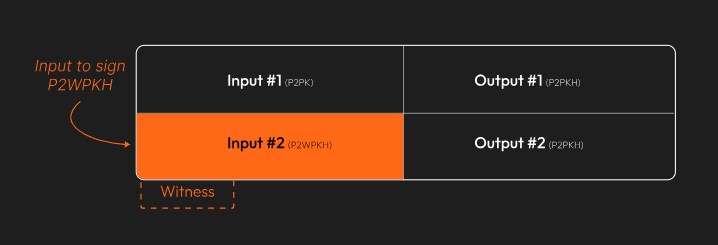
Since this example came from one of the BIP-143 test vectors, we know what the final, signed transaction looks like. The goal is to recreate this:
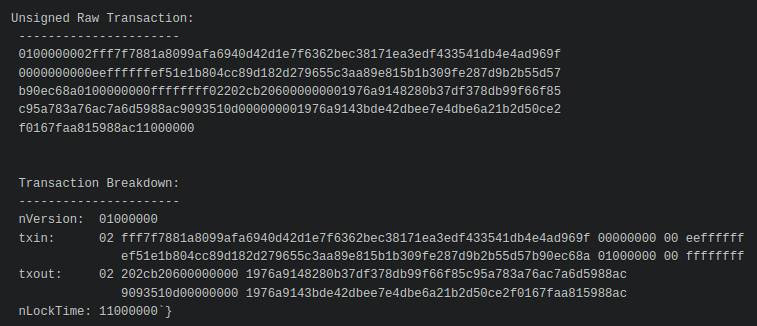
First, we create the base transaction, the transaction without any signatures.
We’ll start with the
- version number
- marker & flag fields (to indicate the tx is segwit)
- locktime
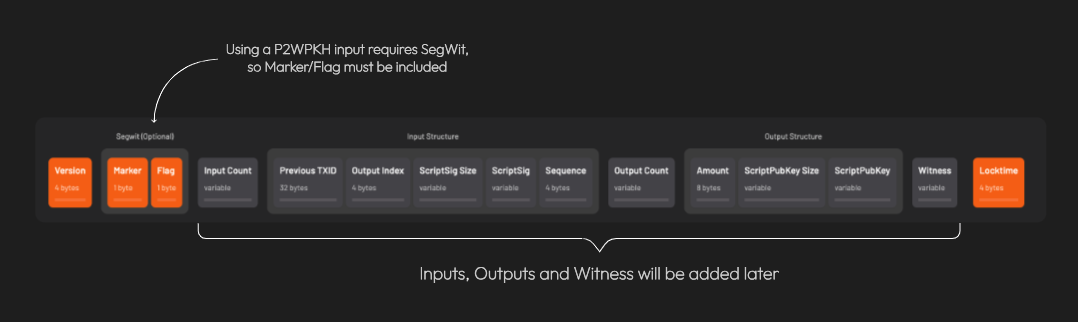
𝐴 𝑛𝑜𝑡𝑒 𝑜𝑛 𝑠𝑒𝑔𝑤𝑖𝑡 𝑣𝑠. 𝑙𝑒𝑔𝑎𝑐𝑦 𝑡𝑟𝑎𝑛𝑠𝑎𝑐𝑡𝑖𝑜𝑛𝑠: 𝐵𝑒𝑐𝑎𝑢𝑠𝑒 𝑎𝑡 𝑙𝑒𝑎𝑠𝑡 𝑜𝑛𝑒 𝑜𝑓 𝑡ℎ𝑒 𝑖𝑛𝑝𝑢𝑡𝑠 𝑖𝑠 𝑠𝑒𝑔𝑤𝑖𝑡 (𝑛𝑎𝑡𝑖𝑣𝑒 𝑜𝑟 𝑤𝑟𝑎𝑝𝑝𝑒𝑑), 𝑡ℎ𝑒 𝑡𝑟𝑎𝑛𝑠𝑎𝑐𝑡𝑖𝑜𝑛 𝑖𝑠 𝑎𝑙𝑠𝑜 𝑐𝑜𝑛𝑠𝑖𝑑𝑒𝑟𝑒𝑑 𝑠𝑒𝑔𝑤𝑖𝑡.
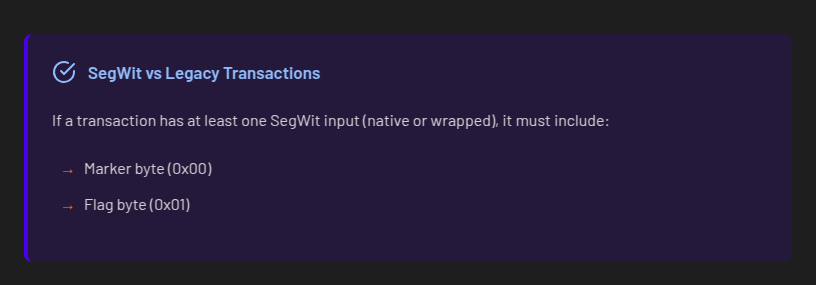
Here’s what we have so far:
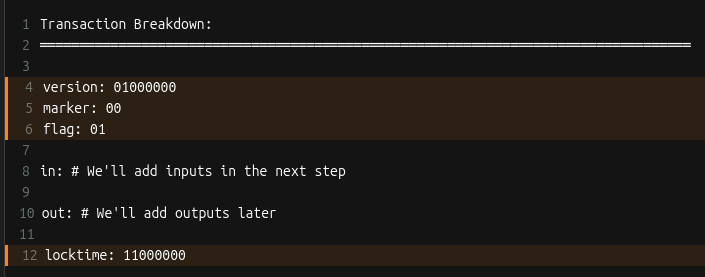
Let’s add inputs! Recall that all inputs come from existing transactions. That means for each input, we need to find the transaction it came from and get:
1. that transaction’s ID
2. the output index
𝐖𝐡𝐚𝐭’𝐬 𝐚𝐧 𝐨𝐮𝐭𝐩𝐮𝐭 𝐢𝐧𝐝𝐞𝐱?
Every transaction has a list of outputs. The “output index” is a way to reference a specific output from the list.
We need to ask, "from a transaction’s list of outputs, which one corresponds to the input I care about?”
For each input, two more things are needed: the 𝐬𝐜𝐫𝐢𝐩𝐭𝐒𝐢𝐠 (placeholder for data required to spend the input), and a 𝐬𝐞𝐪𝐮𝐞𝐧𝐜𝐞 𝐧𝐮𝐦𝐛𝐞𝐫 (usually 0xFFFFFFFF)
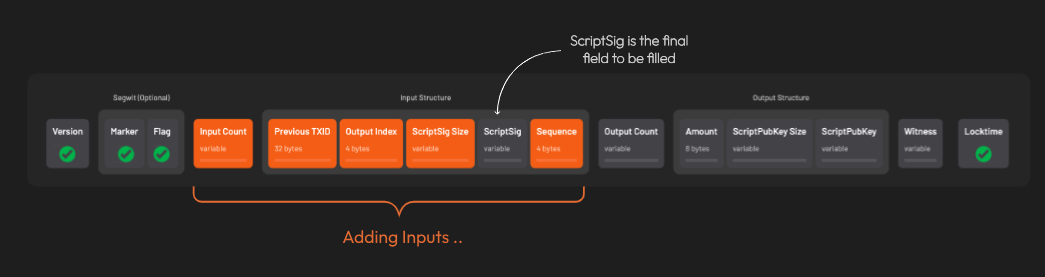
After adding all the inputs, the transaction looks like this:
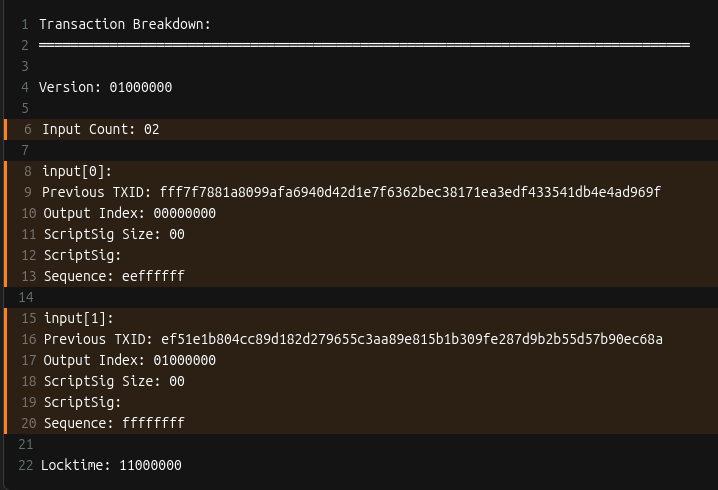
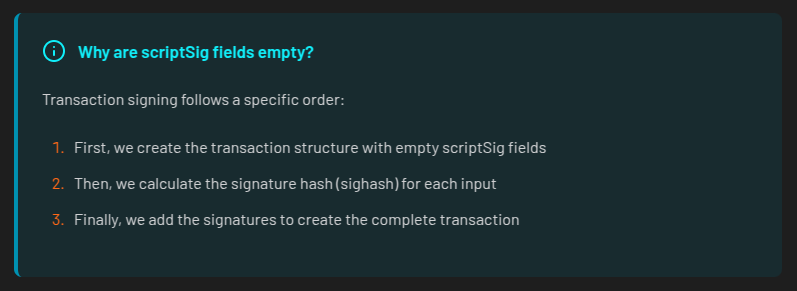
Remember when we said the scriptSig would be a placeholder? Here’s why those fields are currently empty:
Time to add outputs! For each output, we include the
- amount (in satoshis)
- scriptPubKey: the locking script that defines the rules for how the output can be spent

Things are starting to come together!
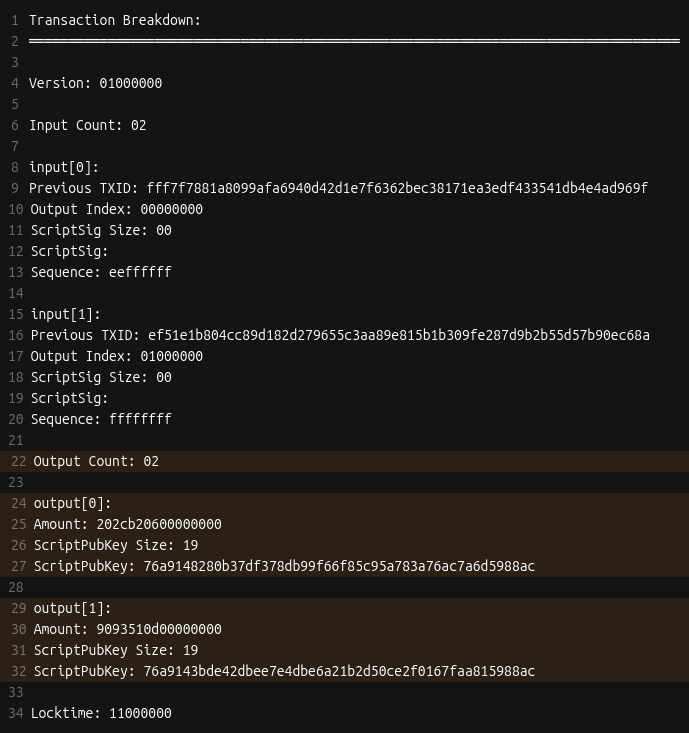
A few more things are needed before we can get to signing. First is setting up the 𝐰𝐢𝐭𝐧𝐞𝐬𝐬 field.
This is where the signature and corresponding public key go for segwit transactions.
The witness field starts off empty. This is different from legacy transactions where signatures are placed directly in the scriptSig field.

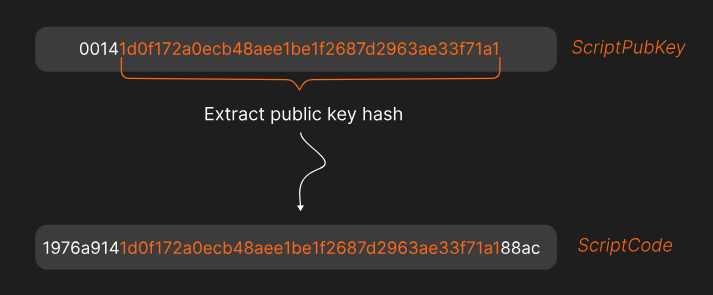
The next thing that’s needed is the 𝐬𝐜𝐫𝐢𝐩𝐭𝐂𝐨𝐝𝐞.
The scriptCode for a P2WPKH (pay-to-witness-public-key-hash) input is:

𝑊ℎ𝑎𝑡’𝑠 𝑡ℎ𝑎𝑡 20 𝑏𝑦𝑡𝑒 𝑝𝑢𝑏𝑘𝑒𝑦 ℎ𝑎𝑠ℎ?
𝐸𝑎𝑟𝑙𝑖𝑒𝑟 𝑤𝑒 𝑠𝑎𝑤 𝑒𝑎𝑐ℎ 𝑜𝑢𝑡𝑝𝑢𝑡 ℎ𝑎𝑠 𝑎 𝑠𝑐𝑟𝑖𝑝𝑡𝑃𝑢𝑏𝐾𝑒𝑦 (𝑟𝑢𝑙𝑒𝑠 𝑓𝑜𝑟 ℎ𝑜𝑤 𝑡𝑜 𝑠𝑝𝑒𝑛𝑑 𝑡ℎ𝑒 𝑜𝑢𝑡𝑝𝑢𝑡). 𝐴𝑙𝑠𝑜, 𝑟𝑒𝑐𝑎𝑙𝑙 𝑡ℎ𝑎𝑡 𝑡ℎ𝑒 𝑖𝑛𝑝𝑢𝑡 𝑡𝑜 𝑜𝑛𝑒 𝑡𝑟𝑎𝑛𝑠𝑎𝑐𝑡𝑖𝑜𝑛 𝑖𝑠 𝑡ℎ𝑒 𝑜𝑢𝑡𝑝𝑢𝑡 𝑓𝑟𝑜𝑚 𝑎𝑛𝑜𝑡ℎ𝑒𝑟.
𝑇ℎ𝑒 20 𝑏𝑦𝑡𝑒 𝑝𝑢𝑏𝑘𝑒𝑦 ℎ𝑎𝑠ℎ 𝑖𝑠 𝑒𝑥𝑡𝑟𝑎𝑐𝑡𝑒𝑑 𝑓𝑟𝑜𝑚 𝑡ℎ𝑒 𝑐𝑜𝑟𝑟𝑒𝑠𝑝𝑜𝑛𝑑𝑖𝑛𝑔 𝑜𝑢𝑡𝑝𝑢𝑡'𝑠 𝑠𝑐𝑟𝑖𝑝𝑡𝑃𝑢𝑏𝐾𝑒𝑦.
Here’s the 𝐬𝐜𝐫𝐢𝐩𝐭𝐂𝐨𝐝𝐞 for the example we’re working on:
Lastly, three important hashes are required.
The first is 𝐡𝐚𝐬𝐡𝐏𝐫𝐞𝐯𝐨𝐮𝐭𝐬. It’s the double SHA256 hash of all input outpoints (outpoint = the transaction id + output index)
The second is 𝐡𝐚𝐬𝐡𝐒𝐞𝐪𝐮𝐞𝐧𝐜𝐞, the double SHA256 hash of all input sequence numbers.
The third is 𝐡𝐚𝐬𝐡𝐎𝐮𝐭𝐩𝐮𝐭𝐬, the double SHA256 hash of all outputs.
That’s everything (finally!). Let’s put it all together into something that can be signed!
When signing a transaction, the spender actually signs a hash of the transaction data, not the entire transaction itself. This hash is called the 𝐬𝐢𝐠𝐡𝐚𝐬𝐡.
The data used to create the sighash is called the 𝐩𝐫𝐞𝐢𝐦𝐚𝐠𝐞.
For a transaction input, the preimage is made of these items:
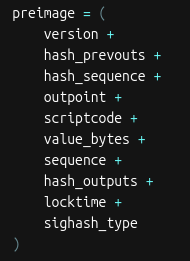
The sighash_type indicates which parts of the transaction the signature is committing to.
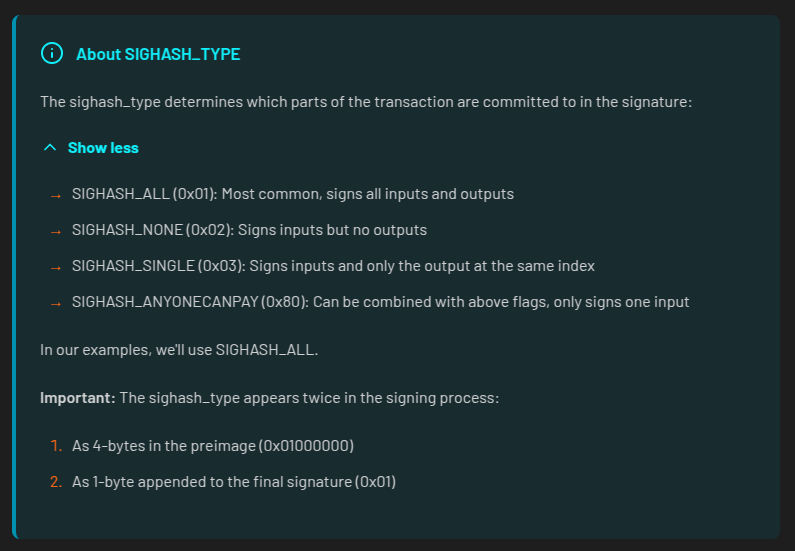
After hashing the preimage twice with SHA-256, we’re left with the sighash.
At last! It’s time to do some signing!
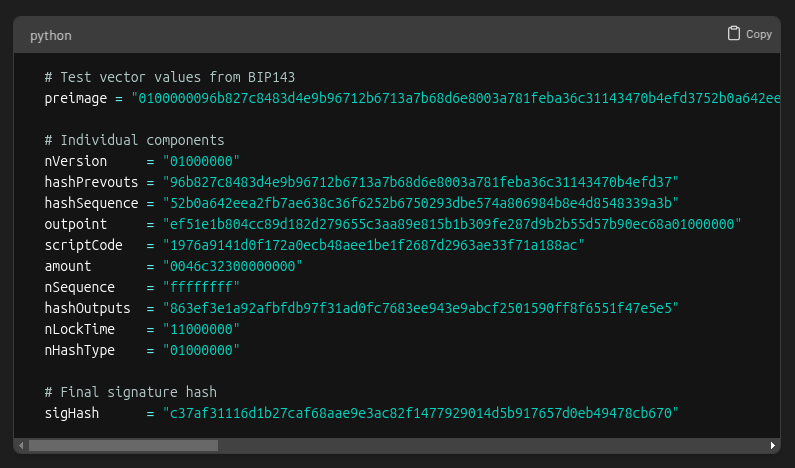
There are a few steps for signing a segwit (v0) transaction.
First, the signer’s private key is used to create an ECDSA signature for the sighash.
The resulting signature has two parts, 𝑟 and 𝑠.
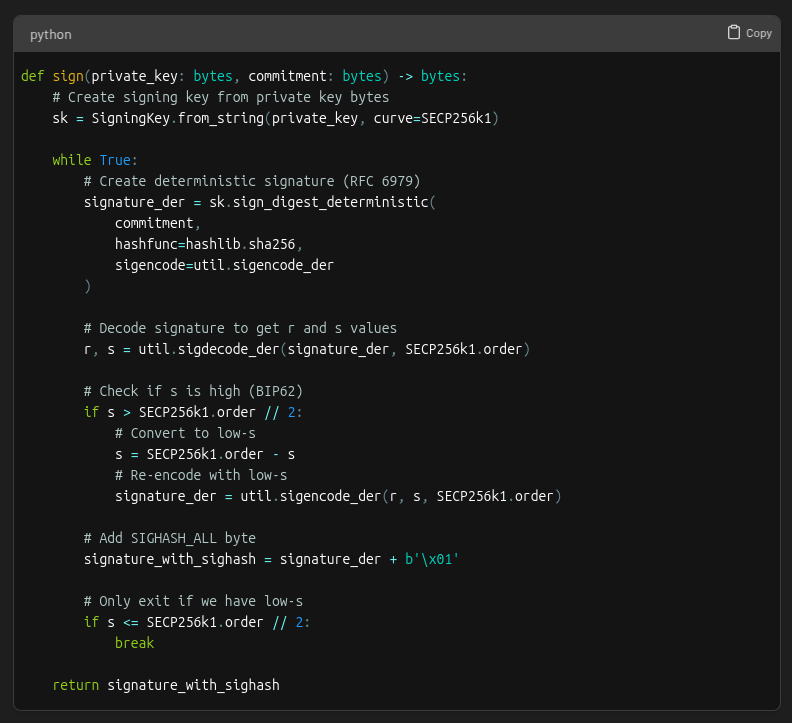
In ECDSA, there are actually two valid s values for every signature: a "high" value and a "low" value.
Both are mathematically valid, but bitcoin requires using the low s value to prevent transaction malleability (that means altering a transaction's ID!)
After selecting the low s value, the signature must be encoded into DER format. This is how it’s structured:
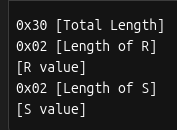
And here’s what the DER encoded signature looks like for our example:
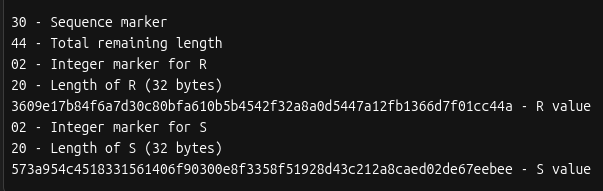
The last step is to add a byte at the end for the sighash type. If we look back at the preimage made earlier we see this example is using SIGHASH_ALL (0x01).
The full code for the signing step looks like this:
Remember the transaction witness field we set space aside for? It’s now time to put the signature in it 🚀

This is how the witness field is structured:

Which works out to be this for our example:
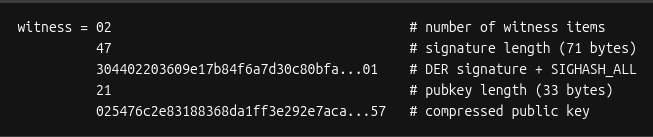
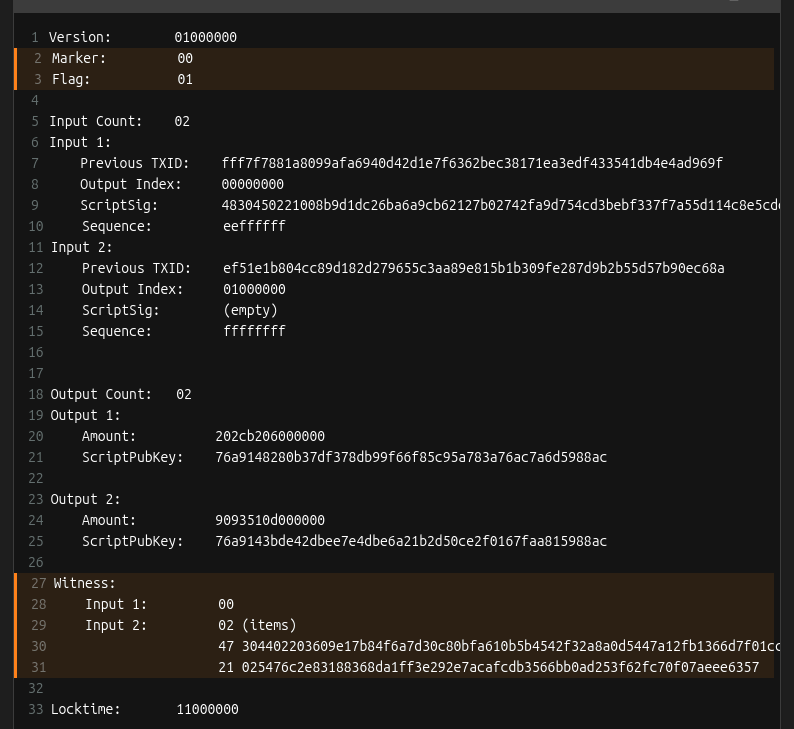
With the completion of the witness field, the transaction is now signed!

This is what the final signed transaction hex looks like broken down:
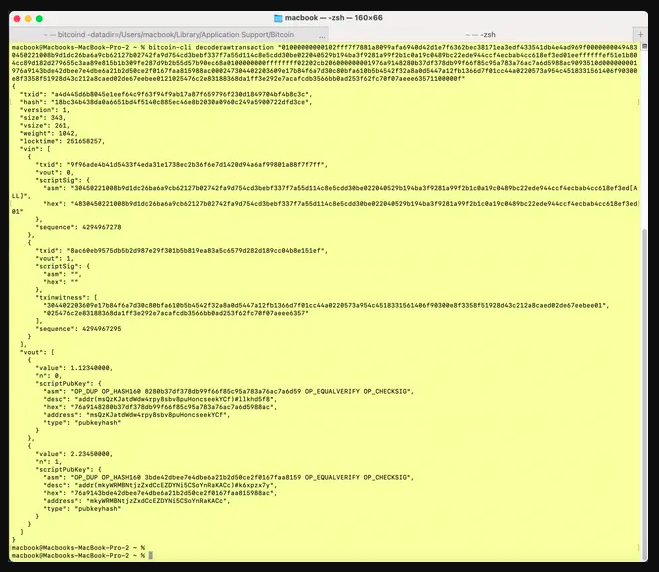
Bonus: You can use the Bitcoin Core CLI decoderawtransaction command to examine all the parts of the raw transaction hex
* ~ * ~ * ~ * ~ * ~ * ~
If you made it to the end, give yourself a pat on the back. If you enjoyed it, be sure to like this post so we know to make more like it!
* ~ * ~ * ~ * ~ * ~ * ~
This material is from Decoding Bitcoin, your go-to resource for understanding bitcoin, #privacy, and #decentralization.
You can visit https://bitcoindevs.xyz/decoding/transaction-signing for the full lesson with all the code examples, as well as more free, interactive content.
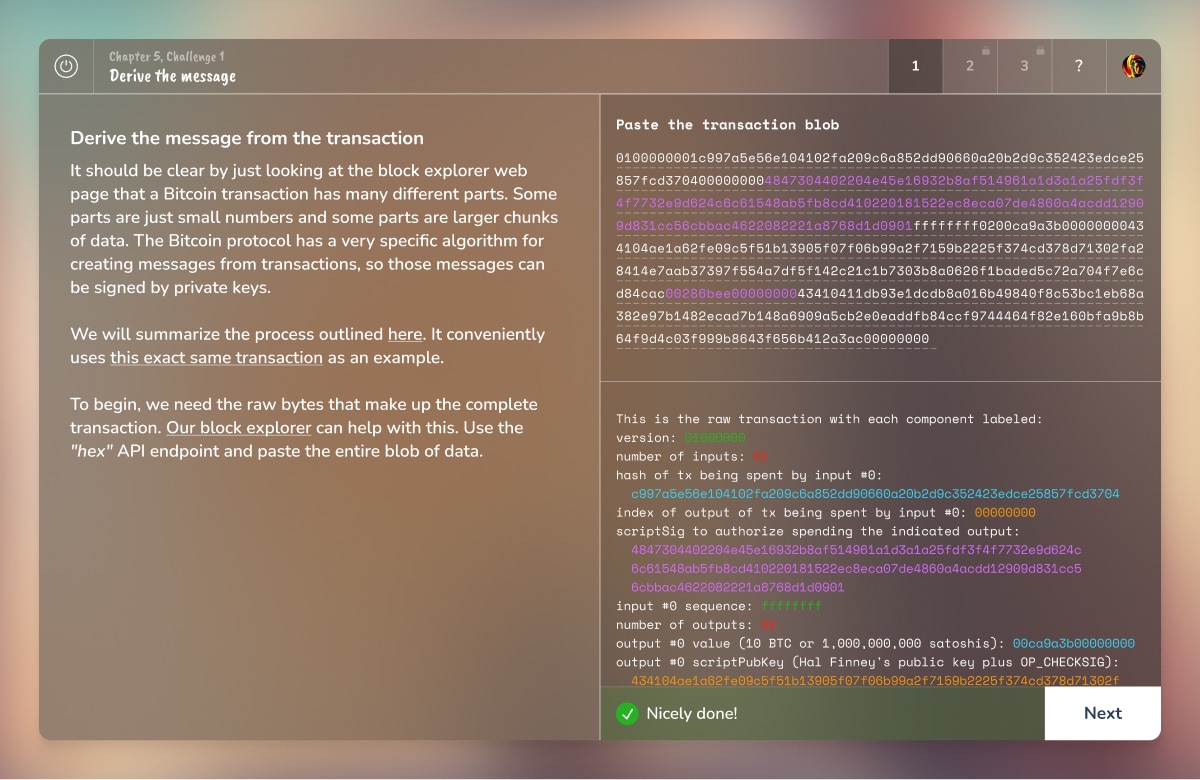
For more of a challenge, play chapters 4, 5, and 6 of nostr:npub1vy6wcgw6jhhtcmpawvlnsfx7g8qt8r40z7qlks9zwa4ed57vm5eqx527hr (https://savingsatoshi.com) to learn about public-private key cryptography, digital signatures, and transaction building 😺
Hope you learned something new about transaction signing. If you enjoyed this, share it with a friend and don’t forget to follow us, nostr:npub10p33xu03t8q7d9nxtks63dq4gmt4v4d3ppd5lcdp4rg9hxsd0f8q7mn2l2 for more content like this.
Thanks for reading!
We’ve got a good #DecodingBitcoin post for you today. The topic? 𝐄𝐧𝐝𝐢𝐚𝐧𝐧𝐞𝐬𝐬, AKA the order of bytes in a computer’s memory.
When we put it like that it sounds a little boring, but there’s something interesting, and dare we say 𝑎𝑛𝑛𝑜𝑦𝑖𝑛𝑔, about how bitcoin handles endianness…
Before we get to that, let’s better understand what endianness is.
Imagine reading directions in different languages: while English is written and read from left to right, Arabic text flows from right to left.

Similarly, computers have two ways to store data:
1. 𝐁𝐢𝐠-𝐞𝐧𝐝𝐢𝐚𝐧 (BE): Most significant byte first
2. 𝐋𝐢𝐭𝐭𝐥𝐞-𝐞𝐧𝐝𝐢𝐚𝐧 (LE): Least significant byte first

When computers with different byte orders try to communicate, they can misread each other. It’s like two people reading numbers from opposite directions.
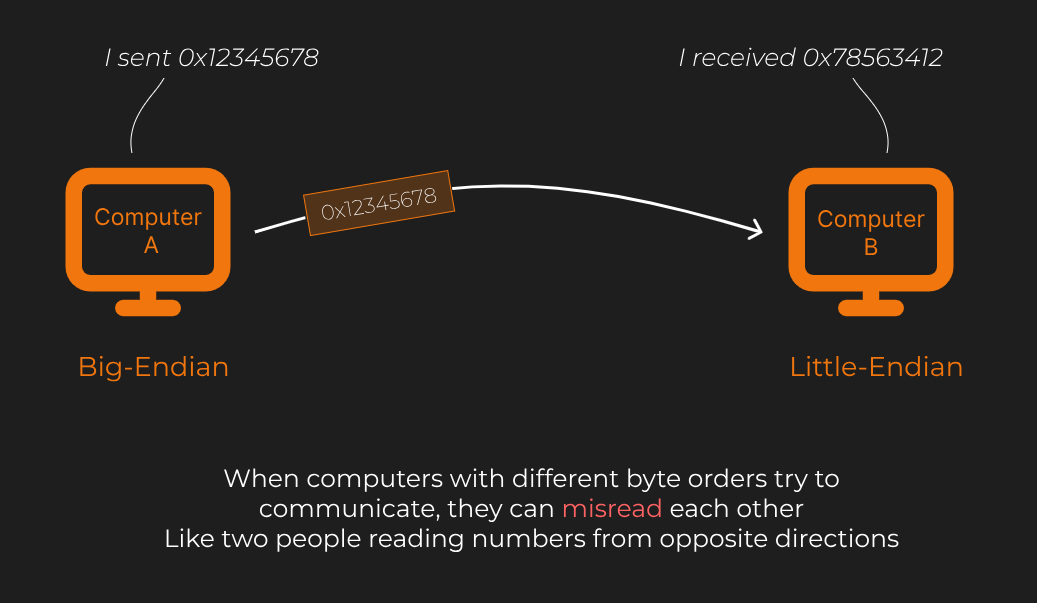
𝐁𝐢𝐠-𝐞𝐧𝐝𝐢𝐚𝐧 𝐬𝐭𝐨𝐫𝐞𝐬 𝐭𝐡𝐞 𝐦𝐨𝐬𝐭 𝐬𝐢𝐠𝐧𝐢𝐟𝐢𝐜𝐚𝐧𝐭 𝐛𝐲𝐭𝐞 𝐟𝐢𝐫𝐬𝐭. This is similar to how humans read numbers and Hex in most cases: starting with the most important information.
Suppose we want to store the number 12345678 (hexadecimal: 0x00BC614E) in memory. In big-endian, the bytes are stored in this order:
00 BC 61 4E
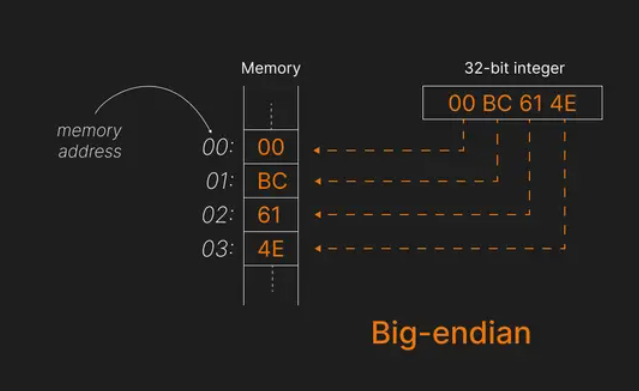
Observe that:
- The 𝐦𝐨𝐬𝐭 𝐬𝐢𝐠𝐧𝐢𝐟𝐢𝐜𝐚𝐧𝐭 𝐛𝐲𝐭𝐞 (00) is stored at the 𝐥𝐨𝐰𝐞𝐬𝐭 𝐦𝐞𝐦𝐨𝐫𝐲 𝐚𝐝𝐝𝐫𝐞𝐬𝐬 (00).
- The 𝐥𝐞𝐚𝐬𝐭 𝐬𝐢𝐠𝐧𝐢𝐟𝐢𝐜𝐚𝐧𝐭 𝐛𝐲𝐭𝐞 (4E) is stored at the 𝐡𝐢𝐠𝐡𝐞𝐬𝐭 𝐚𝐝𝐝𝐫𝐞𝐬𝐬 (03).
Big-endian is considered more "human-readable" because the data is stored in the order we naturally read it.
𝐋𝐢𝐭𝐭𝐥𝐞-𝐞𝐧𝐝𝐢𝐚𝐧 𝐬𝐭𝐨𝐫𝐞𝐬 𝐭𝐡𝐞 𝐥𝐞𝐚𝐬𝐭 𝐬𝐢𝐠𝐧𝐢𝐟𝐢𝐜𝐚𝐧𝐭 𝐛𝐲𝐭𝐞 𝐟𝐢𝐫𝐬𝐭. This might feel counter intuitive to humans but is more efficient for modern processors.
Using the same number 12345678 (0x00BC614E), here's how it looks in little-endian:
4E 61 BC 00
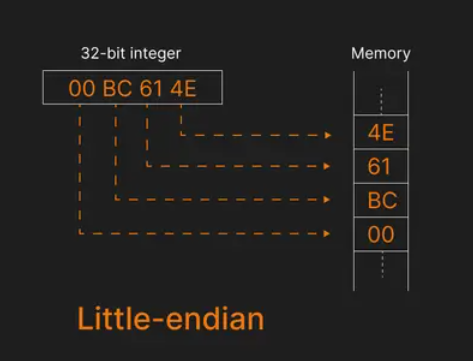
This time, the 𝐥𝐞𝐚𝐬𝐭 𝐬𝐢𝐠𝐧𝐢𝐟𝐢𝐜𝐚𝐧𝐭 𝐛𝐲𝐭𝐞 (4E) is stored at the 𝐥𝐨𝐰𝐞𝐬𝐭 𝐦𝐞𝐦𝐨𝐫𝐲 𝐚𝐝𝐝𝐫𝐞𝐬𝐬 (00).
The 𝐦𝐨𝐬𝐭 𝐬𝐢𝐠𝐧𝐢𝐟𝐢𝐜𝐚𝐧𝐭 𝐛𝐲𝐭𝐞 (00) is stored at the 𝐡𝐢𝐠𝐡𝐞𝐬𝐭 𝐚𝐝𝐝𝐫𝐞𝐬𝐬 (03).
This "reversal" of bytes is common in the Bitcoin Core codebase.
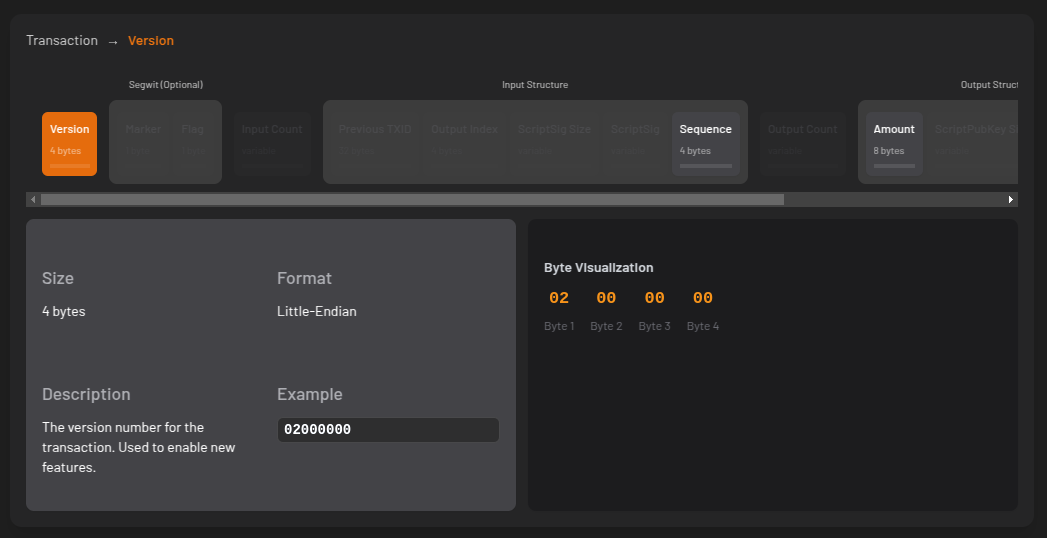
In bitcoin, most data like transaction IDs, block headers, and amounts are all in little-endian format or with the bytes reversed.
𝑁𝑜𝑡𝑒: 𝐸𝑛𝑑𝑖𝑎𝑛𝑛𝑒𝑠𝑠 𝑜𝑛𝑙𝑦 𝑎𝑝𝑝𝑙𝑖𝑒𝑠 𝑡𝑜 𝑖𝑛𝑡𝑒𝑔𝑒𝑟𝑠. 𝐼𝑡 𝑖𝑠 𝑛𝑜𝑡 𝑐𝑜𝑟𝑟𝑒𝑐𝑡 𝑡𝑜 𝑠𝑎𝑦 𝑎 ℎ𝑎𝑠ℎ 𝑖𝑠 𝑙𝑖𝑡𝑡𝑙𝑒-𝑒𝑛𝑑𝑖𝑎𝑛. 𝑆𝑖𝑛𝑐𝑒 𝑡ℎ𝑒𝑟𝑒’𝑠 𝑛𝑜 𝑜𝑓𝑓𝑖𝑐𝑖𝑎𝑙 𝑡𝑒𝑟𝑚 𝑓𝑜𝑟 𝑡ℎ𝑖𝑠 𝑤𝑒 𝑠𝑎𝑦 “𝑏𝑦𝑡𝑒 𝑠𝑤𝑎𝑝𝑝𝑒𝑑” 𝑜𝑟 “𝑟𝑒𝑣𝑒𝑟𝑠𝑒 𝑏𝑦𝑡𝑒𝑠”.
For readability, the bytes are swapped back to the style of big-endian when this data is displayed to humans. A block explorer is one example of where you can see this.
Bitcoin Core’s JSON-RPC interface was the first time block hashes were printed for human consumption. That was when someone decided to reverse the ordering of hash so that it looked like a human readable integer.
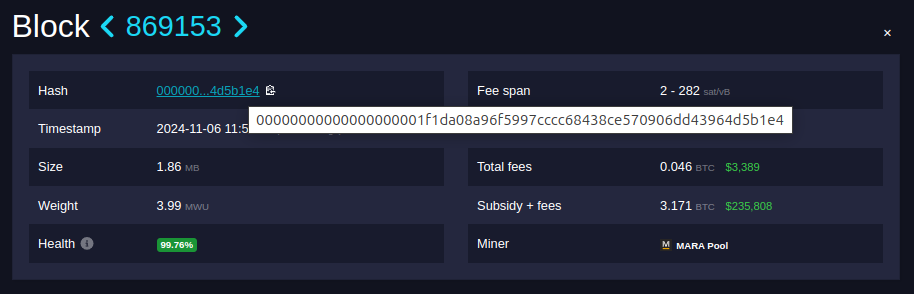
It turns out the real block hash, the actual sha256 value you get if you compute the hash yourself, is:
e4b1d56439d46d9070e58c4368cccc97596fa908daf101000000000000000000
The zeros are actually on the right! At first glance it looks like this is a very large number, but we know the integer value of a block hash actually gets smaller as the difficulty increases.
It's clear that the bytes are reversed and in the style of little-endian. But why? We can thank Satoshi for that. Satoshi decided to interpret the block hash as a little-endian integer. The more zeroes there are on the right side, the smaller the (little-endian) integer.
Since most modern CPUs are little-endian, bitcoin uses it to optimize performance.
However, network protocols typically use big-endian, creating a mismatch 🙀
Big-endian is used for network communication (network byte order). Little-endian is used for bitcoin’s internal storage.
This duality requires developers to frequently, and sometimes frustratingly, convert between the two formats when working with bitcoin data.
Have you been the victim of an endianness oversight when writing bitcoin code? It's a common source of pain for developers new to bitcoin (and even the seasoned ones!)
As covered by the transaction ID example earlier, byte order confusion can be common.
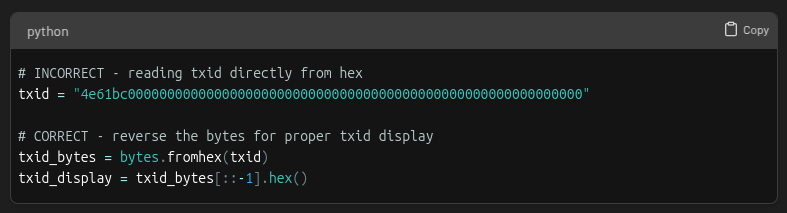
Another gotcha is length specification. When converting to little-endian, always specify the correct byte length:

Hope you learned something new about endianness today. If you enjoyed this, share it with a friend and don’t forget to follow us, nostr:npub10p33xu03t8q7d9nxtks63dq4gmt4v4d3ppd5lcdp4rg9hxsd0f8q7mn2l2 !
This material is from Decoding Bitcoin, your go-to resource for understanding #bitcoin, privacy, and decentralization.
Visit https://bitcoindevs.xyz/decoding for the full lesson, and more free, interactive content.
Thanks for reading!

There is an oft-repeated sentiment in the community that bitcoin does not need you. While bitcoin is designed to be resilient, we 𝑑𝑜 need you. Bitcoin needs all the talent and energy it can gather to solve some of the most difficult technical problems of our time.
Bitcoin in your hands changes everything.


Thank you! We will pass your kind words onto our designers :)
It’s #DecodingBitcoin time! Let’s go over the basic elements of a transaction.
Alice wants to send 5 BTC to Bob. She needs to create a bitcoin transaction using the unspent outputs (UTXOs) in her wallet.

UTXOs are unspent transaction outputs. They can be used as inputs for new transactions.
Think of them as "coins" in a wallet, waiting to be spent.
Alice checks her wallet and finds two UTXOs:

To create a transaction, Alice has to specify exactly which UTXOs to spend.
A UTXO is identified by the transaction it came from, specifically
- the transaction ID and
- an index that says where the UTXO is in the list of transaction outputs

Wallets usually store this information for you but you can also look it up on the blockchain.
Alice's wallet shows these available UTXOs:
- UTXO #1: 4 BTC (from Transaction 1, Output Index 1)
- UTXO #2: 2 BTC (from Transaction 2, Output Index 0)
Together, they provide enough funds (4 BTC + 2 BTC = 6 BTC) for the payment and any transaction fees.
Now Alice has everything she needs to identify her UTXOs. As she adds them to the transaction, she saves space for the signatures she will make later. These signatures authorize the spending of the UTXOs.

Now that the transaction inputs have been taken care of, it’s time to look at the outputs!
Alice needs to create two outputs:
- 5 BTC to Bob (the payment amount)
- 0.99 BTC back to Alice as change (there is a 0.01 BTC transaction fee)

Why do we have to make a separate output for change?
UTXOs must be spent in their entirety. You cannot partially spend a UTXO. Instead, you create a new output that sends the excess amount back to yourself as change.

Looks good! The transaction structure is now complete, but it’s not yet valid. Alice must sign it to prove she owns the inputs. We’ll cover that in a future lesson 🙂
Follow us nostr:npub10p33xu03t8q7d9nxtks63dq4gmt4v4d3ppd5lcdp4rg9hxsd0f8q7mn2l2 to stay updated!
This material is from Decoding Bitcoin, your go-to resource for understanding #bitcoin, privacy, and decentralization.
If you enjoyed it, visit https://bitcoindevs.xyz/decoding for the full lesson, and more free, interactive content.
Thanks for reading!
Are you tired of searching for "lightning" only to get results about sparks in the sky and ice hockey teams in Florida?
So are we. That's why we built Bitcoin Search, which pulls from a curated list of credible #bitcoin tech sources.
We've built the world's largest collection of technical bitcoin-related resources: articles, podcast transcripts, blog posts, and more.
Sources are regularly monitored to make sure your search results are up-to-date.
We hand-pick sources for their contributions to technical bitcoin concepts. Examples include the Bitcoin-dev Mailing List, LN dev Mailing List, Bitcoin Optech, and many more.
Bookmark it and try it out today!


Hooray we finally did it! Thanks for the reminder 😸
Proof of PR: https://github.com/bitcoin-dev-project/bitcoin-dev-project/pull/146

What's the deal with #bitcoin fees? How are they calculated? Where do they go? Let's have a look with a #DecodingBitcoin post:
A transaction's fee is equal to the total amount of bitcoin in the inputs, minus the total amount of bitcoin in the outputs.

Here's how to calculate the fee for this transaction: https://mempool.space/tx/c27c4d2236fce2a7542e024408d7f89b95e50e42a2c3d10be499c3102ccb45ef
Fee = Input - (Output1 + Output2)
Fee = 299.99430000 - (0.00140000 + 299.99240000)
Fee = 299.99430000 - 299.99380000
Fee = 0.00050000
Fee = 50,000 sats
Remember: Sum(Inputs) should always be greater than Sum(Outputs)

Fees incentivise miners to include transactions in blocks. Without fees, miners would have little reason to put transactions into blocks!
In addition to fees, miners also receive a block reward.
Total miner revenue = fees + block reward

How do miners decide what transactions go into a block?
The short answer is miners will usually maximize revenue by prioritizing transactions with the highest fee rate (we've got a whole lesson fee rates coming!)

While miners can choose which transactions to include based on fees, there's a minimum threshold, a "minimum relay fee" that must be met just for a transaction to be relayed through the network.
Transactions below this threshold are rejected by nodes. It helps prevent spam and DoS attacks on the network

This brings us to an important question: What happens if you submit a transaction with a fee rate above the minimum but still too low for current network conditions?
That transaction could sit in the mempool for hours because the fee rate is too low for the high level of network activity. Even if you met the minimum, there can still be plenty of transactions with higher fee rates than yours, ones that miners will choose first.

At this point, you have two main ways to "unstick" it:
1. RBF (Replace-by-Fee)
2. CPFP (Child Pays for Parent)
--------------------------------
That's all for now! We'll dive deeper into fee rates, RBF, and CPFP in a future post.
This material is from Decoding Bitcoin, your go-to resource for understanding #bitcoin, privacy, and decentralization.
If you enjoyed it, visit https://bitcoindevs.xyz/decoding for the full lesson, and more free, interactive content!
And don't forget to follow us for more posts about bitcoin tech and tools to help you in your developer journey 🚀
Psst. Don't have enough hours in the day to read the mailing list and Delving Bitcoin? We have a secret weapon for you.
Bitcoin TLDR has daily summaries, available by post or by thread: https://tldr.bitcoinsearch.xyz
Here's today's summary of the bitcoin-dev mailing list:
- Ava Chow announced Bitcoin Core version 28.1. It makes adjustments to p2p configurations to enhance usability & reduce startup failures. It also has internal ID counting updates, enhancements in key handling, build system improvements, & a call for community participation in reporting bugs and joining the announcement list
- nostr:npub17u5dneh8qjp43ecfxr6u5e9sjamsmxyuekrg2nlxrrk6nj9rsyrqywt4tp raised concerns about the reliability of transaction timestamp data, specifically the vulnerability of nLockTime. It can be manipulated for unfair prioritization benefits, undermining the effectiveness of new prioritization rules.
- Yuval Kogman critiqued misconceptions around privacy mechanisms, focusing on wabisabi credentials & Wasabi wallet. He sheds light on the challenges with safeguarding privacy and security, emphasizing transparency, comprehensive security measures, & ethical considerations.

