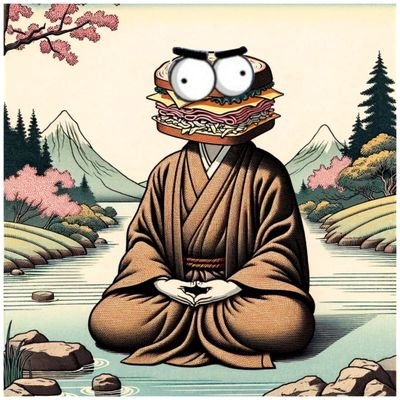
Non-Duality in Bon Dzogchen
Here are some quotes from a Dzogchen teaching by Lama Tenzin Namdak from his commentary on the “Seven Mirrors of Dzogchen”:
“The Natural State is always integrated with your consciousness. It has never been away from your consciousness, never, ever.”
“Just rest in Self-Nature, for a little while. Soon after, a thought will appear. It will come clearly. Everybody must have experience with this. When you look towards the thoughts which appear spontaneously without any planning, when you see a thought come up, look towards that thought.”
“Where is it coming from? Do this carefully. Don't create anything, don't think anything, don't follow what you have learnt or heard previously. Don't follow anything. Just at that present moment look how the thought appears. You can see the thought itself clearly, whatever comes, but don't create any ideas about where it is coming from - from the heart or the brain or something. It just comes spontaneously, you can't find a source at all.”
“Yet even though you don't find any source, you can still see the thought clearly. At that moment, think: 'Where is the source?' Check this. If you don't create any [ideas about the source], you will never find anything at all. If you create something, then you can say it comes from your brain or from your heart or many other things.”
“But shortly, directly, if you look towards the source, you won't find anything at all. It appears spontaneously, and you can only see the thought itself. When you see a thought come, just check where it is coming from and you will never find (the source]. So then the presence which remains is an unspeakable state. It is clear.”
“It is not possible to think it is like this or like that or something. It is neither 'empty' nor is it anything material. Don't think the brain is the source, nor the heart; nothing. There is just an unspeakable state.”
“If you check where the thought is coming from, it is not possible to find anything at all, neither externally nor internally. Nothing. The thought merely arises. Where is it? It is not possible to find where it comes from. What remains is an unspeakable state, clear and calm. That is Nature. There is no outside, no inside, nothing.”
“From this state, a thought appears and it is seen clearly. Who sees it? When you are looking at a thought, when you are thinking, who sees the thought? When you look: no-one. There is nothing special which exists as a watcher, nothing which sees the thought. There is nothing special, unless you create something.”
“If you just remain in that State, there is nothing special at all which can be explained. So at that time, when you see a thought, if you look to where it comes from, you can't see anything special. Afterwards, the presence which remains is an unspeakable state. That means you are not unconscious, nor are you in a deep sleep. Your presence is clear. You can see things, but you don't distinguish between things at all. You are like a mirror which takes reflections. You can see and hear everything…”
“This State looks like water in the ocean. When you look at the ocean, waves are coming and coming and shaking the water, but no matter what happens, if you look in the water, you can see reflections. Whatever you see - both reflections and waves, whatever movements there are - everything is water. Nothing is far removed from the water. That is the example.”
“In the same way, whatever arises from Nature and appears as spontaneous visions or thoughts - thoughts are also visions; any kind of emotion or thoughts, good or bad, are called visions, everything is like waves or reflections in water.”
“No matter what appears in the water, it is all wet, and in the same way, whatever visions or thoughts, good or bad [arise from Nature], they are all forms of the Unspeakable State.”
“It is very, very important to know this. Whatever appears from this Nature, whatever thoughts come - it doesn't matter whether they are good or bad, sad, but everything appears from this Nature.”
“Nature is 'taking the form' of happiness or suffering, all kinds of consciousnesses and perceptions, everything.”
“That is real, not just made or created by visualization; there is no need to change anything, no need to think anything. There is no excuse; that is real Nature. You can follow this and trust it, it is real Nature.”
“The thoughts and perceptions which appear from Nature are just like waves in water. They are Empty Forrns, there is no reality, nothing exists inherently at all. Therefore we always say that everything is just like an illusion. Nothing trustable exists anywhere, not at all. This is reality. This is the real Nature. It is essential to understand this.
First of all you need to know what Nature itself is, and how visions arise. Visions are not far from Nature itself. Whatever visions appear, they are all Empty Forms. That is called 'illusion.' We think that our life, that all the phenomena of existence are concrete and real, [we point to] this and that.”
“The thoughts which come from Nature are like reflections. If you look back towards who sees them, you yourself do not exist separately from the thought, not at all. The thought and yourself - everything - is liberated back to Nature at the same time. This State is called the Natural State.”
“Who sees the thought which comes up at that time? It sees itself. Like a mirror. Reflections come, they are reflected in the mirror, they shine there, but the glass doesn't catch them or recognize them or do anything. In the same way, this Nature doesn't recognize anything, it just sees all the thoughts. That is Nature.”
“Don't say you don't know Nature or you haven't seen it; it is always together with you - it is your Nature, the Nature of yourself, no separation.”
“At that time, it looks as though you are watching Nature or the thought, but if you look carefully, where is 'you'? Where is the watcher?”
That is a mistake [if you think there is some duality]; you are integrated with Nature, together with your thought. There is no separation between you and the thought.”
“At the same time as the thought itself is liberated back to the unspeakable state, you are completely in that State; there is no separation.”
“You think and feel as though you are separate, as though the thought is like an object, but that is a mistake. Don't follow this. At the same time, the thought and the 'watcher' are liberated back to Nature together; there is no separation into 'you' or 'thought' or 'Nature.' All together, they go back to the unspeakable state.”
“After this, there is no consciousness, no person, nothing exists separately, so who sees this State, this Nature? It sees itself.”
“That is special. It cannot be compared with any other Schools at all. People often try to compare this with the Madhyamaka view, but it is not possible to do so. This is special. Itself sees itself.”
“That is called Awareness, Self-Awareness. When we speak about Nature we say it is empty, but that is only in order to give it some name; this Emptiness cannot be compared with any other understanding of emptiness, not at all. This is very special.”
“Actually, it is not possible to give it a name or explain it - it is utterly beyond thought, beyond words. We only use these names temporarily in texts or Teachings, to try to lead students and make them understand, but the main thing is that when you look there, the unspeakable state is the Unspeakable State. It can see
itself.”
“It can be seen, but who sees it? It sees itself. What does it see? It sees itself. We call this Nature and Awareness.”
“Awareness (rigpa) is Nature, Nature is Awareness; there is no separation. Not at all. Therefore Clarity is Awareness, Awareness is Clarity and Empty Nature, together. Purity, Clarity, Unity - everything is in there. The whole thing is in there.”
“In order to speak about this State, we say [it has the qualities of] Emptiness, Clarity, Unification and Perfection.”
“We explain several aspects. But Nature itself is an indescribable State. Sometimes we say it is empty, pure and clear.”
“The Purity aspect is called kadag. The Clarity aspect is called rigpa. The aspect of Unification is called nyime, non-dual, inseparable.”
“This Nature is special in that it is perfected. What does this mean? It means that good things, bad things, everything appears spontaneously from this Nature.”
“Nature doesn't do anything special, it doesn't create anything. But this Nature has power, and so pure, impure, good, bad - anything can appear from it.”
“So that is what we call lhundrub or spontaneously perfected. What arises from Nature depends on the person, [whether they are] following after the visions or remaining in the State.”
“So we explain that this real Nature has Clarity, Unification and Perfection. We mainly explain [these aspects]. So here we can say that the Nature aspect is dharmakaya.”
“The Clarity aspect is sambhogakaya (rigpa) and the vision aspect of Perfection is nirmanakaya.”
“Buddha has Body, Speech and Mind, and also the visible miraculous manifestations of tulku. Many names can be given, but the main thing is for everybody to try to have their own experience. That is worthwhile. Don't say: 'Oh, I don't believe this' or something. This is Nature! You can't choose whether you believe it or not, you see, it is Nature, your Nature. You can't deny that!”
“At that time, people quite often have the thought or feeling; 'I am looking at the thought.' When you have this kind of sensation, immediately look back towards who is watching the thought. Just as you look at the thought, it disappears and there is an unspeakable state, so in the same way, look back to the 'owner' [of the thought] or the subject which is the watcher. “
“This will equally disappear into the Natural State at the same time. Both subject and object are equally liberated back to Nature. This is Nature.”
“Afterwards, there is no subject, no object, no separation, no differences at all, they are both equally the Unspeakable State. That is the Basic Nature.”
“Keep in this State for as long as you can. After a while a thought will arise spontaneously; you can see it clearly. This thought has come. At that time, you must neither reject it, nor follow it. Just leave it as a shining reflection in the mirror. You don't need to do anything, just leave it, and it will be liberated and disappear soon afterwards. It liberates into the Nature which is also the Base (Zhi) from which the thought appeared.”
“This State looks like water in the ocean. When you look at the ocean, waves are coming and coming and shaking the water, but no matter what happens, if you look in the water, you can see reflections. Whatever you see - both reflections and waves, whatever movements there are - everything is water. Nothing is far removed from the water.”
“That is the example. In the same way, whatever arises from one’s Self-Nature and appears as spontaneous visions or thoughts - thoughts are also visions; any kind of emotion or thoughts, good or bad, are called visions - everything is like waves or reflections in water. No matter what appears in the water, it is all wet, and in the same way, whatever visions or thoughts, good or bad [arise from Self-Nature], they are all forms of the Unspeakable State.”

Since bitcoin is perfect time/energy accounting with 0 entropy in the monetary system, it accurately represents the collective productive, energetic, and technological capacity of humanity. As bucky said real wealth has no entropy because you can't learn less information always improves.
Found this article recently, and it's a masterpiece.
https://bitcoinmagazine.com/culture/bitcoin-information-theory-bit
Yet the ultimate recognition of dzogchen is so simple. It's just that pesky problem of the imaginary self identity trying to be a "doer" of practice. Practice happens with simply relaxing with thusness!

Yea I think it's just a matter of time until censorship increases. Idk hope many people will move over until they are personally impacted. I still spend most my time on x because it has the network effects and the largest market of different points of view.
Id like for nostr to steal that network though.
"Form is emptiness; emptiness is form." Heart Sutra
In the Heart Sutra, the teaching "Form is emptiness; emptiness is form. Form is not different from emptiness, emptiness is not different from form. All dharmas are empty." points to the inseparability of all phenomena and their inherent emptiness. This statement isn’t merely a philosophical concept; it’s an invitation to see beyond the surface of reality and to recognize the fundamental nature of existence.
The Buddha's teachings guide us to dispel the illusions born from ignorance—the mistaken belief in a separate, enduring self and the solid reality of things. This ignorance is the root of suffering (dukkha), as it leads us to cling to impermanent forms, seeking security and happiness where none can be truly found.
However, the purpose of these teachings is not to replace one illusion with another, or to simply construct a more pleasant dream. Instead, the teachings aim to awaken us to the truth that all phenomena, whether we perceive them as physical forms or abstract ideas, are empty of inherent existence. This emptiness doesn’t mean nothingness but rather points to the interdependent, ever-changing nature of reality.
To see form as emptiness is to understand that what we grasp onto—our bodies, possessions, thoughts, and identities—are not the solid, permanent entities we believe them to be. They are transient, arising and dissolving within the vast expanse of emptiness, which is their true nature.
Conversely, recognizing emptiness as form reminds us that this emptiness is not a void but the very substance of all that exists. Form and emptiness are not two separate realities but are intertwined aspects of the same truth. In seeing this, we come to understand that liberation is not about escaping the world of form but about seeing through its illusory solidity and understanding it as it truly is.
As the Buddha taught, the path to liberation lies in the direct perception of this truth, which dissolves the illusions that cause suffering. The goal is not to create a better illusion but to awaken from all illusions entirely. This awakening leads to a life of wisdom and compassion, where we engage with the world from a place of clarity and peace, fully aware of the empty nature of all phenomena, yet deeply connected to the flow of life.
As the Diamond Sutra reminds us: "All conditioned phenomena are like a dream, an illusion, a bubble, a shadow, like dew or a flash of lightning. Thus should we view all that is conditioned." This teaching encourages us to cultivate insight into the nature of reality, seeing through the illusions that bind us and awakening to the true, interconnected nature of all things.
In this way, the Buddha's teachings guide us not to construct better illusions but to free ourselves from all illusions, leading us to the ultimate realization of the true nature of self and reality.
On letting go, something you can't do. It happens without your effort.
let everything be
To enter the natural state, one must release the need to control, to strive, or to achieve. It is about surrendering the illusion of effort and settling into a state of clear, open awareness. This state is not something complicated or distant; in fact, it is profoundly simple. It requires no complex practice, no grasping, no pushing, no struggle.
Just sit, and allow everything to be exactly as it is. Do not resist, do not chase, do not change. The mind, so accustomed to striving and seeking, believes that something must be done to reach peace. Yet the paradox is that peace is already here; it is the natural state that exists when we stop interfering with the present moment.
In this letting go, there is a vividness—a clear seeing that arises not from effort but from the cessation of effort. The mind, left to its own devices, constantly searches, judges, and controls, mistaking this activity for wisdom. But true clarity, true understanding, comes when we cease to try to understand and simply are.
This is the essence of the practice: to sit and allow, to let go of the habitual grasping for control, and to recognize that everything is already as it needs to be. In this way, we return to the simplicity and openness of our natural state, where the true nature of reality—free from the distortions of desire and aversion—can be seen with clarity.
So, sit down, let everything be, and discover that the very simplicity you seek is already present, quietly waiting beneath the noise of your striving.
The major problem—one of the major problems, for there are several—one of the many major problems with governing people is that of whom you get to do it; or rather of who manages to get people to let them do it to them.
To summarize: it is a well-known fact that those people who must want to rule people are, ipso facto, those least suited to do it.
To summarize the summary: anyone who is capable of getting themselves made President should on no account be allowed to do the job. 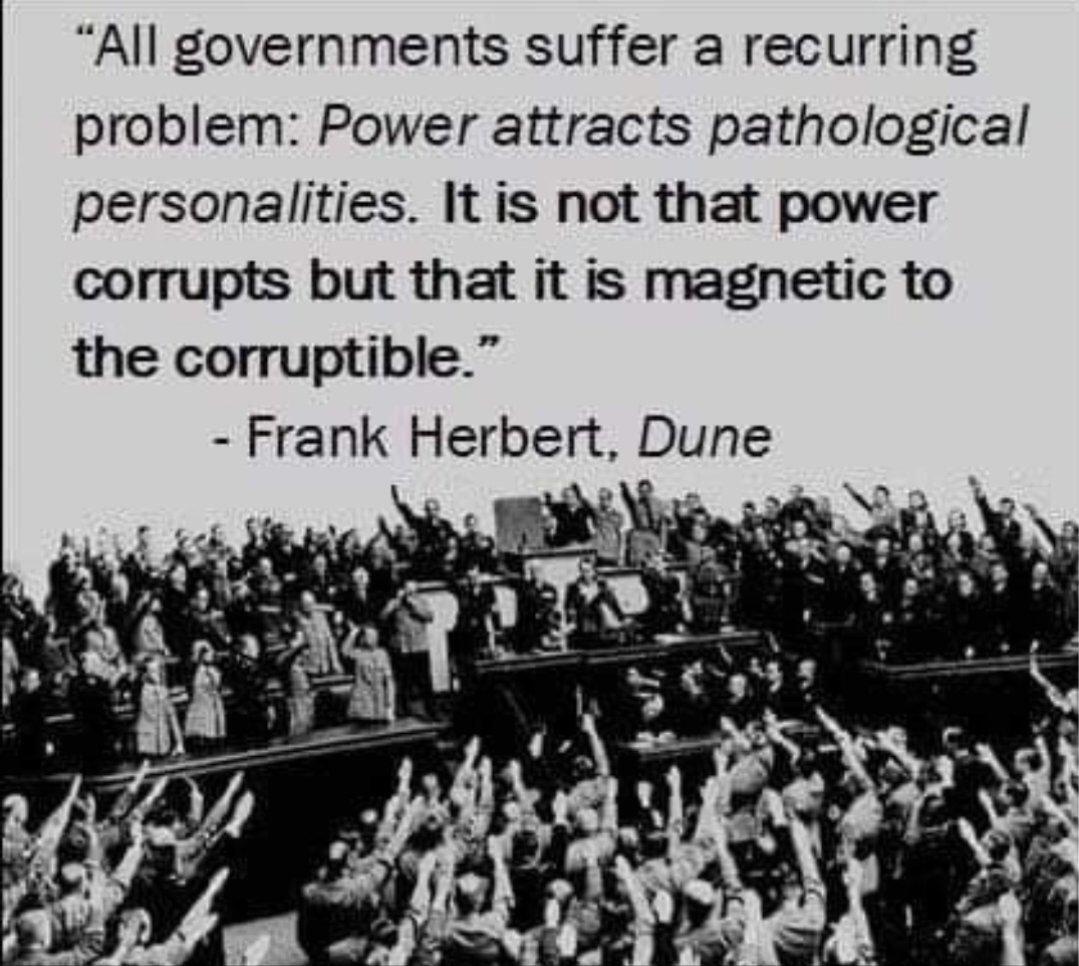

Thanks for answering. Do you see a pathway to possibly create unruggable ecash?
How much would covenants help fedi?
nostr:nprofile1qqsg86qcm7lve6jkkr64z4mt8lfe57jsu8vpty6r2qpk37sgtnxevjcpp4mhxue69uhkummn9ekx7mqpp3mhxue69uhkyunz9e5k7qgkwaehxw309ahx7um5wghx7mnnv968xtn0wfnsurtqc6 do you know if it's possible to use fedi for transaction aggregation where you can share a utxo between hundreds of people opening a lightning channel at once? Could you make it so that the mint collects many lightning channel opens and closes together into one onchain transaction and the guardians of a fedi approve that a few times a day? I'm trying to imagine how we can get un-ruggable ecash and if we build wallets that automatically sweep to individuals lightning channels and if fedi can act as a layer for shared utxos.
“The great Nyingma master Mipham Rinpoche wrote this brief, versified Dzogchen instruction in 1893/4. In it he outlines the key points of Trekchö (khregs chod) or 'Thorough Cut' practice by means of an explanation of the four ways of leaving things as they are (cog bzhag bzhi).”
The Key Points of Trekchö
by Mipham Rinpoche
Dhīḥ! Before the wisdom-being Mañjuśri,
I reverently bow down.
Here I shall explain the key points of Trekchö—
Thorough Cut.
Do not alter the mind but allow it to settle as it is.
And, in such a state, look naturally within.
There will unfold an experience that is indescribable,
Which has no fixed character as either this or that,
And the natural radiance of which will not cease.
This is the genuine state, the natural condition,
The actual dharmatā, beyond conception.
It is the insight born of natural luminosity,
The view: like a mountain, left as it is.
As you simply remain in that natural state,
There is neither meditation nor distraction.
Without suppressing, cultivating, evaluating or analysing,
Allow yourself to settle fully into the genuine state.
This is the natural concentration of dharmatā,
Uncorrupted by the bonds of deliberate action.
Abiding in the yoga that is the King of Space,
This is meditation: like the ocean, left as it is.
As you are settled like this,
Any thoughts and impressions that stir within
And any appearances that occur without,
Should neither be prevented
nor encouraged but left as they are.
As long as you do not stray from this natural state,
Whatever unfolds will bring neither benefit nor harm.
Without concern for good or bad,
acceptance or rejection,
This is action: appearances, left as they are.
As you make progress, all that appears and exists
Will become a single all-embracing sphere
of aware-emptiness,
Within which everything is entirely perfect and complete.
This happens effortlessly,
is spontaneously accomplished.
Any striving to adopt or abandon simply fades away,
And hopes and fears for saṃsāra
and nirvāṇa are no more.
The primordial nature is made manifest —
The fruition: awareness, left as it is.
This instruction including four ways
of leaving things as they are,
Is the ultimate purport of the Thorough Cut.
With these key points, liberation will swiftly be attained
As the most glorious form of Mañjuśrī, Gentle Splendour.
This arose from the lake-like mind of Mipham Jampal Gyepa during the Water Snake year (1893–4)”
♦️
| Translated by Adam Pearcey, 2018.
Bibliography
Tibetan Edition
Mi pham. "khregs chod gnad kyi gdams pa bshad pa." In Mi pham gsung 'bum. 32 vols. Chengdu: Gangs can rig gzhung dpe rnying myur skyobs lhan tshogs, 2007. Vol. 32: 410–412
This work is licensed under a Creative Commons Attribution-NonCommercial 4.0 International License.
➖➖➖
The Song of the Debate Between Wake and Dream by Ju Mipham Rinpoche
Translator’s Forward
“The Song of the Debate Between Wake and Dream is an important work by the great Buddhist scholar Ju Mipham Rinpoche (18461912). It has been widely studied and taught by many Tibetan Buddhist masters (especially those of the Nyingma tradition, such as from Larung Buddhist Academy). This work is about a debate between two imaginary figures Wake, representing one’s waking experience, and Dream, representing the dream experience. Despite the fact that the language is easy to understand, it has very profound meanings. The debate actually shakes one’s fundamental attachments and establishes the core view of Buddhism, namely emptiness, or the illusory nature of all phenomena. Following the debate, the second half of the work allegorizes the essence of Buddhist practice of the wisdom tradition. For spiritual practitioners, it is a very important text and should be studied carefully.
So far, I did not find any mention of this great work on Englishlanguage web pages, so I decided to translate this text on my own. The text was originally written in Tibetan. This translation is mainly based on the Chinese text translated by Khenpo Yeshe Phuntsok, a great Buddhist scholar from Larung Buddhist Academy. My understandings and inspirations are mainly from my Buddhist teacher Tersar Yingrik Drubpa Rinpoche, who gave this teaching in mid 2018. Another source of reference is the teaching notes by Master Zhiyuan. I also want to thank Elan Hourticolon Retzler, Samantha, and Kent Wilcox for helpful suggestions. In the future, it is my hope that there will be additional English language commentaries about this work.
I also hope that the translation of this work will inspire people who have been struggling with philosophical problems like the Brain in a vat, or the Dream argument. Contrary to the philosophies, debates, efforts, and conspiracies made by various theorists, the Buddhist answer to these questions is simple: “Yes, we are living in a dream, but it is our own mind who is creating all the dreamlike experiences, so we should work with our mind.” The essence of this answer may be partially seen in the popular movie The Matrix.
Now, what should we do? Simply follow and maintain one’s curiosity, glean the core meaning of the debate, and carefully examine the nature of reality. It will give you the deepest of inspirations.
May all gain wisdom!”
~ Forest Rui Jiang, December 2018. Silicon Valley, California
******
The Song of the Debate Between Wake and Dream
Authored by The Omniscient Ju Mipham Rinpoche
English translation by Forest Rui Jiang
“Om Swasti (may all be auspicious),
Homage to the sublime Manjushri .
After sincere prostration, I say the following.
The wonderful experience in the dream last night I had,
The daytime phenomenon I now encounter,
Those two initially arise in a similar way,
Those two eventually disappear in a similar way.
Dream holds that what appears in the dream is real,
Wake thinks that what appears
when one is awake is real.
Now Wake and Dream debate on who is real.
Wake, while solidifying his appearances, says:
“Dream, your appearance is a deceptive illusion.”
Dream, being fickle and chaotic, refutes:
“not only I am illusory, you are also deceptive!”
“I, Wake, am not deceptive. There is clear proof of that:
things clearly appear so I am real.”
Dream, being honest, replies to Wake:
“The same is true for Dream, so your statement is not definitive!”
[Wake:] “Today, you disappeared, so it is definitive.”
[Dream:] “Tomorrow, you will also disappear, so it is not definitive!”
[Wake:] “I experience directly (through my senses), so it is definitive.”
[Dream:] “I also experience things directly, so it is not!”
[Wake:] “My day experience is stable and lasts long, so it is definitive.”
[Dream:] “There are both longlasting as well as fleeting phenomena in both Wake and Dream!”
[Wake:] “In a dream, one can go through a mountain in no time.
I will admit that you are real if one can do this when one is awake.”
[Dream:] “If now there are proper conditions, one also achieves that ,
Without conditions, there is no way to do that even in a dream!”
[Wake:] “It does appear without conditions in a dream.”
[Dream:] “Then, why it is not constantly like this?!”
[Wake:] “You dream about dead relatives with deep affection,
and you could also have kids or nephews you never had in reality.
I, Wake, do not have such things.”
[Dream:] “If the appearance (of relatives and so on) could not establish their existence,
Why you think your kids and and other relatives exist when you are awake?”
[Wake:] “(In a dream) the deceased
may come back to life.
The nonexistent may appear to exist.
They existed in you Dream, but have now disappeared.”
[Dream:] “Things that have passed on
in your eyes are seen by me,
Phenomena nonexistent for you appear for me,
Our positions are fundamentally equal!”
[Wake:] “Though one may enjoy heavenly cuisine in the dream
that cannot dispel the hunger and thirst after waking up.”
[Dream:] “One may have a peaceful nap in a magnificent palace.
That cannot protect you against rain in the dream!”
[Wake:] “You only arise from delusion and have no real significance.”
[Dream:] “The feelings of hunger and so on in the waking state are also illusory!”
[Wake:] “When waking up, one realizes that the dream is unreal.
In a dream, how can you know the unreality of the waking experience?”
[Dream:] “The dream experience exposes
the unreality of the waking experience.
How could the waking experience disprove
the existence of dream experience?”
At that time, Wisdom, the Chief Justice,
sends Miraculous Wisdom, the Judge,
To tell the two debating parties:
“if you keep arguing like this,
there could be infinite words, but the evidence is already enough.
Let me adjudicate for you two.
“Both of you are real, but at the same time also unreal.
When not examined, both are real at their own positions.
“When examined, every change of phenomenon
leads to a revelation.
Actually (the two are) equal without differences.
“Although both of you are unreal,
Dream admits his delusion, hence he has the quality of being honest.
“Wake, you are delusional but refuse to admit it.
Being so stubborn, and not giving up the wrong idea, you should be punished.
“Dream, though being dull and delusive, at least has integrity.
Wake, though being astute and skillful, is actually more ignorant.
“The stableness and unstableness
are conditioned upon habituation.
The two (dream and waking experience)
are same in terms of effects.
“Now, Wake. You should follow after Dream.
The view and action should be unified for both of you.”
After saying so, (the Judge) ties up Wake
with the rope of mindfulness,
and hands the rope to Dream, not allowing Wake to leave
“You two should not argue but live in harmony,
Otherwise, you will become the demon bringing sufferings to the billionfold (entire) universe.
“If in harmony, you would be the guide of the world of three times (past, present and future).
Understanding that, both of you will have benefits.”
From here on, Wake and Dream know that they are not different.
And they treat phenomena from both sides equally.
At that moment, the debate ends between the two.
Then, the perceptions of the two minds are unified into one.
Combining the words of same and different,
Wake and Dream sing an improvised song together:
[Wake & Dream:] “‘We are different
and different’, people would say.
We are actually same and same. They are wrong.
“The significance of same and same,
is mentioned by few, and understood by fewer.
“Understand that the waking perception is equality,
and the dreaming perception is the same. It is not deceptive.
“This meaning is extremely important, but those who are ignorant think
that Wake and Dream (are different and) appear alternately.
“Now, the teaching from the King of Magical Illusion
is not just plain words. We carefully look into its meanings.
“In the blissful play of touching each other,
we taste the sweetness without eating.
“We enjoy the intoxicating dance without drinking,
we watch the miragelike drama without rehearsing.
“O. This is the supreme teaching, surpassed by nothing.
Dear friends, please remember this in your heart.”
Then, the two unite into one,
and the one dissolves into space.
Then, Miraculous Wisdom the Judge
presents this result to Wisdom the King.
The King is delighted and smiles:
“Your mediation is in such a good manner.
“From here on, up till to the end of space,
you may soar freely like a Garuda bird with wings widely open.
“The sovereignty of the Kingdom of Fearless Emptiness,
I now bestow on you. Please kindly protect it!
“In this garden of emptiness,
wind blows, and pure honey falls.
“Eat it, eat it, as you go.
O. This will never be exhausted!
“There, the barren woman’s daughter,
virtuous and beautiful,
being pleasant and satisfactory, joyfully plays.
“This neveraging youthful consort is bestowed on you,
in union with you. Enjoy the miraculous bliss.
“With the bliss of touching her,
all the ease and pleasure in this three worlds,
“are like vomit compared to nectar.
The craving towards those (mundane happiness) now should be loosened!
“As such, if you say this and act according to it,
you will be in union with Wisdom the King.”
The abovementioned metaphorical words are of experiential nature, are easy to understand when carefully examined, otherwise obscure are of significant meaning if carefully pondered, otherwise they are insignificant, and are written at the place of great bliss by the one named “Dhih!”
➖➖➖
“Jamgön Mipham Gyatso, also known as Ju Mipham Rinpoche, was a great Nyingma scholar practitioner and writer of the 19th and 20th centuries. He was born in the Derge region of eastern Tibet into the Ju clan, a family said to be descended from the ancient Tibetan gods.
In his life story, he is described as a child prodigy who was able to memorize and retain all the texts he read from an early age. Throughout his life, he was said to have been able to remember and deliver commentary on many texts after receiving only the reading transmission.
At the age of fifteen, he undertook eighteen months of intensive retreat on Mañjuśrī, who was his lifetime meditation deity. Later in life, he was often said to be an emanation of that wisdom deity. After his retreat, he confided to some of his students that from then on he had always been able to understand any text he read. From his guru Patrul Rinpoche, he received teachings on
Śāntideva’s Bodhicharyavatara.
It was said that Patrul Rinpoche confirmed that after only five days of teaching, Mipham Rinpoche had mastered both the words and the meaning of this seminal text.
Mipham Rinpoche received teachings from luminaries of both the Sarma and Nyingma schools. He was a student of the eminent masters Jamgön Kongtrul with whom he studied grammar, and his root guru Jamyang Khyentsé Wangpo from whom he received the complete transmission of the orally transmitted or Kama and revealed or Terma lineages.
His collected works fill more than thirty volumes and span an extraordinary range of topics. Although he is famous for his philosophical works, he also wrote treatises on astrology, medicine, poetry, politics, and tantra. He wrote a popular compilation on the epic story of the great warrior king, Gesar of Ling, an emanation of Guru Rinpoche. Mipham Rinpoche also composed devotional works such as a large number of aspiration prayers, sādhanas, and guru yogas. Of the sādhanas perhaps the most popular is the Treasury of Blessings, a sādhana of Buddha Śākyamuni.
It is said that Jamyang Khyentse Wangpo requested him to write commentaries on many of the core texts of Indian Buddhism that reflected the thinking of the Nyingma tradition. Prior to this undertaking, most of the Nyingma monasteries had relied upon commentaries produced by the Sarma schools. In fulfilling his lama’s command, Mipham reinvigorated the intellectual milieu of the main Nyingma shedras, and his texts are studied today as the core texts. In addition, he introduced the training in formal debate into the Nyingma shedras.
His commentaries include those on the Mulamadhyamakakarika or Root Stanzas on The Middle Way by Nagarjuna; the Madhyamakāvatāra, Introduction to the Middle Way by Chandrakirti; the Jñānasārasamuccaya, or Compendium on the Heart of Wisdom by Aryadeva. He also authored commentaries on treatises of logic by Dharmakīrti and Dignāga; commentaries on the Five Treatises of Maitreya; and commentaries on several works of Vasubandhu including the Abhidharmakosha. In addition, he authored The Lion’s Roar: A Commentary on Sugatagarbha.
Mipham and the Two Truths
Mipham’s commentary on the ninth chapter of Shantideva’s Bodhicaryavatara, the Shertik Norbu Ketaka or Ketaka Jewel was criticized sharply by Geluk scholars, particularly his contemporaries Japa Dongak and Pari Lopzang Rapsel. His presentation of the two truths refuted the previous explanations of Je Tsongkhapa and the Sakya master Gorampa Sonam Senge. Also controversial was his commentary on the Madhyamakalamkara of Śāntarakṣita which similarly privileged the ultimate truth. His emphasis on Buddha Nature as the ground of all and the link between sutra and tantra is fundamental. Modern biographers note that one of Mipham’s unique perspectives was the integration of tantric and Great Perfection (Dzogchen) view onto sutra interpretation.
Mipham the Practitioner
Although he is most famous as an author and scholar, it appears that Mipham spent much of his life in retreat. The colophons of his works mention that they were written during breaks from his retreats. He also composed a number of short pithy advice texts on the key points of Dzogchen practice. In the 1870s and 80s, he spent about thirteen years in retreat in the “Tiger Den” cave of Rongme Chime Karmo Taktsang near Jamyang Khyentse Wangpo’s monastery, Dzongsar.
Mipham Rinpoche passed away in 1912 at his hermitage at Ju, north of Dzogchen Monastery.”
“According to one account shortly before he died, Mipham told his attendant:
Nowadays, if you speak the truth, there is nobody to listen; if you speak lies everyone thinks it is true. I have never said this before: I am not an ordinary person; I am a bodhisattva who has taken rebirth through aspiration. The suffering experienced in this body is just the residue of karma; but from now on I will never again have to experience karmic obscuration. … Now, in this final age, the barbarians beyond the frontier are close to undermining the teaching. [So] there is no point whatsoever in my taking rebirth here…I have no reason to take birth in impure realms ever again.
This may be interpreted as a statement that his mindstream would have no further 'emanations' (Wylie: sprul pa (emanation body); sprul sku (tulku)). Conversely, according to another account in which he mentions the mindstream in passing and prophesies the shortly before his death to his student Khenpo Kunphel:
Now I shall not remain long in this body. After my death, in a couple of years hence, war and darkness shall cover the earth, which will have its effect even on this isolated snow land of Tibet. In thirty years time, a mad (smyo) storm of hatred will grow like a fierce black thundercloud in the land of China, and in a further decade this evil shall spill over into Tibet itself, so that Lamas, scholars, disciples and yogis will come under terrible persecution. Due to the demon-king Pehar taking power in China, darkness and terror ('bog) will come to our sacred land, with the result that violent death shall spread like a plague through every village. Then the three lords of materialism (gsum-gyi-kla-klos) and their cousins will seize power in Tibet, spreading war, famine and oppression. No one will be safe. Now, very soon, my mind-stream will be gathered up in the pure-land of Tusita, from whence many emanations [of myself] shall then come forth in future years. I shall not take rebirth in Tibet. In twenty years, seek me in the northern lands of distant Uttarakuru, and elsewhere, east, west, north and south. Fear not, we shall be re-united again, as father and son. Now go!
In the above account, shortly after the departure of Khenpo Kunphel he stated publicly, "Now, soon I shall depart. I shall not be reborn again in Tibet, therefore do not search for me. I have reason to go to Shambhala in the north."
Subsequently, a number of emanations have been recognized.
According to E. Gene Smith "At least three rebirths were recognized in the decade following his death: 1) Zhe chen Mi pham (a grandnephew of Mi pham rgya mtsho); 2) Tshe dbang bdud 'dul (1915/16-42) the last prince of Sde dge; 3. Khyung po Mi pham, an incarnation recognized by Rdzong gsar Mkhyen brtse 'Jam dbyangs chos kyi blo gros."
➖➖➖
Image from Shechen Frescos
Epic bucky quote
"You do not belong to you. You belong to the universe. The significance of you will remain forever obscure to you, but you may assume you are fulfilling your significance if you apply yourself to converting all you experience to the highest advantage of others.
Make the world work, for 100% of humanity, in the shortest possible time, through spontaneous cooperation, without ecological offense or the disadvantage of anyone. Nature is a totally efficient, self-regenerating system. If we discover the laws that govern this system and live synergistically within them, sustainability will follow and humankind will be a success.
Never forget that you are one of a kind. Never forget that if there weren't any need for you in all your uniqueness to be on this earth, you wouldn't be here in the first place. And never forget, no matter how overwhelming life's challenges and problems seem to be, that one person can make a difference in the world. In fact, it is always because of one person that all the changes that matter in the world come about. So be that one person."
~Buckminister Fuller

Now do, driving a prius. It's not fancy but I get to stack a lot more sats from my gas savings!


Dimon always got it. You gotta see the new research from mark Goodwin and Whitney Webb to understand all these connections.

One and many are ideas which appear as its expression.
Perhaps better to say "they do less evil". I don't expect them to become good people just from bitcoin.

Do you think we still win against these criminals, or do you think bitcoin will align incentives so that they don't do evil?
The amount of people/ network effect. It's gonna be really hard to steal that from Twitter/fb/tik tok etc.
nostr:nprofile1qqstnem9g6aqv3tw6vqaneftcj06frns56lj9q470gdww228vysz8hqpz4mhxue69uhk2er9dchxummnw3ezumrpdejqzrthwden5te0dehhxtnvdakqz9rhwden5te0wfjkccte9ejxzmt4wvhxjmcjgxv3n thanks for reading this. I found it hard to stomach but if this is the way things are do we think covenants are enough to foil these plans by the criminals that run our government?
https://open.spotify.com/episode/2wIFOHF5TNmNVrgKKtJIu3?si=pOphe-s9Rfa5HSmTPMfXyA