

Current AIs can't *think*?
As in: take information as a foundation and then use logic combined with this information to come up with answers to questions.
As far as I know current AIs are merely capable of producing texts that would have a relatively high probability of being uttered by a human, based on the training data. Maybe that is somewhere on a shared spectrum with thinking/reasoning but it's far away.
Or did I miss something and there are AIs that differ significantly from the LLM approach?


So, this probably results in a significantly more weather/water resistant finish compared to just painting wood in unprocessed lin seed oil a few times, right?
Just wondering _how much_ more durable it is to justify the effort.
I recently painted my wooded bike luggage carrier with flax seed oil .. going to find out how resistant to rain that made it. Smells nice at least :-)
Before that, I had smeared vaseline on it some time ago, just because that was the only thing I had on my hands on the occasion. It wore off surprisingly fast from a few dozen times getting heavy rains, considering that stuff is totally water insoluable.

Or maybe: ignore the haters most of the time, but also sometimes call them out?

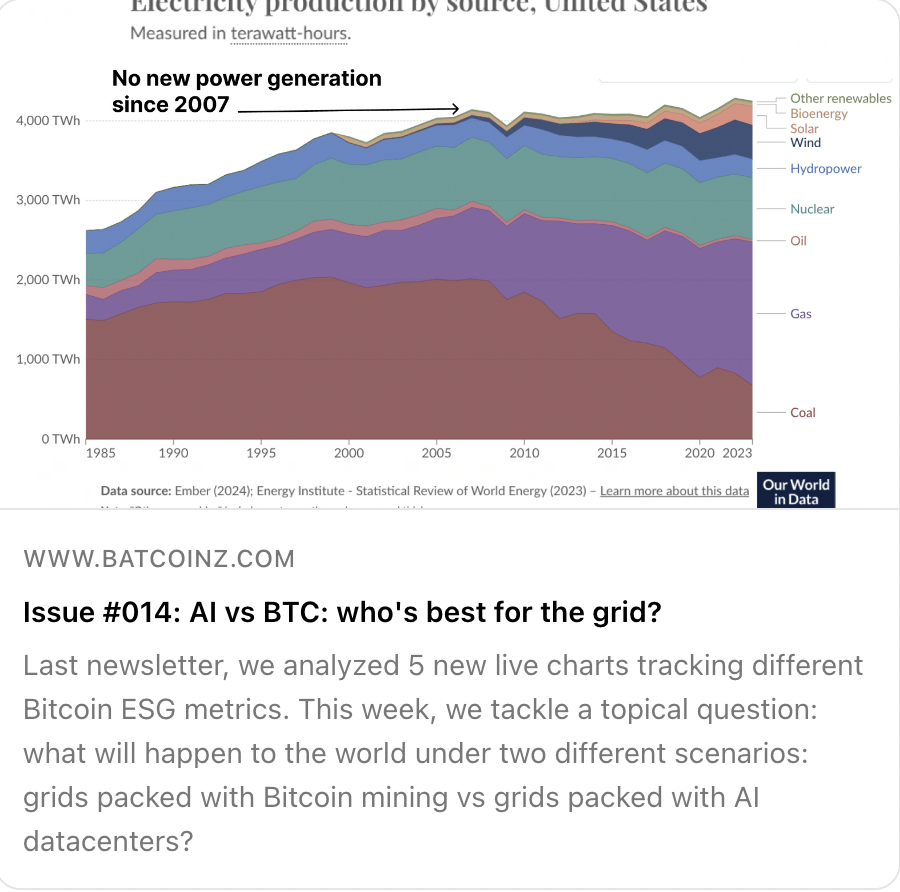
> The key difference between Bitcoin mining and AI/HPC data centers is in their energy consumption patterns. Bitcoin mining can ramp up or throttle down their energy usage on a dime. This flexibility makes them perfect for balancing out the fluctuating energy supply from renewables.
> On the other hand, AI data centers need 24/7 uptime. This means they're not as adaptable to the ebbs and flows of renewable energy.
Don't know anything about data centers / AI data centers so maybe this doesn't make sense, but: aren't there two well distinguishable operating modes / work loads for data centers?
(A) Responding to requests from some user who interacts with an App/AI model/website: these need to be instant, otherwise the usability is just bad
(B) Training models / crunching numbers / solving equations where the result has to be obtained within a reasonable time scale (days/weeks)
On my local computer I can just send the signal to a running process and it will pause. Instantly. I'd guess this can be done in data centers as well.
So I think there are probably AI data centers and tasks (B) that _can_ indeed provide flexible loads to an electrical grid. Not all of them, but surely some.
A while back I thought that maybe part of the reasons why Microsoft is building a large data center in Germany is that they'll regularly have electricity for negative prices for sizable shares of time (noon peak of PV) if the PV buildout continues as it currently goes.

Agree, a declining population is not a private matter.
(And I didn't claim it was.)
A declining population is a public matter and as such it needs to be adressed by some political process that is being agreed upon by the population.
As to "killing unborn people". Feels like we won't come to an agreement about the question: from which number of cells upward is it appropriate to speak of "people"?

As if a shrinking population were inherently a bad thing. How about as a dictator you keep your hands off of people's private issues and instead make policies so that businesses flourish, people have food, crime is kept in check and the environment isn't being destroyed? Bet you'd have enough things on your hands, trying to achieve all that.

What's the exact issue with this though?
It enables homeowners to continue to consume who otherwise wouldn't be able to, because their home is actually too expensive for them?
So it stimulates consumption based on borrowed money?

Easy going. Every employed person just needs to take some $280,000 out of their savings and income and give it to the lenders and payed back it is.

I'd agree that arguing/pushing to achieve the ideal, when things are already bad and also trending towards the worse, is good.
Will any ideal (regardless of which goal you choose) ever be achieved? No. And that's okay IMO.
You won't ever have absolute freedom, no matter how hard you fight for it, unless you entirely leave society.

Maybe some kind of middle ground between a dystopian cashless society and offline analogue cash can be achieved with GNU Taler?
In Scandinavia there's homeless people who receive donations via app.
They will just make apps for every use case unfortunately, so if everyone owns a smartphone anyway from the age of 6, this line of argumentation against cashless will fall on deaf ears with many people.
To be clear, I'm firmly opposed to a cashless society.

Reminds me of reading somewhere about an assumed trade-off in diet between:
(A) longevity
(B) optimisation for high physical/procreational performance
The beef-butter-bacon-eggs diet then would obviously fall in the (B) category.
They don't talk much about cancer. Sure, many cancers are probably caused by metabolic disease and chronic inflammation from too many carbs, which would be prevented by this diet. But intestinal cancer from lots of red meat, isn't that a proven thing as well?
No mention of the word "gout". Wouldn't gout become a problem with such a diet?
Or is the protein intake actually not that big (say 1-1.5 g/kg body weight) because all the fat (since he expressly recommends not lean but fatty meat) makes you sate before you're taking up too much protein?


Mir auch aufgefallen. Hat mich ein wenig verblüfft, dass sie es schaffen sich so weit vom Rest der Zeitungslandschaft abzusetzen. Da muss doch irgendwann ein Rüffel kommen.
nostr:npub15ww3nmpr3tcmzjuv7dsct2fnk9qln98zlaapxgayewm970vg7c0q3wqdm3 .. bin zufällig gerade genau auf so eine Lösung gestoßen:
https://postmarketos.org/blog/2024/06/16/v24.06-release/
> https://compost.party/ .. it's a web server running on an old, broken phone, getting energy from the sun using one of those portable solar chargers that you may also have lying around.
nostr:npub15ww3nmpr3tcmzjuv7dsct2fnk9qln98zlaapxgayewm970vg7c0q3wqdm3 .. bin zufällig gerade genau auf so eine Lösung gestoßen:
You mean ASICS for Bitcoin mining then?
Jou, das ist mir klar. Aber ein altes Smartphone hat wohl fast jeder sowieso rumliegen, nen Raspberry Pi aber nicht.

AFAIK, AI data centers have significantly surpassed Bitcoin in terms of electricity consumption already.
It'll depend on how well AI can actually make money.
I think we'll see kind of a plateau of AI models over the next 5 years. LLMs will have reached a level of "skill" that will make it useful for many things related to interacting directly with humans/content. But there won't be a big break through, like AI models pushing scientific progress on their own towards some kind of singularity.
So maybe we'll see some kind of bubble burst with all the sunk investments not really having delivered uses of AI that people/companies are willing to pay lots of money for.
(Oh wait, maybe dating companions and matching algos that actually work well and bring soulmates together could make money ^^)
AI will probably also be more politically acceptible than Bitcoin mining over the next few years.