Avatar
techfeudalist
98a386c766ac9250f4ce1b500662fd08e4d464a1915743eedc83bd50521decac
Blessed by tech; working to bring the benefits to everyone. Freedom, incorruptible money, privacy.

There is no such thing as gender identity. It’s literally just superficial media stereotypes taken to a ridiculous extreme.

“I don’t feel like a woman” means “I don’t match Disney’s princess stereotype”.

Also, men don’t become women by dressing up as Disney princesses either.

It really is ironic how woke idiots say they want to be themselves by trying to resemble some character they watched on TV. nostr:note1a253nhk7xss5adkvc8y6u358ssmlh5s7vlse33gwp8gvlujynq4qa3p58m


Replying to Avatar Leo Fernevak

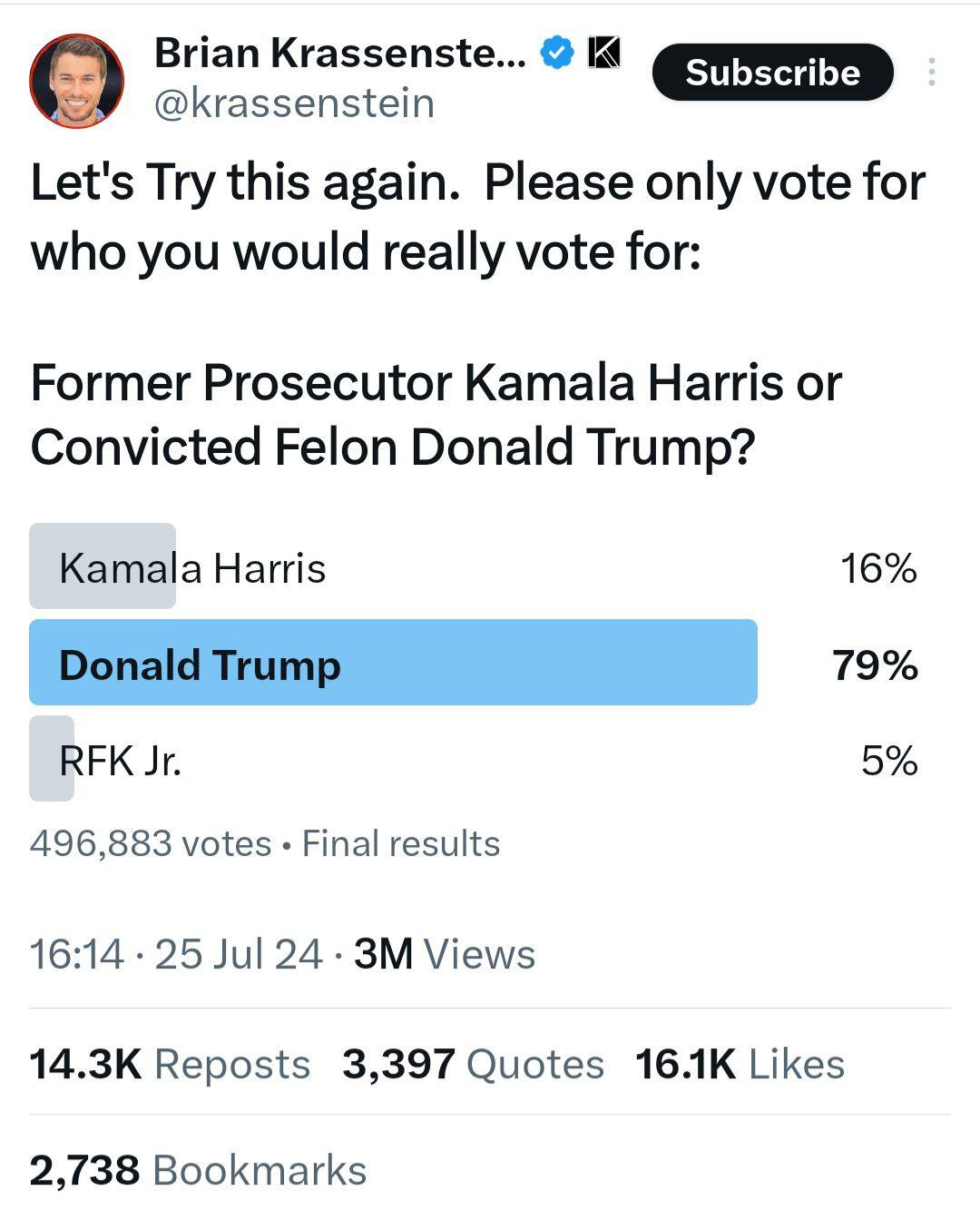
Hilarious voting results on Twitter/X.

It is entirely possible that the platform attracts more of a centre-right audience or that the centre-right is more active.

Yet, the account of Brian Krassenstein has 844k followers and we may assume with some confidence that most of his followers are pro-democrat. If half of his followers had voted, Kamala might have won his poll.

I say *might* here because increased spread of the poll could also have brought more visibility to pro-Trump or pro-JFK jr votes.

This brings me to the formulation. Perhaps referring to Trump as a convicted felon is not the brilliant strategic move Brian thought it was. Maybe the formulation added a few extra thousand votes in favor of Trump. Why? Because the establishment in most Western countries have been against Trump for the past 8 years.

Yet another possibility is that Kamala Harris simply isn't very popular among people in general.

Anti-establishment has become attractive for a lot of people. This means climate *realism*, not climate alarmism, abandoning the UN Agenda 21 sustainability goals, reducing energy costs, energy taxes and costly regulations, avoiding WW3 escalations as well as furthering peace negotiations in Ukraine.

"The Establishment" has come to mean: net zero, ESG scores, DEI ideology, CBDCs, climate scare mongering, increased costs of energy and living expenses, moneyprinting via high degrees of government spending, abandonment of merit in favor of ideology, and so on, with carbon allowances and social credit scores on the establishment horizon.

While Trump is far from perfect, not every polititician has stood up in Davos and told the World Economic Forum to get lost with their socialist de-industrialization and anti-energy policies, calling them "Prophets of Doom".

Trump at Davos in 2020:

https://youtu.be/0UiFRZ3t_KM

Going back to 2017, Trump pulled the US out of the Paris climate accord. He said that it is designed to kill the US economy:

https://youtu.be/iI24uAdAYro

On January 20, 2021, Biden signed the US back into the Paris climate accord. This was done on his first day in office. Clearly a high priority issue even if perhaps mostly symbolic. It displayed allegiance to the UN Agenda 21.

2023. Trump critiquing Germany for its harmful climate alarmism policies:

https://youtu.be/sJSr4tFkjcA

2024, February:

"I will not allow the creation of a CBDC"

https://youtu.be/oUjMK8d6omo

It is possible that Trump became anti-establishment by pure chance, as his stance was to protect US energy sector and strengthen the American economy.

From there is was inescapable that Trump would end up in conflict with the UN Agenda 21 and its next milestone Agenda 2030. Probably without even knowing what they were.

His pro-energy stance was unacceptable to the Al Gore's of the world, including Bill and Hillary Clinton, Barack Obama, Elizabeth Warren, Justin Trudeau, Emmanuel Macron, Rishi Sunak, Angela Merkel as well as the deep state in the Scandinavian countries, all of which have heartily embraced the UN Agenda 21 and its authoritarian de-industrialization plans.

Clean, cheap and reliable energy runs the world and provides us with the benefits of civilization.

Being pro-energy has become anti-establishment.

#Trump #Agenda21 #Agenda2030 #Establishment #Energy #CBDC

I suspect the “felon” strategy is coming from Alex Soros. In my mind, that would explain how out of touch the strategy is.

For people paying attention, bitcoin’s utility for countries is now in sharp focus.

It’s fascinating to watch it burrow deeper into national financial systems, adopted by countries to further their own self interests.

It’s like a Trojan horse. It’s early but I believe that we can see now how the path eventually leads to the separation of money and state, which could have a profound and positive impact on humanity.

Expecting that we’ll eventually see Russia charge a premium for oil in fiat currencies.

The advantages for Russia are incredible. Instant final settlement, no censorship, no seizures, no need to buy treasuries or invest in international bonds, no need to physically transport or verify gold, etc. nostr:note1pz8lezayfrzd92puse9grxjdjnmgjt447arllg73vz0q4j0c9ftqtshh6r

Replying to Avatar Rusty Russell

First up, I want to recognize that this is an uncomfortable topic! Bitcoin is inevitably changing towards user-pays, and that's not all positive. But facts we don't like are still facts: can't engineer a solution if we can't think about the problems.

There are three kinds of bitcoiners.

A. Those who can afford any fee.

B. Those who can afford a UTXO, but not often.

C. Those who can't afford a UTXO.

Nobody worries about the A group (and in the early days, that was everyone). Obviously Lightning (my area!) caters to the B group, and we want it to be as large as possible. To do this we can (1) make lightning as resiliant as we can so onchain spends are rare, (2) make bitcoin as efficient as possible so we can cram as much as we can into what we have.

(1) Making lightning more resilient and reliable is engineering. Lots of people working on this, even before we get soft-forks which could help further.

(2) More efficiency has two benefits: obviously if your own onchain spends are 20% smaller, that's 20% cheaper. But if *everyone's* onchain spends are 20% smaller, that means fees are lower *for everyone* too (and it's non-linear). So we really care about all Bitcoin usage! Some things are obvious wins: Taproot so you can avoid even putting the script onchain in many cases, FROST so you can cram your 2 of 3 or other scheme into a single key and signature. We know we want to get more aggressive with sharing one signature across multiple inputs (Cross Input Signature Aggregation), but that needs a lot more research, and a soft-fork.

But even with all these, the math is clear: some people, even if you somehow gave them their wealth in a UTXO, it couldn't afford its own fees to spend. The C group is real. Spoiler alert: we don't have an answer for this! But let's look at some approaches people have tried.

Firstly, there are attempts to move these people into the B group: give them long enough that maybe fees will reach a point they can afford. This seems unlikely to me:

1. As fees increase everyone will start doing the work to take advantage of low fee times, and that itself means that low-fee times won't be so low.

2. These schemes tend to increase onchain footprints, so they need fees to drop a lot to overcome that (typical is 2x the transaction size, so you need fees to halve to gain anything).

3. If you really can't afford the fee, you probably also can't afford to wait.

4. You still haven't actually dealt with those who really, really can't afford the fees. Ever.

Another suggestion is that someone (e.g. a lightning service provider) will lock up funds which would cover fees, in case something goes wrong. This doesn't work economically, because nobody is paying $100 for a $5 user (not at scale), but it doesn't even work mathematically: the reason some people will have small UTXOs is because there are not enough sats for 10 billion people with any realistic distribution.

There are two basic approaches left:

1. Group people, so they fall into the B category (i.e. onchain tx is possible, but expensive).

2. Trust someone, but rely on incentives.

1. Grouping people is possible, but they need to work together if somenthing goes wrong. So grouping inside a community is probably better than grouping with randos.

For example, there are various tree-of-transaction schemes where you go onchain only if the coordinator fails/goes rogue, and how much it costs you depends on whether anyone near you in the tree pays to get themselves out. These are basically free if nothing goes wrong (one UTXO required for thousands of users!). But this is subject to ghettoization, where the coordinator makes sure all the C people are grouped together, knowing none of them can afford the transactions they need to get their funds back. It's particularly bad because the coordinator can insert its own fake "whales" to make it look like it's not ghettoized.

You can play with incentives here, too: more research needed. The details matter!

2. Relying on incentives.

As a simple example, lightning-connected e-cash mints. They can't rug individuals very easily, they have to rug everyone together (or go fractional and rug the last ones to exit). Maybe with enough anonymity and reputation, these would be Good Enough.

More ambitious would be a single UTXO held for multiple people by a coordinator. Can we make it so that if a coordinator is dishonest, you can force them to burn your funds? Maybe burn more than your funds (ie. a bond)? Won't get your money, but it aligns incentives so they're not motivated to rug you. The details here really matter!

There's a cute scheme which has been proposed where the coordinator pays a temporary bond, and asserts that they actually have everyone's signature to transfer the funds. If nobody challenges within a week, they get the bond back and the funds move. If someone challenges, all the signatures are put onchain, and if they're not all valid, the bond gets half-burned and half-given to the (successful) challenger. This is hard to make work, though. Someone needs to get the money to challenge (hard if you don't have the money in the first place, plus it's hard to prove to someone you *didn't* sign something!), and then make sure nobody gets the challenge bond before them (in particular, a dishonest coordinator, seeing the game is up, completes the successful challenge *themselves* and gets half their bond back), and make sure someone can't grief and delay the settlement indefinitely or bankrupt the coordinator.

More research needed, here, too.

Summary

A longer post than I had expected to write. And it's buried in the middle of a thread nobody will read. (I do this sometimes. I suck at marketing I guess!)

Sub-fee bitcoin amounts will have tradeoffs, involving trusting someone who has more money than you (at least, in someone's competence, even if their *financial* incentives can be made to match yours). This is difficult to build well, and not a very exciting thing to build today, so it hasn't really happened (custodial things are much, much easier!).

This is also a key reason I believe we need to make Bitcoin more expressive: if we can do *more* with our own UTXOs, we can build better solutions. And by "we" I mean "someone smarter than me" of course!

Feedback welcome!

Innovations on upper layers are welcome but changes to the core L1 protocol should be a last resort, to solve some existential problem that cannot be solved in any other way.

We don’t have a scaling problem yet. We probably will in the future, but we don’t have one now. We don’t need to rush out solutions ahead of time. We should just do R&D and deploy candidate proposals elsewhere to other working systems to gain experience with them.

When we do face a scaling problem, we should allow the pain of it to motivate solutions on upper layers before we entertain changes to the core protocol. Necessity is always the mother of invention and the pain of the actual problem may motivate solutions we didn’t consider before.

We also need to keep in mind that L1 transactions are not for buying coffee. L1 is for safeguarding the world’s money. We can’t continue to mess it up (eg. witness discount). Future generations are counting on us.

Argentina, Venezuela, and Canada. All are resource rich countries caught in the grip of socialism. Each at different phases.

Argentina peaked in 1910s, Venezuela in the 1970s, Canada in 2010s. Argentina now appears to be heading up. Venezuela is several decades ahead of Canada. Hopefully Canada gets off the path.

Game theory in action:

- Trump says the USA should prevent China from dominating BTC

- Hong Kong official announces exploring holding BTC reserves

- Russia announces BTC payments (presumably to acquire BTC by selling oil)

The secret to AI assisted development is to do test driven development step by step.

Also, when AI does the drudgery of writing tests, I end up with much better test coverage too.

Spent some time in the Trump shooting rabbit hole 🐇 🕳️.

There is some decent acoustic evidence that there were two shooters that day. If you’re curious, check out the Peak Prosperity podcast, including this episode:

https://peakprosperity.com/three-audio-files-aligned-the-strongest-explanation-is-two-shooters/

Just zapped you 42 sats. That seemed pretty fast and inexpensive to use. And lightning is fairly private for senders.