Avatar
Zach
9e9159423eac7c7595e31deb22641d02691f632f0111cf17951d3684f8133dec
Dad. Husband. Math teacher. Runner. Amateur writer. Fisherman. Mediocre guitar player and volleyball player. We need a new cultural enlightenment. I want to be a part of it.

I am writing a blog post and was conflicted about whether to use a semi-colon or a dash. Boldly went with a semi-colon. Checked with chatGPT and according to the AI overlords, I nailed it.

Replying to Avatar Rusty Russell

First up, I want to recognize that this is an uncomfortable topic! Bitcoin is inevitably changing towards user-pays, and that's not all positive. But facts we don't like are still facts: can't engineer a solution if we can't think about the problems.

There are three kinds of bitcoiners.

A. Those who can afford any fee.

B. Those who can afford a UTXO, but not often.

C. Those who can't afford a UTXO.

Nobody worries about the A group (and in the early days, that was everyone). Obviously Lightning (my area!) caters to the B group, and we want it to be as large as possible. To do this we can (1) make lightning as resiliant as we can so onchain spends are rare, (2) make bitcoin as efficient as possible so we can cram as much as we can into what we have.

(1) Making lightning more resilient and reliable is engineering. Lots of people working on this, even before we get soft-forks which could help further.

(2) More efficiency has two benefits: obviously if your own onchain spends are 20% smaller, that's 20% cheaper. But if *everyone's* onchain spends are 20% smaller, that means fees are lower *for everyone* too (and it's non-linear). So we really care about all Bitcoin usage! Some things are obvious wins: Taproot so you can avoid even putting the script onchain in many cases, FROST so you can cram your 2 of 3 or other scheme into a single key and signature. We know we want to get more aggressive with sharing one signature across multiple inputs (Cross Input Signature Aggregation), but that needs a lot more research, and a soft-fork.

But even with all these, the math is clear: some people, even if you somehow gave them their wealth in a UTXO, it couldn't afford its own fees to spend. The C group is real. Spoiler alert: we don't have an answer for this! But let's look at some approaches people have tried.

Firstly, there are attempts to move these people into the B group: give them long enough that maybe fees will reach a point they can afford. This seems unlikely to me:

1. As fees increase everyone will start doing the work to take advantage of low fee times, and that itself means that low-fee times won't be so low.

2. These schemes tend to increase onchain footprints, so they need fees to drop a lot to overcome that (typical is 2x the transaction size, so you need fees to halve to gain anything).

3. If you really can't afford the fee, you probably also can't afford to wait.

4. You still haven't actually dealt with those who really, really can't afford the fees. Ever.

Another suggestion is that someone (e.g. a lightning service provider) will lock up funds which would cover fees, in case something goes wrong. This doesn't work economically, because nobody is paying $100 for a $5 user (not at scale), but it doesn't even work mathematically: the reason some people will have small UTXOs is because there are not enough sats for 10 billion people with any realistic distribution.

There are two basic approaches left:

1. Group people, so they fall into the B category (i.e. onchain tx is possible, but expensive).

2. Trust someone, but rely on incentives.

1. Grouping people is possible, but they need to work together if somenthing goes wrong. So grouping inside a community is probably better than grouping with randos.

For example, there are various tree-of-transaction schemes where you go onchain only if the coordinator fails/goes rogue, and how much it costs you depends on whether anyone near you in the tree pays to get themselves out. These are basically free if nothing goes wrong (one UTXO required for thousands of users!). But this is subject to ghettoization, where the coordinator makes sure all the C people are grouped together, knowing none of them can afford the transactions they need to get their funds back. It's particularly bad because the coordinator can insert its own fake "whales" to make it look like it's not ghettoized.

You can play with incentives here, too: more research needed. The details matter!

2. Relying on incentives.

As a simple example, lightning-connected e-cash mints. They can't rug individuals very easily, they have to rug everyone together (or go fractional and rug the last ones to exit). Maybe with enough anonymity and reputation, these would be Good Enough.

More ambitious would be a single UTXO held for multiple people by a coordinator. Can we make it so that if a coordinator is dishonest, you can force them to burn your funds? Maybe burn more than your funds (ie. a bond)? Won't get your money, but it aligns incentives so they're not motivated to rug you. The details here really matter!

There's a cute scheme which has been proposed where the coordinator pays a temporary bond, and asserts that they actually have everyone's signature to transfer the funds. If nobody challenges within a week, they get the bond back and the funds move. If someone challenges, all the signatures are put onchain, and if they're not all valid, the bond gets half-burned and half-given to the (successful) challenger. This is hard to make work, though. Someone needs to get the money to challenge (hard if you don't have the money in the first place, plus it's hard to prove to someone you *didn't* sign something!), and then make sure nobody gets the challenge bond before them (in particular, a dishonest coordinator, seeing the game is up, completes the successful challenge *themselves* and gets half their bond back), and make sure someone can't grief and delay the settlement indefinitely or bankrupt the coordinator.

More research needed, here, too.

Summary

A longer post than I had expected to write. And it's buried in the middle of a thread nobody will read. (I do this sometimes. I suck at marketing I guess!)

Sub-fee bitcoin amounts will have tradeoffs, involving trusting someone who has more money than you (at least, in someone's competence, even if their *financial* incentives can be made to match yours). This is difficult to build well, and not a very exciting thing to build today, so it hasn't really happened (custodial things are much, much easier!).

This is also a key reason I believe we need to make Bitcoin more expressive: if we can do *more* with our own UTXOs, we can build better solutions. And by "we" I mean "someone smarter than me" of course!

Feedback welcome!

Does drivetrain a la Paul Sztorc theoretically improve this in any way?

Eric Weinstein talks with RFK Jr.’s running mate. #politics

https://youtu.be/lyXYVvMZf4I?si=_AFYFxywxm-p82TL

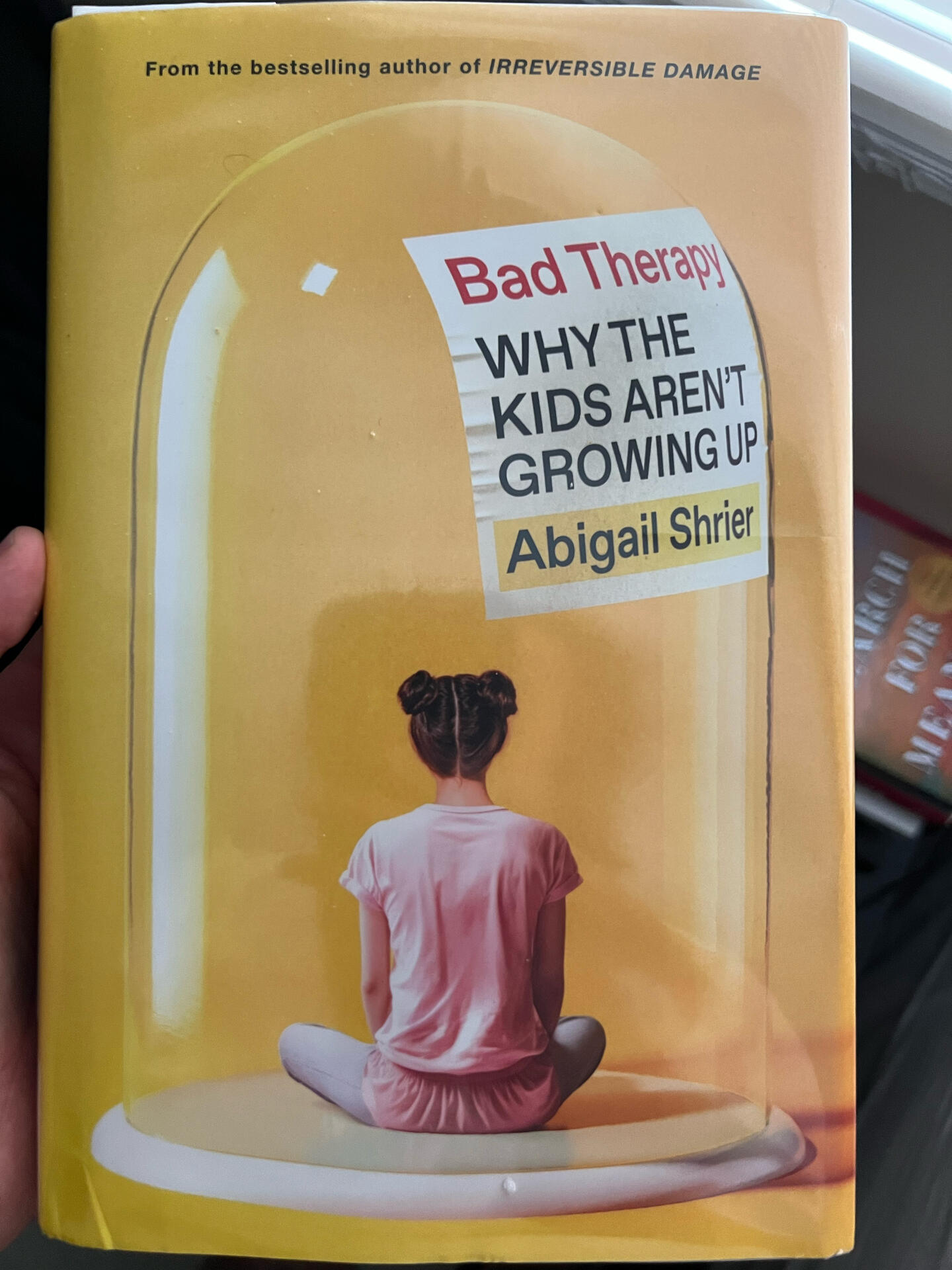
I recommend all parents, teachers, therapists, and any other people concerned about children give this book a read.

Here’s the description: From the author of Irreversible Damage, an investigation into a mental health industry that is harming, not healing, American children

In virtually every way that can be measured, Gen Z’s mental health is worse than that of previous generations. Youth suicide rates are climbing, antidepressant prescriptions for children are common, and the proliferation of mental health diagnoses has not helped the staggering number of kids who are lonely, lost, sad and fearful of growing up. What’s gone wrong with America’s youth?

In Bad Therapy, bestselling investigative journalist Abigail Shrier argues that the problem isn’t the kids—it’s the mental health experts. Drawing on hundreds of interviews with child psychologists, parents, teachers, and young people, Shrier explores the ways the mental health industry has transformed the way we teach, treat, discipline, and even talk to our kids. She reveals that most of the therapeutic approaches have serious side effects and few proven benefits. Among her unsettling findings:

Talk therapy can induce rumination, trapping children in cycles of anxiety and depression

Social Emotional Learning handicaps our most vulnerable children, in both public schools and private

ā€œGentle parentingā€ can encourage emotional turbulence – even violence – in children as they lash out, desperate for an adult in charge

Mental health care can be lifesaving when properly applied to children with severe needs, but for the typical child, the cure can be worse than the disease. Bad Therapy is a must-read for anyone questioning why our efforts to bolster America’s kids have backfired—and what it will take for parents to lead a turnaround.
I gave up social media since about June 5 but I downloaded Twitter on Saturday when I heard about the assassination attempt. I just deleted it again. It’s such a bloody cesspool I can’t believe anyone voluntarily spends time there and I feel bad for people who have to use it for their profession.

Fb and instagram have lots of problems but there’s something about the structure of Twitter and the algorithm that just creates a black hole of misery. (Changing the color scheme from blue to black makes a lot of sense.)

It’s 71, sunny, and breezy. It’s, dare I say, perfect weather. Especially after the heat we’ve been having. ā˜€ļø

I’m really enjoying the stripped down versions of these songs. #tunestr

Fair enough. I don’t think we’re gonna see eye to eye on this and that’s okay.

Who are your favorites?

So dead inside, then? šŸ˜‰

I think the born to run album is a masterpiece. So is the river. And honestly I love tunnel of love. The rising is pretty good too.

I hate that he’s a pawn for the Democratic Party but otherwise 🤘

Look, I don’t know you that well. Maybe you’re dead inside. Or maybe you’d enjoy this compilation of the live version of every song on Born in the USA by Bruce Springsteen.

#tunestr #grownostr

Ugh. Nerdy*** nostr:note13jz7xmqvjvuegper3vpw0cj29u0plyxw80686cqzjpqvk9s6czts424yh2

This is needy in the best way. For you fans of mathematics out there. #grownostr

https://mathwithbaddrawings.com/2024/06/25/is-the-derivative-a-rhetorical-intensifier/

I’m not particularly well read but that might be the best book I’ve ever read. nostr:note1smzwk58crmqnxqllsn64dzem0zc0rylz70d584zcqtxl9g977daqj3uk7m

Replying to Avatar Gigi

mood

I’m not particularly well read but that might be the best book I’ve ever read.

Just stumbled on this gem. šŸ”„

#tunestr

I like when she says she couldn’t sleep the previous night I awake to a a dozen texts of reels she watched… when she was ā€œtrying to fall asleepā€ā€¦

The internet has probably always been mostly garbage. But something about reels/tiktoks/shorts has surfaced that garbage on a far more regular basis. Some of them that my wife shows me I just can’t believe more than three people outside of that person’s immediate family have viewed.