

Clearly Mr Rushworth lacked the "benefit" of centralised social media, and of university education.
There is no way a contemporary analogue could have "opinions in general unfixed". :-p

It would also need to make the regulators and politicians die of malaria, so Canadians could take advantage of the upside.
We can all hope, I guess!

There's no right answer, unfortunately. I only have questions.
If you didn't have the unexpected bill, would you have considered borrowing against your stack to buy more BTC?
(Status quo bias means we are often willing to take poor gambles to avoid a loss that we wouldn't have done to make a gain.)
And if the hype cycle peaked now for whatever reason and BTC then dropped back to its lowest price in three years, could you survive financially whilst repaying the debt?

I liked Immanuel Kant a lot better once I realised his "imperatives" were never intended to be absolutes.
It is not in easy conformity with popular opinion or categorical imperatives that we can measure a man, but in how he handles situations where they conflict and there is no perfect solution. Humanity vs Autonomy, for the plot of many great stories.
Every meaningful moral choice is a necessary evil.

The full list of Coalition MPs who went to hang out with Jordan Peterson
#australian #coalition
https://www.crikey.com.au/2023/11/23/coalition-mps-jordan-peterson-alliance-responsible-citizenship/
I really admire Jacinta Nampijinpa Price. And Barnaby Joyce is crooked and deeply flawed, but occasionally a decent human being.
The others? I'd pay to watch them being fed to sharks. Sadly the other side of the aisle are just as fake and evil...
I'm sure this Democrat; National Security Adviser turned full-time lobbyist wasn't ALWAYS a racist genocidal loon.
I'm sure he can't be a typical and representative (but indiscreet) Washington Insider and member of The Blob.
I'm sure this fountain of hatred and malice isn't the sort of thing that the architects of Western foreign policy are carefully selected for.
(Any takers?)
Government's NZYQ migration amendments are unconstitutional -- I'm sure of it
#court
https://www.crikey.com.au/2023/11/23/nzyq-migration-amendments-unconstitutional/
The writer agrees with the outcome, but disagrees with the process (on some quite nebulous grounds).
"The High Court has repeatedly upheld as valid the raft of state laws that allow for continuing the imprisonment of criminal offenders after they’ve completed their sentences and even the pre-emptive detention of people on the basis of a perceived risk that they will commit certain crimes otherwise.
That is the appropriate mechanism for ensuring public safety in these very limited contexts. The Department of Home Affairs is not."
I think "precrime" is bull---t from start to finish, and if you can't find probable cause to charge a man with anything you need to harden the fuck up and tell people you're letting him go as part of the price of their freedoms.
People in 2023 want a lawless dictatorship that panders to their whims. They should be careful, because they're only ever going to get the first half.
The real reason Christian Zionists love Israel
#christian #community
https://www.alternet.org/alternet-exclusives/christian-zionists/
"That’s because we often don’t follow through on thinking about the logical conclusion of our beliefs."
Nailed it.

No one has enough #money to end hunger or poverty. That's not something #money can do.
India receives enough foreign aid each year to provide safe treated water to 1.3bn people. Half of the population still don't have access to it, because #corruption.
#money is #power.
Until you come up against the interests of people with actual #power.
Then you learn: no, #power is #power.
GM mosquitos that can't spread disease is something #money CAN create, with enough supervision. Credit to him there, most billionaires just buy a bigger island, and a third yacht.

New York is "special" that way. Ending the statute of limitations was a cheap way to grift off #metoo.
Pro tip to the defendant - put half your wealth in your lawyer's trust account, and the other half in #monero.
Due process is SO last century...

Needs to work on the "non-binary" if she wants Foggy Bottom to choose her as President.
Other than that, a very credible candidate.
Might not have much face recognition yet...

If you were Klaus Schwab, you could do a lot of things you can't now.
https://en.m.wikipedia.org/wiki/Klaus_Schwab
He seems to have a gift for grift, and like his father who was a Nazi defence contractor who kept his wealth and was never prosecuted.
I wonder which Whale wallet is Klaus'?
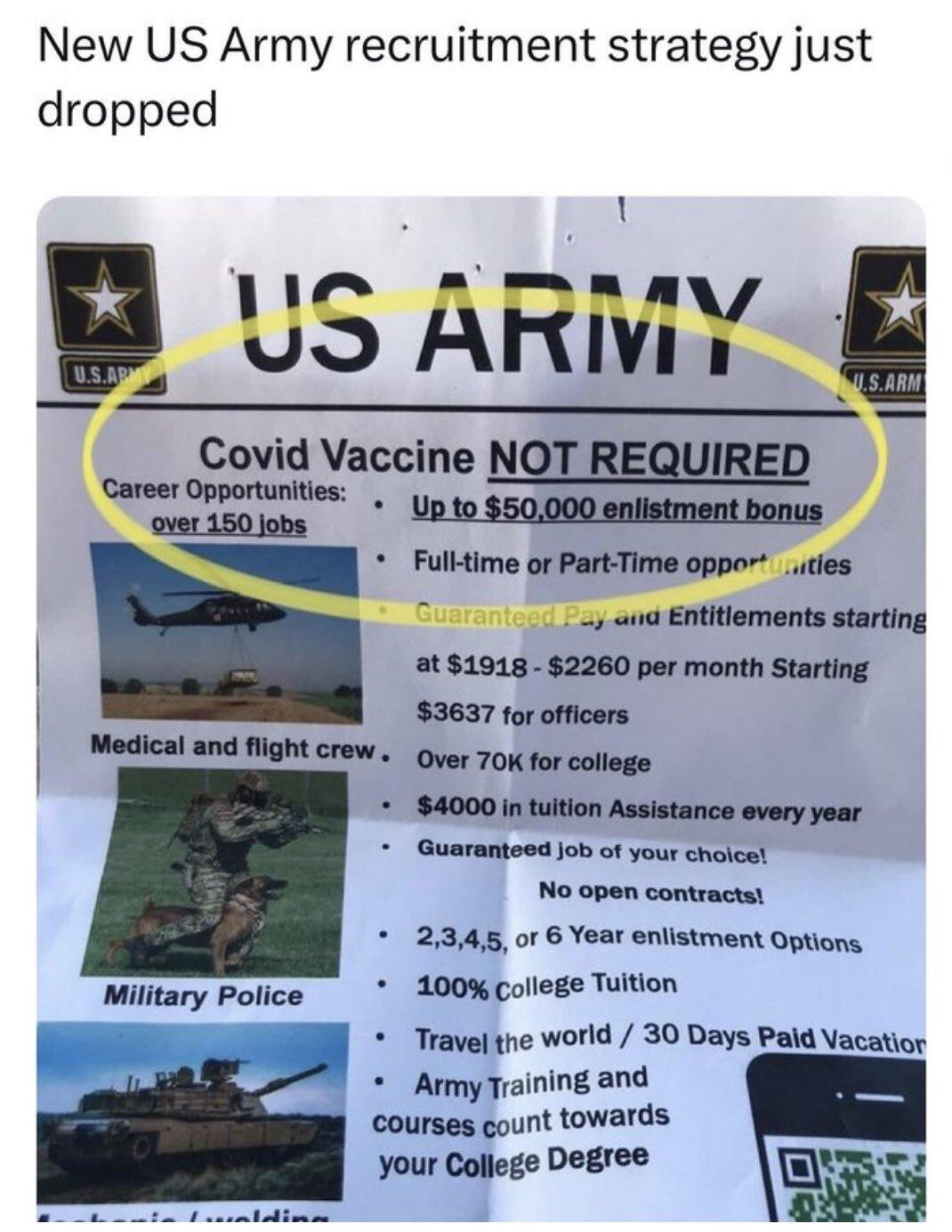
No vaxx required! (No promotion either)
Guaranteed job! (Kill people you've never met)
Travel the world! (Return in pieces)
You do you bro, but I wouldn't take out a loan against a liquid asset like Bitcoin.
You're paying interest, plus you're on the hook for the downside (as well as the upside).
There are no sure bets except death and taxes.


Sounds like most Lemnites have found the safe space they were asking for.
Great!
May they stay there...
"Relationship version of necrophilia"
Hahaha that's gold!
Those guys should buy a doll, and rent a maid.

 ?width=1200&auto=webp
LOL
Well, he explicitly ruled out resorting to war.
The Falklands have been part of Argentina for just two months in their entire history of human habitation. And those two months were far from voluntary...
"Hard Work, in a Rigged System" might have been a better title for this OpEd by Sohrab Ahmari in TAC.
Reproduced in full below:
Vivek Ramaswamy says he wants to “make hard work cool again.” The long-shot Republican candidate has been visiting places GOP politicians typically avoid, like college campuses, preaching the supposedly countercultural virtue of toil. His messaging won’t win him the nomination, much less address the crises of the American labor market. Yet they are a striking reminder of the stability of Whig ideology in our political life across nearly 200 years.
Whig ideology—or “the Whig Counter-Reformation,” as Arthur Schlesinger Jr. called it—denies the existence of enduring social classes in the United States, or else suggests that there are no enduring conflicts between the classes. Social misery is the product of either rare misfortune or the failure of indolent individuals to seize opportunity. And reform isn’t a matter of redressing imbalances in power through politics. No, it’s the heart or “the culture” that has to be reformed. Hard work has to be made “cool again,” as Ramaswamy says.
In framing things this way, Ramaswamy stands in an old tradition. Whig ideology was the response mounted by America’s market elites to the Jacksonian uprising. For decades since the Founding, America’s market system had chugged along, industrializing the economy, proletarianizing its once-independent working men, and imposing enormous new stresses on the yeomanry. But it wasn’t until the crash of 1819 that the frustrations of the many, and their sense of vulnerability relative to the few, congealed into what then–Secretary of War John C. Calhoun described memorably as a “general mass of disaffection.”
Not unlike Donald Trump in 2015-16, Andrew Jackson was the unlikely outsider who gave voice to the disaffected. His 1824 presidential bid began as a ruse by local oligarchs against their enemies in his native Tennessee but soon resonated nationally. Old Hickory, who had been left in debt by his own failed stint as a land speculator, blamed paper money and banks for the people’s suffering. Blocked by the “corrupt bargain” between John Quincy Adams and Henry Clay in 1824, Jackson clinched the presidency four years later. His anger soon found a more specific target in the imperious Second Bank of the United States. The BUS was a private, profiteering institution that was chartered and partially funded by Congress but that strenuously resisted democratic control. This, although it effectively acted as a central bank and disciplined the flow of credit by buying and holding—or selling and demanding specie for—the paper notes of much weaker state banks.
Jackson’s anti-Bank message resonated with broad ranks of American society (although the exact share of the population that supported Jackson’s Bank War has long been contested by historians). Western and Southern smallholders, urban workers in the North, and smaller capitalists everywhere who felt excluded by the establishment rallied to the Jacksonian cause, as did reformist intellectuals like Orestes Brownson, George Bancroft, William Leggett, Frances “Fanny” Wright, William Cullen Bryant, and so on.
Jackson’s “solution” to the tyranny of the BUS was small government: Another old pattern in American history is the libertarian conviction that often goes hand-in-hand with populist sentiment. Jackson, while in some respects an expansive nationalist, was in others a Jeffersonian strict constructionist. He had long believed that “the congress has no constitutional power to grant a charter...of paper issues,” as he told his Democratic senatorial ally (and one-time duel opponent) Thomas Hart Benton. So he vetoed the Bank’s charter when it came up for renewal, and then proceeded to remove federal taxpayer funds from its coffers, placing them instead in select state banks, the so-called pets.
For our purposes, the substance of Jackson’s reforms in the Bank War matters less than the reaction they elicited from market elites jittery about the rise of democracy, both political and economic. Save for a few pseudo-aristocratic strongholds like Rhode Island and South Carolina, the franchise had in this period expanded to include many formerly excluded ranks of white men. A people grown accustomed to having a more direct say in political matters also increasingly demanded popular control over market institutions: not just banking and the currency, but also the workplace became a site of political contestation through the rise of the labor movement.
It was against this backdrop that Whig ideology began to take hold among the wealthy and upper middle classes. An earlier generation of old-school Federalists—men like Chancellor James Kent, Noah Webster, and, yes, Alexander Hamilton—could simply insist that the rabble have no business shaping policy. As Noah Webster wrote, if distinctions between rich and poor were to endure, and they always would, then why not recognize them in the structure of the state? For “the man who has half a million of dollars in property...has a much higher interest in government, than the man who has little or no property.” The one deserves a much greater say than the other.
Yet by the 1830s, Jackson and the Jacksonians had made it impossible to speak this way. One sign of the change came in 1834, when Roger Brooke Taney, among the most militant Jacksonians in Old Hickory’s Parlor (as opposed to “Kitchen”) Cabinet, returned to his home in Baltimore, having helped the general slay the banking “monster” as his Treasury secretary. The local pro-Bank organ, the Chronicle, mocked the working classes who turned up to greet Taney. Their horses, the paper noted, bore collar marks on their necks—meaning, these were poor people with humble livestock.
Democratic papers naturally took advantage of the misstep and, as usual, counterpunched twice as hard. If the Chronicle’s reporter had examined the hands of the men riding the work-worn animals, bellowed the Jacksonian Republican, he would have noticed the same “striking indications of work as were witnessed on the necks of the horses.” It added: “We had reason to believe that our neighbor had but little regard for ‘working men,’ but did not suppose the antipathy went so far as to ridicule a procession on account of the employment in it of working horses.” The Chronicle’s class arrogance was downright ridiculous in this new age.
Yet the elites would soon master a different political vernacular, and this was the Whig ideology. Partly, it had to do with how Whig politicians presented themselves. Going forward, even politicians representing market elites would have to pitch themselves as men of humble origins, solicitous, above all, for the happiness and prosperity of other Americans from such backgrounds. The Whigs would master this transfiguration by 1840, embracing their nominee William Henry Harrison’s dubious image as a downhome man of the people. What Jackson dismissed privately as the Whigs’ “Logg cabin hard cider and Coon humbuggery” would prove thoroughly winsome at the ballot box, to Old Hickory’s chagrin and that of his Democratic successor, Martin Van Buren, who was swept out of office that year.
But beyond campaign imagery, there was a deeper ideological effort afoot. Gone was the old-school Federalist idea that those with property should have greater say in the affairs of state. Instead, the Whigs promoted the idea that we shouldn’t think of class differences at all, since “the interests of the classes [were] identical,” as Schlesinger noted. A prominent Philadelphia Whig, for example, wrote that “however selfish may be the disposition of the wealthy, they cannot benefit themselves without serving the labourer.” Thus, “if the labouring classes are desirous of having the prosperity of the country restored”—this was in the aftermath of the Bank War—“they must sanction all measures tending to reinstate our commercial credit, without which the wealthy will be impoverished.”
A step further was the idea that America simply has no social classes at all. Wrote one Whig critic of the labor movement: “These phrases, higher orders, and lower orders, are of European origin, and have no place in our Yankee dialect”—seeming to forget his own ideological forebears’ insistence that there are, in fact, rich and poor, and that the former must be allowed to rule unchallenged.
Still another variation was to suggest that social classes in America are so fluid and mobile as to be politically meaningless. Today’s worker is tomorrow’s capitalist, who hires a hand, and this third will tomorrow own his own shop and hire still other workers. And so on. “The wheel of fortune is in constant operation,” wrote the Whig Sen. Edward Everett, “and the poor in one generation furnish the rich of the next.” The Whig minister Calvin Colton agreed: “Every American laborer can stand up proudly, and say, I AM THE AMERICAN CAPITALIST, which is not a metaphor but literal truth.” Abraham Lincoln, too, promoted this idea — which I have elsewhere called the cycle-of-classes theory of political economy — in his famous Speech to the Wisconsin Agricultural Society.
Yet the most powerful element of Whig ideology was the primacy of internal, spiritual, or cultural uplift over governmental policy or material reforms. The worker will rise, wrote the Unitarian minister William Ellery Channing, not by “struggling for another rank,” nor through “political power,” but by “Elevation of Soul.” Instead of seeking worldly reforms, Channing advised, workers should grow in “intelligence” and “self-respect.” Another Whig reformer declared: “Legislation can do nothing; combinations among working classes”—that is, labor unions—“could probably effect no permanent remedy.” But if workers bettered themselves interiorly, they would find the peace that no external policy solution could bring.
“Making hard work cool again” harks back to these old Whig themes. For it suggests that a significant share of American workers simply decided to stop participating in the labor market or grew tired of making productivity gains. The problem, in this telling, aren’t things like the loss of U.S. manufacturing thanks to neoliberal trade policies and the rise of a low-wage and precarious services-based economy. Nor is the financial industry’s erosion of the real economy to blame. No, American workers just decided, en masse, that work is un-cool, and it’s up to the Whiggish politician to tell them that work is pretty cool, actually.
Nearly 200 years ago, Orestes Brownson, the Massachusetts preacher, journalist, and Jacksonian reformer, who certainly wasn’t one to pooh-pooh spiritual uplift, answered Whig ideology once and for all. “This position,” he countered,
is not tenable. If it were, it would be fatal to all progress, and be most heartily pleasing to all tyrants. The plain English of it is, perfect the individual before you undertake to perfect society make your men perfect, before you seek to make your institutions perfect. This is plausible, but we dislike it, because it makes perfection of institutions the end, and that of individuals merely the means. Perfect all your men, and no doubt, you could then perfect easily and safely your institutions. But when all your men are perfect, what need of perfecting your institutions? And wherein are those institutions, under which all individuals may attain to the full perfection admitted by human nature, imperfect?
https://www.theamericanconservative.com/whiggism-is-still-wrong/

I was impressed at the remains of the central heating the Romans installed at the Hadrian's Wall forts. And bathhouses, with steam rooms.
Wonder if that was the only way they could get troops to serve in such a dismal climate :-p


Terrifying trend line.
All of that debt requires a return, and the rate global GDP growth is far lower than the rate of global debt growth.
The required return can only be extracted by squeezing harder on the productive parts of society.
Increased taxes? Creation of new forms of property? New, consolidated global mechanisms for debt recovery?