
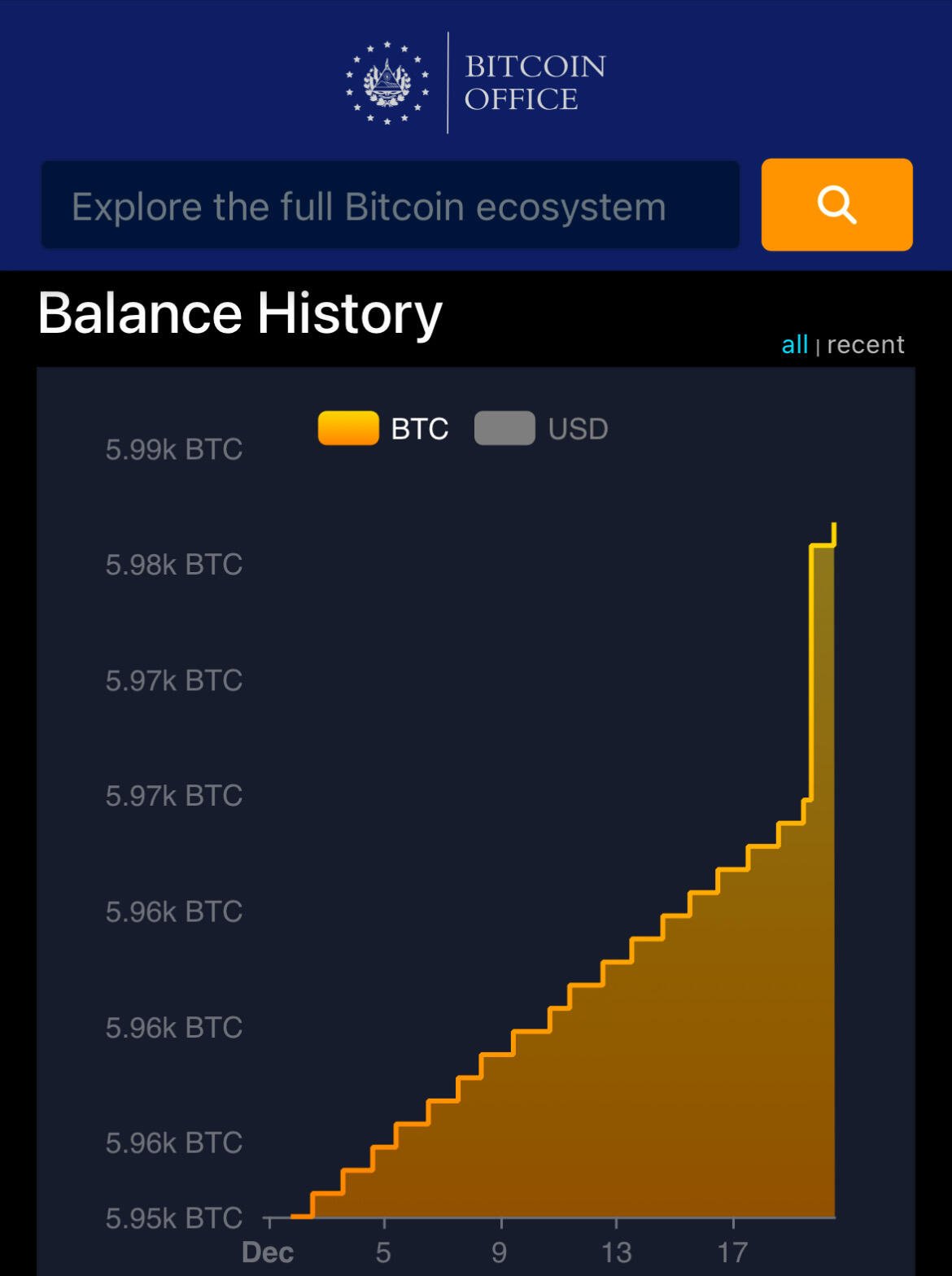
Bukele bought the dip. 11 bitcoin @ 1 million USD. What a baller move.
Here's some reasons why I think Linux is a FANTASTIC operating system:
* Software Updates & OS Upgrades are done on YOUR schedule
* The decision about which features YOU get and don't get belongs to YOU.
* Nobody is forcing you to pay them anything. There is no for-profit motive programmed into the OS.
* It is literally some of the highest quality software to exist on the planet. Made by the most brilliant minds of the planet.
* I am genuinely just thankful for every level of the stack of software supporting every single computing use case I could think of and in any thinkable format. Servers run Linux. Gaming PC's run Linux. TV's run Linux. Phones run Linux. A fucking 5g modem inside a smartphone runs Linux. It's everywhere.
* What is your excuse to not learn everything you can about it? It's the Bitcoin of operating systems.
#linux #opensource #bitcoin #debian
Did everyone forget that Trump is the one that gave everyone $1200 during covid to spend on whatever and likely caused the following bout of high inflation?
Why is nobody talking about this.


Did you ever consider that bitcoin mining and generative ai is what is going to take humanity to level 1 on the Kardashev scale?

Thanks, that makes it clear. I only saw that you referenced a gitlab url and thought that was not in line with the rest of the document. Seems like you thought of that 😊

I'm not going to disagree with you, but consider the survivorship bias. For all the lips you thought looked good, you didn't consider any of them looked modified in any way.
Most people's opinions are based on absolutely dogshit reasoning. This goes doubly so for opinions I tend to agree with.
Dear loved one(s),
I hope this letter finds you well. This letter is for you and your eyes only. After my unfortunate demise, I want you to take control of my bitcoin, this is my will to you.
Please read this document carefully, and in its entirety. I take great pride in having saved all of what I have and I wish for it to be handled with care, and importance so that it may serve you for years to come.
## An important disclaimer
After carefully following all the instructions in this letter, you will be the only person(s) in the entire world to have control of the bitcoin, just as I was before you. I hope you can grasp and treasure the significance of this.
Please take time to follow all the instructions in this letter and avoid taking shortcuts. The information I provide to you is sensitive and you should understand the dangers of mishandling it; it could lead to an irrecoverable loss of the bitcoin forever.
Since technology evolves quickly, I have included several company names, application titles, and device references within my instructions. I encourage you to carefully assess each option, using online resources to gather information, before determining the tools and services you wish to proceed with.
## Creating bitcoin wallets
You may already have a crypto wallet, or even an account with an exchange or custodian such as Coinbase or Wallet of Satoshi. These are not suitable wallets as they do not possess an appropriate level of basic security, privacy and control for your inheritance.
In order to safely take control of the bitcoin, you should first know how to set up a "cold wallet", a "watch only wallet", and a "hot wallet". With these things created, you will be ready to receive and responsibly protect your inheritance and you will be capable of using it safely, however you wish.
### Setting up a hot wallet
The first type of wallet we should create is the hot wallet. It is the easiest to set up, and may provide context for some of the concepts we will discuss later on.
Setting up a hot wallet is as simple as installing an application and following the on-screen steps required to set it up. I recommend one of the following hot wallets:
For mobile and tablet devices:
* Phoenix Wallet (<https://phoenix.acinq.co/>)
* Muun Wallet (<https://muun.com/>)
* Breez Wallet (<https://breez.technology/>)
A hot wallet may ask you to privately write a secret code onto paper, do not ignore this step if it is provided. In some cases, the option to back up may be presented to you after you have set up the wallet or may be hidden in settings. Be sure to back up your wallet before continuing.
Hot wallets generate and save sensitive information on your personal device. This makes it suitable for keeping **only** small amounts at a time. A hot wallet sacrifices some security, but is convenient, making it appropriate for daily spending and earning.
As you accrue more bitcoin on this wallet, you will want to transfer funds to a cold wallet in order to ensure that any amount of any significance is safely secured.
### Setting up a cold wallet
Cold wallets are named as such because the sensitive information, that allows spending funds, is kept away from personal devices that might become compromised or vulnerable during its lifetime. By contrast, "hot" refers to sensitive information that is subject to becoming compromised remotely (i.e. via the internet, or via malware that infects connected drives and devices until it can broadcast sensitive information online).
Security focused hardware is required to create a cold wallet *(or pages of complicated mathematics, but no one does that)*. These devices are often called bitcoin signing devices, or hardware wallets. It is important to keep in mind, that devices that market themselves as convenient and multi-purpose should be avoided as they are more likely to have vulnerabilities that can eventually lead to disaster and loss of funds.
The best devices are marketed as "air-gapped", and will have instructions explaining how to use it for spending without having it connected it to a personal device via a cable, or via wireless technology. These are my currently known to be suitable and recommended devices for creating a cold wallet:
* ColdCard (<https://coldcard.com/>)
* Seed Signer (<https://seedsigner.com/>)
#### Secure with dice or coin flips
At the heart of all bitcoin security, and indeed all digital security, is a unique, large, **random** number. Computers cannot produce random numbers, but they can create random-looking numbers.
Some devices provide a "true random number generator" (TRNG) device that reads small atmospheric signals in an attempt to produce unique and unpredictable numbers. Many will also allow you to enter your own random numbers sourced from around 151 dice rolls, or 256 coin flips; dice rolls and coin filps are universally accepted as a fair, reliable source of randomness.
When setting up your cold wallet, find and use the appropriate feature to input your own dice rolls or coin flips to ensure that you have a genuinely secure wallet - unaffected by vulnerabilities or limitations that may exist in electronic hardware designed for mass production.
#### The importance of isolation
Keeping the cold wallet away from your personal devices and anything that could be infected or hacked, will help to protect your cold wallet for a lifetime. This is not always possible if you ever need to update the device, but you should certainly avoid connecting the device to anything other than a power supply when **creating** your cold wallet and while using it to perform sensitive operations like signing transactions.
When setting up your device, you will be prompted to "write down" or "backup" a set of English words (typically 12 or 24 words). **Do not enter these words onto a personal device or capture them in any photos.** Your backup, and all records and copies of it, must also remain inaccessible from the internet at all times. If you ever discover that the backup may have been compromised, you should set up a new cold wallet and move any funds from your old to your new wallet as the funds are now susceptible to remote, silent theft.
### Setting up a watch-only wallet
Once you have your cold wallet created, you will want to be able to conveniently add to it, and periodically check your activity and balance. This is exactly what a watch-only wallet does, and your hardware wallet can be relegated to authenticating withdrawals and spends only.
The watch-only wallet provides a convenient interface for your cold wallet, but it has no authority to spend from it. This allows it to be installed on your personal devices for convenience, and even if any malware or hacker gains access to it, they will still be unable to steal from it.
The following applications are able to act as a watch only wallet:
For mobile and tablet devices:
* BlueWallet (<https://bluewallet.io/>)
* Nunchuck (<https://nunchuk.io/>)
For desktop or laptops:
* Sparrow Wallet (<https://www.sparrowwallet.com/>)
* Electrum (<https://electrum.org/>)
To set up a watch-only wallet, you will need to find the appropriate feature on your hardware wallet to "export your wallet" or "export XPUB" (XPUB stands for extended public key, it is what a watch only wallet uses to understand where to find the bitcoin your hardware device controls).
You will then need to either scan a QR code, or transfer a file to your personal device to import the details for your watch-only wallet.
## Physical seed word backups
By now, you will have been prompted to write down and back up some sensitive information. It is important that this backup is kept safe, not only from theft, but also from harm.
For your cold wallet, the "seed words" are effectively 99% of the information required to gain access to your wallet, should your hardware device get destroyed, or should someone else inherit the wallet. You may also have written down a "wallet descriptor" which helps to provide the last 1% of information, however even without it, most wallets are able to discover and assume control of your bitcoin with just the seed words.
To avoid any sort of damage, the standard is to imprint these words onto a stainless steel plate using jewellery metal stamping kits. These plates are relatively cheap and will resist damage from water, fire and bending over time.
To avoid theft, the plate should be covered and sealed with a tamper evident seal. A metallic cover will prevent theft by touch, and a tamper evident bag will keep inquisitive and curious minds from discovering and compromising the sensitive information.
The plate should be kept hidden in plain sight, or kept out of view to avoid garnering the attention of strangers and tradespeople whom you don't trust, but should also be accessible for you to be able to visually inspect from time to time, verifing that the tamper evident seal has not been compromised.
To protect against loss or negligence, copies can be made, however keep in mind that copies naturally increase the chances of theft.
At this point, the sensitive information is unlikely to be discovered and compromised unless somebody has a reason to premeditate a targeted robbery of your bitcoin. Once you are happy with your backup solution, you are ready to receive the bitcoin I have left to you.
If you wish to investigate further protection ideas designed to aid in inheritance planning (or to just feel like a super-spy), there are much more advanced ideas which start by fragmenting your sensitive information in order to allow storage in multiple locations, such that a thief would have to find and combine them all to steal your bitcoin; you should investigate "SeedXOR" and "Shamirs Secret Sharing scheme" to learn more on this topic. If you wish to share custody with someone else, look into bitcoin "multisig" ideas which allow for a setup where nothing can be spent or withdrawn without multiple parties agreeing to digitally sign the transaction.
## Guidance
By now, you understand the significance of seed words, and more importantly, the sensitive nature of them. Please follow these principles to ensure that you, and you alone, have the ability to use and spend the bitcoin I pass on to you, at all times:
1. Don't draw attention to yourself.
2. Never reveal seed words to anyone.
3. Never entrust your bitcoin to others.
4. Security is much easier in the physical realm.
5. Don't get too clever; future you won't appreciate it.
### Don't draw attention to yourself
It should come as no surprise, that boasting about yourself in earshot of the wrong person can lead to trouble. There is a reason that celebrities and wealthy individuals pay for security guards to protect them in public; they have wealth that others would take for themselves if given the opportunity.
In the worst cases, you or your friends and family may be attacked and harmed in such an attempt. If you wish to live luxuriously, either try to keep a low and private profile, or be sure to invest well into your personal security.
### Never reveal seed words to anyone
Seed words are private. Anyone who might have a copy, or who might be able to recall your seed words will have access to your bitcoin and can move them without notice at any time. In such a case, no insurer will cover your losses, law enforcement are unlikely to recover any funds, and **nobody** can undo the damage.
Allowing people to see your seed words, is the same as handing out copies of your home keys and expecting no one to break in and break or steal your in-valuables. Worse still is if someone you trusted were to expose those words to someone else, you will only ever have yourself to blame, and only you will suffer the losses of such a mistake.
### Never entrust your bitcoin to others
Companies around the world will offer to protect your bitcoin on your behalf as a custodian; some may even do it for free. No matter how reputable the company, you do not own bitcoin if you use their services; you are given a legally backed promise, in exchange for a very valuable and scarce asset - it is not worth the trade.
As many past examples have shown, when such a promise is broken, the law cannot always provide appropriate compensation and in some cases, it can prevent you from being compensated at all when bankruptcy is on the table. If you must use a custodian, use it only for small amounts at a time and in small periods of time.
As a side note, this is exactly the situation with government money sitting in a bank, and even to an extent with physical cash. The "economy" is always more important than your own situation, even if you are homeless with only a little money to get by. This bitcoin is our lifeboat should the needs of the economy outweigh our human rights.
### Security is much easier in the physical realm
Most computers and electronic devices are terrible at protecting your privacy; personal computers, laptops, tablets and mobile devices are optimised for speed over security. A fitting example of this is when you delete a file, the file is marked as deleted, but the data remains on the physical disk until another file happens to write over it some time in the future. Actually deleting the file would cost time and energy, making the device feel slow and unresponsive, and personal devices are designed for convenience, not for security.
Never type your seed words into a personal computer; as convenient as it may seem to be able to create a digital copy, it is not worth the risk of losing your bitcoin to cyber criminals.
It should be noted also, that **photos with words on them are no more secure than text files**; do not take photos of your seed words, and if you ever feel like your bitcoin might be at risk, take the appropriate steps to move the bitcoin to a new wallet.
By keeping your seed words away from electronic devices, your bitcoin is infinitely more secure than those stored with a custodian. Custodians need to invest resources and effort in monitoring and risk management, trying to find the a balance between customer convenience and security.
Using specialised hardware, and by distributing funds appropriately to different kinds of wallets such as hot and cold wallets, we are able to create much the same convenience of custodial services, with much stronger security, less financial risk, and at the cost of a slightly more time spent setting up. You will be able to view your balance and request and receive funds without ever jeapordizing your exclusive ability to spend for your larger wallets, while having the ability to spend more frequently and much more easily from hot wallets with smaller amounts, trading off simpler security, for greater convenience.
### Don't get too clever; future you won't appreciate it
When we first learn about how we can hide and protect our physical seed words, many of us attempt to use local knowledge and our own experiences to concoct a unique strategy such as mixing words or disguising them as pictures or references to pages in a niche book.
This type of strategy often requires leaving little to no clues for our future selves and many people find themselves struggling to recover their words when they urgently need it later.
It is better to follow popular solutions that you can refer back to in the future. Of course the complexity and effort of the solution you choose to put into the security of a wallet should somewhat match the amount you wish to protect with it. You can always create more secure wallets in the future if you accrue more, or find that your bitcoin has become much more valuable in the future.
If you still desire to experiment with ideas, be sure to experiment with relatively small amounts until you are confident with the safety and longevity of your setup.
## Claiming your inheritance
By now you have the tools, knowledge and experience to claim and care for the bitcoin that I am entrusting to you.
In order to ensure that the bitcoin did not land in the hands of the wrong person, I fragmented the key and you will find them in the following locations:
1. The first fragment is accompanied with this letter that you found in my safe.
2. The second is within an email I had sent you on the 1st of January 2020 with instructions to keep private and safe and 12 random words.
3. The final fragment is the words `bacon bacon bacon bacon bacon bacon bacon bacon bacon bacon bacon bacon` (x12).
To properly combine the fragments, you will need to follow the instructions found on this website: <https://github.com/dipunm/seedxor>. The final seed after combining the fragments will have 12 words and the last word will be `author`.
Use the provided seed signer device to finally claim control of the bitcoin, and then follow these steps to ensure you are properly set up to go about your day without worrying about the security of your inherited bitcoin:
1. Set up a watch-only wallet for this new cold wallet you have inherited.
2. Send only a small amount of it to the cold wallet you created for yourself earlier.
3. Reset your hardware wallet.
4. Restore your backed up seed words to re-instate the hardware wallet.
5. Use your own watch-only and your hardware wallet together to move the funds back to the inherited cold wallet.
> Once you have done this, you can be certain that you have set up your cold wallet correctly.
6. Send a small amount from the inherited wallet to your hot wallet for carrying around with you.
7. Move the rest of the funds to your own cold wallet.
These steps may take time, and they may incur fees, however it is important to follow these steps for peace of mind.
I hope dearly that this inheritance serves you well and that you will build onto it or with it, a legacy worth passing down yourself for generations to come.
> Note: if you want to learn more about how to prepare for inheritance, this letter is only one part of it. Read about what else you may wish to prepare in my follow-up post: nostr:naddr1qq24jemrxgm56wp4wfx5vwpnfcm4qut42ve95q3qpktmatjk0l8vn3jhfuwxaasjd65kn4ye9sce3egup7k993f8fg2qxpqqqp65w0uc55y
Will SeedXOR project be available when your inheritance is ready to pass?
I want to write more articles like this. Any criticism is welcome (especially from experienced writers)

I am at least glad that we are at a point now where renewable energy is obviously "worth it" from an economical sense. Now we just need to get rid of all distractions from the purest possible price signal - fiat money and subsidies to non-renewables.


Maybe if we had done something rational and long-sighted three decades ago when it was time to do something about it, people would not be so hysterical right now. lol