

Maybe one could build some expandable transparent dome and put a selection of species like algae, tardigrades and some extremophiles in there to kick start a biosphere?


Did you happen to go on a stroll through any western city's business district?

The "fiat collapse" can only happen, if there are enough people (regular people) using Bitcoin, thus forcing states/institutions to also use Bitcoin.
Majorities of voters (motivated by their incentive to preserve the utility/usability/legality of their Bitcoin holdings) will have to basically force pro-Bitcoin policy.
Otherwise, institutions/states won't be under any pressure to even care about Bitcoin. They'll just happily continue using fiat currencies as a tool to get more leeway for setting policy.
Another Example for a feature:
Somehow help with categorising followed npubs.
Categories could be:
A, new info npubs (news bot or heavy poster, never replied to any of my replies, not following me back)
B, high volume poster (not news bot like A, but frequent posts in discussions)
C, low volume poster (but is following me back, replied to a few of my notes)
D, ...
And for each category I'd like a separately scrollable feed.
The slow evolution of each npub's follow list is where I'd like more tools from the client devs.
I'd like features that help me with systematic management of my follow list(s).
Example:
Give me a single button on each note (accessible without _any_ additional tap/click, so that it's minimal effort) to mark the note as "interesting/relevant to me".
Then show me statistics from these marks so that I can directly see for all my followed npubs:
- number of notes seen in the last x days
- % of these notes marked as relevant
- ...

This may well be an accurate description of the current status of the nostrverse.
But, I don't think it's the big Npubs' fault.
I rather think this is mostly the inevitable dynamic that occurs in a system that's designed in this way (no feed algorithms at all).
And I think it's kind of a bootstrap dynamic that mostly characterises the beginning of the network.
After this initial phase I'd assume that other dynamics will evolve. New social circles/ sub communities will form around high impact accounts that have nothing to do with the initial big Npubs.
So I think we need patience and we'll get slow evolution, because every npub is slowly bootstrapping their way according to their interests.
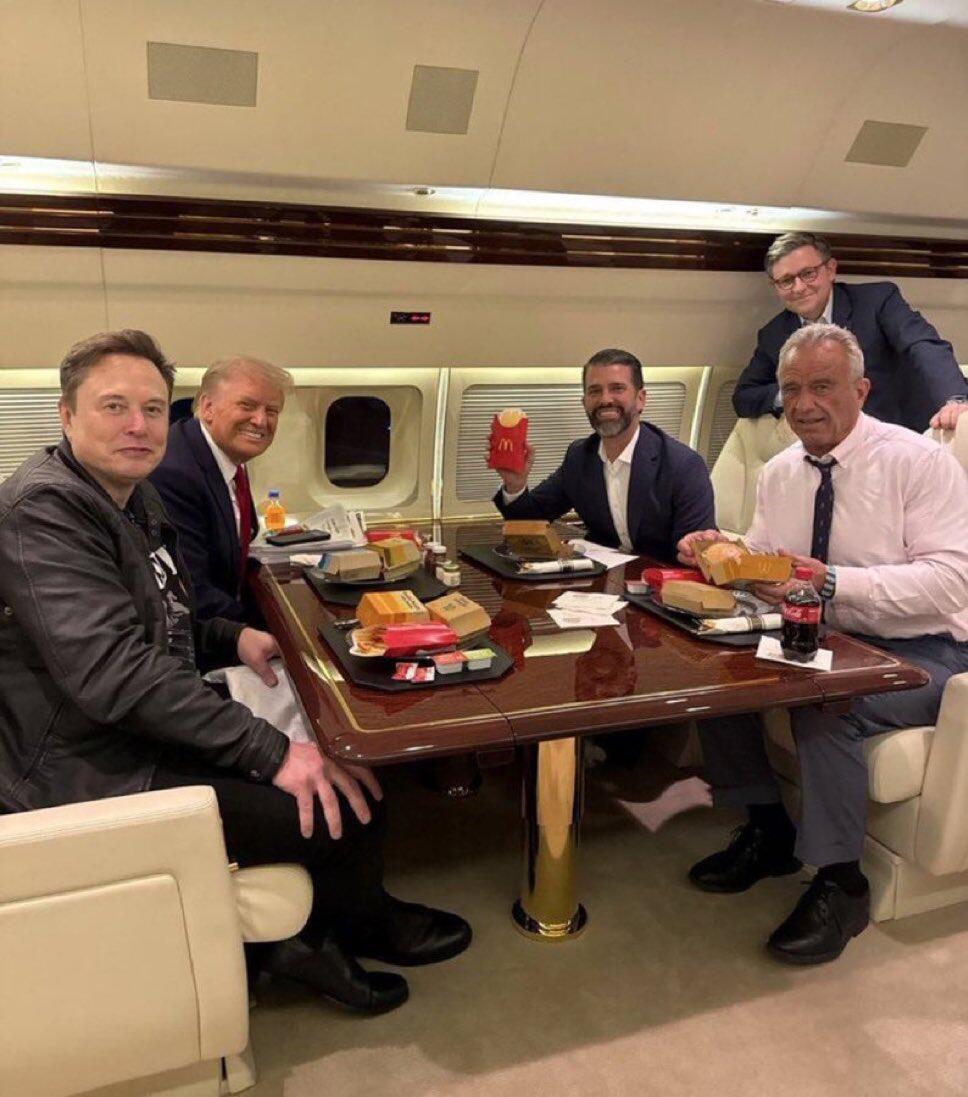
RFK gathering evidence by personal experimentation.


The Seeds Of Social Revolution: Extreme Wealth Inequality
https://www.zerohedge.com/political/seeds-social-revolution-extreme-wealth-inequality
> We seem to be approaching the point where a rebalancing of extreme asymmetries is at hand, and so we have to choose between policy changes and social upheaval.
🤔 Social upheaval? I don't see it happening anytime soon. At least not as a phenomenon of social class, transcending the political spectrum. Why? Because unlinke with examples of upheaval in history, one very powerful if not the fundamental motivation for it - because it is so visceral - mostly isn't there in the developed world: hunger. (Or am I missing something? Yes food banks are becoming ever more prevalent, but we're far away from mass starvation.)
That, combined with all the contemporary circuses (bread and circuses) like digital games and fake social engagement possibilityies that have a dulling effect.
Almost as Aldous Huxley described in Brave New World.
Trump Picks Fracking Boss As Next Energy Secretary
https://www.zerohedge.com/markets/trump-picks-fracking-boss-next-energy-secretary
Well, the claim that fracking gas has a lower climate impact than coal is AFAIK wrong.
All the leaking methane from bore sites and processing plants, combined with the efficiency losses from having to compress/regas the stuff bring LNG to the same order of magnitude of emissions as coal, if not higher.
Good for the U.S. economy, for sure, cleaner than coal, probably not.


How so many people, who talk about "improving domestic business" as a remedy for a faltering economy, don't seem to understand the essential difference between sectors (like manufacturing) that are absolutely necessary to access any kind of foreign goods/services and other sectors that do nothing in that regard (like health care), is beyond me.
Just curious, what do you then make of the following way of looking at pension systems?
Regardless of any financial considerations, the very young and the very old _always_ have to be taken care of by those of working age. There's no way around it, it's just physics/biology.
The intergenerational contract, as they call it.
It may well be that the financialisation of this inherent aspect of human societies has introduced pyramid dynamics. But that just exists in the higher layer. The base layer (physical/biological) only depends on demography and technology and will somehow continue to work, regardless of how price tags develop.
The question that intrigues me is: is the number of at least 2.1 children per woman (allegedly necessary to get a stable system) derived through financial considerations? If so, then it might be false, too high. Because deflationary technology should bring it lower, right?

Can they reliably destroy underground facilities?
Have you already tried the following concept?
Giving your body small amounts of carbs _most_ of the time. Not even keto, but just at most maybe 100 g of carbs (dry mass) per day.
But every few days or so having quite a bit of carbs (maybe half of total calories).
The idea is to not let your body think it needs to slow its metabolism because there's restrictions.
So you don't buy into this whole "atherosclerosis is actually caused by inflammation and seed oil plant lipids" theory, proposed by eg Paul Mason?
I'm just like your average lazy thinking YouTube watcher, who found this quite in depth talk very interesting and compelling:
Dr. Paul Mason - 'The Clotting Theory of Atherosclerosis and Seed Oil Toxicity (updated)' - https://www.youtube.com/watch?v=_lRXZfs6Sjs
Just came across basically what you described with the FPGA:
https://www.contrib.andrew.cmu.edu/~somlo/BTCP/
> My goal is to build a Free/OpenSource computer from the ground up, so I may completely trust that the entire hardware+software system's behavior is 100% attributable to its fully available HDL (Hardware Description Language) and Software sources.
> My thinking was "the most likely commercially available fast processors to not be backdoored would be new ones in new areas of technology".
May be right.
There really ought to be a RISC-V based module for the MNTReform.
Although they claim that this one is "Fully open hardware design", which would imply it could be audited by third party:
Secure Smartphone recommendation now and in Future
In my Opinion a Oneplus 6 with PostmarketOS (real Mainline Linux) and Gnome Edge is by far the most secure and best possibility right now.
https://www.youtube.com/watch?v=wOmRMg546UY
In Future it will be libre-soc.org or the Company-Spin-off from RedSemiconductor.com.
The Cool Thing is that there are even Anti-Temper-Circuits in there and you have Control over Ring -3, Meaning Full-Hardware Control over every single Transistor. Except things like pcie ddr... which are still hard-makros. But by Far the most private and secure chip in the World.
Also it is does not have any Accelerator at all. Meaning everything is done by the CPU-Cores but extremly efficiant. Simd at the Developer-End gets automaticly Vectorised. No Opcode-Proliveration, no Overhead between CPU and Accelerator (GPU,VPU etc), no tear-up and tear-down cases, sec-fault on boundary etc.
The Team is Centered around Luke Kenneth Casson Leighton. lkcl on that stupid censored Platform named Youtube. Search for libre-soc on his Channel or Playlist. Also It is getting ratified by IBM right now. All Open-Source Hardware and Software!
Check out libre-soc.org and their mailing-lists for more information.
What's your view on PostmarketOS?
Which RISC-V processors/boards do you find trustworthy?
Wouldn't gov agencies go to great lengths to try to inject hardware backdoors especially in open-source hardware projects out of fear of people actually getting almost secure devices?