Natural low-time preference.

Is NixOS truly reproducible?
https://luj.fr/blog/is-nixos-truly-reproducible.html
Build reproducibility is often considered as a de facto feature provided by functional package managers like Nix. Although the functional package manager model has important assets in the quest for build reproducibility (like reproducibility of build environments for example1), it is clear among practitioners that Nix does not guarantee that all its builds achieve bitwise reproducibility. In fact, it is not complicated to write a Nix package that builds an artifact non-deterministically.
originally posted at https://stacker.news/items/867193

1. Foreign Cinema
2. Kokkari Estiatorio
3. Nopa
4. Liholiho Yacht Club
5. Cotogna
6. Zuni Café
7. The Progress
#GOMA
nostr:note1e4559ad3ut8y33462gekdft7h77dg6vlvt7z84dax0n9letmgurqhkgx4y


Chimera Linux works toward a simplified desktop [LWN.net]
https://lwn.net/Articles/1004324/
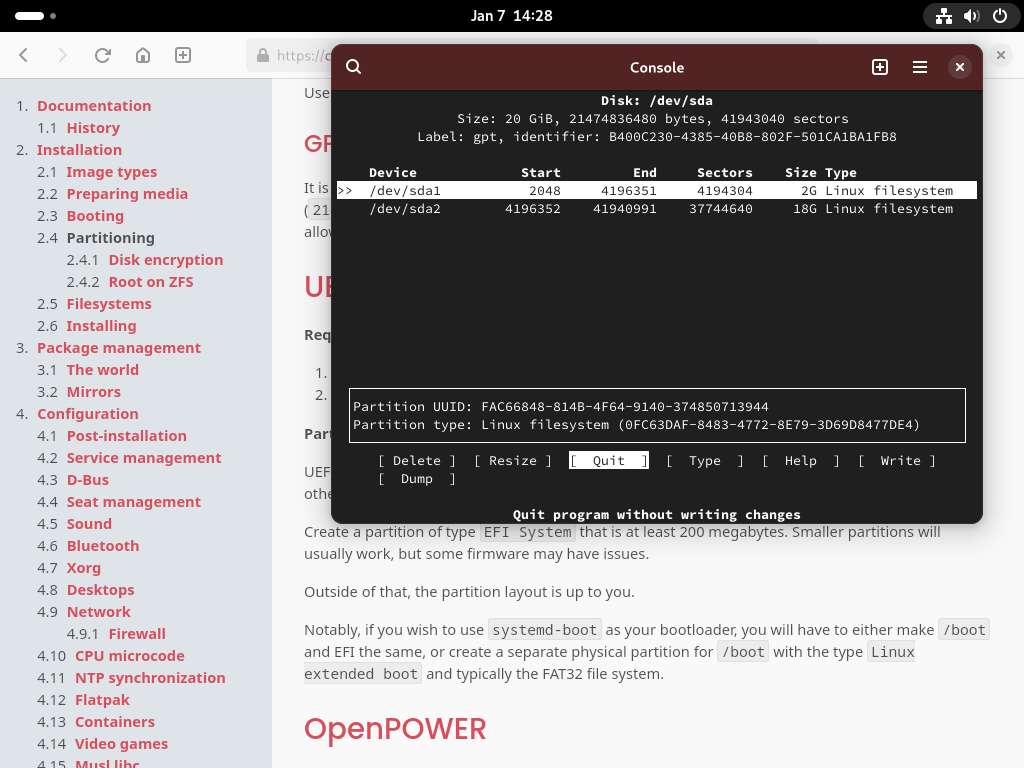
Chimera Linux is a new distribution designed to be "simple, transparent, and easy to pick up". The distribution is built from scratch, and recently announced its first beta release. While the documentation and installation process are both a bit rough, the project already provides a usable desktop with plenty of useful software — one built primarily on tools adopted from BSD.
Chimera Linux was started by "q66" (who previously worked on Void Linux) in 2021 with the goal of creating a modern distribution that could "eliminate legacy cruft where possible" to provide a simple, practical desktop. In service of that goal, the project is based on BSD tools. Chimera's frequently asked questions page explains that unlike other projects that use those tools for licensing reasons, project picked BSD tools for their smaller code size and reduced complexity. Bootstrapping a modern Linux distribution is quite complex, with many packages that depend on other packages; using BSD tools allowed the project to avoid a lot of that complexity. For example, Chimera uses musl as its C library, which cuts out a lot of dependencies from the GNU C library.
originally posted at https://stacker.news/items/864527



This Nostr site has a similar layout:

What if your nsec is compromised one day, you can’t delete your past DMs


What is Ember?
Open Heart Protocol
The Open Heart protocol lets an anonymous user sends an emoji reaction to a URL.
originally posted at https://stacker.news/items/863733
Oracle Linux is the best local VM for MacBooks
https://xeiaso.net/notes/2025/k8s-dev-mac-oracle-linux/
> Part of working on Anubis means that I need a local Linux environment on my MacBook. Ideally, I want Kubernetes so that I have a somewhat cromulent setup. Most of my experience using a local Kubernetes cluster on a MacBook is with Docker Desktop. I have a love/hate relationship with Docker Desktop. Historically it's been a battery hog and caused some really weird issues.
> I tried to use Docker Desktop on my MacBook again and not only was it a battery hog like I remembered; whenever the Kubernetes cluster is running the machine fails to go to sleep when I close it. I haven't been able to diagnose this despite help from mac expert friends in an infosec shitposting slack. I've resigned myself to just shutting down the Docker Desktop app when I don't immediately need Docker.
> I have found a solution thanks to a very unlikely Linux distribution: Oracle Linux. Oracle Linux is downstream of Red Hat Enterprise Linux, and more importantly they ship a "no thinking required" template for UTM. Just download the aarch64 UTM image from their cloud images page, extract it somewhere, rename the .utm file to the name of your VM, double click, copy the password, log in, change your password on first login, and bam. You get a Linux environment.
originally posted at https://stacker.news/items/863703


#GOMA
nostr:note189e55zw7pgna3m9ak8jc6ldyckpeavlfcj74md94lxstjqmwhjls7alr9j

#Nostrnights