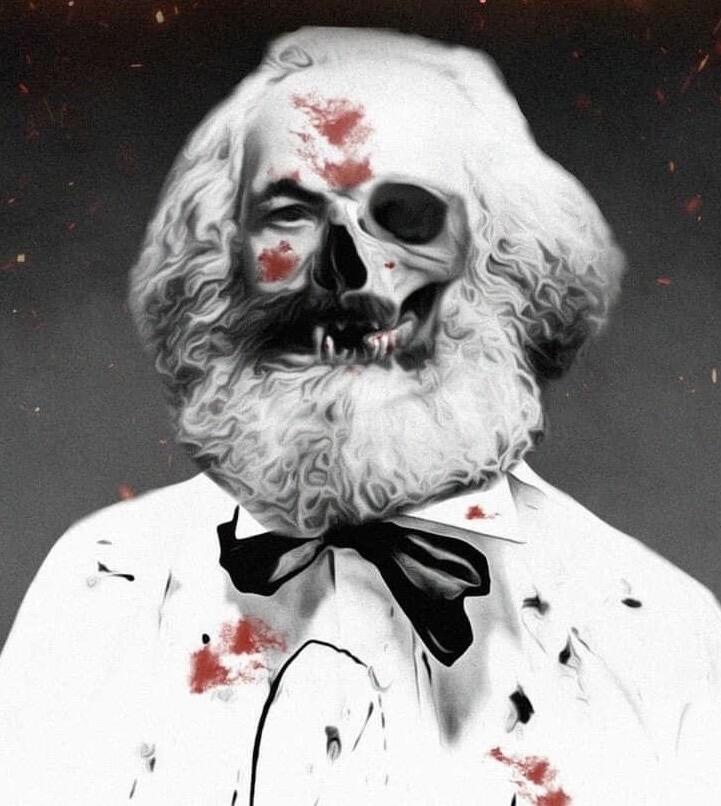
If I understand correctly, the neoliberal elites would start a #war with #Russia, but so that they command from behind, and we peasants go to the third Battle of Kursk and die for their #democracy? 🤷

GM

The European Union should be simplified as much as possible, and the bureaucracy in Brussels should be completely abolished. The only bureaucracy that should exist is one that will introduce, coordinate and supervise a common defense policy and common policies that are necessary for free trade - a ban on the unilateral introduction of any barriers, a ban on subsidies and a common policy towards non-members.
These are the six points that should be implemented if we want to save the European Union:
1. Reduction of bureaucracy and regulatory burden
The EU has become synonymous with endless regulations that stifle entrepreneurship and innovation. According to the European Commission, small and medium-sized enterprises – which make up 99% of all companies in the EU and employ two-thirds of the workforce – often spend up to 30% of their time and resources on complying with bureaucratic rules. Reform means revising and scrapping unnecessary regulations, especially those that overlap with national legislation. For example, why should farmers or technology companies have to comply with dozens of different EU directives when a simple, single framework would suffice? The aim is to create a “regulatory minimum” – only what is necessary to make the single market work, without excessive intervention.
2. Decentralisation and giving power back to the member states
The European aristocracy in Brussels often makes decisions without understanding local needs. The principle of subsidiarity – that decisions should be taken at the lowest possible level – exists on paper but is rarely applied. Reform would mean strengthening the role of national governments and parliaments in key areas such as social policy, health, or education. At the same time, the EU would retain competence only in those areas where a common approach makes sense: trade, border security, and a common monetary policy for the eurozone. This would reduce the power of unelected bureaucrats and return democratic accountability to where it belongs – closer to the citizens.
3. End the policy of “picking winners”
The EU has a bad habit of spending public money on projects that benefit politically connected players. Take the recovery funds from the coronavirus pandemic, for example, €750 billion from the NextGenerationEU plan often ended up in the hands of large corporations or politically convenient sectors, rather than being evenly distributed for real economic stimulus. We see a similar pattern with new “investments” in defense – under the pretext of the Russian threat, money is flowing toward the military-industrial complex, often without a clear strategy or oversight. Reform would scrap such programs and replace them with tax breaks and deregulation, allowing the market – not bureaucrats – to decide who succeeds and who fails.
4. Transparency and accountability of elites
The European aristocracy – from the members of the Commission to the lobbyists who swarm the corridors of Brussels – often operate behind closed doors. The procurement of vaccines during the pandemic was shrouded in secrecy, with contracts full of deleted pages, while billions of euros were spent without public scrutiny. Reform requires complete transparency: all contracts, spending, and decisions must be publicly available, with strict audits by independent bodies. Also, the terms of office of officials such as the President of the Commission or the European Central Bank should be limited to prevent the concentration of power and the creation of lifelong “aristocrats”.
5. Focus on economic growth and freedom
The EU was created as a community for economic cooperation, not a political experiment. Today, however, economic goals often give way to ideological projects such as the Green Deal, which imposes costly obligations without clear benefits for competitiveness. Reform would bring the focus back to the single market: removing remaining trade barriers within the EU, encouraging innovation through tax incentives instead of subsidies, and concluding free trade agreements with global partners. For example, why wouldn’t the EU speed up negotiations with South America or Asia instead of raising tariffs and protecting inefficient domestic industries?
6. Reforming EU financing
The current EU budget, which amounts to around 1% of member states’ GDP, is often spent on agricultural subsidies (which favor large landowners) or regional funds that end up in corruption schemes. Reform would reduce the budget and redirect it to shared priorities such as research and development or infrastructure, with strict controls. Member states’ contributions could be reduced if the EU stops funding bureaucratic fantasies like “strategic autonomy” that only increase costs.
Why would it work?
This approach avoids the pitfalls of nationalism – by retaining the benefits of the single market and cooperation – while breaking the power of the aristocracy that impoverishes Europeans. Instead of Brussels deciding how your money is spent, you – citizens, entrepreneurs, innovators – are given the space to create wealth. This is the EU as it was meant to be: an ally of freedom, not a burden on our backs.
Europe must be neither a battlefield for nationalist egotisms nor a playground for bureaucratic experiments. A reformed EU can be a space of freedom, prosperity and cooperation – but only if we change our mindset and remove those who see public money as their private ATM. It is time to reset our priorities: less aristocracy, more free markets.

We have become a society without balls and I don't see who exactly could implement something like that. The EU is not homogeneous at all and as such represents a paradise for bureaucratic parasites who have arranged everything for their own interests.



The European Union today stands at a crossroads, between two extremes that threaten its future. On the one hand, we have nationalists like Marine Le Pen in France to Viktor Orbán in Hungary – who dream of returning to the era of closed borders and dismantling the European project. For them, the EU is the enemy of sovereignty, a bureaucratic monster that stifles national identity. On the other hand, there is the European aristocracy – the politicians in power and the unelected bureaucrats in Brussels – who want to turn the Union into a centralized superstate, a kind of European empire under their control.
Both approaches lead to ruin. Instead of demolition or excessive centralization, the EU needs reform that will return it to its core values: freedom, the market, and economic progress.
Let’s look first at this “aristocracy.” For decades, European leaders and bureaucrats have built a system that increasingly resembles a self-service supermarket for their own interests. The flu pandemic was a clear example: hundreds of billions of euros were spent on recovery programs, vaccine procurement and other measures, but where is the transparency? How much of that money ended up in the pockets of well-heeled entrepreneurs and lobbyists, and how much actually helped citizens? Now, under the pretext of “defense” and geopolitical tensions, they are trying to repeat the same trick – “investments” that sound noble, but often serve to finance their political allies and increase their own power.
The result? Europeans are getting poorer while the elite and their cronies are getting richer at the expense of taxpayers.
On the other hand, nationalists offer a false solution. Their recipe for Europe – a return to the 19th century with hard borders and protectionism – forgets that it was cooperation within the EU that made decades of peace and economic growth possible. Trump’s “America First” approach may sound appealing in America, but applied to Europe would lead to fragmentation, trade wars and weakness in the face of global challenges such as China, Russian imperialism or climate change. Nationalism is not the answer; it is an illusion that sells a nostalgic past instead of a realistic future.
So what would be the solution? The EU should neither be dismantled nor transformed into a single state. It needs reform to make it leaner, more efficient, and focused on citizens, not elites. That means less bureaucracy and more freedom for entrepreneurs and innovators. Instead of Brussels using public money to determine winners in the market – whether through subsidies or dubious “investments” – the focus must be on creating the conditions for free economic growth. Reducing regulation, easing taxes, and decentralizing decision-making would put power back where it belongs: in the hands of the people, not the aristocracy.
#EU #aristocracy #bureaucracy #taxation #freedom #progress #defense #peace #war #Nationalism #growth #regulation
Solution: send crazy and hysterical females into war 😁
Are you aware that the EU is creating its own Military-Industrial Complex? And it will most likely become a worse monster than the American one. This is very dangerous, when an industry is created that will depend on war, then there will always be war.
#EU #war

Oh we get it... It just takes time to leave the Titanic
Imagine we lived in a world where all cars were EVs, and then along comes a new invention the "Internal Combustion Engine"! Think how well they would sell: A vehicle half the weight, half the price that will almost quarter the damage done to the road. A vehicle that can be refueled in 1/10th of the time and has a range of up to 4 times the distance in all weather conditions. It does not rely on the environmentally damaging use of non-renewable rare earth elements to power it, and use far less steal and other materials.
If only there was such a vehicle 🤔
Exactly 🤣

When I wrote that Germany has the fiscal capacity to increase spending on defense and infrastructure reconstruction, I had this in mind. Germany has a much smaller public debt compared to other large EU members (France, Italy, Spain) and a smaller budget deficit, so it is one of the few large economies that can now "pull".
France and Italy, for example, do not have the capacity for such a thing. Their budget deficits and public debt are such that the market would show a "red light" immediately to any similar attempt to stimulate the economy.
On what basis do I claim this? Well, we have a recent example from the UK a little over two years ago. British Prime Minister Liz Truss proposed a large tax relief, the abolition of the highest income tax rate, etc., which would worsen budget deficits that were already around 5% of GDP. The bond market went crazy, yields on British bonds jumped sharply, pension funds ran into problems, the Bank of England had to react, etc. General chaos. The market reaction was so strongly negative that Liz Truss could not calm her down, neither by changing the finance minister, nor by withdrawing most of the proposals, nothing. She had to resign and thus became the person with the shortest prime ministership in the history of British politics.
So, the market reaction was the exact opposite of the reaction to this German fiscal stimulus. For the UK, the market considered the plan bad (despite the positive effects that tax relief would have in the short term) because it is unsustainable in the long term given the current level of public debt of around 100% of GDP and a deficit of 5%, while for Germany the market gives the green light. Because the Germans saved when they needed to (they had budget surpluses in the years before the corona).
And just a response to those who think that I am "celebrating" the increase in government spending. First, I am not celebrating anything, I am just explaining why the market reacted the way it did and why the presented plan makes sense. Second, this planned increase in state spending does not go into increasing salaries in state and public services, increasing social expenditures, pensions, etc., but rather investments in INFRASTRUCTURE (energy, renovation of the power grid, railways, roads, etc.) and DEFENSE. These are the basic functions of the state.
Germany currently spends shamefully little on defense, just 1.5% of GDP. This is below the NATO standard of 2%, twice less than the USA (3% of GDP), four times less than Russia (6% of GDP), etc. If we lived in la-la land, that would be ok. But we are not, the reality is that we have the bloodiest war in Europe since the Second World War, therefore increasing the allocation for defense is a necessity (pledge for a safer future).
To conclude, I do not know what the final effect of the German fiscal stimulus will be, that is, whether in five years the positive effects will outweigh the potentially negative ones (say, a possible flare-up of inflation). The point is that the market, at least for now, is giving them the green light. We will see what the implementation of the plan will be like in reality.
#Germany #defense #EU #debt #UK #spending #war #inflation

The same people who advocated the entry of the EU into the war against Russia 2 weeks ago are now publicly agitating against mandatory military service
I wonder who they would send to the war then, probably those 'traitors' who are against the war? 🥸
#EU #Ukraine #Russia #war
First they came for the diesels, I didn't complain because I don't have a driver's license.
Then they came for the straws, I didn't complain because I'm not a turtle.
Then they glued the bottle caps on, I kept quiet because I drink from the tap.
Then they came for the unrealized savings, I had no right to say anything because there were so many dips and I don't have savings anymore.
Sorry #EU 😭😭 #Bitcoin will set you straight eventually

FDP files a constitutional complaint against the amendment of the constitution. They claim that it will increase the debt of all states within Germany and that for this they should have sought the consent of each individual state and their parliaments. In other words - states rights!
#FDP #constitution #Germany #debt
