
GM! Last week, Chainalysis claimed that Syrian rebels used cryptocurrency to finance its operations leading up to the toppling of the Assad regime.
We identified one of the addresses referenced in Chainalysis' report: it received a total of $807 USD.
Across the Telegram Group we identified, we found that participants had raised around $13,000 USD since November 27th via USDT – it may be arguable whether this amount contributed significantly to terrorist financing within the country.
But here's what's even more interesting:
Chainalysis claims that an OFAC sanctioned btc address shared mutual consolidation addresses with donation campaigns operating on Tron – a technical impossibility, leading us to believe that Chainalysis broadly simplified its depiction of events.
While Chainalysis' report claims to look at funding leading up to and following the events of December 8th, the identified OFAC sanctioned address last transacted in August 2021.
Why does this matter?
Chainalysis, as the primary Government contractor for blockchain surveillance, holds vast influence with both the Government and the public on the perception of btc.
Without regulatory oversight of the technologies Chainalysis uses and the methodologies it applies, the public has no opportunity to fact check whether what the contractor claims accurately reflects reality.
If we want to have an honest discussion on terrorist financing on bitcoin, blockchain surveillance firms need to be held to scientific standards and a minimum degree of transparency in their operations – otherwise, we run the risk of designing policy based on the claims of for-profit surveillance firms that can hardly be held accountable.

Updated story: https://www.therage.co/chainalysis-claims-cryptocurrency-funds-syrias-hts-2/


There is no evidence of that assessment. Let me know when there is, and Ill be the first to cheer it on.

They reached a $1.4B agreement yesterday. Have to wind down Chivo, revert tax payments in btc (only payable in Dollars again), have to „limit“ btc purchases, and „improve transparency, regulation, and supervision“ of btc usage (aml). 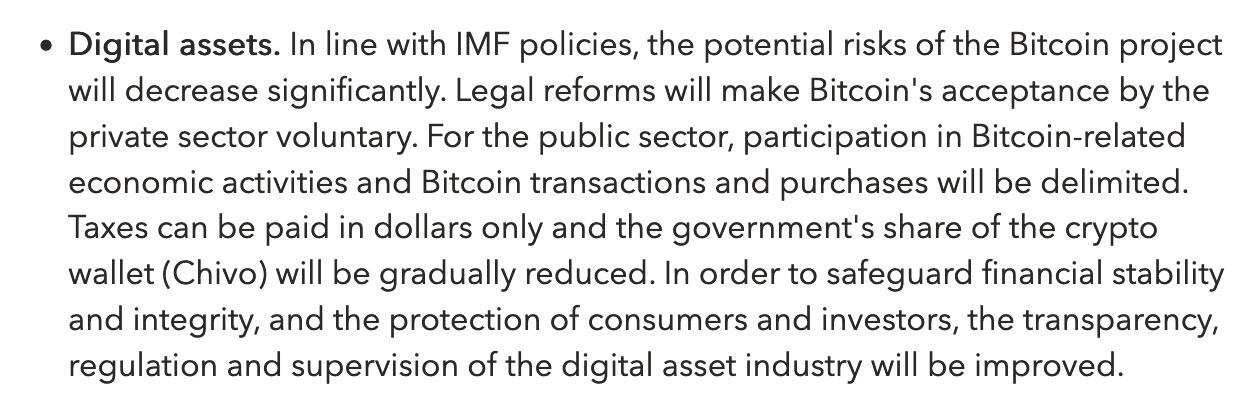

Its nice that you think that. Let me know when you have any evidence to back this educated opinion up.
False equivalent.
A BSR increases the likelihood of increased AML/KYC in bitcoin, no matter who proposes it.
The US won‘t add an „asset“ to its treasury used by „terrorists“, „criminals“, and „crypto anarchists“, to paraphrase a certain someone.
Heart may be in the right place, incentives are screwed.
IMF forcing ES to wind down btc operations is only the start of the game.
Hear me out: a bitcoin policy initiative led by people using and developing Bitcoin instead of Michael Saylor funded think tanks ran by aspiring politicians


David Bailey just posted the draft for an executive order for the Bitcoin Strategic Reserve under Trump – and it's an absolute nightmare for anyone using bitcoin as money.
First, the draft order defines Bitcoin as "a finite store-of-value asset, akin to digital gold."
As someone who has lived on Bitcoin for a fairly long time, I can say that Bitcoin is not merely a "store-of-value asset", but a money for payment and day to day purchases.
Defining Bitcoin as a "store-of-value asset" reinforces the ossification narrative (who needs to move a stonk several times in a day?) which may put developers at risk when prioritizing changes to btc to make it more usable as money (think scaling for example).
With this definition, a softfork to activate covenants may become an issue of US national security that goes against the US' definition of its primary goals - directly putting developers in the firing line of the United States Government.
The draft states that federal agencies, such as the US Marshall's Service, may not auction seized Bitcoin off, but must contribute them to the strategic reserve.
This not only reduces the Bitcoin in circulation available to the public, but additionally sets the incentive for the US to increase its seizing efforts – think increased AML/KYC.
While I'm no fan of the strategic reserve in general, this draft is an even bigger disappointment than Sen. Lummis' proposed Bitcoin Act.
To compare this to how El Salvador has implemented Bitcoin, which I admit I initially wasn't a fan of either, ES directly gives citizens rights to use Bitcoin as money - which is a huge upside to benefit the people, and not just the national security state.
No offense, but letting a couple of children that just graduated college and a guy who runs a magazine draft US policy is a scene straight out of idiocracy.
Next time, maybe try speaking to the people actually building and using bitcoin, not just to the boomers and national security goons that sit on the money like a fat kid at the cake buffet.
Incredibly unprofessional conduct here by BPI, a huge risk to anyone using Bitcoin for anything other than an investment, and a testament to the people involved being more interested in furthering their own importance than to empower people with a money without state.
Sincerely hope that this EO is drastically challenged on all levels and hopefully somehow deemed unconstitutional to protect btc and the people developing it.

yes – two more batches added, now totaling 17 TB (and still not done)
https://www.therage.co/samourai-wallet-trial-set-for-november-3-2025/
Remember when TDev's attorney said that the volume of discovery was equal to 75% of the Library of Congress, or that, if stacked, it would reach from earth to the moon 22 times?
The Government since added two new batches of discovery – now totaling 17 terabytes – and is in the process of providing an additional batch to Rodriguez' defense in the next seven days.
To give the defense more time to sort through the available information, the next hearing has been postponed until March 12th.
The trial date has been set for Nov 3rd 2025.
Full Story:
https://www.therage.co/samourai-wallet-trial-set-for-november-3-2025/
20+ years of internet history to look back on telling us how peer-to-peer software is corrupted by corporate and government interests, and yet we have learned nothing anon

Can Chainalysis tell the difference between funds used for humanitarian aid and funds used to finance terr*rism?
I guess we will find out 📨

Oh look, Chainalysis released a new report on terrorist financing in Syria, claiming that the rebels who overthrew Assad raised funds in cryptocurrency – but it won't say how much.
Interestingly, Chainalysis states that when "legitimate humanitarian concerns" mesh with "extreme ideology and lack of accountability," situations can result in "analytic and ethical quandaries."
Who would have thought.

🔗 https://www.therage.co/chainalysis-claims-cryptocurrency-funds-syrias-hts-2/
Right, but do we have a central database to share branding information across the globe with hundreds of thousands of law enforcement officers monitoring world wide cow compliance programs? I dont think so
Bad news guys we're gonna need to KYC all the cows

The Treasury just answered my FOIA request for Yellen's response to Congress asking for clarity on the use of Bitcoin for terrorist financing.
According to the document, the Treasury briefed the Congressmen on the matter on February 01, 2024.
But here's the problem: the document I was sent is dated Feb 05, four days *after* the briefing took place – so it can't be the Treasury's direct response.
Thanks to hearings in Congress, we already know that Hamas' use of Bitcoin financing was blown way out of proportion. Now the Treasury is trying to hide its actual response to the Congressmen's inquiry.
I just filed an appeal for incomplete information – send sats if you want to support this work.


Conceptually, yes.
Practically, unless you want to suggest that your node does the same volume as coinbase, no one is going to care what you think, unfortunately.
Ignoring the fact that governments can just _make_ any miner and institution under their jurisdiction enforce compliance coin...
How much of the network do you believe would be willing to put their Dollar value at risk to ensure that "terrorists and criminals" can continue to use bitcoin?

The blocksize war illustrated exactly what is outlined above. The majority of miners and exchanges were on the side of the big blockers. The only reason UASF was successful is because the majority of bitcoin holders told them that they can go fuck themselves with their retardation coin.
I do not think that scenario would be playing out the same today.