

It might not get rendered in your note because it's a kind 1 note. I think nostr:npub107jk7htfv243u0x5ynn43scq9wrxtaasmrwwa8lfu2ydwag6cx2quqncxg started writing markdown in kind 1 notes but that drove nostr:npub180cvv07tjdrrgpa0j7j7tmnyl2yr6yr7l8j4s3evf6u64th6gkwsyjh6w6 crazy. So that nip came into existence.
Don't know anymore where I heard it and if it's true, but well there is the nip.
#NostrHistory
You are right. I wrote up a #markdown post on #nostr here:
I guess the tags did not work as hoped…
The [Nostr](https://nostr.com/) client on which I am writing this called [YakiHonne](https://yakihonne.com/) supports Markdown with an editor that allows one to write both directly and a WYSIWYG editor (What You See is What you Get).
I recently used this Dilbert picture for a page on the logic of [saying that](https://github.com/co-operating-systems/PhD/blob/main/Logic/Says.md) developed for decentralized Access Control and Authorization.
I am going to incorporate it here by link rather than needing to upload it.
 )
)
The logic of saying that is illustrated perfectly in every comic strip: it shows some agent related to a text bubble. Everybody can understand that. Interestingly enough, it is fully compatible, in my view with #RDF, the #SemWeb semantic standard to publish data. (We'll see if those hashtags work later).
Now the big question for folks at [Mathstodon](https://mathstodon.xyz/) a #mastodon instance aimed at #mathematicians (or for #math folks) is if [YakiHonne](https://yakihonne.com/) could also accept Math markup. If it did then you would open the door to a lot of intelligent content and the #crypto folks would have folks to ask interesting mathematical questions.
Ok, I think this is long enough for now. Let's see what happens when I publish!
Nice to see that #Damus displays #markdown written posts on #nostr!
See thread above

Speaking as someone who just came to the platform, I could not tell initially if there were a lot of people here or just very few. I did not want to follow all the people that were suggested to me in part because they all seemed overly bitcoin related. (I quite like Lightning btw, so one can slowly be converted :-)
But then not having followed a lot of people, my client was filtering the topics such as #scala. It took me some time to work out that I had to open the the filter on one client from close social network to the extended one (can’t remember quite which web client that was now) to see anything at all.
Then with the extended network set it still does not seem to be a lot of discussion on feeds like #scala or #RDF, well even less than on Mastodon which was not very busy either. So it helped when I worked out to add mostr.pub . Though I think tweets from there should be highlighted differently.
On an open social network one has to be able to see what the intermediary friends of friends are that led one to see a specific post, if only so that one remove some intermediaries that lead to too much spam, but also to understand how people are related.
I think whatever could help foster discussions would help people build communities more quickly.
I found the perfect picture to illustrate my logical take on
#W3C Verifiable Presentations
https://github.com/co-operating-systems/PhD/blob/main/Logic/VerifiableCredentials.md

But it also finally helped me explain to my father why I did not go to work in a business suite.

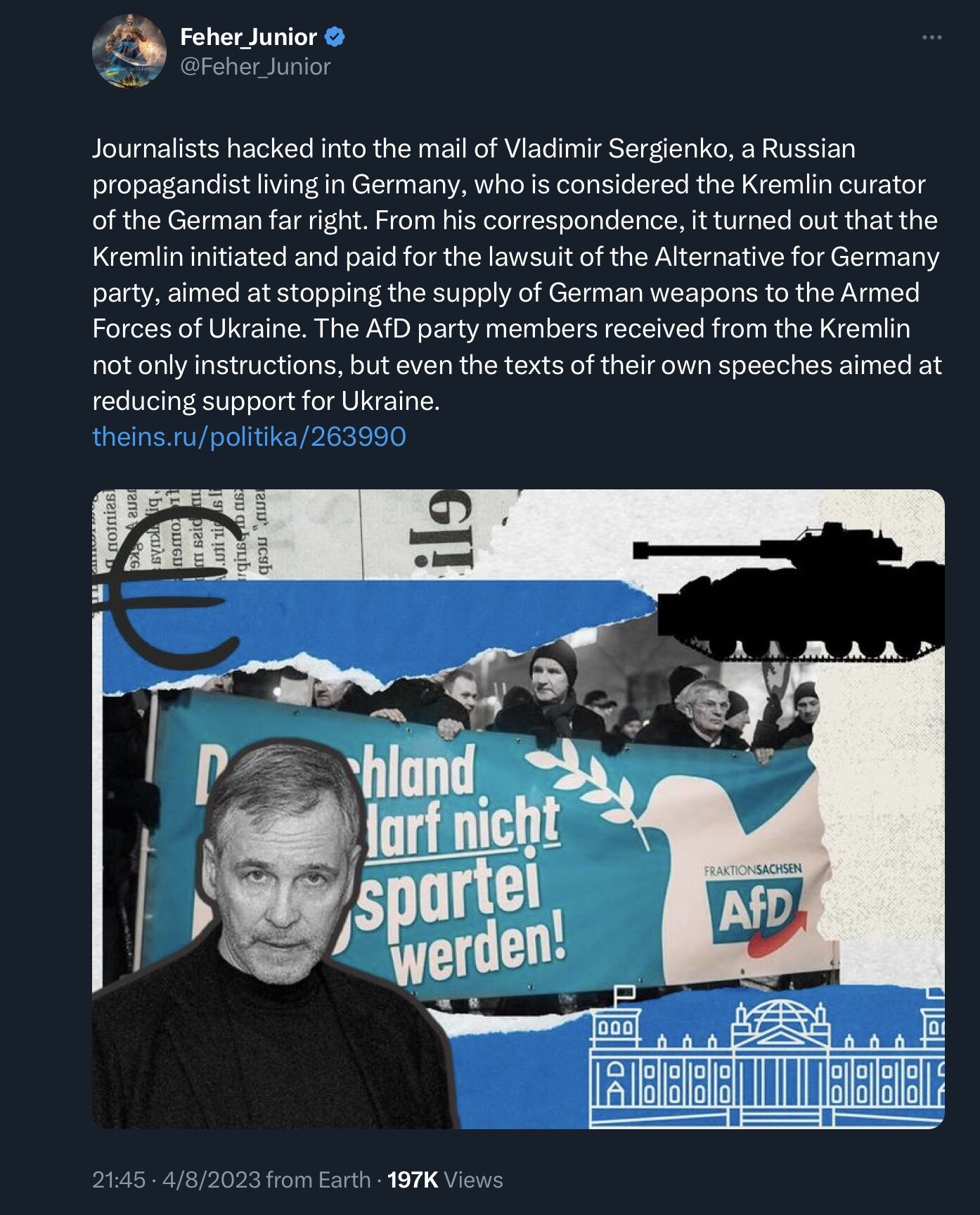
Russia=Nazi: “it turned out that the Kremlin initiated and paid for the lawsuit of the Alternative for Germany party, aimed at stopping the supply of German weapons to the Armed Forces of Ukraine. The AfD party members received from the Kremlin not only instructions, but even the texts of their own speeches aimed at reducing support for Ukraine.” https://twitter.com/feher_junior/status/1687429541831086081?s=61&t=JJuSa--kJdX04FADgZO2KA
http://theins.ru/politika/263990
Reminds me of Eurocommunism in the 1970s.
Perhaps it is just the continuation of that process?
https://books.google.at/books/about/Eurocommunism.html?id=kKLaAAAAMAAJ&redir_esc=y

Interesting. But I think #NIP98 has just been made obsolete by the #IETF publication of HTTP Message Signatures https://lists.w3.org/Archives/Public/ietf-http-wg/2023JulSep/0124.html .
That provides a way to sign HTTP headers with keys, and there is no reason one could not use the keys that #nostr uses, by either publishing them at an http location or using a #DID URI (did:key, or did:jws, ...) .
But you are right that it is similar to foaf+ssl, or WebID-TLS, though much more flexible in fact, since TLS can only sign the connection whereas message signatures can sign every request, and every request differently.
I show how "Message Signatures" can be used to speed up #BigData access to #LDES files in this demo.
Tim Bray, one of the XML pioneers, a colleague of mine at Sun Microsystems when I worked on the Atom specs for blogging, wrote an overview of Mastodon but does not mention #Nostr. See my reply to his post.
nostr:note1ra5sp2ms703xetzjw6y5kd6nauu2gm2wky3ra8dvvkptxt68m90q3uyw4v
So just recently, I was wondering how the #Exodus story was meant to be interpreted, I was pointed to this talk on Symbolism by Jonathan Pageau...
https://www.youtube.com/watch?v=qzdjUMkxsdE&feature=youtu.be
There he mentions....
In the talk “Symbolism Happens” Jonathan Pageau mentions a talk on the Symbolism of #ConspiracyTheories which I followed up on. Quite a rabbit hole of course…
nostr:note15gc9jjjxnh03auz2sfzaw2jpce8dw7dy4vsvtfqp70w7spltuvcsz0h77l
You need to look at #nostr, which solves the problems that you describe for #Mastodon
- accounts and posts are not tied to a URL, but to a public key, so there is no problem with migration between domains (they need to develop a story of key migration, but that is well-known territory)
- migration of user interfaces is easy (I use 5 regularly for their various advantages)
- there is a good payment story with lightning
- it solves the censorship problem, which is much worse on Mastodon than on Twitter. The problem is that Mastodon acts as a slander machine, spreading false rumours in that tags section and censoring people trying to give opposing points of views.
Here is the details on that:
https://primal.net/e/note1dve7jxdmrk5j3euww7p07ere9ju768ywjksdqptpnkrlrchutu9s6v8net
And you can see the story in a number of other web interfaces here:
(But there are also apps for Android and iPhone, desktop etc...)
Is it perfect? No.
But it is bringing something very new to the table.
Of course that means one has to point to the original conversation where that discussion takes place
So just recently, I was wondering how the #Exodus story was meant to be interpreted, I was pointed to this talk on Symbolism by Jonathan Pageau...
https://www.youtube.com/watch?v=qzdjUMkxsdE&feature=youtu.be
There he mentions....
A few months ago there was the First Conference on the Philosophy of #ConspiracyTheory, attended by Prof. Catarina Dutilh Novaes. I am looking forward to the papers being published... just the titles are pretty interesting....
I will use this thread to point to interesting thoughts on that topic.
nostr:note15g94tp5nwlnrschux6hu4k5m7mz0g3xtk533ax54vv2f9wmjcx5qd5mx4q
Ok so here is an idea for #nostrclients on how to display #narings [1] filters by social network.
It is really important to know what the social network graph through which one saw a post, so that one can see if some one of the people one is following is is linking to spammers. So when showing a #naring it would be good to show the shortest link to that node as a small (linear) graph.
[1] #naring and #Narings was an idea by #chatGPT for a name for #nostr posts
nostr:note1yhxy3qhct5nlg40n2m5thwy6l5w3fcjxafz6xem6cd5sr9czgxpqszj0zj
Idea from #ChatGPT: call #nostr posts #naring.
I searched the web and found that næring is Old Swedish for Food.
https://en.wiktionary.org/wiki/n%C3%A6ring#Old_Swedish
This was ChatGPT’s argument
"Posts on the Nostr social network could be called "Narings." The term "Narings" is derived from combining "Nostr" with "sharing," reflecting the concept of sharing posts on the Nostr network while incorporating the unique branding of the platform.
Additionally, given the emphasis on decentralization and the use of private keys to sign posts, "Narings" also conveys the idea of securely and openly communicating, which aligns with the philosophy of the Nostr network.
Feel free to use or adapt this suggestion as you see fit for your social network branding!”
“Law for Computer Scientists”
A great book, online free to read by Prof. Mireille Hildebrandt
https://lawforcomputerscientists.pubpub.org
#[0]

Thanks YouTube URLs now show up with pictures on #nostur.
Another thing. I created a relay filter just for #mostr the #Mastodon proxy, just to see what type of things are coming from that direction.
From time to time I want to look at the profile of someone there, but you only show mostr.pub . The interesting thing is that all the data about an identity is shown there in the encoded email before the “mostr.pub”. I could not find any way to have that information shown.
For all #nostrclients, #mostr posts should be highlighted somewhat differently from other posts, because they are quotes of other posts. Ie. the Principal speaking is
in the says logic [1] Mostr|SomeAgent , ie Mostr.pub quoting some agent. If we trust mostr when it speaks for Mastodon instances then we trust that the agent said what it said. But there is an indirection that newcomers may not know, and that #mostr and similar services should make explicit if they could. But that requires quoting data.
[1]https://github.com/co-operating-systems/PhD/blob/main/Logic/Says.md
In 2019 I wrote this paper "#Epistemology in the #Cloud"
https://medium.com/@bblfish/epistemology-in-the-cloud-472fad4c8282
which argued using a counterfactual analysis of #knowledge developed by Robert Nozick in "#Philosophical Explanations" that #centralized systems will lead to the inability to #think.
We start with Nozick's thought experiment [1] of the possibility of Alpha Centaurians having conducted a raid at night on earth and captured you, dear reader, then brought you up in their labs orbiting the earth and placed your brain in a vat, to make you think you were in front of the screen reading this. This possibility seemed to break down all possibilities of knowledge. Nozick [2] found an answer using counterfactual logic that depends on a distance relation between possible worlds. That world seemed far out in the 1980s and still does to most of us when we are sipping our morning cup of coffee. But what happens if similar problematic worlds become much closer to us? Well, consider this passage from DuskoPavlovic's 2012 paper [3] on the #ManInTheMiddle or MiM attack:
"In the #MiM-attacks on authentication protocols, the intruder inserts himself1 between the honest parties, and impersonates them to each other. MiM is the strategy used by the chess amateur who plays against two grandmasters in parallel, and either wins against one of them, or ties with both. #MiM is also used by the spammers, whose automated agents solve the automated Turing test by passing it to the human visitors of a free porn site, set up for that purpose [20]. MiM is, in a sense, one of the dominant business model on the web, where the portals, search engines and social networks on one hand insert themselves between the producers and the consumers of information, and retrieve freely gathered information for free, but on the other hand use their position in the middle to insert themselves between the producers and the consumers of goods, and supply advertising for a fee."
How much can you know if all your messages go through a MiM who can alter them, filter them, redirect them, emphasise them?
Have we not witnessed in the past 10 years people going crazier and crazier, from the ease with which such messages could be inserted by foreign entities and so people’s thought directed willy nilly towards whatever those who paid the most for wanted?
Do you think your neighbour is a #fascist? Perhaps a #communist even ready to kill your children? Do you perhaps even feel you are on the verge of being #genocided? Well those are symptoms of a 12 year growing #MiM attack.
I will need to update my paper now that #nostr is out since if you sign every note, that changes the argument. At least you know that the message has not been changed, and you could make it difficult for history to be rewritten as it was constantly in George Orwell’s 1984.
[1] that's what we philosophers do! we sit in labs with large comfy chairs and build thought experiments!
[2] Also known as the author of "Anarchy, State and Utopia" which I have not read, but if you push me here, I could put some time aside for it... Leave a note :-)
[3] "Tracing the in the Middle Attack in Monoidal Categories" Dusko Pavlovic
Come to think about it the #BabelFish is if not the ultimate #MiM then the #fish in the middle.
In 2019 I wrote this paper "#Epistemology in the #Cloud"
https://medium.com/@bblfish/epistemology-in-the-cloud-472fad4c8282
which argued using a counterfactual analysis of #knowledge developed by Robert Nozick in "#Philosophical Explanations" that #centralized systems will lead to the inability to #think.
We start with Nozick's thought experiment [1] of the possibility of Alpha Centaurians having conducted a raid at night on earth and captured you, dear reader, then brought you up in their labs orbiting the earth and placed your brain in a vat, to make you think you were in front of the screen reading this. This possibility seemed to break down all possibilities of knowledge. Nozick [2] found an answer using counterfactual logic that depends on a distance relation between possible worlds. That world seemed far out in the 1980s and still does to most of us when we are sipping our morning cup of coffee. But what happens if similar problematic worlds become much closer to us? Well, consider this passage from DuskoPavlovic's 2012 paper [3] on the #ManInTheMiddle or MiM attack:
"In the #MiM-attacks on authentication protocols, the intruder inserts himself1 between the honest parties, and impersonates them to each other. MiM is the strategy used by the chess amateur who plays against two grandmasters in parallel, and either wins against one of them, or ties with both. #MiM is also used by the spammers, whose automated agents solve the automated Turing test by passing it to the human visitors of a free porn site, set up for that purpose [20]. MiM is, in a sense, one of the dominant business model on the web, where the portals, search engines and social networks on one hand insert themselves between the producers and the consumers of information, and retrieve freely gathered information for free, but on the other hand use their position in the middle to insert themselves between the producers and the consumers of goods, and supply advertising for a fee."
How much can you know if all your messages go through a MiM who can alter them, filter them, redirect them, emphasise them?
Have we not witnessed in the past 10 years people going crazier and crazier, from the ease with which such messages could be inserted by foreign entities and so people’s thought directed willy nilly towards whatever those who paid the most for wanted?
Do you think your neighbour is a #fascist? Perhaps a #communist even ready to kill your children? Do you perhaps even feel you are on the verge of being #genocided? Well those are symptoms of a 12 year growing #MiM attack.
I will need to update my paper now that #nostr is out since if you sign every note, that changes the argument. At least you know that the message has not been changed, and you could make it difficult for history to be rewritten as it was constantly in George Orwell’s 1984.
[1] that's what we philosophers do! we sit in labs with large comfy chairs and build thought experiments!
[2] Also known as the author of "Anarchy, State and Utopia" which I have not read, but if you push me here, I could put some time aside for it... Leave a note :-)
[3] "Tracing the in the Middle Attack in Monoidal Categories" Dusko Pavlovic
From my client it looks like you responded to my note above in a non-threaded way, so I’ll just link to your response from here
nostr:note1wzl7w5sfsj6dw04k7h4wj6qurrws9vl7ld6454s9acfgq72txkzsjpdeqm
It seems like that could be a minor update to a little personal relay software:
to track a few relays and just store the responses too (trying to avoid spam somehow). But it clearly looks like this should be very light weight, and hardly use up any resources.