
“Much of what goes by the name of pleasure is simply an effort to destroy consciousness. If one started by asking, What is man? What are his needs? How can he best express himself? one would discover that merely having the power to avoid work and live one's life from birth to death in electric light and to the tune of tinned music is not a reason for doing so. Man needs warmth, society, leisure, comfort and security: he also needs solitude, creative work and the sense of wonder. If he recognised this he could use the products of science and industrialism eclectically, applying always the same test: does this make me more human or less human? He would then learn that the highest happiness does not lie in relaxing, resting, playing poker, drinking and making love simultaneously. And the instinctive horror which all sensitive people feel at the progressive mechanisation of life would be seen not to be a mere sentimental archaism, but to be fully justified. For man only stays human by preserving large patches of simplicity in his life, while the tendency of many modern inventions - in paticular the film, the radio and the aeroplane - is to weaken his consciousness, dull his curiosity, and, in general, drive him nearer to the animals.”
— George Orwell, Essays (Everyman’s Library) p. 989
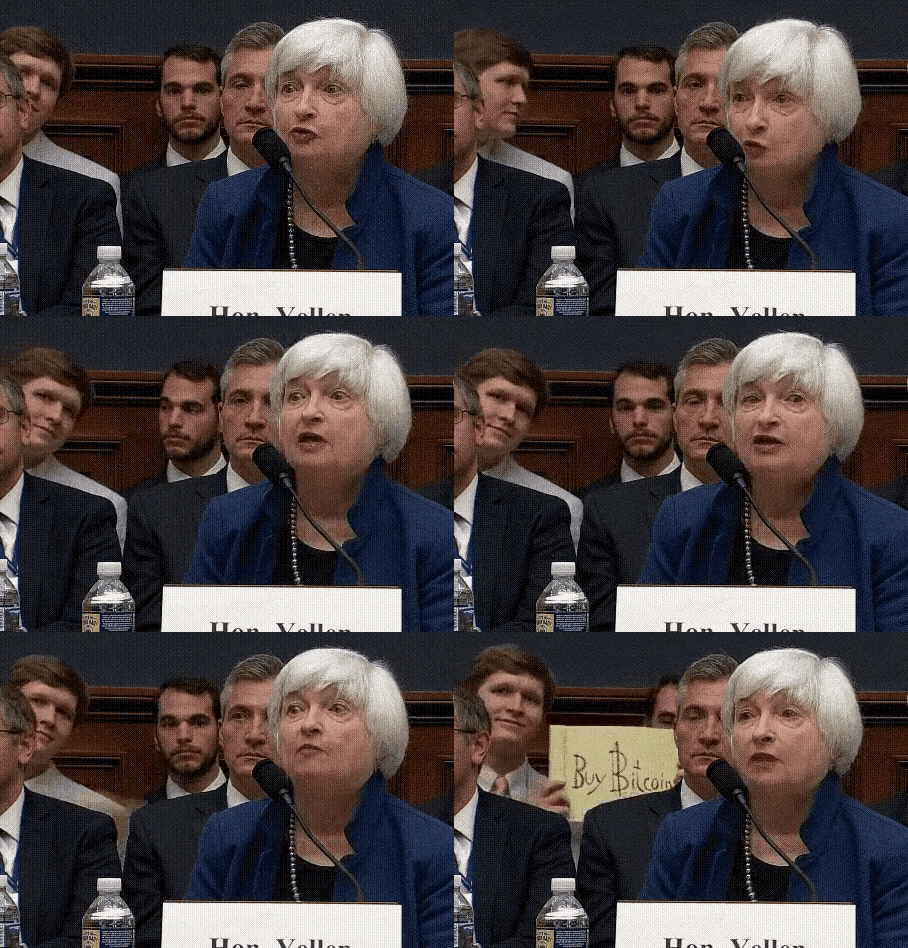
Well to me if they were truly greedy they would simply be stacking sats.
It seems to me that Nostr + Bitcoin is what Facebook + Libra wanted to be
“Zuckerberg says Facebook and other forces on the Internet now create sufficient transparency for gift economies to operate at a large scale. ‘When there’s more openness, with everyone being able to express their opinion very quickly, more of the economy starts to operate like a gift economy. It puts the onus on companies and organizations to be more good, and more trustworthy. A more transparent world creates a better-governed world and a fairer world.”
— David Kirkpatrick, The Facebook Effect (2010) p. 287-288
This is one of my favorite things on the Internet:

That’s smart because it’s like a micro-transaction version of how sponsorships work everywhere else

At the moment I’m having to copy and paste it many times, so I keep it stored in a notepad app for easy reference

They are my oracles
If it’s important I will hear about it from an autistic rando

For sure, and maybe a lot of these causes can receive a surprising amount of support through Zaps by being active on Nostr. The social aspect of promoting your cause on Nostr is very important. It’s challenging because it’s not like most people are desperate to leave their network effects on Instagram or YouTube. Those are still very much seen as essential platforms for distribution and discovery.
I don’t have the best vantage point, but it seems to me that corporations are doing 1000x or 100x more than individual patrons. Artists that I really like are being supported this way in Canada, but I can’t speak to other countries. But that’s very diluted, like out of $100,000,000, maybe $5,000 finds it’s way to an artist that I like as a one-time grant! So it’s relatively easy for an individual patron who really cares to “outspend” the corporations when it comes to supporting a particular artist, who are doing more of a shotgun approach. You could say both are helpful in their own way, but I think individual patrons are really an endangered species that needs to come back in the form of Bitcoin maximalists.
One medium that gets closer to the MP3 model of distribution would be the casting of bronzes or precious metals and making a limited run by hand or even 3D scanning / 3D printing those at scale. That’s one niche that could work, but it doesn’t really apply to other mediums that I can think of.
I think this works well for the funding of music, but visual arts is much more of a one-on-one patron-artist relationship. If physical works of art could be distributed as easily as CD-quality music on the Internet, would a more decentralized model be possible? Maybe! There is something unique to the visual arts where individual patrons can form lifelong friendships with artists and be the primary sponsor for decades. I think of the relationship between Calouste Gulbenkian and Rene Lalique. I find it hard to believe that that level of patronage could be replicated today using a decentralized model, because the costs would have been enormous and possibly there wouldn’t be enough people who would be interested in helping.
For the most important projects that I’ve participated in, I relied on hundreds of thousands of dollars worth of prior commissions or projects that other people had paid for, in just three different portfolios. It would have been impossible for me to make sense of anything without those costs already being covered, and those commissions completed.
Is there a way to achieve that with a very low budget? Possibly, but if a higher budget would be an improvement, then that’s not optimal. And I think it would be a mistake to try to cut corners in the budget of an artist’s portfolio, of all places.
It’s like a chicken or the egg problem because I can’t make a decision without looking at a high quality portfolio, and I expect works in a high quality portfolio to cost 4-5 figures just for materials. So somebody has to be the one paying for those projects with no prior example to compare to, and it’s not fair to expect each artist to do that at their own expense.
This is how I described it a couple years ago in a guest post for Bitcoin Magazine:
https://bitcoinmagazine.com/culture/bitcoin-astonishing-instrument-change

I search for my username on nostr.band. I’m not sure if that’s accurate either but it’s like 3x higher than what Damus says 😂
I find that there is a huge gap between what living artists create at their best and historical masterpieces displayed in museums, and that this gap can be closed through individual art patronage.

Wow that’s an amazing story, thank you for sharing!