

2. On Bitcoin miners
You are correct that mining companies are always looking for the cheapest energy possible. But contracts are contracts, and if the government pays a miner for a certain amount of hash power, it means that wherever those mining computers are and wherever they get their power, the Bitcoin generated would be distributed to the network based on the terms of that contract. I'm not suggesting that the government own the mining systems, just sign contracts with existing (and new) mining companies. The more of those companies we can encourage and develop, the better.
I asked an AI to explain PayGo:
Overview of PAYGO in the 1990s
Pay-As-You-Go (PAYGO) was a budgetary rule established in the early 1990s to promote fiscal discipline in Congress. It required that any new spending or tax cuts be offset by either cuts in other spending or increases in revenue, ensuring that such measures did not increase the federal deficit. This system was part of a broader effort to address the significant budget deficits that the U.S. was facing at the time.
The initial PAYGO regimen was enacted in 1990 and was designed to prevent future Congresses from reversing fiscal agreements without accountability. If new legislation increased projected deficits, it would trigger a "sequestration," leading to automatic, across-the-board spending cuts in non-exempt mandatory programs
. This mechanism was effective in maintaining budgetary discipline, contributing to the budget surpluses experienced in the late 1990s
.
Effectiveness and Challenges
During its operation from 1990 to 2002, PAYGO was credited with helping to reduce the federal deficit significantly. Budget experts generally agree that it worked well during this period, as it was supplemented by caps on discretionary spending, which further reinforced fiscal responsibility
. However, the effectiveness of PAYGO diminished over time as Congress began to find ways to circumvent its rules, leading to a gradual erosion of its impact.
Why PAYGO is Not Widely Used Today
The original PAYGO rules effectively ended in 2002, and while there have been attempts to reinstate similar measures, such as the Statutory Pay-As-You-Go Act of 2010, these have not been consistently enforced or adhered to
. The political landscape has changed significantly since the 1990s, with increasing polarization making bipartisan agreements on fiscal matters more challenging. Additionally, the growing national debt and the complexity of modern fiscal policy have led to debates about the appropriateness and feasibility of strict PAYGO rules in today's economic environment
.
In summary, while PAYGO was a successful tool for fiscal discipline in the 1990s, its decline can be attributed to political challenges and changing economic conditions that have made strict adherence to such rules more difficult in contemporary Congress.
Basically, it failed because Congress decided to stop enforcing it. If we could get people into elected office who actually care about this country and want to actually balance the budget for real instead of just a slide presentation during election cycles, we could bring it back and it would work again. But I've given up on that happening.
Bitcoin does not need the United States Government.
The United States Government needs Bitcoin.
I first need to state the endgame goal, which is to replace the debt based fiat currency system with a wealth based hard money system. No more currency debasement by printing, no more governments that have to pay off international slavery loans or face sanctions by their trading partners. I believe that Bitcoin could be used as an international standard for the base layer wealth measurement system that underpins a global monetary system, but everyone is going to have to agree to that before it happens.
The ideal path for me would be as follows:
The United States Federal Government balances the budget. This is not going to be a quick process, but it was done in the past and can be done again. Easiest thing to do would be for Congress to start using Pay As You Go rules for legislation again. If someone files a bill in Congress that results in an expense, that piece of legislation needs to identify the exact funding source for that expense on a 1:1 ratio. We did this up to the 2001 budget in the late 90's and it worked. But the Afghanistan/Iraq war years destroyed it, and Congress has refused to use PayGo rules ever since. It's still on the books, they just need to enforce it.
Once we have a balanced budget, and indeed during the time period when we are trying to get to that point again, 1% of all federal revenue is directed towards Bitcoin Mining. Not a Strategic Reserve, but actual hash contracts that are funded by the Federal Government. The Bitcoin that is generated by these miners is not held or hoarded, but used. At first it would be sold at market rate and the resulting dollars would be added to the general fund. The more hash contracts are in place, the more the revenue would be, and the more the general fund is supported. Positive feedback loop.
When the budget is balanced, we keep it balanced. We pay off existing bonds, bills and notes as they come due as part of the regular expenditures. We don't need to sell any more bonds because the expenditures are paid for by selling the Bitcoin that the miners continue to generate. And as the debt is slowly paid off, the number of US Dollars in the system slowly begins to go down over time. Gradually the business world changes over to using Bitcoin, not just as a reserve asset store of value but as a medium of exchange and unit of account. Things are still priced in dollars, because that's a huge change that we won't be ready for until a decade or two passes.
Celebrations across the country erupt when the final 30 year Treasury Bond is paid off, and the US Government formally transitions over to the Satoshi as the base money, joining many other nations around the world that were able to do that already.
The most important question I would have for you is why. If Congress isn't going to bother to try and save the US national currency, why should we do anything?

Left were the people who were putting people into the guillotines. Right were the people who supported bring back the monarchy. Not great people on either side.

And this path could be used by any government, actually any level of government. The more capital that comes from Bitcoin mining into the general fund, the lower taxes could go. This is what El Salvador should be doing. This is what all nation state governments should be doing. And state governments and municipal governments. Hell, the UN should be doing this to pay for their own expenses.
Doing anything else just doesn't make sense.
Nobody sane is saying it will or even should happen overnight.
"Realistically" is subjective. I don't like the way things are going now, and I'm not going to really love any of the paths in front of us.
I first need to state the endgame goal, which is to replace the debt based fiat currency system with a wealth based hard money system. No more currency debasement by printing, no more governments that have to pay off international slavery loans or face sanctions by their trading partners. I believe that Bitcoin could be used as an international standard for the base layer wealth measurement system that underpins a global monetary system, but everyone is going to have to agree to that before it happens.
The ideal path for me would be as follows:
The United States Federal Government balances the budget. This is not going to be a quick process, but it was done in the past and can be done again. Easiest thing to do would be for Congress to start using Pay As You Go rules for legislation again. If someone files a bill in Congress that results in an expense, that piece of legislation needs to identify the exact funding source for that expense on a 1:1 ratio. We did this up to the 2001 budget in the late 90's and it worked. But the Afghanistan/Iraq war years destroyed it, and Congress has refused to use PayGo rules ever since. It's still on the books, they just need to enforce it.
Once we have a balanced budget, and indeed during the time period when we are trying to get to that point again, 1% of all federal revenue is directed towards Bitcoin Mining. Not a Strategic Reserve, but actual hash contracts that are funded by the Federal Government. The Bitcoin that is generated by these miners is not held or hoarded, but used. At first it would be sold at market rate and the resulting dollars would be added to the general fund. The more hash contracts are in place, the more the revenue would be, and the more the general fund is supported. Positive feedback loop.
When the budget is balanced, we keep it balanced. We pay off existing bonds, bills and notes as they come due as part of the regular expenditures. We don't need to sell any more bonds because the expenditures are paid for by selling the Bitcoin that the miners continue to generate. And as the debt is slowly paid off, the number of US Dollars in the system slowly begins to go down over time. Gradually the business world changes over to using Bitcoin, not just as a reserve asset store of value but as a medium of exchange and unit of account. Things are still priced in dollars, because that's a huge change that we won't be ready for until a decade or two passes.
Celebrations across the country erupt when the final 30 year Treasury Bond is paid off, and the US Government formally transitions over to the Satoshi as the base money, joining many other nations around the world that were able to do that already.
Like I said, subjective. But that's the vision I have.
The US Dollar doesn't need to be backed.
It needs to be destroyed.

Basically it means that anyone who commits a crime could be trying to "send a message" and that could be applied to absolutely anything. Steal a loaf of bread because you are hungry and it's terrorism because you are sending out a message about all the people who are hungry around the world. I mean come on. a crime like this is bad enough, there is no need to create an environment that floods the world with hyped up subjectivity.
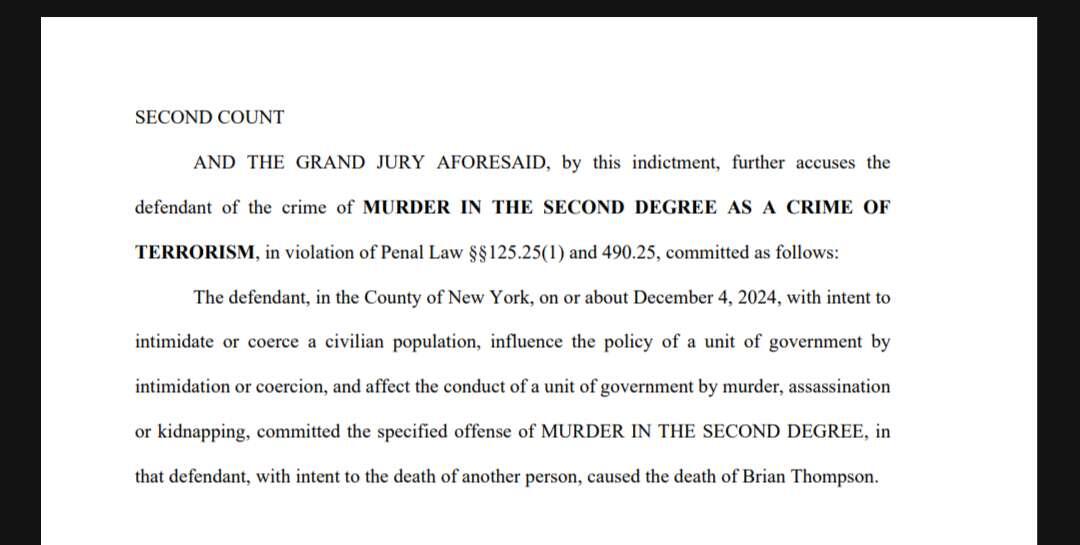
Thank you. always willing to accept that I was wrong when presented with evidence.
I still think it's stupid, but I guess that's the world we live in.
I've looked at the charges that were filed. That is not one of them.
https://www.justice.gov/d9/2024-12/signed_complaint_mangione.pdf
If you have different information, please share.
That is not one of the charges filed against him.
Saw a meme this morning.
What's preventing the 99% from overthrowing the 1%?
Lifetimes of indoctrination and the most ubiquitous propaganda network ever assembled.
And the strongest leg of that propaganda network is the belief that the US Dollar and other fiat currencies are Money. They are not.
Fix the money, fix the world.

it's the appreciation model instead of the advertising model. if you appreciate what someone has done or is doing, you help support them so they can continue doing what you appreciate. much less complicated than having your time and screen space wasted on products and services you don't want.
nostr:npub1zga04e73s7ard4kaektaha9vckdwll3y8auztyhl3uj764ua7vrqc7ppvc & nostr:npub16c0nh3dnadzqpm76uctf5hqhe2lny344zsmpm6feee9p5rdxaa9q586nvr I only see this relay on nostr:npub12vkcxr0luzwp8e673v29eqjhrr7p9vqq8asav85swaepclllj09sylpugg, which worries me a bit.
I think we have a scam operator on the Nostr network. Heads up, and please let me know if I'm missing anything.
Yesterday I got a lightning invoice via Messages on Primal from an npub with 0 following and 0 followers:
npub1328ynyhjgv3jkmxudl70n25ls3zfm57mucs4qvyzehmsfh36deyq8cr2m6
The message was basically an advertisement from a relay, nostr.extrabits.io, that I did not have on my regular relay list, but DOES show up on the list of relays in my settings, at least while this lightning invoice is active (It runs for an hour and then expires).
I looked up the domain, and it does have a link to a Nostr npub for a Jamin at npub1e76y89fn094scpkzl6vvh7d6qyzysmgtg494ympu3cs9mczvkadq0p7rxg Looks like he was active a year ago, but nothing since.
If this had been a one time deal, I would have ignored it. But I'm wondering how many people are getting these invoices and paying them without actually looking to see if this relay is one that they have added to their network list. Interesting way to collect sats without doing a lot of work.
Anyway, if Jamin is watching, please explain how this works and if I'm missing anything. If not, then this is just a scam and I'm worried how many people are getting sats stolen by the scheme. Stay humble AND vigilant.