
Fiat influencers.
That’s it. That’s the post.

The perverse incentives you so aptly observe can be poison for the soul
Have you ever considered that there might be people with valuable things to say who lack either the skills or the desire to grow their follower count? Maybe they don’t have the time. Or maybe they kinda like the idea of flying under the radar.
Here’s my essay on how web of trust can free us from the tyranny of the legacy advertisements-addicted system which worships social media “influencers” at the expense of everyone else. How WoT can give us the tools to find the users and the content we want. Even when those users don’t have a high follower count.
https://prettygoodproject.substack.com/p/the-pretty-good-way-to-calculate
Gonna write this essay on habla when I get the time
Only so much time in the day
Advertiser-Influencer Industrial Complex should join the lexicon alongside Military Industrial Complex, Pharmaceutical Industrial Complex, Academic Industrial Complex, etc.
https://prettygoodproject.substack.com/p/the-pretty-good-way-to-calculate

Web of trust will do that by doing a better job of curating content than anything that currently exists. Most users won’t care about the underlying ideology. They’ll use it bc it works.
I would love everyone in the world to become passionate about freedom of speech, but we cannot assume that will ever happen. We need to build tools that people will use bc they work, not bc they align with a worldview.
Example: Peter schiff hates btc ideologically but has accepted it on his website for years bc it works. That sort of thing.

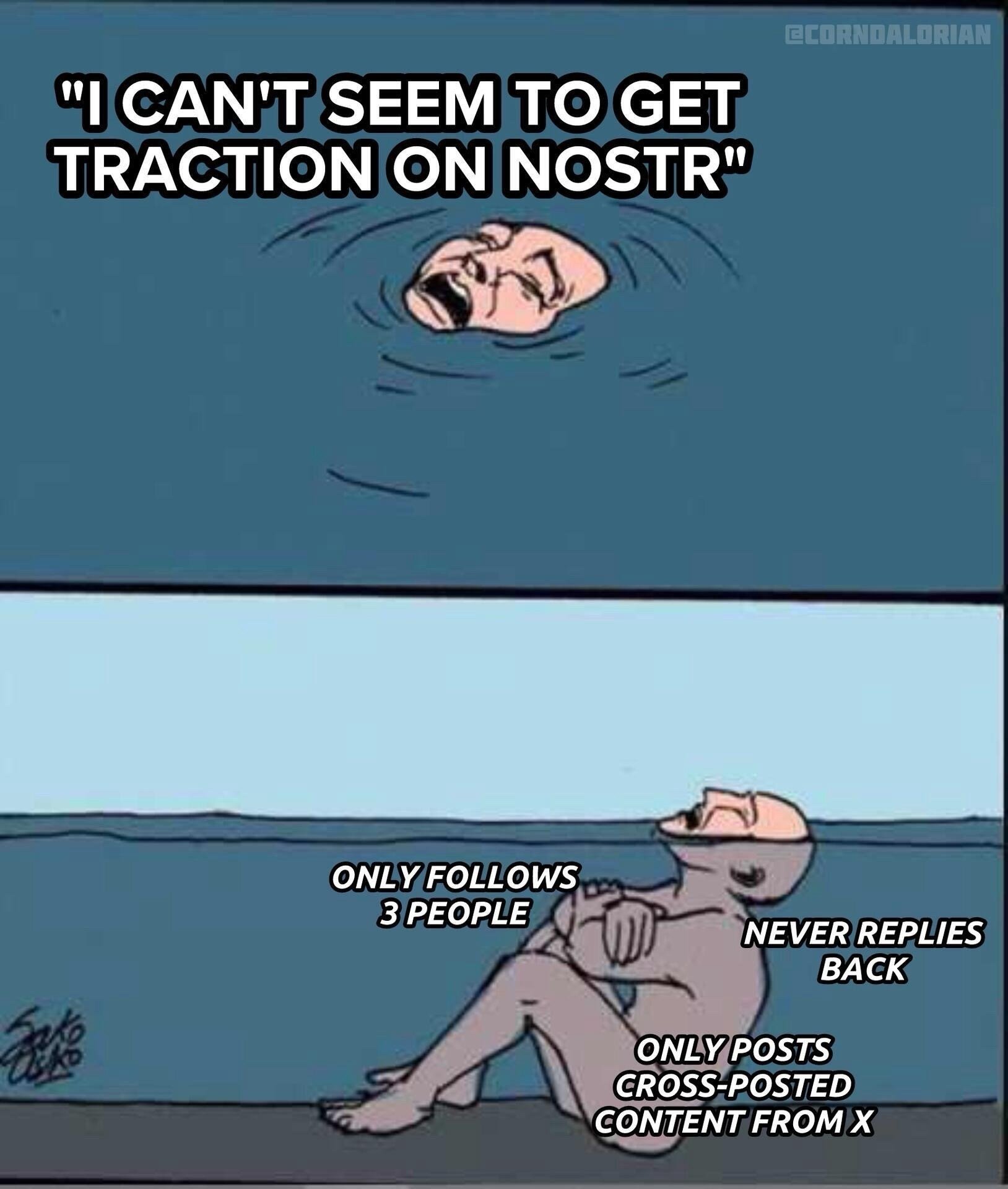
hard work is cool and all … but you had me at “new meme”
GIVE THIS NOSTRICH A FOLLOW
😂
They will want to maintain control of the digital stewards. Which is why we must put stewardship of our digital tools of communication into the hands of our WoT.
Fix the language, fix the world.
I’m going to begin the search for a cofounder with the title: Director of Product. Maybe Chief Product Officer. Someone with a track record and the skills I don’t have: hire a team, manage a team, bring a product to market. PR. Someone who understands and appreciates the needs of the consumer and can help me strategize a product roadmap that aligns with the vision of the tapestry protocol, the management of which will fall to me.
Feel free to DM me for more information.
How many people in the nostr community see this coming and appreciate its significance, I wonder?
Yup. I can’t help wondering how long it will be before they make a list of “approved” relays. Which will get whittled down to a handful of relays, all controlled by primal.
Precisely
I don’t think we’ll have a truly decentralized web until our digital tools are themselves managed by our web of trust, rather than by digital stewards like primal or standards committees or repository managers.
Spoken languages are truly decentralized. Who decided the string of syllables we use in English for pencil? No one. Everyone. The question itself is kinda silly.
We need to respond the same way to the question: who decided the json schema we all use for a nostr note? Currently the answer is: fiatjaf. I look forward to the day when the answer is: what a silly question. No one is in charge.

My concern with Primal is that it could end up being too much like just another Twitter in too many ways.
Improvements over Twitter: our identities are cryptographic key pairs that are not controlled by primal, and the notes are stored on relays that are not controlled by primal.
Same as the old Twitter: monetization by advertisements. Which means primal is going to end up building algos that reward people with high follower counts, at the expense of everyone else.
Wait a second - did I say “end up?” They’re already doing it. Screw that, I say.
https://prettygoodproject.substack.com/p/the-pretty-good-way-to-calculate
Have you ever considered that there might be people with valuable things to say who lack either the skills or the desire to grow their follower count? Maybe they don’t have the time. Or maybe they kinda like the idea of flying under the radar.
Here’s my essay on how web of trust can free us from the tyranny of the legacy advertisements-addicted system which worships social media “influencers” at the expense of everyone else. How WoT can give us the tools to find the users and the content we want. Even when those users don’t have a high follower count.
https://prettygoodproject.substack.com/p/the-pretty-good-way-to-calculate

Interesting. Was Listening to nostr:npub1h8nk2346qezka5cpm8jjh3yl5j88pf4ly2ptu7s6uu55wcfqy0wq36rpev AI Unchained with a guest, HopeTS. He's trying to build what I would describe as an AI-powered truth-filter to help us disseminate fact from fiction by checking politicians' track record of public actions against the bullshit they're deciding to spew in the moment.
Thought there might be overlap.
I can envision the utility of the Grapevine would be that it would help people discover the AI-powered tool that you mention. If someone in my grapevine has used the tool, that person can attest to its utility, and can also assign it to relevant categories, like the category of “truth filters”. The categories are themselves managed by my Grapevine. So when I go looking for a tool in that category, I’ll be able to find it.

In my conversations about WoT, people often ask whether WoT will just result in more echo chambers. It’s a fair question. My response usually is that if you explicitly want a better echo chamber, you’ll be able to build it. It’s permissionless so no one can stop you. But I think most people would like tools to help them discover when they are being misled by their echo chamber. We can build those tools with WoT. We will be able to ask: what does tribe X think about topic Y? Or what does not(tribe X) think about topic Y? The ability to make these types of queries will be super interesting and informative.

According to the tapestry protocol, you are always at the center of your grapevine (your WoT). You select the ppl who select the ppl who select the ppl (and so on) who do the curation.
I’ve built a proof of concept for curation of lists as a desktop app. I haven’t coded the curation of categories yet, but that part of the protocol exists and the existing proof of concept should give you the general idea. Here is an overview with screenshots from the desktop app that shows exactly how it works.
https://github.com/wds4/pretty-good/blob/main/appDescriptions/curatedLists/overview.md
Web of trust is a consensus problem. Equal in significance to the Byzantine generals problem. But this consensus problem concerns language. So I call it the problem of how to reach linguistic consensus.
This is the problem: how do we get a decentralized community to build our digital tools of communication without reliance on centralized authorities, like w3c committees and repo managers?
If we can solve the problem of linguistic consensus over the spoken word, we should be able to do it in the digital world too.
Solution: the tapestry protocol. The concept graph + the grapevine. An approximation of how we solve the problem in normal life, ported over into the digital realm.
Scaling Dunbar’s number up from 150 to 8 billion.
Imagine a nostr apps page that enables your grapevine to manage a list of nostr apps, a hierarchy of categories of apps, and assigns each app to the appropriate category(ies).
Imagine a Wikipedia where you pick the ppl who pick the ppl who pick the ppl who manage the articles.
Imagine Yelp where your WoT weeds out fake reviews. Imagine being able to pay a few sats for reviews from trusted sources, thus incentivizing users to enter high quality info into the system (bc when ppl see low quality info, the WoT will decrease their trust score in that context).
Imagine legacy social media minus all the bots, scammers and trolls, with better ability to find the content you want.
Every legacy platform will be rebuilt. And your identity and all associated information will be portable.
No more walled gardens.
The protocol I am using is divided into two main sections: the concept graph, which describes how information is represented, and the grapevine, which describes how it is curated. The concept graph describes how to ask a question and the grapevine describes how your WoT answers it.
Ultimately, this protocol will be encoded using the concept graph and managed by your grapevine. Your grapevine is going to manage the protocol and the code that allows your grapevine to exist! Gonna take a long time to get there but it will happen. But even before we reach that point, we’ll be able to build some useful platforms.