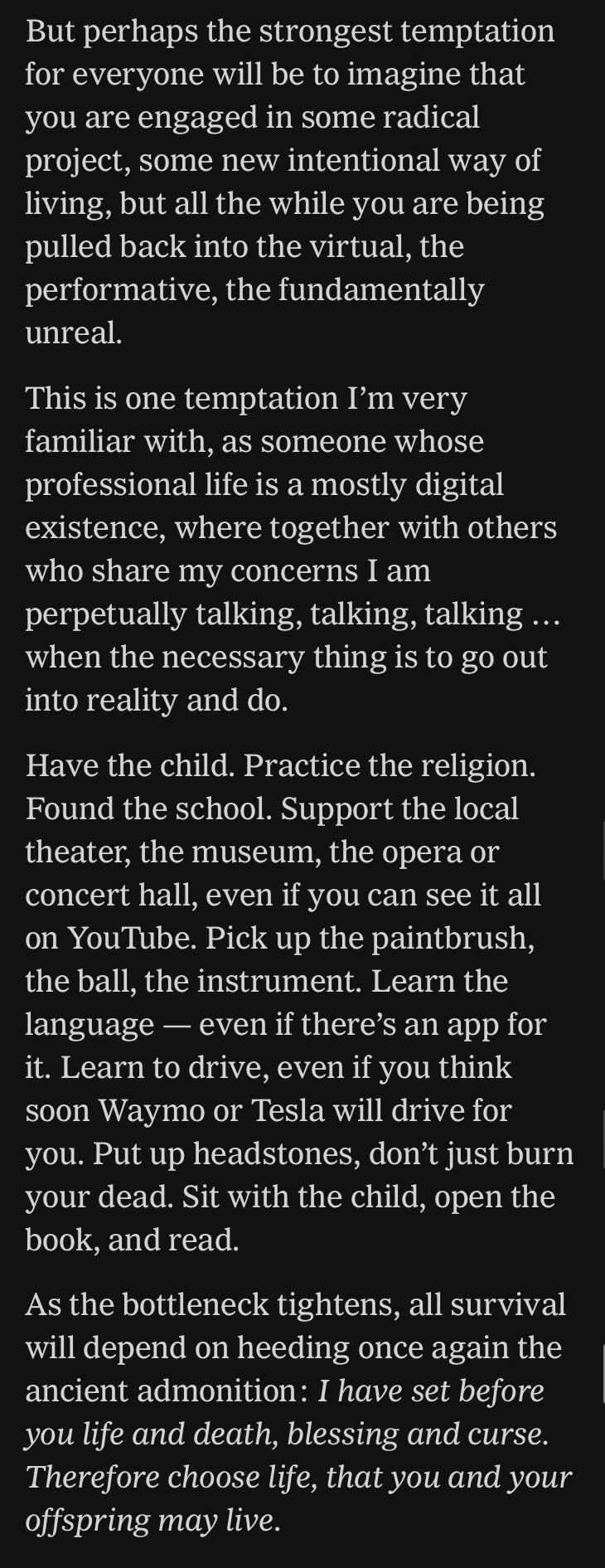
There’s an annoying trend on Twitter wherein the algorithm feeds you a lot of threads like “five keys to gaining wealth” or “10 mistakes to avoid in relationships” that list a bunch of hacks for some ostensibly desirable state of affairs which for you is presumably lacking. It’s not that the hacks are wrong per se, more that the medium is the message. Reading threads about hacks on social media is almost surely not the path toward whatever is promised by them.
. . .
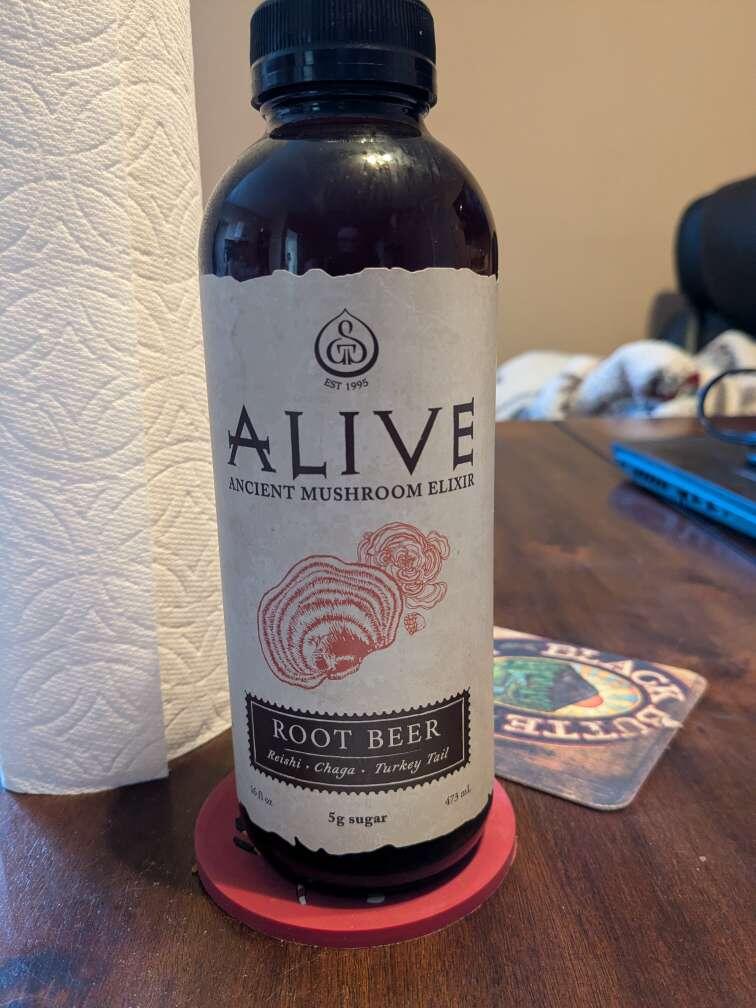
I’ve tried a lot of health supplements over the years. These days creatine is trendy, and of course Vitamin D (which I still take.) I don’t know if this is helping me, though it surely helps me pass my blood tests with robust levels. The more I learn about health and nutrition, the less I’m sure of anything beyond a few basics. Yes, replacing processed food with real food, moving your body and getting *some* sun are almost certainly good, but it’s harder to know how particular interventions affect me.
Maybe some of them work in the short term then lose their effect, Maybe some work better for particular phenotypes, but not for mine. Maybe my timing in the day is off, or I’m not combining them correctly for my lifestyle and circumstances. The body is a complex system, and complex systems are characterized by having unpredictable outputs given changes to initial conditions (inputs).
. . .
I started getting into Padel recently — a mini-tennis-like game where you can hit the ball off the back walls. I’d much rather chase a ball around for exercise than run or work out, and there’s a social aspect I enjoy. (By “social aspect”, I don’t really mean getting to know the people with whom I’m playing, but just the incidental interactions you get during the game, joking about it, for example, when you nearly impale someone at the net with a hard forehand.)
A few months ago, I was playing with some friends, and I was a little off. It’s embarrassing to play poorly at a sport, especially when (as is always the case in Padel) you have a doubles partner you’re letting down. Normally I’d be excoriating myself for my poor play, coaching myself to bend my knees more, not go for winners so much. But that day, I was tired — for some reason I hadn’t slept well — and I didn’t have the energy for much internal monologue. I just mishit a few balls, felt stupid about it and kept playing.
After a few games, my fortunes reversed. I was hitting the ball cleanly, smashing winners, rarely making errors. My partner and I started winning games and then sets. I was enjoying myself. In the midst of it I remember hitting an easy ball into the net and reflexively wanting to self-coach again. I wondered, “What tips did I give to right the ship when I had been playing poorly at the outset?” I racked my brain as I waited for the serve and realized, to my surprise, there had been none. The turnaround in my play was not due to self-coaching but its absence. I had started playing better because my mind had finally shut the fuck up for once.
Now when I’m not playing well, I resist, to the extent I’m capable, the urge to meddle. I intend to be more mind-less. Not so much telling the interior coach to shut up but not buying into the premise there is a problem to be solved at all. The coach isn’t just ignored, he’s fired. And he’s not just fired, his role was obsoleted.
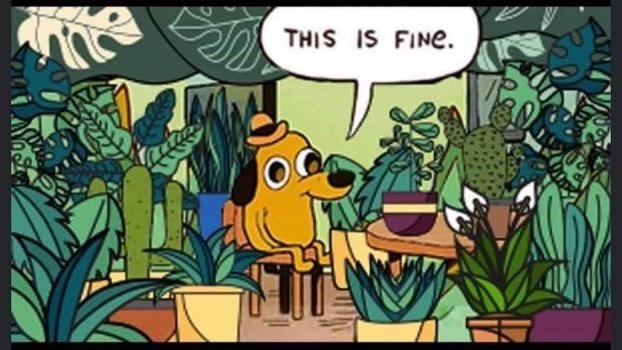
You blew the point, you’re embarrassed about it and there’s nothing that needs to be done about it. Or that you started coaching yourself like a fool and made things worse. No matter how much you are doing the wrong thing nothing needs to be done about any of it whatsoever. There is always another ball coming across the net that needs to be struck until the game is over.
. . .
Most of the hacks, habits and heuristics we pick up to manage our lives only serve as yet more inputs in unfathomably complex systems whose outputs rarely track as we’d like. There are some basic ones that are now obvious to everyone like not injecting yourself with heroin (or mRNA boosters), but for the most part we just create more baggage for ourselves which justifies ever more hacks. It’s like taking medication for one problem that causes side effects, and then you need another medicine for that side effect, rinse and repeat, ad infinitum.
But this process can be reverse-engineered too. For every heuristic you drop, the problem it was put into place to solve re-emerges and has a chance to be observed. Observing won’t solve it, it’ll just bring it into the fold, give the complex system of which it is a part a chance to achieve an equilibrium with respect to it on its own.
You might still be embarrassed when you mishit the ball, but embarrassment is not a problem. And if embarrassment is not a problem, then mishitting a ball isn’t that bad. And if mishitting a ball isn’t that bad, then maybe you’re not worrying about what happens if you botch the next shot, instead fixing your attention on the ball. And so you disappear a little bit into the game, and it’s more fun as a result.
I honestly wish there were a hack for this — being more mindless — but I don’t know of any. And in any event, hack Substacks won’t get you any farther than hack Twitter threads.