Avatar
Debt’s Not Money
fdc0d54a6d1a3ffce67f416d818105c148a6d3fdaa4db63b96ae59c914809687
Science -> Tech

https://youtu.be/wrIBIlfWp_w

Excerpt on Kelly optimization of Bitcoin in a portfolio, with Sina of 21st Capital #bitcoin

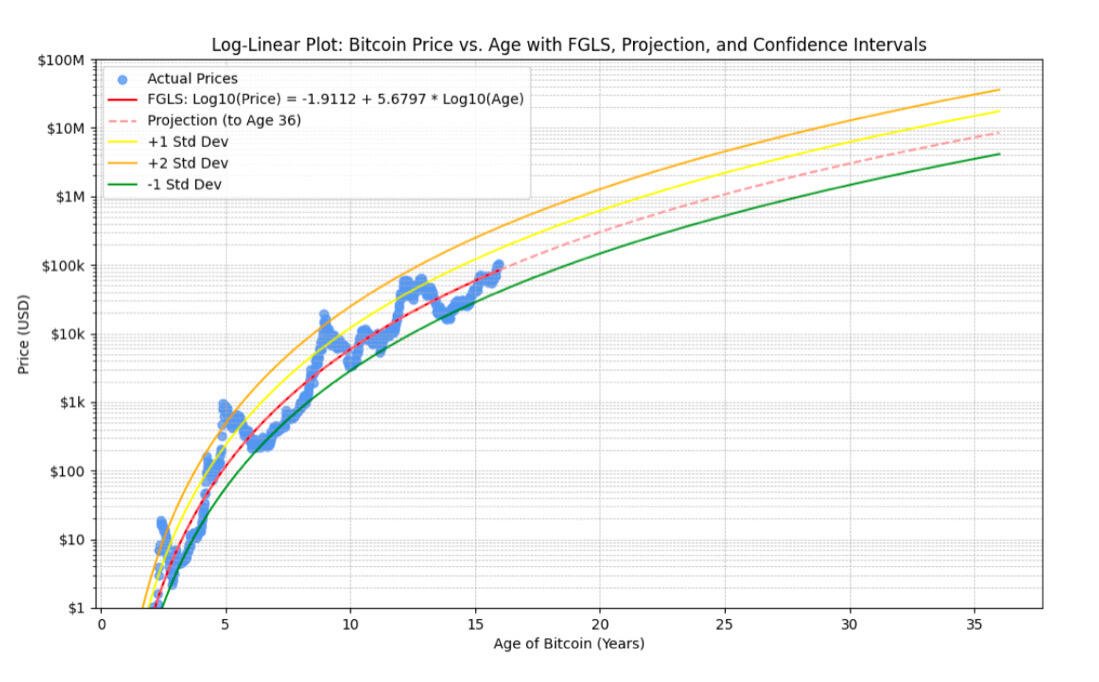
The #Bitcoin power law persists. Autocorrelation of weekly history corrected to second order.

Left chart: Log-log thus a straight line. Age^5.68

Right chart: Same fit log-linear plot, so curved lines, added -1, +1, +2 standard deviation lines and projection forward for next 20 years, if the anti-fragile and Lindy power law continues in similar fashion.

Replying to Avatar Lyn Alden

I spoke at a big bitcoin-adjacent company this week and one of the best questions was from someone who asked what the downsides of bitcoin adoption might be.

I always do appreciate these steelman questions, the skeptical questions, the ones where we challenge ourselves. Only when we can answer those types of questions do we understand the concept that we are promoting.

So the classic example is that in modern economic literature, "deflation is bad". This, however, is only the case in a highly indebted system. Normally, deflation is good. Money appreciates, technology improves, and goods and services get cheaper over time as they should. Price of Tomorrow covers this well. My book touches on this too, etc. The "deflation is bad" meme is still alive in modern economic discourse and thus is worth countering, but I think in the bitcoin spectrum of communities, people get that deflation is fine and good.

My answer to the question was in two parts.

The first part was technological determinism. In other words, if we were to re-run humanity multiple times, there are certain rare accidents that might not replicate, and other commonalities that probably would. Much like steam engines, internal combustion engines, electricity, and nuclear power, I think a decentralized network of money is something we would eventually come across. In our case, Bitcoin came into existence as soon as the bandwidth and encryption tech allowed it to. In other universes or simulations it might look a bit different (e.g. might not be 21 million or ten minute block times exactly), but I think decentralized real-time settlement would become apparent as readily as electricity does, for any civilization that reaches this point. So ethics aside, it just is what it is. It exists, and thus we must deal with it.

The second part was that in my view, transparency and individual empowerment is rarely a bad thing. Half of the world is autocratic. And half of the world (not quite the same half) deals with massive structural inflation. A decentralized spreadsheet that allows individuals to store and send value can't possibly be a bad thing, unless humanity itself is totally corrupted. I then went into more detail with examples about historical war financing, and all sorts of tangible stuff. In other words, a whole chapter full of stuff. I've addressed this in some articles to.

In your view, if you had to steelman the argument as best as you could, what are the scenarios where bitcoin is *BAD* for humanity rather than good for it, on net?

On other thing, a disinflationary currency can be (is) more natural for this demographic era with population peaking in Europe and East Asia incl. China and workforce age cohort shrinking in the most productive economies (US peaked 2020?, that are also loaded up with debt and facing slow growth). #Bitcoin Not discounting rapid tech-driven AI and more growth but population segment in prime spending years is falling in wealthier economies.

Replying to Avatar Lyn Alden

I spoke at a big bitcoin-adjacent company this week and one of the best questions was from someone who asked what the downsides of bitcoin adoption might be.

I always do appreciate these steelman questions, the skeptical questions, the ones where we challenge ourselves. Only when we can answer those types of questions do we understand the concept that we are promoting.

So the classic example is that in modern economic literature, "deflation is bad". This, however, is only the case in a highly indebted system. Normally, deflation is good. Money appreciates, technology improves, and goods and services get cheaper over time as they should. Price of Tomorrow covers this well. My book touches on this too, etc. The "deflation is bad" meme is still alive in modern economic discourse and thus is worth countering, but I think in the bitcoin spectrum of communities, people get that deflation is fine and good.

My answer to the question was in two parts.

The first part was technological determinism. In other words, if we were to re-run humanity multiple times, there are certain rare accidents that might not replicate, and other commonalities that probably would. Much like steam engines, internal combustion engines, electricity, and nuclear power, I think a decentralized network of money is something we would eventually come across. In our case, Bitcoin came into existence as soon as the bandwidth and encryption tech allowed it to. In other universes or simulations it might look a bit different (e.g. might not be 21 million or ten minute block times exactly), but I think decentralized real-time settlement would become apparent as readily as electricity does, for any civilization that reaches this point. So ethics aside, it just is what it is. It exists, and thus we must deal with it.

The second part was that in my view, transparency and individual empowerment is rarely a bad thing. Half of the world is autocratic. And half of the world (not quite the same half) deals with massive structural inflation. A decentralized spreadsheet that allows individuals to store and send value can't possibly be a bad thing, unless humanity itself is totally corrupted. I then went into more detail with examples about historical war financing, and all sorts of tangible stuff. In other words, a whole chapter full of stuff. I've addressed this in some articles to.

In your view, if you had to steelman the argument as best as you could, what are the scenarios where bitcoin is *BAD* for humanity rather than good for it, on net?

If the fiat authorities are provoked to global thermonuclear or global ‘conventional’ war by some cascade of events related to defending, promoting respective currency regimes (e.g. $,€ vs. BRCS+). ‘Spreadsheet’ term feels weak, given extreme security with Zettahash scale of enforced scarcity: an exponentially hardened and decentralized ledger

Taleb doesn’t know it yet but once again the SEC suits against CZ and Coinbase have shown #Bitcoin is highly anti-fragile. Here are 20 ways https://medium.com/the-capital/bitcoin-is-anti-fragile-20-reasons-b299e2d734b0

Reupping this one now that CZ has been accused of money shuffling between the exchange and his companies, Frodo FTX style. nostr:note1ej0qsql3ufg4hf09qpcjwpmwfmzhqwv3607f3gd3ynhv8umma0csgy8239

Ivory and antler snow blindness preventers

The FAST Act reduced the dividend rate applicable to Reserve Bank depository institution stockholders with total assets of more than $10 billion (large member banks) to the lesser of 6 percent or the most recent 10-year Treasury auction rate prior to the dividend payment.

https://cryptoassets0417.medium.com/tenth-cryptosuper500-report-72f66ee20850 Medium blog on Tenth CryptoSuper minting report, total dominance by #Bitcoin, sorry Elon. Full report is free no reg. wall at OrionX.net/research

Voting (POS) does not create value. It apportions it.

Work, energy = power x time (POW) creates value. #Bitcoin

#Bitcoin  Maximalism is self-evident since Bitcoin has always had, and will continue to have, the highest market cap. As a result of maximal energy input. We hold this truth to be self-evident.

Gold coins all had a standard amount of metal and fineness defined. All identical until a debasement declared. #Bitcoin  is fungible but each from a different block has a different amount of energy, time, and crypto power encapsulated. #invert

The only proof of work coin that greatly matters is Bitcoin. The only one with 1/3 of a Zettahash of global supercomputer power is Bitcoin. And only proof of work coins can be fully honest. Tenth semi-annual Crypto Super mining report will be released in a week.

I was at a party and a young girl was trying to impress me that she was at McKinsey. I have a Harvard PhD since 1977, did not mention that. Probably helped me understand Bitcoin, but it was the exponential hardening of all prior blocks that really did it for me: